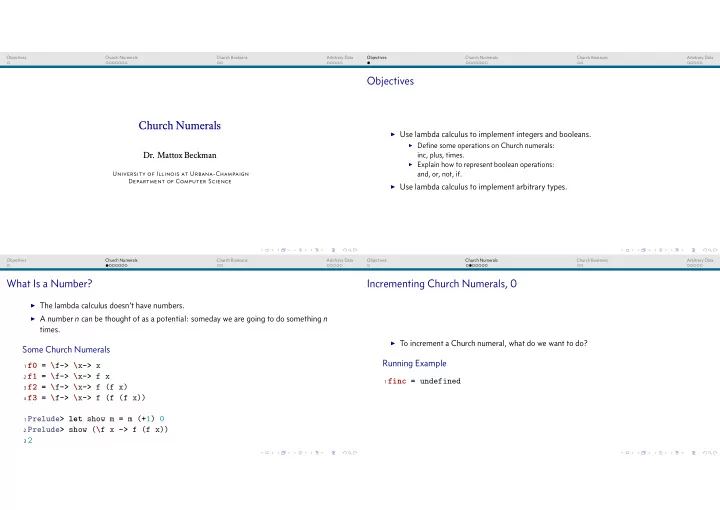
Objectives Church Numerals Use lambda calculus to implement - - PowerPoint PPT Presentation

objectives church numerals
SMART_READER_LITE
LIVE PREVIEW

Objectives Church Numerals Use lambda calculus to implement - - PowerPoint PPT Presentation

Objectives Church Numerals Church Booleans Arbitrary Data Objectives Church Numerals Church Booleans Arbitrary Data Objectives Church Numerals Use lambda calculus to implement integers and booleans. Defjne some operations on Church


slide-1
SLIDE 1

Objectives Church Numerals Church Booleans Arbitrary Data

Church Numerals

  • Dr. Mattox Beckman

University of Illinois at Urbana-Champaign Department of Computer Science

Objectives Church Numerals Church Booleans Arbitrary Data

Objectives

◮ Use lambda calculus to implement integers and booleans.

◮ Defjne some operations on Church numerals:

inc, plus, times.

◮ Explain how to represent boolean operations:

and, or, not, if.

◮ Use lambda calculus to implement arbitrary types.

Objectives Church Numerals Church Booleans Arbitrary Data

What Is a Number?

◮ The lambda calculus doesn’t have numbers. ◮ A number n can be thought of as a potential: someday we are going to do something n

times.

Some Church Numerals

1 f0 = \f-> \x-> x 2 f1 = \f-> \x-> f x 3 f2 = \f-> \x-> f (f x) 4 f3 = \f-> \x-> f (f (f x)) 1 Prelude> let show m = m (+1) 0 2 Prelude> show (\f x -> f (f x)) 3 2 Objectives Church Numerals Church Booleans Arbitrary Data

Incrementing Church Numerals, 0

◮ To increment a Church numeral, what do we want to do?

Running Example

1 finc = undefined

slide-2
SLIDE 2

Objectives Church Numerals Church Booleans Arbitrary Data

Incrementing Church Numerals, 1

◮ To increment a Church numeral, what do we want to do? ◮ First step, take the Church numeral you want to increment.

Running Example

1 finc = \m -> undefined Objectives Church Numerals Church Booleans Arbitrary Data

Incrementing Church Numerals, 2

◮ To increment a Church numeral, what do we want to do? ◮ First step, take the Church numeral you want to increment. ◮ Second step, return a Church numeral representing your result.

Running Example

1 finc = \m -> \f x -> undefined Objectives Church Numerals Church Booleans Arbitrary Data

Incrementing Church Numerals, 3

◮ To increment a Church numeral, what do we want to do? ◮ First step, take the Church numeral you want to increment. ◮ Second step, return a Church numeral representing your result. ◮ Third step, apply f to x, m times.

Running Example

1 finc = \m -> \f x -> m f x Objectives Church Numerals Church Booleans Arbitrary Data

Incrementing Church Numerals, 4

◮ To increment a Church numeral, what do we want to do? ◮ First step, take the Church numeral you want to increment. ◮ Second step, return a Church numeral representing your result. ◮ Third step, apply f to x, m times. ◮ Finally, apply f once more to the result.

Running Example

1 finc = \m -> \f x -> f (m f x)

slide-3
SLIDE 3

Objectives Church Numerals Church Booleans Arbitrary Data

Adding Church Numerals

◮ Similar reasoning can yield addition and multiplication. ◮ Here is addition. Can you fjgure our multiplication? Hint: What does (nf) do? ◮ Subtraction is a bit more tricky.

Running Example

1 fadd m n = \f x -> m f (n f x) Objectives Church Numerals Church Booleans Arbitrary Data

Implementing Booleans

◮ Church numerals represented integers as a potential number of actions. ◮ Church Booleans represent true and false as a choice.

T ≡ λab.a F ≡ λab.b

1 true = \ a b -> a 2 false = \ a b -> b 3 showb f = f True False

◮ Type these into a REPL and try them out! ◮ Next slide: and and or. Try to fjgure it out before going ahead!

Objectives Church Numerals Church Booleans Arbitrary Data

And and Or

◮ There are a couple of ways to do it.

and ≡ λxy.xyF

  • r ≡

λxy.xTy if ≡ λcte.cte

1 and = \x y -> x y false 2 or = \x y -> x true y 3 cif = \c t e -> c t e Objectives Church Numerals Church Booleans Arbitrary Data

Representing Arbitrary Types

◮ Suppose we have an algebraic data type with n constructors. ◮ Then the Church representation is an abstraction that takes n parameters. ◮ Each parameter represents one of the constructors.

T ≡ λab.a F ≡ λab.b

slide-4
SLIDE 4

Objectives Church Numerals Church Booleans Arbitrary Data

The Maybe Type

◮ The Maybe type has two constructors: Just and Nothing.

1 data Maybe a = Just a 2

| Nothing

◮ Can you give the lambda-calculus representation for Just 3?

Just a ≡ λjn.ja Nothing ≡ λjn.n Try to fjgure out how to represent linked lists ....

Objectives Church Numerals Church Booleans Arbitrary Data

The Maybe Type

◮ The Maybe type has two constructors: Just and Nothing.

1 data Maybe a = Just a 2

| Nothing

◮ Can you give the lambda-calculus representation for Just 3?

Just a ≡ λjn.ja Nothing ≡ λjn.n Just 3 ≡ λjn.jλfx.f(f(fx))

◮ Try to fjgure out how to represent linked lists ....

Objectives Church Numerals Church Booleans Arbitrary Data

Linked Lists

◮ A list has two constructors: Cons and Nil.

1 data List a = Cons a (List a) 2

| Nil

◮ Can you give the lambda-calculus representation for

Cons True (Cons False Nil)? Cons x y ≡ λcn.cxy Nil ≡ λcn.n Write a function length that determines the length of one of these lists. Assume you are allowed to use recursion. (Note, Haskell’s type system will not let you write this.)

Objectives Church Numerals Church Booleans Arbitrary Data

Linked Lists

◮ A list has two constructors: Cons and Nil.

1 data List a = Cons a (List a) 2

| Nil

◮ Can you give the lambda-calculus representation for

Cons True (Cons False Nil)? Cons x y ≡ λcn.cxy Nil ≡ λcn.n λc1n1.c1(λab.a)(λc2n2.c2(λab.b)(λc3n3.n3))

  • r...

λcn.c(λab.a)(c(λab.b)n)

◮ Write a function length that determines the length of one of these lists. Assume you are

allowed to use recursion. (Note, Haskell’s type system will not let you write this.)

slide-5
SLIDE 5

Objectives Church Numerals Church Booleans Arbitrary Data

Length

Cons x y ≡ λcn.cxy Nil ≡ λcn.n Length x = x(λxy.inc (Length y)) zero

Objectives Church Numerals Church Booleans Arbitrary Data

Higher Order Abstract Syntax

◮ It is possible to represent lambda-calculus in lambda calculus! ◮ We can let variables represent themselves. ◮ This is a non-recursive version:

M = λfa.[ [M] ]f

a

[ [Var x] ]f

a =

x [ [Abs x M] ]f

a ≡

fλx.[ [M] ]f

a

[ [App e1 e2] ]f

a ≡

a[ [e1] ]f

a[

[e2] ]f

a ◮ You can then write an interpreter for this!

Abstraction: x x Application: e e e e

Objectives Church Numerals Church Booleans Arbitrary Data

Higher Order Abstract Syntax

◮ It is possible to represent lambda-calculus in lambda calculus! ◮ We can let variables represent themselves. ◮ This is a non-recursive version:

M = λfa.[ [M] ]f

a

[ [Var x] ]f

a =

x [ [Abs x M] ]f

a ≡

fλx.[ [M] ]f

a

[ [App e1 e2] ]f

a ≡

a[ [e1] ]f

a[

[e2] ]f

a ◮ You can then write an interpreter for this!

◮ Abstraction: λx.x ◮ Application: λe1e2.e1e2