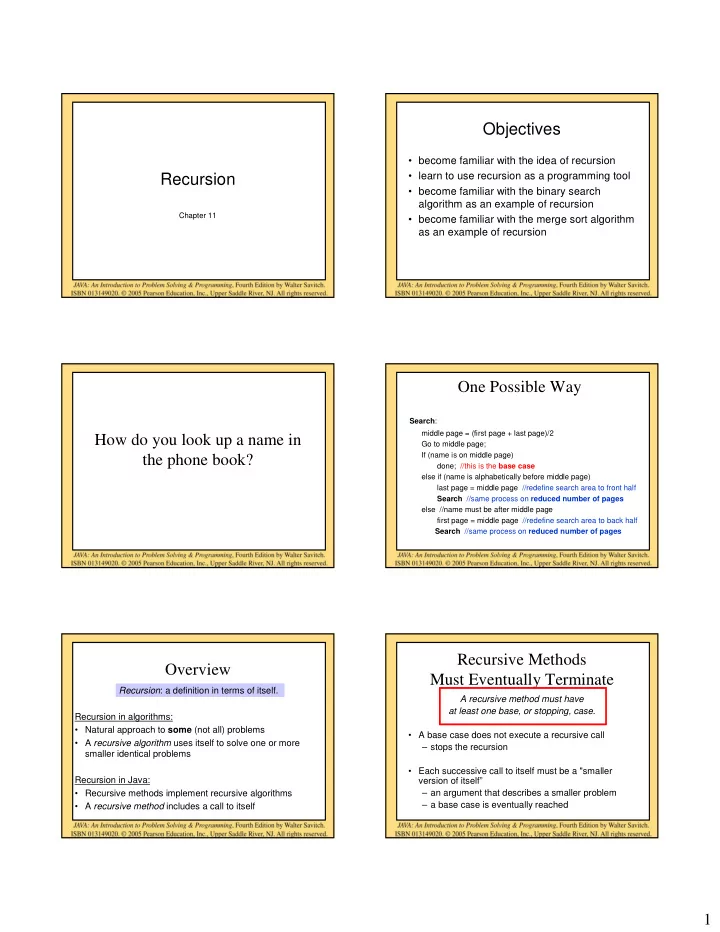
Objectives become familiar with the idea of recursion learn to - - PDF document

objectives
SMART_READER_LITE
LIVE PREVIEW

Objectives become familiar with the idea of recursion learn to - - PDF document

Objectives become familiar with the idea of recursion learn to use recursion as a programming tool Recursion become familiar with the binary search algorithm as an example of recursion Chapter 11 become familiar with the merge


slide-1
SLIDE 1

1 Recursion

Chapter 11

Objectives

  • become familiar with the idea of recursion
  • learn to use recursion as a programming tool
  • become familiar with the binary search

algorithm as an example of recursion

  • become familiar with the merge sort algorithm

as an example of recursion

How do you look up a name in the phone book? One Possible Way

Search: middle page = (first page + last page)/2 Go to middle page; If (name is on middle page) done; //this is the base case else if (name is alphabetically before middle page) last page = middle page //redefine search area to front half Search //same process on reduced number of pages else //name must be after middle page first page = middle page //redefine search area to back half Search //same process on reduced number of pages

Recursion: a definition in terms of itself. Recursion in algorithms:

  • Natural approach to some (not all) problems
  • A recursive algorithm uses itself to solve one or more

smaller identical problems Recursion in Java:

  • Recursive methods implement recursive algorithms
  • A recursive method includes a call to itself

Overview Recursive Methods Must Eventually Terminate

A recursive method must have at least one base, or stopping, case.

  • A base case does not execute a recursive call

– stops the recursion

  • Each successive call to itself must be a "smaller

version of itself” – an argument that describes a smaller problem – a base case is eventually reached

slide-2
SLIDE 2

2

Key Components of a Recursive Algorithm Design

  • 1. What is a smaller identical problem(s)?

Decomposition

  • 2. How are the answers to smaller problems combined to

form the answer to the larger problem? Composition

  • 3. Which is the smallest problem that can be solved easily

(without further decomposition)? Base/stopping case

Examples in Recursion

  • Usually quite confusing the first time
  • Start with some simple examples

– recursive algorithms might not be best

  • Later with inherently recursive algorithms

– harder to implement otherwise

Factorial (N!)

  • N! = (N-1)! * N [for N > 1]
  • 1! = 1
  • 3!

= 2! * 3 = (1! * 2) * 3 = 1 * 2 * 3

  • Recursive design:

– Decomposition: (N-1)! – Composition: * N – Base case: 1!

factorial Method

public static int factorial(int n) { int fact; if (n > 1) // recursive case (decomposition) fact = factorial(n – 1) * n; // composition else // base case fact = 1; return fact; }

public static int factorial(int 3) { int fact; if (n > 1) fact = factorial(2) * 3; else fact = 1; return fact; } public static int factorial(int 3) { int fact; if (n > 1) fact = factorial(2) * 3; else fact = 1; return fact; } public static int factorial(int 2) { int fact; if (n > 1) fact = factorial(1) * 2; else fact = 1; return fact; }

slide-3
SLIDE 3

3

public static int factorial(int 3) { int fact; if (n > 1) fact = factorial(2) * 3; else fact = 1; return fact; } public static int factorial(int 2) { int fact; if (n > 1) fact = factorial(1) * 2; else fact = 1; return fact; } public static int factorial(int 1) { int fact; if (n > 1) fact = factorial(n - 1) * n; else fact = 1; return fact; } public static int factorial(int 3) { int fact; if (n > 1) fact = factorial(2) * 3; else fact = 1; return fact; } public static int factorial(int 2) { int fact; if (n > 1) fact = factorial(1) * 2; else fact = 1; return fact; } public static int factorial(int 1) { int fact; if (n > 1) fact = factorial(n - 1) * n; else fact = 1; return 1; } public static int factorial(int 3) { int fact; if (n > 1) fact = factorial(2) * 3; else fact = 1; return fact; } public static int factorial(int 2) { int fact; if (n > 1) fact = 1 * 2; else fact = 1; return fact; } public static int factorial(int 1) { int fact; if (n > 1) fact = factorial(n - 1) * n; else fact = 1; return 1; } public static int factorial(int 3) { int fact; if (n > 1) fact = factorial(2) * 3; else fact = 1; return fact; } public static int factorial(int 2) { int fact; if (n > 1) fact = 1 * 2; else fact = 1; return 2; } public static int factorial(int 3) { int fact; if (n > 1) fact = 2 * 3; else fact = 1; return fact; } public static int factorial(int 2) { int fact; if (n > 1) fact = 1 * 2; else fact = 1; return 2; } public static int factorial(int 3) { int fact; if (n > 1) fact = 2 * 3; else fact = 1; return 6; }

slide-4
SLIDE 4

4

Execution Trace (decomposition)

public static int factorial(int n) { int fact; if (n > 1) // recursive case (decomposition) fact = factorial(n – 1) * n; (composition) else // base case fact = 1; return fact; }

factorial(4) factorial(3) 4

Execution Trace (decomposition)

public static int factorial(int n) { int fact; if (n > 1) // recursive case (decomposition) fact = factorial(n – 1) * n; (composition) else // base case fact = 1; return fact; }

factorial(4) factorial(3) 4 factorial(2) 3

Execution Trace (decomposition)

public static int factorial(int n) { int fact; if (n > 1) // recursive case (decomposition) fact = factorial(n – 1) * n; (composition) else // base case fact = 1; return fact; }

factorial(4) factorial(3) 4 factorial(2) 3 factorial(1) 2

Execution Trace (composition)

public static int factorial(int n) { int fact; if (n > 1) // recursive case (decomposition) fact = factorial(n – 1) * n; (composition) else // base case fact = 1; return fact; }

factorial(4) factorial(3) 4 factorial(2) 3 factorial(1)->1 2 * * *

Execution Trace (composition)

public static int factorial(int n) { int fact; if (n > 1) // recursive case (decomposition) fact = factorial(n – 1) * n; (composition) else // base case fact = 1; return fact; }

factorial(4) factorial(3) 4 factorial(2)->2 3 * *

Execution Trace (composition)

public static int factorial(int n) { int fact; if (n > 1) // recursive case (decomposition) fact = factorial(n – 1) * n; (composition) else // base case fact = 1; return fact; }

factorial(4) factorial(3)->6 4 *

slide-5
SLIDE 5

5

Execution Trace (composition)

public static int factorial(int n) { int fact; if (n > 1) // recursive case (decomposition) fact = factorial(n – 1) * n; (composition) else // base case fact = 1; return fact; }

factorial(4)->24

Improved factorial Method

public static int factorial(int n) { int fact=1; // base case value if (n > 1) // recursive case (decomposition) fact = factorial(n – 1) * n; // composition // else do nothing; base case return fact; }

Fibonacci Numbers

  • The Nth Fibonacci number is the sum of the previous

two Fibonacci numbers

  • 0, 1, 1, 2, 3, 5, 8, 13, …
  • Recursive Design:

– Decomposition & Composition

  • fibonacci(n) = fibonacci(n-1) + fibonacci(n-2)

– Base case:

  • fibonacci(1) = 0
  • fibonacci(2) = 1

fibonacci Method

public static int fibonacci(int n) { int fib; if (n > 2) fib = fibonacci(n-1) + fibonacci(n-2); else if (n == 2) fib = 1; else fib = 0; return fib; }

Execution Trace (decomposition)

fibonacci(4) fibonacci(3) fibonacci(2)

Execution Trace (decomposition)

fibonacci(4) fibonacci(3) fibonacci(2) fibonacci(1) fibonacci(2)

slide-6
SLIDE 6

6 Execution Trace (composition)

fibonacci(4) fibonacci(3) fibonacci(2) fibonacci(1)->0 fibonacci(2)->1 + +

Execution Trace (composition)

fibonacci(4) fibonacci(3)->1 fibonacci(2)->1 +

Execution Trace (composition)

fibonacci(4)->2

Remember: Key to Successful Recursion

  • if-else statement (or some other branching

statement)

  • Some branches: recursive call

– "smaller" arguments or solve "smaller" versions of the same task (decomposition) – Combine the results (composition) [if necessary]

  • Other branches: no recursive calls

– stopping cases or base cases

Template

… method(…) { if ( … )// base case { } else // decomposition & composition { } return … ; // if not void method }

Template (only one base case)

… method(…) { … result = … ;//base case if ( … ) // not base case { //decomposition & composition result = … } return result; }

slide-7
SLIDE 7

7 What Happens Here?

public static int factorial(int n) { int fact=1; if (n > 1) fact = factorial(n) * n; return fact; }

What Happens Here?

public static int factorial(int n) { return factorial(n – 1) * n; }

Warning: Infinite Recursion May Cause a Stack Overflow Error

  • Infinite Recursion

– Problem not getting smaller (no/bad decomposition) – Base case exists, but not reachable (bad base case and/or decomposition) – No base case

  • Stack: keeps track of recursive calls by JVM (OS)

– Method begins: add data onto the stack – Method ends: remove data from the stack

  • Recursion never stops; stack eventually runs out of space

– Stack overflow error

Mistakes in recursion

  • No composition -> ?
  • Bad composition -> ?
  • Example: 2030 has 2 zeros
  • If n has two or more digits

– the number of zeros is the number of zeros in n with the last digit removed – plus an additional 1 if the last digit is zero

  • Examples:

– number of zeros in 20030 is number of zeros in 2003 plus 1 – number of zeros in 20031 is number of zeros in 2003 plus 0

Number of Zeros in a Number

recursive

numberOfZeros Recursive Design

  • numberOfZeros in the number N
  • K = number of digits in N
  • Decomposition:

– numberOfZeros in the first K - 1 digits – Last digit

  • Composition:

– Add:

  • numberOfZeros in the first K - 1digits
  • 1 if the last digit is zero
  • Base case:

– N has one digit (K = 1)

slide-8
SLIDE 8

8 numberOfZeros method

public static int numberOfZeros(int n) { int zeroCount; if (n==0) zeroCount = 1; else if (n < 10) // and not 0 zeroCount = 0; // 0 for no zeros else if (n%10 == 0) zeroCount = numberOfZeros(n/10) + 1; else // n%10 != 0 zeroCount = numberOfZeros(n/10); return zeroCount; } Which is (are) the base case(s)? Why? Decompo stion, Why? Compositi

  • n, why?

numberOfZeros(2005) numberOfZeros(200) 5 numberOfZeros(20) 0 numberOfZeros(2)

  • Each method

invocation will execute one of the if-else cases shown at right.

public static int numberOfZeros(int n) { int zeroCount; if (n==0) zeroCount = 1; else if (n < 10) // and not 0 zeroCount = 0; // 0 for no zeros else if (n%10 == 0) zeroCount = numberOfZeros(n/10) + 1; else // n%10 != 0 zeroCount = numberOfZeros(n/10); return zeroCount; }

numberOfZeros(2005)->2 numberOfZeros(200)->2 5->0 numberOfZeros(20)->1 0->1 numberOfZeros(2)->0 0->1

  • Recursive calls

return

public static int numberOfZeros(int n) { int zeroCount; if (n==0) zeroCount = 1; else if (n < 10) // and not 0 zeroCount = 0; // 0 for no zeros else if (n%10 == 0) zeroCount = numberOfZeros(n/10) + 1; else // n%10 != 0 zeroCount = numberOfZeros(n/10); return zeroCount; }

+ + +

Number in English Words

  • Process an integer and print out its digits

in words – Input: 123 – Output: "one two three”

  • RecursionDemo class

inWords Resursive Design

  • inWords prints a number N in English words
  • K = number of digits in N
  • Decomposition:

– inWords for the first K – 1 digits – Print the last digit

  • Composition:

– Execution order of composed steps [more later]

  • Base case:

– N has one digit (K = 1)

inWords method

public static void inWords(int numeral) { if (numeral < 10) System.out.print(digitWord(numeral) + " "); else //numeral has two or more digits { inWords(numeral/10); System.out.print(digitWord(numeral%10) + " "); } }

Base case executes when only 1 digit is left Size of problem is reduced for each recursive call

slide-9
SLIDE 9

9 Execution Trace (decomposition)

  • No output yet, why?

Execution Trace (composition)

  • Output: nine eight seven

What Happens with a Recursive Call

  • inWords (slightly simplified) with

argument 987

inWords(987) if (987 < 10) // print digit here else //two or more digits left { inWords(987/10); // print digit here }

1

Execution Trace

  • The if condition is false
  • recursive call to inWords, with 987/10
  • r 98 as the argument

inWords(987) if (987 < 10) // print digit here else //two or more digits left { inWords(987/10); // print digit here } inWords(98) if (98 < 10) // print digit here else //two or more digits left { inWords(98/10); // print digit here }

2

Computation waits here until recursive call returns The argument is getting shorter and will eventually get to the base case.

Execution Trace

  • the if condition is false
  • another recursive call is

made.

inWords(987) if (987 < 10) // print digit here else //two or more digits left { inWords(987/10); // print digit here } inWords(98) if (98 < 10) // print digit here else //two or more digits left { inWords(98/10); // print digit here } inWords(9) if (9 < 10) // print digit here else //two or more digits left { inWords(numeral/10); // print digit here }

3

inWords(9) if (9 < 10) // print nine else //two or more digits left { inWords(numeral/10); // print digit here }

Execution Trace

  • if condition is true (base

case)

  • prints nine and returns
  • no recursive call

inWords(987) if (987 < 10) // print digit here else //two or more digits left { inWords(987/10); // print digit here } inWords(98) if (98 < 10) // print digit here else //two or more digits left { inWords(98/10); // print 98 % 10 }

4

Output: nine

slide-10
SLIDE 10

10

Output: nine eight

Execution Trace

  • executes the next statement after the recursive call
  • prints eight and then returns

inWords(98) if (98 < 10) // print out digit here else //two or more digits left { inWords(98/10); // print out 98 % 10 here }

5

inWords(987) if (987 < 10) // print out digit here else //two or more digits left { inWords(987/10); // print digit here }

Output: nine eight seven

Execution Trace

  • executes the next statement after

the recursive method call.

  • prints seven and returns

6

inWords(987) if (987 < 10) // print out digit here else //two or more digits left { inWords(987/10); // print 987 % 10 }

6

Composition Matters

public static void inWords(int numeral) { if (numeral < 10) System.out.print(digitWord(numeral) + " "); else //numeral has two or more digits { System.out.print(digitWord(numeral%10) + " "); inWords(numeral/10); } }

Print before making the recursive call

Recursive Design:

  • 1. Print the last digit
  • 2. inWords for the first K – 1 digits

Execution Trace (decomposition)

  • Output: seven

Execution Trace (decomposition)

  • Output: seven eight

Execution Trace (decomposition)

  • Output: seven eight nine
slide-11
SLIDE 11

11 Execution Trace (composition)

  • No additional output

"Name in the Phone Book" Revisited

  • !"#$!%&

'!( )#! (%%* !#!*!!+*#! !"!%%##!# %%!! !%%*#! #"!%%#*,!# %%!!

Binary Search Algorithm

  • Searching a list for a particular value

– sequential and binary are two common algorithms

  • Sequential search (aka linear search):

– Not very efficient – Easy to understand and program

  • Binary search:

– more efficient than sequential – but the list must be sorted first!

Why Is It Called "Binary" Search?

Compare sequential and binary search algorithms: How many elements are eliminated from the list each time a value is read from the list and it is not the "target" value? Sequential search: only one item Binary search: half the list! That is why it is called binary - each unsuccessful test for the target value reduces the remaining search list by 1/2.

Binary Search Method

  • public

find(target) calls private search(target, first, last)

  • returns the index of the

entry if the target value is found or -1 if it is not found

  • Compare it to the

pseudocode for the "name in the phone book" problem

private int search(int target, int first, int last)

{ int location = -1; // not found if (first <= last) // range is not empty { int mid = (first + last)/2; if (target == a[mid]) location = mid; else if (target < a[mid]) // first half location = search(target, first, mid - 1); else //(target > a[mid]) second half location = search(target, mid + 1, last); } return location; }

Where is the composition?

  • If no items

– not found (-1)

  • Else if target is in the middle

– middle location

  • Else

– location found by search(first half) or search(second half)

slide-12
SLIDE 12

12

5 7 9 13 32 33 42 54 56 88

1 2 3 4 5 6 7 8 9

Indices Contents target is 33 The array a looks like this:

Binary Search Example

mid = (0 + 9) / 2 (which is 4) 33 > a[mid] (that is, 33 > a[4]) So, if 33 is in the array, then 33 is one of: 33 42 54 56 88

5 6 7 8 9

Eliminated half of the remaining elements from consideration because array elements are sorted. 5 7 9 13 32 33 42 54 56 88

1 2 3 4 5 6 7 8 9

Indexes Contents target is 33 The array a looks like this: Binary Search Example mid = (5 + 6) / 2 (which is 5) 33 == a[mid] So we found 33 at index 5: 33

5

mid = (5 + 9) / 2 (which is 7) 33 < a[mid] (that is, 33 < a[7]) So, if 33 is in the array, then 33 is one of: 33 42

5 6

Eliminate half of the remaining elements

Tips

  • Don’t throw away answers (return values)--

need to compose the answers

– Common programming mistake: not capturing and composing answers (return values)

  • Only one return statement at the end

– Easier to keep track of and debug return values – “One entry, one exit”

  • www.cs.fit.edu/~pkc/classes/cse1001/BinarySearch/BinarySearch.java

Worst-case Analysis

  • Item not in the array (size N)
  • T(N) = number of comparisons with array elements
  • T(1) = 1
  • T(N) = 1 + T(N / 2)

Worst-case Analysis

  • Item not in the array (size N)
  • T(N) = number of comparisons with array elements
  • T(1) = 1
  • T(N) = 1 + T(N / 2)

= 1 + [1 + T(N / 4)]

Worst-case Analysis

  • Item not in the array (size N)
  • T(N) = number of comparisons with array elements
  • T(1) = 1
  • T(N) = 1 + T(N / 2)

= 1 + [1 + T(N / 4)] = 2 + T(N / 4) = 2 + [1 + T(N / 8)]

slide-13
SLIDE 13

13 Worst-case Analysis

  • Item not in the array (size N)
  • T(N) = number of comparisons with array elements
  • T(1) = 1
  • T(N) = 1 + T(N / 2)

= 1 + [1 + T(N / 4)] = 2 + T(N / 4) = 2 + [1 + T(N / 8)] = 3 + T(N / 8)

= …

Worst-case Analysis

  • Item not in the array (size N)
  • T(N) = number of comparisons with array elements
  • T(1) = 1
  • T(N) = 1 + T(N / 2)

= 1 + [1 + T(N / 4)] = 2 + T(N / 4) = 2 + [1 + T(N / 8)] = 3 + T(N / 8) = … = k + T(N / 2k ) [1]

Worst-case Analysis

  • T(N) = k + T(N / 2k ) [1]
  • T(N / 2k ) gets smaller until the base case: T(1)

– 2k = N – k = log2N

  • Replace terms with k in [1]:

T(N) = log2N + T(N / N) = log2N + T(1) = log2N + 1

  • “log2N” algorithm
  • We used recurrence equations

Main steps for analysis

  • Set up the recurrence equations for the

recursive algorithm

  • Expand the equations a few times
  • Look for a pattern
  • Introduce a variable to describe the pattern
  • Find the value for the variable via the base

case

  • Get rid of the variable via substitution

Binary vs. Sequential Search

  • Binary Search

– log2N + 1 comparisons (worst case)

  • Sequential/Linear Search

– N comparisons (worst case)

  • Binary Search is faster but

– array is assumed to be sorted beforehand

  • Faster searching algorithms for “non-sorted arrays”

– More sophisticated data structures than arrays – Later courses

Recursive Versus Iterative Methods

All recursive algorithms/methods can be rewritten without recursion.

  • Iterative methods use loops instead of recursion
  • Iterative methods generally run faster and use less

memory--less overhead in keeping track of method calls

slide-14
SLIDE 14

14 So When Should You Use Recursion?

  • Solutions/algorithms for some problems are

inherently recursive – iterative implementation could be more complicated

  • When efficiency is less important

– it might make the code easier to understand

  • Bottom line is about:

– Algorithm design – Tradeoff between readability and efficiency

Pages 807 NOT a good tip

[Programming Tip: Ask Until the User Gets It Right]

public void getCount() { System.out.println("Enter a positive number:"); count = SavitchIn.readLineInt(); if (count <= 0) { System.out.println("Input must be positive. System.out.println("Try again."); getCount(); //start over } }

read a number Use a recursive call to get another number.

  • Recursion continues until user enters valid input.
  • No notion of a smaller problem for recursive design
  • Easily implemented using iteration without loss
  • f readability

Merge Sort— A Recursive Sorting Algorithm

  • Example of divide and conquer algorithm
  • Recursive design:

– Divides array in half and merge sorts the halves (decomposition) – Combines two sorted halves (composition) – Array has only one element (base case)

  • Harder to implement iteratively

Execution Trace (decomposition)

1 7 4 5 2 8 6 3 2 8 6 3 1 7 4 5 6 3 2 8 4 5 1 7

3 6 8 2 5 4 7 1

Execution Trace (composition)

8 7 6 5 4 3 2 1 8 6 3 2 7 5 4 1 6 3 8 2 5 4 7 1

3 6 8 2 5 4 7 1

Merging Two Sorted Arrays

2 6 3 8 2

slide-15
SLIDE 15

15 Merging Two Sorted Arrays

3 2 6 3 8 2

Merging Two Sorted Arrays

6 3 2 6 3 8 2

Merging Two Sorted Arrays

8 6 3 2 6 3 8 2

Merge Sort Algorithm

1. If array a has more than one element:

  • a. Copy the first half of the elements in a to array

front

  • b. Copy the rest of the elements in a to array tail
  • c. Merge Sort front
  • d. Merge Sort tail
  • e. Merge the elements in front and tail into a

2. Otherwise, do nothing

Merge Sort

recursive calls make "smaller" problems by dividing array Combine the two sorted arrays base case: a.length == 1 so a is sorted and no recursive call is necessary. do recursive case if true, base case if false

public static void sort(int[] a) { if (a.length >= 2) { int halfLength = a.length / 2; int[] front = new int[halfLength]; int[] tail = new int[a.length – halfLength]; divide(a, front, tail); sort(front); sort(tail); merge(a, front, tail); } // else do nothing. }

Worst-case Theoretical Analysis

  • Comparisons of array elements
  • None during decomposition
  • Only during merging two sorted arrays

(composition) – To get an array of size N from two sorted arrays of size N/2 – N - 1 comparisons (worst case: the largest two elements are in different halves)

slide-16
SLIDE 16

16 Analysis: Array of size N

  • Let T(N) be the number of comparisons
  • T(1) = 0
  • T(N) = 2 T(N / 2) + (N – 1)

Analysis: Array of size N

  • Let T(N) be the number of comparisons
  • T(1) = 0
  • T(N) = 2 T(N / 2) + (N – 1)

= 2 [2 T(N / 4) + (N / 2 – 1)] + (N – 1)

Analysis: Array of size N

  • Let T(N) be the number of comparisons
  • T(1) = 0
  • T(N) = 2 T(N / 2) + (N – 1)

= 2 [2 T(N / 4) + (N / 2 – 1)] + (N – 1) = 4 T(N / 4) + (N – 2) + (N – 1) = 4 [ 2 T(N / 8) + (N / 4 – 1) ] + (N – 2) + (N – 1)

Analysis: Array of size N

  • Let T(N) be the number of comparisons
  • T(1) = 0
  • T(N) = 2 T(N / 2) + (N – 1)

= 2 [2 T(N / 4) + (N / 2 – 1)] + (N – 1) = 4 T(N / 4) + (N – 2) + (N – 1) = 4 [ 2 T(N / 8) + (N / 4 – 1) ] + (N – 2) + (N – 1) = 8 T(N / 8) + (N – 4) + (N – 2) + (N – 1)

Analysis: Array of size N

  • Let T(N) be the number of comparisons
  • T(1) = 0
  • T(N) = 2 T(N / 2) + (N – 1)

= 2 [2 T(N / 4) + (N / 2 – 1)] + (N – 1) = 4 T(N / 4) + (N – 2) + (N – 1) = 4 [ 2 T(N / 8) + (N / 4 – 1) ] + (N – 2) + (N – 1) = 8 T(N / 8) + (N – 4) + (N – 2) + (N – 1) = 8 T(N / 8) + 3N – (1 + 2 + 4)

Analysis: Array of size N

  • Let T(N) be the number of comparisons
  • T(1) = 0
  • T(N) = 2 T(N / 2) + (N – 1)

= 2 [2 T(N / 4) + (N / 2 – 1)] + (N – 1) = 4 T(N / 4) + (N – 2) + (N – 1) = 4 [ 2 T(N / 8) + (N / 4 – 1) ] + (N – 2) + (N – 1) = 8 T(N / 8) + (N – 4) + (N – 2) + (N – 1) = 8 T(N / 8) + 3N – (1 + 2 + 4) = … = 2k T(N / 2k ) + kN – (1 + 2 + … 2k-1 ) [1]

slide-17
SLIDE 17

17 Analysis Continued

  • T(N) = 2k T(N / 2k ) + kN – (1 + 2 + … 2k-1 ) [1]

= 2k T(N / 2k ) + kN – (2k - 1) [2]

  • T(N / 2k ) gets smaller until the base case T(1):

– 2k = N – k = log2N

  • Replace terms with k in [2]:

T(N) = N T(N / N) + log2N*N – (N – 1) = N T(1) + Nlog2N – (N – 1) = Nlog2N – N + 1

  • “Nlog2N” algorithm

Geometric Series and Sum

  • 1 + 2 + 4 + 8 + … + 2k

– 1 + 2 = 3 – 1 + 2 + 4 = 7 – 1 + 2 + 4 + 8 = 15

Geometric Series and Sum

  • 1 + 2 + 4 + 8 + … + 2k

– 1 + 2 = 3 (4 – 1) – 1 + 2 + 4 = 7 (8 – 1) – 1 + 2 + 4 + 8 = 15 (16 – 1)

Geometric Series and Sum

  • 1 + 2 + 4 + 8 + … + 2k

– 1 + 2 = 3 (4 – 1) – 1 + 2 + 4 = 7 (8 – 1) – 1 + 2 + 4 + 8 = 15 (16 – 1)

  • 1 + 2 + 4 + 8 + … + 2k

= 2k+1 - 1

  • 1 + r + r2 + r3 + … + rk

= r0 + r1 + r2 + r3 + … + rk = (rk+1 – 1) / (r – 1) [for r > 1]

Merge Sort Vs. Selection/Insertion/Bubble Sort

  • Merge Sort

– “NlogN” algorithm (in comparisons)

  • Selection/Insertion/Bubble Sort

– “N2” algorithm (in comparisons)

  • “NlogN” is “optimal” for sorting

– Proven that the sorting problem cannot be solved with fewer comparisons – Other NlogN algorithms exist, many are recursive

Real Data Set: Web Server Log

  • http://www.cs.fit.edu/~pkc/classes/writing/data/jan99.l
  • g
  • 4.6 MB (44057 entries)
  • Example entry in log:

ip195.dca.primenet.com - - [04/Jan/1999:09:16:51 - 0500] "GET / HTTP/1.0" 200 762

  • Extracted features

– remote-host names (strings) – file-size (integers)

  • List size - 100 to 44000 entries
slide-18
SLIDE 18

18

CPU Time: Randomly Ordered Integers

C P U time vs. List size fo r rando m list o f integers (R - real data set; S- synthetic data set)

0.1 1 10 100 1000 10000 100000 1000000

1 1 00 1 ,000 5,000 1 0,000 20,000 30,000 44,000

List size C P U tim e (m illis e c

  • n

d s ) R-Bubble S-Bubble R-Merge S-Merge

CPU Time: Randomly Ordered Strings

C P U time vs. List size fo r rando m list o f strings (R eal D ata Set)

0.1 1 10 100 1000 10000 100000 1000000 10000000

1 1 00 1 ,000 5,000 1 0,000 20,000 30,000 44,000

List size C P U tim e (m illis e c

  • n

d s ) R-Bubble R-Merge

Google’s PageRank (1998)

  • PageRank(x) depends on:
  • 1. How many pages (y’s) linking to x
  • how many incoming links (citations) from y’s to x
  • 2. How important those pages (y’s) are:
  • PageRank(y)’s
  • How to determine PageRank(y)’s?
  • What is the base case?

Summary

  • Recursive call: a method that calls itself
  • Powerful for algorithm design at times
  • Recursive algorithm design:
  • Decomposition (smaller identical problems)
  • Composition (combine results)
  • Base case(s) (smallest problem, no recursive calls)
  • Implementation

– Conditional (e.g. if) statements to separate different cases – Avoid infinite recursion

  • Problem is getting smaller (decomposition)
  • Base case exists and reachable

– Composition could be tricky

Summary

  • Binary Search

– Given an ordered list – “logN” algorithm (in comparisons) – “Optimal”

  • Merge Sort

– Recursive sorting algorithm – “NlogN” algorithm (in comparisons) – “Optimal”