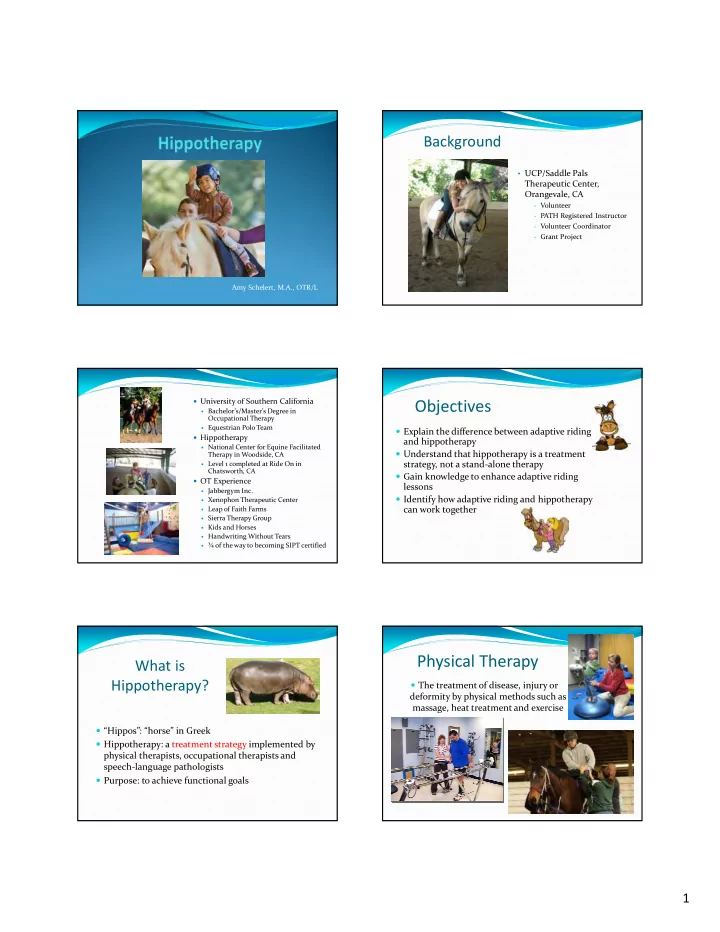
Objectives Bachelors/Masters Degree in Occupational Therapy - - PDF document

objectives
SMART_READER_LITE
LIVE PREVIEW

Objectives Bachelors/Masters Degree in Occupational Therapy - - PDF document

Background UCP/Saddle Pals Therapeutic Center, Orangevale, CA Volunteer PATH Registered Instructor Volunteer Coordinator Grant Project Amy Schelert, M.A., OTR/L University of Southern California Objectives


slide-1
SLIDE 1

1

Amy Schelert, M.A., OTR/L

Background

  • UCP/Saddle Pals

Therapeutic Center, Orangevale, CA

  • Volunteer
  • PATH Registered Instructor
  • Volunteer Coordinator
  • Grant Project

University of Southern California

Bachelor’s/Master’s Degree in

Occupational Therapy

Equestrian Polo Team

Hippotherapy

National Center for Equine Facilitated

Therapy in Woodside, CA

Level 1 completed at Ride On in

Chatsworth, CA OT Experience

Jabbergym Inc. Xenophon Therapeutic Center Leap of Faith Farms Sierra Therapy Group Kids and Horses Handwriting Without Tears ¾ of the way to becoming SIPT certified

Objectives

Explain the difference between adaptive riding and hippotherapy Understand that hippotherapy is a treatment strategy, not a stand-alone therapy Gain knowledge to enhance adaptive riding lessons Identify how adaptive riding and hippotherapy can work together

What is Hippotherapy?

“Hippos”: “horse” in Greek Hippotherapy: a treatment strategy implemented by physical therapists, occupational therapists and speech-language pathologists Purpose: to achieve functional goals

Physical Therapy

The treatment of disease, injury or deformity by physical methods such as massage, heat treatment and exercise

slide-2
SLIDE 2

2

Occupational Therapy

Treatment that helps people across the lifespan participate in the things they want and need to do through the therapeutic use of everyday activities (occupations)

Speech Therapy

Speech therapy is aimed at improving speech, language, social and swallowing skills.

Semantics

No such thing as a “Hippotherapist” or a Hippotherapy Practice

Therapists include hippotherapy in their

practice

Therapists use the movement of the

horse (or equine movement) in treatment Hippotherapy is a treatment strategy

NOT a modality, unique treatment

approach, form of therapy or treatment.

Why a Horse?

Gait

Human Gait =Equine Gait

Equine movement generates responses in the client

that are similar and essential for walking

Human Gait

Gait Cycle: interval during which a regular sequence of walking events is completed

Heel strike to heel strike on same side Phases of Gait

Stance Phase: heel strike and push off (62%) Swing Phase (38%)

  • Pelvic Motion
  • Anterior/Posterior Pelvic Tilt (acceleration/deceleration)
  • Lateral Pelvic Tilt: shock absorber during single leg stance of gait
  • Pelvic Rotation: to progress and lengthen limb
  • Lateral Displacement: occurs as weight shifts from side to side
slide-3
SLIDE 3

3

Equine Gait

Hoof off: horse pushes off with the hind leg

Barrel of Horse: swings to opposite side creating lateral flexion in horse’s spine

Hoof strike:

hoof lands and horse moves over leg, the barrel shifts over to that side with

pelvis raised and barrel elongated

Horse’s Pelvis is at a 90 degree angle with human when astride on horse

Human Gait vs. Equine Gait

Human Cadence: Equine Cadence Adult: 111-122 steps/min Medium Horse: 90-110 steps/min Child: 123 steps/min Medium Horse: 90-110 steps/min Pony: 120 steps/min Translated Rider Pelvic Movement Equine Pelvic Movement Lateral Pelvic Tilt Rotation of Horse’s Pelvis Pelvic Rotation Lateral Flexion Anterior Pelvic Tilt Acceleration during swing phase of hind leg Posterior Pelvic Tilt Deceleration at strike and stance of hind leg Lateral Pelvic Displacement Center of gravity shifts side to side as horse steps

Strength

Balance & Postural Control

Flexibility Coordination

  • Gross Motor Coordination
  • Fine Motor Coordination (hands and oral muscles)
  • Bilateral Coordination
  • Visual Motor Coordination
slide-4
SLIDE 4

4

Sensory Integration

The way the nervous system receives messages from the senses and turns them into appropriate motor and behavioral responses

Sensory Integration: Tactile

Tactile Processing: touch sensations to the skin Tactile Input: touch, textures, messy play, etc.

Sensory Integration: Vestibular

Vestibular Processing: perception of body position relative to gravity Vestibular Input: movement, spinning, turning, etc.

Sensory Integration: Proprioceptive

Proprioception: sensation of body position felt by pressure to muscles and joints Proprioceptive input: muscle work or deep pressure which gives input to muscles and joints Horses walk about 60 steps per minute, providing 2,500 inputs per average therapy session!

Speech

Articulation Phonation Respiration Voice

Language

Expressive Receptive

slide-5
SLIDE 5

5

Social Skills

Cognition Typical Therapy Goals

Long Term Goals (12-26 weeks)

What does patient/family want to achieve?

Patient will be able to participate in Special Olympics soccer

league.

Short Term Goals (2-4 weeks)

Smaller steps to reach ultimate goal

Patient will walk over a 3 step obstacle course with uneven

surfaces with good balance.

Patient will kick ball from standing position 3 x with no loss

  • f balance.

Patient will walk and run 300 ft over uneven terrain with no

assistance.

Positioning

Forward Sitting

Facilitates posterior pelvic tilt/less hip

abduction Backward Sitting

Anterior pelvic tilt/increases base of support

Side-Sitting and Modified Side-Sitting

Lateral weight shifts/more balance

challenge/scapular retraction

Dissociation of trunk/pelvis

Prone Over Barrel

Relaxation of spastic muscles/trunk extension

Supine On Rump

Elongation of pectorals and rib cage Strong vestibular and propioceptive input Requires very smooth, graded movement of

the horse

Horse Selection

Height

Safety/fear considerations

Width

Wide or narrow base of support (BOS) Posture (anterior/posterior pelvic tilt) Hip flexibility

Impulsion

  • Postural responses
  • Patient’s muscle tone

Movement

Pelvic motion desired in patient Is motion gradable?

Utilizing the Horse

Circles Serpentine Figure Eight Speed changes Transitions

slide-6
SLIDE 6

6

Does Hippotherapy Work?

Evidenced based Research proven http://www.americanhippotherapyassociation.org/research/

Typical Therapy Goals

Long Term Goals (12-26 weeks)

What does patient/family want to achieve?

Patient will be able to participate in Special Olympics soccer

league without difficulty.

Short Term Goals (2-4 weeks)

Smaller steps to reach ultimate goal

Patient will walk over a 3 step obstacle course with uneven

surfaces with good balance.

Patient will kick ball from standing position 3 x with no loss

  • f balance.

Patient will walk and run 300’ over uneven terrain with no

assistance.

Discharge Criteria

Patient reaches goals/desired outcome Patient does not wish to continue Medical complications prevent progress toward goals Therapist determines patient will no longer benefit

Plateau Conditions occurring that compromise safety of patient

  • r staff/horses

What happens next?

Where does the patient go after discharge from therapy?

Home Exercise Program Sports/ Extra Curricular Activities

(Riding???)

Adaptive Riding

A unique combination of sport, recreation and

  • education. Specially trained PATH International qualified

instructors use their knowledge of disabilities to teach horsemanship skills to riders with varying ability levels.

Adaptive Riding & Hippotherapy Together

Brings more participants to facility/helps more people

Doctors can refer for medical-based therapy treatment Center can bill insurance companies/Medicaid

Brings more volunteers

Students interested in becoming therapists/need observation

hours

Clinical internship opportunities for PT/OT/ST students

Collaboration between riding instructors and therapists

Modifications Techniques specific to patient Therapist provides status at discharge and goals met to

instructor

slide-7
SLIDE 7

7

What Happens if Patient Declines

If minor

Call therapist Have therapist watch a riding lesson Can participate in both adaptive riding and

hippotherapy If major

May need to refer back Resume adaptive riding after another round of

hippotherapy

Current Adaptive Riding Clients

Patients that may benefit from hippotherapy also

Difficulty ambulating into arena Difficulty climbing stairs to get onto horse Difficulty maintaining sitting balance while on horse Difficulty participating in sessions without constant guarding Difficulty participating in activities during sessions without

assistance

It Benefits Everybody!

Families don’t feel abandoned after D/C from hippotherapy Adaptive Riding Instructors have more knowledge of patient and patient’s history Therapists get more feedback after D/C Full circle of therapy

Continuation of client/patient care

We do this because we are passionate and love it!

Thank You!

Any Questions?