Objectives Describe common problems among homeless youth which can - - PDF document

objectives
SMART_READER_LITE
LIVE PREVIEW

Objectives Describe common problems among homeless youth which can - - PDF document

APNA 29th Annual Conference Session 4036: October 31, 2015 Dialectical Behavior Therapy Skills Training: Its Impact on Resilience in Homeless Young Adults Linda Grabbe PhD, FNP BC, PMHNP BC School of Nursing, Emory University Connie


slide-1
SLIDE 1

APNA 29th Annual Conference Session 4036: October 31, 2015 Grabbe 1

Dialectical Behavior Therapy Skills Training: Its Impact on Resilience in Homeless Young Adults

Linda Grabbe PhD, FNP‐BC, PMHNP‐BC School of Nursing, Emory University Connie Buchanan, MS, NP‐C, FNP Community Advanced Practice Nurses, Inc. Kristy Martyn, PhD, CPNP‐PC, FAAN School of Nursing, Emory University

  • This research was partially funded by the Community Engagement Research Program

Dissemination Micro Grant from the Atlanta Clinical & Translational Science Institute (Morehouse School of Medicine, Emory University, Georgia Tech)

  • The speaker has no conflicts of interest to disclose
  • The Resiliency Model and the Distress Cycle image are used with permission

Objectives

  • Describe common problems among homeless

youth which can interfere with their ability regulate emotions

  • Describe the core concept which underlies the

emotion regulation, distress tolerance, interpersonal skills in DBT skills training

  • Describe how the concept of wise mind applies to

DBT skills training and developing resilience

  • Explain the difficulties in measuring resilience in

this population

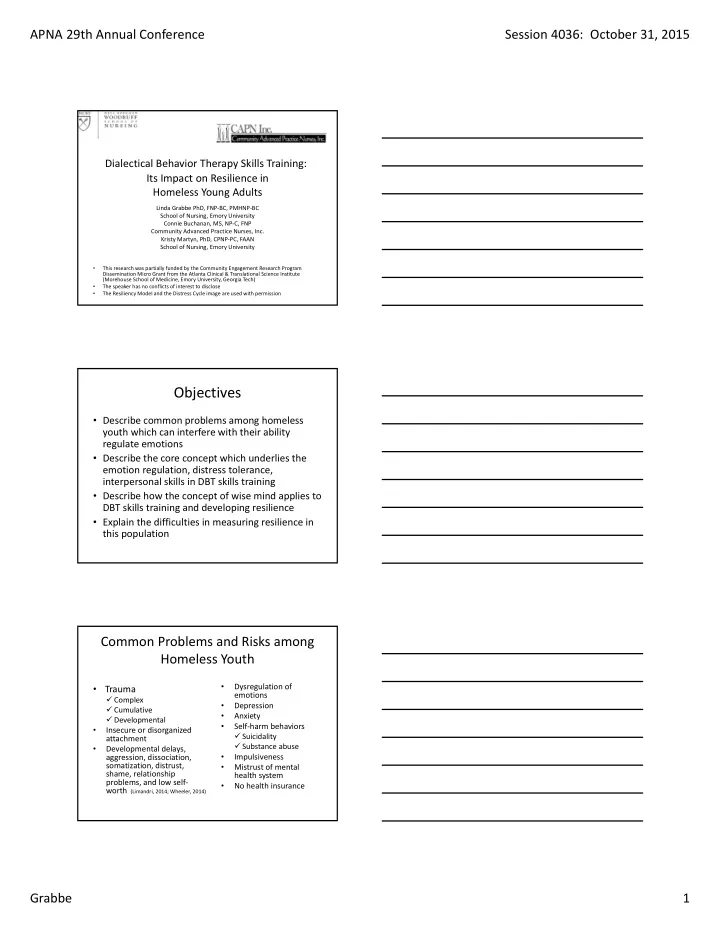
Common Problems and Risks among Homeless Youth

  • Trauma

 Complex  Cumulative  Developmental

  • Insecure or disorganized

attachment

  • Developmental delays,

aggression, dissociation, somatization, distrust, shame, relationship problems, and low self‐ worth (Limandri, 2014; Wheeler, 2014)

  • Dysregulation of

emotions

  • Depression
  • Anxiety
  • Self‐harm behaviors

 Suicidality  Substance abuse

  • Impulsiveness
  • Mistrust of mental

health system

  • No health insurance
slide-2
SLIDE 2

APNA 29th Annual Conference Session 4036: October 31, 2015 Grabbe 2

Research Purpose

  • To pilot an abbreviated group Dialectical

Behavior Therapy (DBT) skills intervention to increase emotional regulation and resiliency in this high‐risk population

www.shutterstock.com

Community Resiliency Model (CRM)

(Karas‐Miller, 2015)

slide-3
SLIDE 3

APNA 29th Annual Conference Session 4036: October 31, 2015 Grabbe 3 Community Resiliency Model (CRM)

(Karas‐Miller, 2015)

Methods

  • A concentrated DBT skills training program
  • Location: a large Atlanta shelter for 18 to 21 year
  • ld homeless youth
  • Open, rolling entry into group sessions
  • Sessions rotated over time
  • Biweekly initially  weekly
  • Same nurse providing intervention throughout

the year

  • IRB approval; informed consent

Methods

  • Phase I Fall 2014: Baseline data on resilience and mental health problems

with post‐test after 8 sessions Findings‐‐inadequate numbers to do post‐test after 8 sessions; too rapid turnover of shelter residents; unpredictable length of stay; 4 sessions was maximum attended by most youth

  • Phase II Winter/Spring 2015: Repeated weekly resilience measures using

five key resilience variables Findings—minimal improvement on resilience measure; youth personal situations possibly too unstable to be impacted by one hour of DBT per week

  • Phase III Fall 2015: specific pre‐ and post‐4 session depression, anxiety,

anger, somatic symptom measures (PROMIS measures) with resilience measure; participants will receive incentive after 4 sessions (Study not yet started)

slide-4
SLIDE 4

APNA 29th Annual Conference Session 4036: October 31, 2015 Grabbe 4 Measures

Phase 1

  • The DSM5 Level I Cross Cutting Measure

(American Psychiatric Association, 2013)

  • The Connor Davidson Resilience scale

(Connor & Davidson, 2003)

Phase 2

Five items from the Connor Davidson Resilience Scale

Phase 1 and 2

Qualitative data from the participants

Sample Characteristics for Phase 1 and 2

  • 187 young adults attended at

least 1 session

  • 21 attended 4 or more sessions
  • Average group size: 6
  • Age: range 18‐21
  • Not a therapy group
  • Race/Ethnicities:
  • Caucasian
  • African‐American
  • Hispanic
  • Native American

addiction.lovetoknow.com

Dialectical Behavior Therapy (DBT) Skills Training

  • Evidence‐based skills training for individuals with

suicidality, self‐injury, borderline personality disorder, emotion dysregulation

(Linehan, 1993, 2015; Valentine et al., 2015)

  • Purpose of DBT: Develop emotional stability,

distress tolerance, and interpersonal skills through mindfulness

  • Standard DBT = group + individual therapy x 24

weeks

slide-5
SLIDE 5

APNA 29th Annual Conference Session 4036: October 31, 2015 Grabbe 5

  • DBT skills training research

– Skills training as stand alone treatment – Adolescents leaving state custody or in corrections – Brief forms of group skills training – Beneficial treatment for African‐American women

(Katz, Cox, Gunasekara, & Miller, 2004; Rizvi & Steffel, 2014; Shelton et al., 2011; Meaney‐Tavares, 2013; Creswell, 2014; Andrew et al., 2014; Valentine et al, 2015)

– No research on DBT for homeless individuals

  • Mindfulness/meditation training of homeless

youth (at least 4 of 8 sessions; no control group)

– significant increase in resilience, spirituality, well‐ being – significant decrease in somatic, depression, anxiety symptoms (Grabbe et al, 2011)

Connor‐Davidson Resilience Scale (2003)

5/25 items

0‐4 not true at all to nearly all of the time

  • 11. I believe I can achieve my goals even if there are
  • bstacles.
  • 14. Under pressure, I stay focused and think clearly.
  • 19. I am able to handle unpleasant or painful feelings

like sadness, fear, and anger.

  • 21. I have a strong sense of purpose in life.
  • 22. I feel in control of my life.

Reliability data for Visit 1 Cronbach's Alpha=0.793 Inter‐item correlations were > 0.34 N=184

DSM‐5 Level 1 Cross Cutting Measure

23 questions covering 13 mental health domains

  • Depression, anger, “mania,” anxiety, somatic

symptoms, suicidal ideation, psychosis, sleep problems, memory, repetitive thoughts/behaviors, dissociation, personality function, substance use

(www.psychiatry.org)

2 PTSD Questions added

  • Serious attack or threat in the past
  • Flashbacks of the event

(Anxiety and Depression Detector: Means‐Christensen et al, 2006)

slide-6
SLIDE 6

APNA 29th Annual Conference Session 4036: October 31, 2015 Grabbe 6

Baseline Resilience Scores –

70% of the youth had high resilience scores. Subjects with higher scores at baseline were more likely to come back for 5+ sessions Phase 1

DSM‐5 Level 1 Cross‐cutting Measure

n= 137 Phase 1

DBT components and examples

  • Mindfulness: attention to the present moment to develop self‐

awareness and regulation

  • Interpersonal effectiveness: how to communicate what you want
  • r need; saying “no;” and validation
  • Distress tolerance: strategies to tolerate distress, without making it

worse (by engaging in impulsive and self‐destructive behaviors)

– Distraction; self‐soothing techniques; interrupting emotions – “Radical acceptance”

  • Emotion regulation: identifying and describing emotions,

increasing positive emotions; analyzing harmful behaviors

slide-7
SLIDE 7

APNA 29th Annual Conference Session 4036: October 31, 2015 Grabbe 7

3 states of mind: youtube (hear the song!)

Typical Session

  • Mindfulness practice,

usually focus on breath

  • Wise mind
  • Skill instruction with

handouts

  • Practice

Atmosphere

  • Attachment‐ and trauma‐

informed

  • Playful
  • Accepting
  • Validating
  • Some self‐disclosure

www.trengovestudios.com

Mindfulness

www.planet‐science.com; http://4.bp.blogspot.com; http://artdrum.com/IMAGES

slide-8
SLIDE 8

APNA 29th Annual Conference Session 4036: October 31, 2015 Grabbe 8

Type over and name slide

Youth comments on changes due to DBT

  • Sitting outside and

looking at what is going

  • n in the nature …you

watch a squirrel or something….your still doing DBT and that is kinda cool…..

  • These exercises help me

stay calm and focused; more in control

www.helpingservices.org

More comments on change

  • How to slow my reactions
  • Use these strategies before

my emotions become unbearable

  • Turn bad emotions into good

emotions

  • I will validate others/my

children

  • I’m not going to be that

street thug any more, with no regard for human life

  • Breathe slowly if you are

arguing with someone to calm down

  • Being active can help with

sadness

www.shutterstock.com

slide-9
SLIDE 9

APNA 29th Annual Conference Session 4036: October 31, 2015 Grabbe 9

Change in mean resilience score over 5 sessions Phase 2

(Example‐‐Item 19 of CD Risc: I am able to handle unpleasant or painful feelings like sadness, fear, and anger: 14/20 stayed the same or improved)

Changes in weekly resilience scores over 5 sessions Phase 2

Conclusions Limitations

  • Reality of instability in the

youths’ lives

  • Necessarily a limited DBT

skill training program

  • Sessions are not necessarily

sequential

  • Highest‐risk youth more

likely to be discharged from the shelter

  • High rates of both distress

and resilience

  • Youth are responsive to the

skills training

  • A large number of high‐risk

youths may be reached

  • Program may need to be

more intensive

  • Include the Community

Resilience Model (Miller‐

Karas, 2015)

www.psychologytoday.com

slide-10
SLIDE 10

APNA 29th Annual Conference Session 4036: October 31, 2015 Grabbe 10

Plan

  • 4 critical DBT sessions (see poster at this meeting)
  • Better ways to capture evidence of impact

through problem scenarios

  • Email and possible telehealth contact
  • Pre‐ and post‐test with control group using the

10‐item CD‐Resilience Scale and 4 brief measures: depression, anger, anxiety, somatic symptoms

(NIH PROMIS measures: https://www.assessmentcenter.net/Manuals.aspx Somatic Symptom Scale: Gierk et al, 2014)