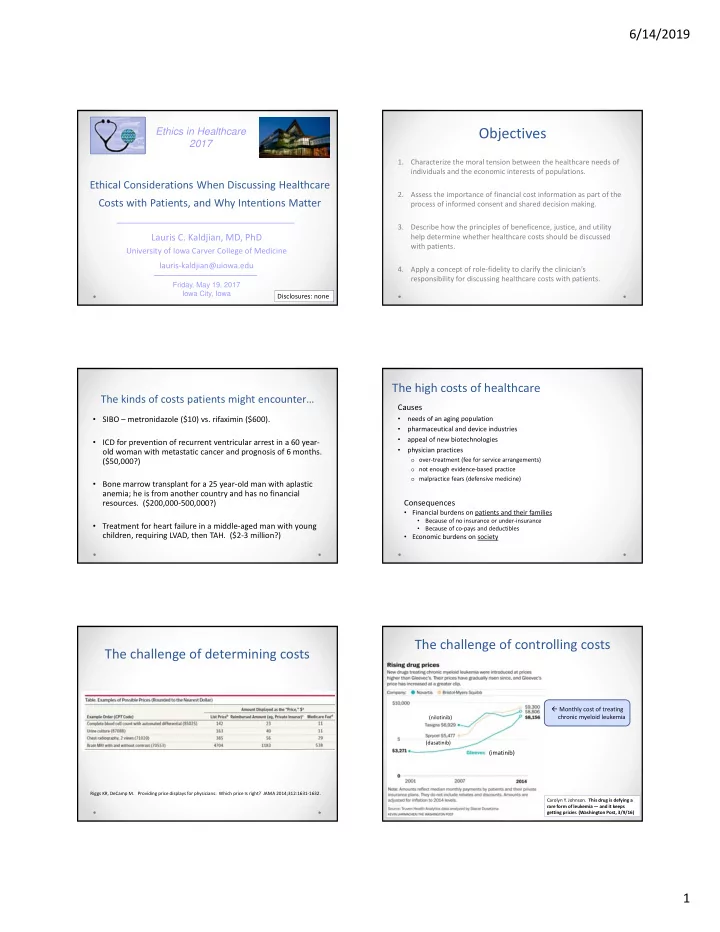
Objectives Ethics in Healthcare 2017 1. Characterize the moral - - PDF document

objectives
SMART_READER_LITE
LIVE PREVIEW

Objectives Ethics in Healthcare 2017 1. Characterize the moral - - PDF document

6/14/2019 Objectives Ethics in Healthcare 2017 1. Characterize the moral tension between the healthcare needs of individuals and the economic interests of populations. Ethical Considerations When Discussing Healthcare 2. Assess the importance


slide-1
SLIDE 1

6/14/2019 1

Ethical Considerations When Discussing Healthcare Costs with Patients, and Why Intentions Matter

Lauris C. Kaldjian, MD, PhD

University of Iowa Carver College of Medicine lauris‐kaldjian@uiowa.edu

Ethics in Healthcare 2017

Friday, May 19, 2017 Iowa City, Iowa Disclosures: none

Objectives

1. Characterize the moral tension between the healthcare needs of individuals and the economic interests of populations. 2. Assess the importance of financial cost information as part of the process of informed consent and shared decision making. 3. Describe how the principles of beneficence, justice, and utility help determine whether healthcare costs should be discussed with patients. 4. Apply a concept of role‐fidelity to clarify the clinician’s responsibility for discussing healthcare costs with patients.

The kinds of costs patients might encounter…

  • SIBO – metronidazole ($10) vs. rifaximin ($600).
  • ICD for prevention of recurrent ventricular arrest in a 60 year‐
  • ld woman with metastatic cancer and prognosis of 6 months.

($50,000?)

  • Bone marrow transplant for a 25 year‐old man with aplastic

anemia; he is from another country and has no financial

  • resources. ($200,000‐500,000?)
  • Treatment for heart failure in a middle‐aged man with young

children, requiring LVAD, then TAH. ($2‐3 million?)

The high costs of healthcare

Causes

  • needs of an aging population
  • pharmaceutical and device industries
  • appeal of new biotechnologies
  • physician practices
  • over‐treatment (fee for service arrangements)
  • not enough evidence‐based practice
  • malpractice fears (defensive medicine)

Consequences

  • Financial burdens on patients and their families
  • Because of no insurance or under‐insurance
  • Because of co‐pays and deductibles
  • Economic burdens on society

The challenge of determining costs

Riggs KR, DeCamp M. Providing price displays for physicians: Which price Is right? JAMA 2014;312:1631‐1632.

The challenge of controlling costs

Carolyn Y. Johnson. This drug is defying a rare form of leukemia — and it keeps getting pricier. (Washington Post, 3/9/16)

 Monthly cost of treating chronic myeloid leukemia (imatinib)

(dasatinib) (nilotinib)

slide-2
SLIDE 2

6/14/2019 2 The challenge of discussing costs

Video recorded patient‐oncologist clinical interactions (n = 103). Cost discussions occurred in 45% of clinical interactions. Patients initiated 63% of discussions; oncologists initiated36%.

Hamel LM et al. Do patients and oncologists discuss the cost of cancer treatment? An

  • bservational study of clinical interactions between African American patients and their
  • ncologists. J Oncol Pract 2017;13:e249‐e257.

Patient‐initiated (63%) Physician‐initiated (36%) Time away from work (short‐term) 56% 38% Insurance 16% 41% Transportation & parking 11% 9% Time away from work (long‐term) 7% Out‐of‐pocket expenses 6% 9% General financial concerns 4% 3%

The challenge of trying to help patients with their concerns about cost

Costs were discussed in 527 (30%) clinic visits in 3 clinical settings (breast CA, depression, RA), and 231 (44%) of these included discussions of cost‐saving strategies.

Hunter WG et al. What strategies do physicians and patients discuss to reduce out‐of‐pocket costs? analysis of cost‐saving strategies in 1,755 outpatient clinic visits. Med Decis Making 2016;36:900–910.

% Changing logistics of care 23 Facilitating co‐pay assistance or coupons 21 Providing free samples 13 Changing or adding insurance plans 5 Changing to lower‐cost alternative intervention 22 Switching to generic form of intervention 7 Changing dosage/frequency of intervention 5 Stopping or withholding intervention 4 Strategies involving care‐plan changes Strategies not involving care‐plan changes

The challenge of responding effectively to concerns about out‐of‐pocket costs

Physicians may fail to address patients’ financial concerns:

  • Failure to recognize potential concerns
  • Distracted form patients’ concerns by frustration with system
  • Dismissal of patients’ concerns
  • Hasty acceptance of patients’ dismissal of concerns

Physicians my offer only limited resolution of these concerns:

  • Assuming “coverage” means full coverage
  • Assuming generic medications are affordable
  • Assuming copayment assistance programs & coupons resolve concerns
  • Temporizing financial burden without discussing long‐term solutions
  • Failure to consider less expensive alternatives

Ubel PA et al. Study of physician and patient communication identifies missed opportunities to help reduce patients’ out‐of‐pocket spending. Health Affairs 2016;35:654–661.

Background assumptions

  • Resources should be used cost‐effectively
  • Resources are limited (actually or potentially)
  • Opportunity costs exist
  • “Needs” should be distinguished from “wants”
  • Value of marginal benefits is hard to assess
  • Individual needs should be tempered by

community needs

2 focal points of concern regarding COSTS Patient Society

Or perhaps 4 focal points of concern regarding COSTS?

Patient Society Health professional Hospital/ Practice

slide-3
SLIDE 3

6/14/2019 3

  • The Merit‐Based Incentive Payment System (MIPS), part of the Quality

Payment Program (QPP), is based on a clinician's performance in four reporting categories:

  • Quality
  • Advancing care information
  • Improvement activities
  • Cost (a component of value)
  • Cost will be incorporated into the overall score starting in 2018 and will

increase to 30% of the MIPS score by 2019.

  • Depending on data submitted, Medicare payments will be adjusted up,

down, or not at all.

http://www.acpinternist.org/archives/2017/04/tips.htm https://qpp.cms.gov/

Medical Bills Survey: 2,575 respondents ages 18‐64 (2015)

Kaiser Family Foundation/New York Times

  • 26% of U.S. adults (ages 18‐64) said they or someone

in their household had problems paying or an inability to pay medical bills in the past 12 months.

  • Uninsured: 53%
  • Insurance, self‐purchased: 22%
  • Insurance, employer: 19%
  • Insurance, Medicaid: 18%

http://kff.org/report‐section/the‐burden‐of‐medical‐debt‐section‐4‐patients‐as‐consumers/

Patient‐centered concerns

http://kff.org/report‐section/the‐burden‐of‐medical‐debt‐section‐4‐patients‐as‐consumers/

Insured and Uninsured Report Taking Actions to Pay Medical Bills

(among those who had problems paying medical bills in past 12 months)

http://kff.org/report‐section/the‐burden‐of‐medical‐debt‐section‐4‐patients‐as‐consumers/

Addressing patient‐centered concerns

Helping patients avoid financial harm is like preventing hospital‐acquired infections. Recommendations:

  • 1. Screen to assess for financial risk and preferences.
  • 2. “Universal precautions” approach (ask everyone if they have concerns).
  • 3. Take responsibility for knowing the financial ramifications of the care plan.
  • 4. Optimize personal care plans (based on patient’s coverage).

“Physicians can live up to the mantra of “First, do no harm” by not only caring for their patients’ health, but also for their financial well‐being.”

Moriates, Shah, Arora. First, do no (financial) harm. JAMA 2013;310:577‐578.

Society‐centered concerns

Managing the care of high‐cost patients is a key concern of ACOs. Costliest 1% of patients account for 15‐20% of overall spending.

  • multiple chronic conditions (HTN, CKD, CAD, CHF, hyperlipidemia)
  • mental health conditions (depression, anxiety, bipolar)
  • catastrophic injuries
  • neurological events
  • specialty pharmaceuticals

“High‐risk care management”: directing additional resources and services toward patients who are likely to incur high costs and experience poor

  • utcomes … could substantially reduce costs and improve quality.”

(Notice that their title was not “ACOs and high‐complexity or high‐need patients”)

Powers & Chaguturu. ACOs and high‐cost patients. N Engl J Med 2016;374:203‐205.

slide-4
SLIDE 4

6/14/2019 4 Words matter: Stewardship vs. Rationing

Sheeler RD et al. A National Survey. J Gen Intern Med 31(12):1444–51.

Population Health and Cost Control

Population health:

  • Enhanced integration of patient care and public health with

three interrelated aims: (1) improving care for individual patients, (2) improving health of populations, and (3) reducing per capita costs. This dual perspective of population health is increasingly seen as part of the clinician’s professional responsibility. But is it an attempt to wear two hats?

  • Gourevitch. Acad Med 2014;89:544-9.

Clinicians as advocates for individual patients

  • 1. Within a given patient‐clinician relationship, should this

particular clinician be the advocate of this particular patient?

  • 2. If so, does advocacy invite or discourage the discussion of costs as

part of shared decision making in healthcare?

Assume ‘advocacy’ means representing the needs

  • f a given patient in the midst of potentially

competing needs of other patients or parties (setting aside triage situations …).

Dimensions of shared decision making

(how we engage patients’ medical needs) Diagnosis, Prognosis Goals of care

Intervention or test

Probability

  • f outcomes

Level of treatment burden Cost (to whom?)

Consider the moral dynamic of communication in shared decision making:

Routine types of communication include:

  • Informing … Recommending … attempting to Persuade

Consider particularly challenging communications:

  • E.g., discussing situations of medical futility

Are such communications susceptible to bias and inequality?

The possibility of injustice in shared decision making

If clinicians are asked to control costs for populations, they should guide decisions on the basis of medical reasoning, with impartial judgment.

  • How likely is this?

A realistic moral anthropology includes recognizing our fallibility

  • Our capacity for injustice cautions against optimistic proposals that

ask clinicians to be “cost controllers” for the population.

  • There are likely to be non‐standardized (biased) applications of

any general economic imperatives.

  • Population health may invite a shift in attitudes toward an ethic
  • f cost control (from beneficence  to utility) that may distract
  • ur attention from the needs of individual patients.
  • We need to maintain role‐fidelity to our specific fiduciary duties.
slide-5
SLIDE 5

6/14/2019 5

OK, so as humans we’re at risk of injustice…

  • But isn’t it also unjust to perpetuate an economically

unsustainable healthcare system?

  • Don’t we have to admit there are two sides to this debate?
  • Just because the needs of individual patients ought to be

addressed does not mean there aren’t principled reasons to concern ourselves with the wider economic needs of society.

The two sides of the debate can be stated in terms of ethical principles that express the tension between patient‐centered and society‐centered concerns

Promoting the good of persons

  • Beneficence (one patient at a time)
  • Utility (maximizing beneficence)

Promoting justice

  • “Commutative”

Giving to each what they are due as persons In healthcare: to each according to their need

  • “Distributive”

Justice as fairness: similar treatment for similar cases

Patient Society … and after all, we do at times expect our patients to consider the interests of others

Infectious diseases: avoid exposing other people to harm. Organ transplantation: we expect recipients of solid organ transplants to be “good stewards” of their transplant.

Should Clinicians Inform Their Patients about Costs?

It depends on the intention …

Is the intention PATIENT‐CENTERED?

  • To allow informed decisions about how to spend their own money
  • To allow decisions that avoid financial harm
  • To allow them to appreciate the financial cost/value of a test or service

Is the intention SOCIETY‐CENTERED?

  • To discourage costly treatments/tests that create economic burdens for society
  • To discourage treatments/tests that are only marginally beneficial
  • To justify recommendations for less expensive but still reasonable options
  • To encourage concern for others who are more needy or more able to benefit

(altruism, justice, utility)

  • Consider an analogy: the possibility of changing the “dead

donor rule” in organ transplantation.

  • “Many people harbor a fear that physicians have a greater

interest in procuring their organs than in their welfare.”

(Bernat. N Engl J Med 2013;14:1289‐91)

  • Two‐part prudential test for assessing proposed changes to

the dead donor rule: ask what effect changes would have on (1) protection of vulnerable persons (2) preserving the public trust

(Robertson JA. The dead donor rule. Hastings Cent Rep 1999;29(6):6‐14.)

… and we should consider the effect it may have on trust Practical details are also important If we believe patients should be informed about costs…

Which patients?

  • Insured … self‐paying … indigent … everyone?

Which services?

  • All treatments/tests (emergent, urgent, elective)?
  • Marginally beneficial treatments/tests?
  • Not beneficial (wasteful or futile) treatments/tests?

When?

  • Before care, in the process of care, after care?

By whom?

  • Physician … nurse … social worker … chaplain … discharge planner …

business office … financial counselor … website … iPad…?

slide-6
SLIDE 6

6/14/2019 6

  • Within the patient‐clinician relationship, we should find

appropriate ways to provide patient‐centered information.

  • Outside of the patient‐clinician relationship, we should find

ways of providing society‐centered information.

  • As advocates for individual patients, individual clinicians

should maintain role fidelity (trust).

  • Avoid trying to “represent” the patient and population simultaneously.
  • Accept and “manage” the ethical tensions that exist between

individuals, populations, institutions, and society.

Should Clinicians Inform Their Patients about Costs?

… approaching an answer Medical Professionalism in the New Millennium: A Physician Charter (… and its ethical tensions)

Principle of primacy of patient welfare.

This principle is based on a dedication to serving the interest of the patient. Altruism contributes to the trust that is central to the physician–patient relationship. Market forces, societal pressures, and administrative exigencies must not compromise this principle.

Principle of patient autonomy.

Physicians must have respect for patient autonomy. Physicians must be honest with their patients and empower them to make informed decisions about their treatment. Patients’ decisions about their care must be paramount, as long as those decisions are in keeping with ethical practice and do not lead to demands for inappropriate care.

Principle of social justice.

The medical profession must promote justice in the health care system, including the fair distribution of health care resources. Physicians should work actively to eliminate discrimination in health care, whether based on race, gender, socioeconomic status, ethnicity, religion, or any other social category.

ABIM Foundation. American Board of Internal Medicine. Medical professionalism in the new millennium: a physician charter. Ann Intern Med 2002;136:243‐6.

Thank you

Lauris‐Kaldjian@uiowa.edu

References

  • ABIM Foundation. American Board of Internal Medicine. Medical professionalism in the new

millennium: a physician charter. Ann Intern Med 2002;136:243‐6.

  • Gourevitch MN. Population Health and the Academic Medical Center: The Time Is Right.

Acad Med 2014;89:544‐9.

  • Hamel LM et al. Do patients and oncologists discuss the cost of cancer treatment? An
  • bservational study of clinical interactions between African American patients and their
  • ncologists. J Oncol Pract 2017;13:e249‐e257.
  • Hunter WG et al. What strategies do physicians and patients discuss to reduce out‐of‐pocket

costs? analysis of cost‐saving strategies in 1,755 outpatient clinic visits. Med Decis Making 2016;36:900–910.

  • https://kaiserfamilyfoundation.files.wordpress.com/2016/01/8806‐the‐burden‐of‐medical‐

debt‐results‐from‐the‐kaiser‐family‐foundation‐new‐york‐times‐medical‐bills‐survey.pdf

  • Moriates C et al. First, do no (financial) harm. JAMA 2013;310:577‐578.
  • Powers BW, Chaguturu SK. ACOs and high‐cost patients. N Engl J Med 2016;374:203‐205.
  • Riggs KR, DeCamp M. Providing price displays for physicians: Which price Is right? JAMA

2014;312:1631‐1632.

  • Sheeler RD et al. Self‐reported rationing behavior among US physicians: A national survey. J

Gen Intern Med 31(12):1444–51.

  • Ubel PA et al. Study of physician and patient communication identifies missed opportunities to

help reduce patients’ out‐of‐pocket spending. Health Affairs 2016;35:654–661.