Objectives Typing Semantics Explain the parts of a type judgment. - - PowerPoint PPT Presentation

objectives typing semantics
SMART_READER_LITE
LIVE PREVIEW

Objectives Typing Semantics Explain the parts of a type judgment. - - PowerPoint PPT Presentation

Introduction Typing Rules Monotypes Examples Introduction Typing Rules Monotypes Examples Objectives Typing Semantics Explain the parts of a type judgment. Build proof trees to indicate the derivation of a type for a program. Dr.


slide-1
SLIDE 1

Introduction Typing Rules Monotypes Examples

Typing Semantics

  • Dr. Mattox Beckman

University of Illinois at Urbana-Champaign Department of Computer Science

Introduction Typing Rules Monotypes Examples

Objectives

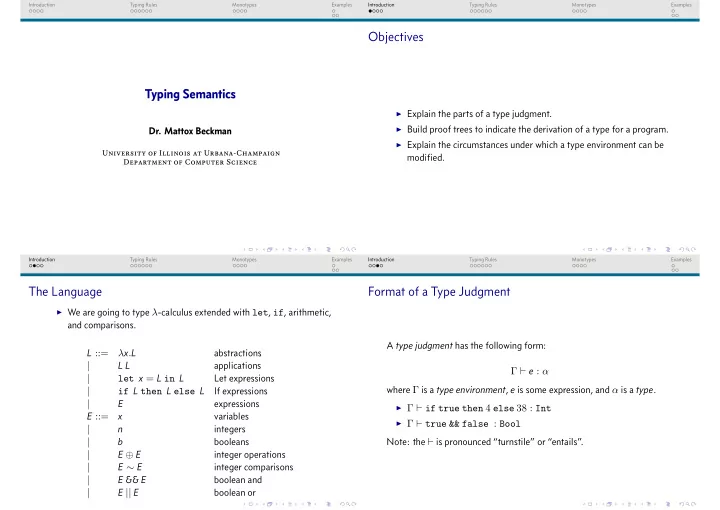
◮ Explain the parts of a type judgment. ◮ Build proof trees to indicate the derivation of a type for a program. ◮ Explain the circumstances under which a type environment can be

modifjed.

Introduction Typing Rules Monotypes Examples

The Language

◮ We are going to type λ-calculus extended with let, if, arithmetic,

and comparisons. L ::= λx.L abstractions | L L applications | let x = L in L Let expressions | if L then L else L If expressions | E expressions E ::= x variables | n integers | b booleans | E ⊕ E integer operations | E ∼ E integer comparisons | E && E boolean and | E || E boolean or

Introduction Typing Rules Monotypes Examples

Format of a Type Judgment

A type judgment has the following form: Γ ⊢ e : α where Γ is a type environment, e is some expression, and α is a type.

◮ Γ ⊢ if true then 4 else 38 : Int ◮ Γ ⊢ true && false : Bool

Note: the ⊢ is pronounced “turnstile” or “entails”.

slide-2
SLIDE 2

Introduction Typing Rules Monotypes Examples

The Parts of a Rule

Assumptions on top Γ ⊢ e1 : Int Γ ⊢ e2 : Int Γ ⊢ e1 + e2 : Int Conclusion on the bottom

◮ If a rule has no assumptions, then it is called an axiom. ◮ Γ is a set of the form {x : α; . . .}. ◮ Γ may be left out if we don’t need a type environment. ◮ Basic Idea: The meaning of an expression can be determined by

combining the meaning of its parts.

Introduction Typing Rules Monotypes Examples

Axioms

Constants ⊢ n : Int , when n is an integer. ⊢ true : Bool ⊢ false : Bool Variables Γ ⊢ x : α, if x : α ∈ Γ

◮ Here, α is a type variable; it stands for another type. ◮ These are rules that are true no matter what the context is.

Introduction Typing Rules Monotypes Examples

Simple Rules

Arithmetic Γ ⊢ e1 : Int Γ ⊢ e2 : Int Γ ⊢ e1 ⊕ e2 : Int Relations Γ ⊢ e1 : Int Γ ⊢ e2 : Int Γ ⊢ e1 ∼ e2 : Bool Booleans Γ ⊢ e1 : Bool Γ ⊢ e2 : Bool Γ ⊢ e1&& e2 : Bool Γ ⊢ e1 : Bool Γ ⊢ e2 : Bool Γ ⊢ e1|| e2 : Bool

Introduction Typing Rules Monotypes Examples

Example 0

Suppose we want to prove that Γ ⊢ (x ∗ 5 > 7)&& y : Bool . Assume that Γ = {x : Int ; y : Bool } First thing: Write down the thing you are trying to prove, and put a bar

  • ver it.

Γ ⊢ (x ∗ 5 > 7)&& y : Bool Look at the outermost expression. What rule applies here?

slide-3
SLIDE 3

Introduction Typing Rules Monotypes Examples

Example 0

Suppose we want to prove that Γ ⊢ (x ∗ 5 > 7)&& y : Bool . Assume that Γ = {x : Int ; y : Bool } First thing: Write down the thing you are trying to prove, and put a bar

  • ver it.

Γ ⊢ (x ∗ 5 > 7)&& y : Bool Look at the outermost expression. What rule applies here? Γ ⊢ e1 : Bool Γ ⊢ e2 : Bool Γ ⊢ e1&& e2 : Bool

Introduction Typing Rules Monotypes Examples

Example 0

Suppose we want to prove that Γ ⊢ (x ∗ 5 > 7)&& y : Bool . Assume that Γ = {x : Int ; y : Bool } Write parts on top and put a bar over them as well. Γ ⊢ x ∗ 5 > 7 : Bool Γ ⊢ y : Bool Γ ⊢ (x ∗ 5 > 7)&& y : Bool What to do next? Let’s work left to right. The expression we want next is a “greater” expression. (Besides, the y expression is already an axiom.)

Introduction Typing Rules Monotypes Examples

Example 0

Suppose we want to prove that Γ ⊢ (x ∗ 5 > 7)&& y : Bool . Assume that Γ = {x : Int ; y : Bool } Following the “greater” rule, we break the x * 5 > 7 into two parts. Γ ⊢ x ∗ 5 : Int Γ ⊢ 7 : Int Γ ⊢ x ∗ 5 > 7 : Bool Γ ⊢ y : Bool Γ ⊢ (x ∗ 5 > 7)&& y : Bool We will turn our attention to the multiplication now.

Introduction Typing Rules Monotypes Examples

Example 0

Suppose we want to prove that Γ ⊢ (x ∗ 5 > 7)&& y : Bool . Assume that Γ = {x : Int ; y : Bool } At this point, there are no more subtrees to expand out. We are done. Γ ⊢ x : Int Γ ⊢ 5 : Int Γ ⊢ x ∗ 5 : Int Γ ⊢ 7 : Int Γ ⊢ x ∗ 5 > 7 : Bool Γ ⊢ y : Bool Γ ⊢ (x ∗ 5 > 7)&& y : Bool

slide-4
SLIDE 4

Introduction Typing Rules Monotypes Examples

Type Variables in Rules

A monotype τ can be a

◮ type constant (e.g., Int , Bool , etc.) ◮ instantiated type constructor (e.g., [Int], Int → Int) ◮ a type variable α

If Rule

Γ ⊢ e1 : Bool Γ ⊢ e2 : α Γ ⊢ e3 : α Γ ⊢ if e1 then e2 else e3 : α

◮ Here, α is a meta-variable. ◮ This rule says that if can result in any type, as long as the then and

else branches have the same type. This could even include functions.

Introduction Typing Rules Monotypes Examples

Function Application

Γ ⊢ e1 : α2 → α Γ ⊢ e2 : α2 Γ ⊢ e1 e2 : α

◮ If you have a function of type α2 → α and an argument e2 of type

α2, then applying e1 to e2 will produce an expression of type α.

◮ You can generalize this rule to multiple arguments.

Γ ⊢ incList : [Int] → [Int] Γ ⊢ xx : [Int] Γ ⊢ incList xx : [Int]

Introduction Typing Rules Monotypes Examples

Function Rule

Γ ∪ {x : α1} ⊢ e : α2 Γ ⊢ λx.e : α1 → α2

◮ Important point: this rule describes types, and also describes when

you may change Γ.

◮ You may NOT change Γ except as described!

Example: show that {} ⊢ λx.x + 1 : Int → Int .

Introduction Typing Rules Monotypes Examples

Function Rule

Γ ∪ {x : α1} ⊢ e : α2 Γ ⊢ λx.e : α1 → α2

◮ Important point: this rule describes types, and also describes when

you may change Γ.

◮ You may NOT change Γ except as described!

{} ⊢ λx.x + 1 : Int → Int

slide-5
SLIDE 5

Introduction Typing Rules Monotypes Examples

Function Rule

Γ ∪ {x : α1} ⊢ e : α2 Γ ⊢ λx.e : α1 → α2

◮ Important point: this rule describes types, and also describes when

you may change Γ.

◮ You may NOT change Γ except as described!

{x : Int } ⊢ x + 1 : Int {} ⊢ λx.x + 1 : Int → Int

Introduction Typing Rules Monotypes Examples

Function Rule

Γ ∪ {x : α1} ⊢ e : α2 Γ ⊢ λx.e : α1 → α2

◮ Important point: this rule describes types, and also describes when

you may change Γ.

◮ You may NOT change Γ except as described!

{x : Int } ⊢ x : Int {x : Int } ⊢ 1 : Int {x : Int } ⊢ x + 1 : Int {} ⊢ λx.x + 1 : Int → Int

Introduction Typing Rules Monotypes Examples

Let Rule

◮ Here is let. Note that Haskell uses the recursive rule, and it is

polymorphic. Let Γ ⊢ e1 : τ1 Γ ∪ [x : τ1] ⊢ e2 : τ2 Γ ⊢ let x = e1 in e2 : τ2 Letrec Γ ∪ [x : τ1] ⊢ e1 : τ1 Γ ∪ [x : τ1] ⊢ e2 : τ2 Γ ⊢ let x = e1 in e2 : τ2

Introduction Typing Rules Monotypes Examples

Example 1 — Proof

Prove that Γ ⊢ (λx.λy.x + y) : Int → Int → Int . Assume that Γ = {}

slide-6
SLIDE 6

Introduction Typing Rules Monotypes Examples

Example 1 — Proof

Prove that Γ ⊢ (λx.λy.x + y) : Int → Int → Int . Assume that Γ = {} {} ⊢ (λx.λy.x + y) : Int → Int → Int

Introduction Typing Rules Monotypes Examples

Example 1 — Proof

Prove that Γ ⊢ (λx.λy.x + y) : Int → Int → Int . Assume that Γ = {} {x : Int } ⊢ (λy.x + y) : Int → Int {} ⊢ (λx.λy.x + y) : Int → Int → Int

Introduction Typing Rules Monotypes Examples

Example 1 — Proof

Prove that Γ ⊢ (λx.λy.x + y) : Int → Int → Int . Assume that Γ = {} {x : Int , y : Int } ⊢ x + y : Int {x : Int } ⊢ (λy.x + y) : Int → Int {} ⊢ (λx.λy.x + y) : Int → Int → Int

Introduction Typing Rules Monotypes Examples

Example 1 — Proof

Prove that Γ ⊢ (λx.λy.x + y) : Int → Int → Int . Assume that Γ = {} Γ′ ⊢ x : Int Γ′ ⊢ y : Int Γ′ ≡ {x : Int , y : Int } ⊢ x + y : Int {x : Int } ⊢ (λy.x + y) : Int → Int {} ⊢ (λx.λy.x + y) : Int → Int → Int

slide-7
SLIDE 7

Introduction Typing Rules Monotypes Examples

Example 1 — inferencing

Infer the type of (λx.λy.x + y). Assume that Γ = {}

Introduction Typing Rules Monotypes Examples

Example 1 — inferencing

Infer the type of (λx.λy.x + y). Assume that Γ = {} {} ⊢ (λx.λy.x + y) : α

Introduction Typing Rules Monotypes Examples

Example 1 — inferencing

Infer the type of (λx.λy.x + y). Assume that Γ = {} {x : β} ⊢ (λy.x + y) : γ {} ⊢ (λx.λy.x + y) : α ≡ β → γ

Introduction Typing Rules Monotypes Examples

Example 1 — inferencing

Infer the type of (λx.λy.x + y). Assume that Γ = {} {x : β, y : δ} ⊢ x + y : τ {x : β} ⊢ (λy.x + y) : γ ≡ δ → τ {} ⊢ (λx.λy.x + y) : β → δ → τ

slide-8
SLIDE 8

Introduction Typing Rules Monotypes Examples

Example 1 — inferencing

Infer the type of (λx.λy.x + y). Assume that Γ = {} Γ′ ⊢ x : Int Γ′ ⊢ y : Int Γ′ ≡ {x : Int , y : Int } ⊢ x + y : Int {x : Int } ⊢ (λy.x + y) : Int → Int {} ⊢ (λx.λy.x + y) : Int → Int → Int

Introduction Typing Rules Monotypes Examples

Example 2

Γ ⊢ let id = λx .x in id (id 10) : Int Let Γ′ ≡ Γ ∪ {id : Int → Int }

Introduction Typing Rules Monotypes Examples

Example 2

Γ ⊢ λx .x : Int → Int Γ′ ⊢ id (id 10) : Int Γ ⊢ let id = λx .x in id (id 10) : Int Let Γ′ ≡ Γ ∪ {id : Int → Int }

Introduction Typing Rules Monotypes Examples

Example 2

Γ ∪ {x : Int } ⊢ x : Int Γ ⊢ λx .x : Int → Int Γ′ ⊢ id (id 10) : Int Γ ⊢ let id = λx .x in id (id 10) : Int Let Γ′ ≡ Γ ∪ {id : Int → Int }

slide-9
SLIDE 9

Introduction Typing Rules Monotypes Examples

Example 2

Γ ∪ {x : Int } ⊢ x : Int Γ ⊢ λx .x : Int → Int Γ′ ⊢ id : Int → Int Γ′ ⊢ id 10 : Int Γ′ ⊢ id (id 10) : Int Γ ⊢ let id = λx .x in id (id 10) : Int Let Γ′ ≡ Γ ∪ {id : Int → Int }

Introduction Typing Rules Monotypes Examples

Example 2

Γ ∪ {x : Int } ⊢ x : Int Γ ⊢ λx .x : Int → Int Γ′ ⊢ id : Int → Int Γ′ ⊢ id : Int → Int Γ′ ⊢ 10 : Int Γ′ ⊢ id 10 : Int Γ′ ⊢ id (id 10) : Int Γ ⊢ let id = λx .x in id (id 10) : Int Let Γ′ ≡ Γ ∪ {id : Int → Int }