OCD: Particulated Cartilage Gregory C Berlet MD, FRCS(C), FAOA - - PowerPoint PPT Presentation

ocd particulated cartilage
SMART_READER_LITE
LIVE PREVIEW

OCD: Particulated Cartilage Gregory C Berlet MD, FRCS(C), FAOA - - PowerPoint PPT Presentation

OCD: Particulated Cartilage Gregory C Berlet MD, FRCS(C), FAOA Orthopedic Foot and Ankle Center Columbus Ohio Disclosures Consultant/Speaker Bureau/Royalties/ Stock: Wright Medical, Stryker, ZimmerBiomet, DJO, Plasmology 4 , Amniox
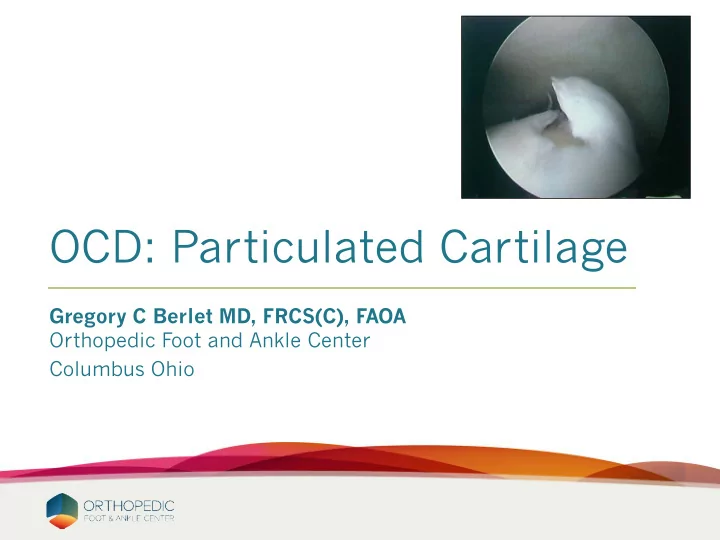

slide-1
SLIDE 1

OCD: Particulated Cartilage

Gregory C Berlet MD, FRCS(C), FAOA Orthopedic Foot and Ankle Center Columbus Ohio

slide-2
SLIDE 2

Disclosures

  • Consultant/Speaker Bureau/Royalties/

Stock: Wright Medical, Stryker, ZimmerBiomet, DJO, Plasmology4, Amniox Medical, United Orthopedic Group, Paragon 28, CrossRoads, Ossio

slide-3
SLIDE 3

They call it medical practice for a reason ….

1 year post microfracture of 1 x 1.5 cm OCD

slide-4
SLIDE 4

Scope, Drilling OCD Talus

  • 1.0 X 1.2 cm OCD
  • contained

10 x 15 mm lesion

slide-5
SLIDE 5

One Year Later With our Patient … Disappointment

  • Pain initially was better but now has

come back

  • Swelling
  • Does not feel ‘right’
  • Complication: Failure to achieve long

term clinical success for our patient

slide-6
SLIDE 6

Why did it fail ?

  • Size of the lesion - maybe
  • Access to lesion

– Don’t think so

  • Bone support

– Don’t think so but …

  • Limitation of microfracture
slide-7
SLIDE 7

I Believe That ….

Quality of Repair Matters:

  • Quality of the cartilage repair is at

least part of the reason that size matters

  • I focus on critical size defects for my

advanced cartilage restoration

  • Lesions between 1.0 – 2.0:
  • Particulated cartilage grafting
slide-8
SLIDE 8

Juvenile Cartilaginous Allograft Tissue

  • Particulated cartilage with viable cells
  • Secured into chondral defects with fibrin

Juvenile Donor Joint

slide-9
SLIDE 9

Treatment of osteochondral lesions in the ankle with a particulated juvenile cartilage allograft: mid-term outcomes in a challenging clinical population

J.C. Coetzee1, E. Giza2, L. Schon3, G. Berlet4, S. Neufeld5, P . Reischling6, and E. Wilson6

1Minnesota Orthopedic Sports Medicine Institute, 2Univeristy of California Davis, 3Union Memorial Hospital, 4Orthopedic Foot & Ankle Center, 5Orthopaedic Foot &

Ankle Center of Washington, 6Zimmer Orthobiologics

Coetzee et al FAI 34(9), 2013

slide-10
SLIDE 10

DeNovo NT Graft Talus Study

Purpose:

  • Evaluate mid-

term outcomes

  • f DeNovo NT

Graft for the treatment cartilage lesions in the talus

Hypothesis:

  • DeNovo NT Graft

provides good clinical

  • utcomes in a

challenging patient population

Coetzee et al FAI 34(9), 2013

slide-11
SLIDE 11

Study Design

  • Retrospective

and prospective

–All cases of ankle DeNovo NT Graft included

  • Single-arm,

multi-center

  • 5 study centers
  • 24 patients
  • FAAM, AOFAS,

VAS Pain (100mm), SF- 12, Pt Satisfaction

Coetzee et al FAI 34(9), 2013

slide-12
SLIDE 12

24 Patients ; >50% Revision Surgery

Age (years) 35 (range, 17.5 to 69) BMI (kg/m2) 27.7 ± 5.8 (range, 19 to 45) Time from Injury/Symptom Onset to Surgery (years) 6.85 ± 11 (range, 0.53 to 40) Previous Surgery None ≥ 1 10 (42%) 14 (58%) Surgical Procedure Open Arthroscopic Extended Portal 12 (50%) 3 (12.5%) 9 (37.5%)

Coetzee et al FAI 34(9), 2013

slide-13
SLIDE 13

Large Lesions

Containment Full 75 to 99% 50 to 74% 6 (27%) 11 (50%) 5 (23%) Bone Removal None Osteotomy Plafondplasty 4 (17%) 12 (50%) 8 (33%) Lesion Size (mm2) 125 ± 75 (range, 50 to 300) Lesion Depth (mm) 7 ± 5 (range, 3 to 20)

Coetzee et al FAI 34(9), 2013

slide-14
SLIDE 14

Results at ≥ 12 months

Average Outcome Scores @ Final F/U

78% of ankles demonstrating good to excellent scores (AOFAS ≥ 80)

Coetzee et al FAI 34(9), 2013

slide-15
SLIDE 15

Results at ≥ 12 months

Re-Operation Reason # Re-Operations Removal of symptomatic or failed osteotomy hardware 5 Anterior Impingement 1 Partial Graft Delamination (full revision) 1 (~ 25% of graft)

Coetzee et al FAI 34(9), 2013

slide-16
SLIDE 16

Treatment of osteochondral lesions in the ankle with a particulated juvenile cartilage allograft: mid-term

  • utcomes in a challenging clinic population

Post-market Retrospective study

– J. Chris Coetzee, MD – Eric Giza, MD – Lew Schon, MD – Gregory Berlet, MD – Steven Neufeld, MD – Patrick Reischling, MBS – Erin L Wilson, MS

slide-17
SLIDE 17

Retrospective Study

  • 16 patients
  • Average age at

surgery of 32.5

  • 9/16 had prior

surgery

  • The average lesion

size (n=14) was 128 ± 78mm

  • Average depth of

6±5 mm

  • All lesions had at

least one dimension ≥ 10 mm

slide-18
SLIDE 18

Retrospective Study

  • Average outcome

at follow-up

  • AOFAS 82±20

– SF12 PCS 49±11 – FAAM Sports 65±28 – VAS pain (100mm) 19±23

  • Average follow-up

time of 16.4 mths (10.5-24.0)

  • Available pre-
  • perative scores

– AOFAS 59±24 – SF12 PCS 52±6.6 – SF12 MCS 58±3.6

slide-19
SLIDE 19

Juvenile Articular Cartilage

Saltzman et al (2017):

  • Systematic review

– Total of 32 patients – Level IV and V evidence – Mean OCD size 117.8 mm2

  • Substantial clinical improvement
  • No implant related adverse events
  • Only one conversion to bulk allograft

Saltzman et al, Cartilage 8(1), 2017

slide-20
SLIDE 20

Unanswered Questions

  • Can we treat the

cartilage deficiency without treating the bone ?

  • Does BME matter ?
  • Can we treat BME

without treating the cartilage deficiency ?

slide-21
SLIDE 21

Correlation of MRI Edema and Outcomes after Micro#

Cuttica, Berlet et al (2011):

  • 30 patients at an avg of 9 mo post op
  • Talus edema classified as none, mild,

moderate or severe on MRI Those with moderate or severe edema had poorer clinical outcome

Cuttica DJ… Berlet GC: FAS 4(5), 2011

slide-22
SLIDE 22

My Practice: 2017

  • < 1.0 cm = microfracture is the gold

standard

  • Gap Strategy

 1.0 – 2. 0 cm = particulated cartilage  > 2.0 cm = osteoarticular options

  • Our Patient: She would get juvenile

particulated cartilage in my hands

SUMMARY

slide-23
SLIDE 23

THANK YOU

Thank you and acknowledgment to Dr Eric Giza MD