of tunable hybrid nanostructures Viktor Iudin 1 , Yali Sun 1 , - - PowerPoint PPT Presentation

of tunable hybrid nanostructures
SMART_READER_LITE
LIVE PREVIEW

of tunable hybrid nanostructures Viktor Iudin 1 , Yali Sun 1 , - - PowerPoint PPT Presentation

Numerical modeling of scattering properties of tunable hybrid nanostructures Viktor Iudin 1 , Yali Sun 1 , Evgeniy Minkevich 1 , Eduard Ageev 1 , and Dmitry Zuev 1 1 Department of Physics and Engineering, ITMO University, 197101 Saint-Petersburg,


slide-1
SLIDE 1

Introduction Simulation Setup Results Conclusion 1 Department of Physics and Engineering, ITMO University, 197101 Saint-Petersburg, Russia

Numerical modeling of scattering properties

  • f tunable hybrid nanostructures

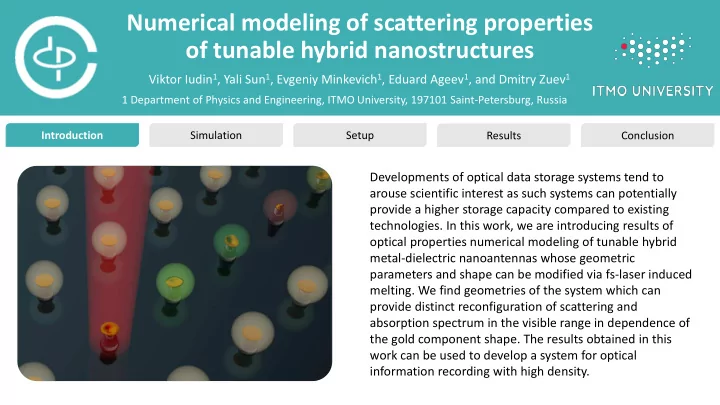
Viktor Iudin1, Yali Sun1, Evgeniy Minkevich1, Eduard Ageev1, and Dmitry Zuev1 Developments of optical data storage systems tend to arouse scientific interest as such systems can potentially provide a higher storage capacity compared to existing

  • technologies. In this work, we are introducing results of
  • ptical properties numerical modeling of tunable hybrid

metal-dielectric nanoantennas whose geometric parameters and shape can be modified via fs-laser induced

  • melting. We find geometries of the system which can

provide distinct reconfiguration of scattering and absorption spectrum in the visible range in dependence of the gold component shape. The results obtained in this work can be used to develop a system for optical information recording with high density.

slide-2
SLIDE 2

ACS for different shape of nanoantenna ACS for different diameter of nanoantenna

Numerical modeling of scattering properties

  • f tunable hybrid nanostructures

Viktor Iudin, Yali Sun, Evgeniy Minkevich, Eduard Ageev, and Dmitry Zuev

50000 100000 150000 200000 250000 600 800 1000 1200 ACS, nm2 Wavelength, nm disk cup sphere ACS, a.u. Wavelegth, nm d=200 nm d=220 nm d=240 nm d=300 nm Au Si d

Introduction Simulation Setup Results Conclusion

Ti: Sapphire Ti: Sapphire

slide-3
SLIDE 3

Introduction Simulation Setup Results Conclusion

C D E B A F Setup for DF spectroscopy Setup for laser modification

Numerical modeling of scattering properties

  • f tunable hybrid nanostructures

Viktor Iudin, Yali Sun, Evgeniy Minkevich, Eduard Ageev, and Dmitry Zuev A B C D E F G A – Ti: Sapphire fs-laser B, C, D – Attenuator E – Beam delivery system F, G – Beam positioning system A – Halogen lamp E – Beam splitter B – Polarizer F – Spectrometer C – Objectives D – CCD camera

slide-4
SLIDE 4

DF images of modified structures in massive of particles Measured DF spectra of nanoantennas

Numerical modeling of scattering properties

  • f tunable hybrid nanostructures

Viktor Iudin, Yali Sun, Evgeniy Minkevich, Eduard Ageev, and Dmitry Zuev

78.1 J/cm2 67.0 J/cm2 49.1 J/cm2 0 J/cm2

S-pol P-pol

Wavelength, nm Wavelength, nm Intensity, a.u.

SEM S-pol P-pol 1 um 1 um

Introduction Simulation Setup Results Conclusion

slide-5
SLIDE 5

1 Department of Physics and Engineering, ITMO University, 197101 Saint-Petersburg, Russia

Numerical modeling of scattering properties

  • f tunable hybrid nanostructures

We investigate the influence of the gold component shape of hybrid nanoantenna on the scattering and absorption properties of the system. In these calculations, we take into account optimal parameters of initial gold disk geometry suitable for modification on the operation wavelength of solid state Ti: Sapphire laser. The results of the experiments demonstrate that the structures are potentially can be used as application for optical data storage system with high density. V International Conference on Metamaterials and Nanophotonics METANANO 2020 a) Corresponding author: viktor.iudin@metalab.ifmo.ru Viktor Iudin1 a), Yali Sun1, Evgeniy Minkevich1, Eduard Ageev1, and Dmitry Zuev1

Introduction Simulation Setup Results Conclusion