OFFER, STRENGTHEN, SUSTAIN Celebrating the Sacraments of Initiation - - PowerPoint PPT Presentation

offer strengthen sustain
SMART_READER_LITE
LIVE PREVIEW

OFFER, STRENGTHEN, SUSTAIN Celebrating the Sacraments of Initiation - - PowerPoint PPT Presentation

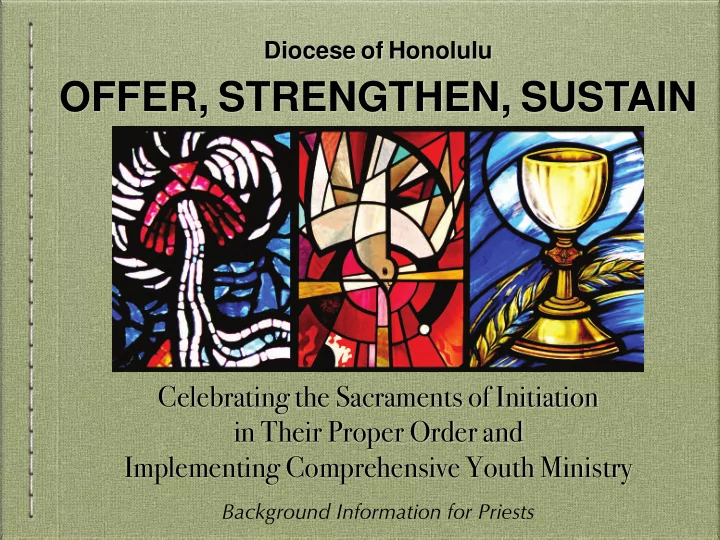
Diocese of Honolulu OFFER, STRENGTHEN, SUSTAIN Celebrating the Sacraments of Initiation in Their Proper Order and Implementing Comprehensive Youth Ministry Background Information for Priests Goals: To restore the sacraments of initiation for

slide-1
SLIDE 1

Diocese of Honolulu

OFFER, STRENGTHEN, SUSTAIN

Celebrating the Sacraments of Initiation in Their Proper Order and Implementing Comprehensive Youth Ministry

Background Information for Priests

slide-2
SLIDE 2

Goals:

To restore the sacraments of initiation for those baptized as infants (before age 7) to their proper order: Baptism, Confirmation, and then first Holy Communion Confirmation and first Holy Communion will be received at the same Mass at the age of reason (ordinarily 7 years). Implement comprehensive youth ministry in all parishes as defined in the USCCB document, Renewing the Vision

slide-3
SLIDE 3

Why change?

“There was this experience: the sacrament of Confirmation — what is this sacrament called?

  • Confirmation. No! Its name has

changed: the ‘sacrament of farewell.’ They do this and then they leave the Church. Is this true or not? … Many young people move

  • ff after receiving Confirmation, the

sacrament of farewell, of goodbye, as I said. It is an experience of failure, an experience that leaves emptiness and discourages us. Is this true or not?”

Pope Francis describes the current situation:

– Meeting with Young People in Cagliari, September 22, 2013

slide-4
SLIDE 4

But even before that, we are also losing half of

  • ur baptized young people who are not even

getting confirmed (Diocese of Honolulu statistics):

Infant Baptism

1st Communion

Confirmation

slide-5
SLIDE 5

Guiding Principles:

To move away from a strictly school-year based model of catechesis and sacramental preparation To strengthen religious education programs in parishes and Catholic schools to create an emphasis on total family catechesis, the role of parents, and the domestic church Family involvement is the most likely indicator

  • f retention in faith formation programs, not the

age of Confirmation (Source: Diocese of Tyler).

slide-6
SLIDE 6

Concomitant goals:

Develop parish programs for Catholic adults who were never confirmed (or haven’t received first Holy Communion) to complete their Christian initiation Programs should be tailored to the catechetical needs of the person; one size does not fit all. Have programs planned for the future for those children above the age of discretion who have not completed initiation

slide-7
SLIDE 7

Theological rationale:

Membership in clubs often have “three degrees.”

The three degrees of membership in the Church are the sacraments of initiation: Baptism, Confirmation, and first Holy Communion. This is the order of sacraments received by adults in the Rite of Christian Initiation of Adults.

slide-8
SLIDE 8

Blessed Paul VI: ““The faithful are born anew by Baptism, strengthened by the sacrament of Confirmation, and finally are sustained by the food of eternal life in the Eucharist. By means of these sacraments of Christian initiation, they thus receive in increasing measure the treasures of divine life and advance toward the perfection of

  • charity. … Finally, Confirmation is so closely

liked with the Holy Eucharist that the faithful, after being signed by holy Baptism and Confirmation, are incorporated fully into the body of Christ by participation in the Eucharist” (Apostolic Constitution, Divinae Consortium Naturae, 1971).

slide-9
SLIDE 9

The Eucharist is the summit of initiation, as it is the apex of our lives as Christians. The Holy Spirit, received in Baptism and Confirmation, prepares us for the Eucharist.

Catechism 1322: “The Holy Eucharist completes Christian initiation.“

slide-10
SLIDE 10

Confirmation is a sacrament of initiation (beginning), not a sacrament of becoming an adult (transition). We do not confirm our faith in Confirmation. It is God who confirms our faith through the ministry

  • f the bishop.

Current practice can mislead people into believing that Confirmation is a rite of passage to adulthood, which lacks a basis in Scripture or tradition.

slide-11
SLIDE 11

“Although Confirmation is sometimes called the ‘sacrament of Christian maturity,’ we must not confuse adult faith with the adult age of natural growth, nor forget that the baptismal grace is a grace of free, unmerited election and does not need ‘ratification’ to become effective” (Catechism

  • f the Catholic Church 1308).
slide-12
SLIDE 12

Current Confirmation praxis can result in the sacrament of Confirmation not being experienced as a free gift from God, a grace, but as something earned, a reward (the heresy of Pelagianism).

Baptism = Our share in Jesus’ death and resurrection Confirmation = Our participation in Pentecost Together Easter and Pentecost are one mystery.

slide-13
SLIDE 13

Jesus is baptized and then is confirmed. Baptism is the contract; Confirmation is the seal (like a seal on an official document).

Matthew 3:16-17: “After Jesus was baptized, he came up from the water and behold, the heavens were opened for him, and he saw the Spirit of God descending like a dove and coming upon him. And a voice came from the heavens, saying, ‘This is my beloved Son, with whom I am well pleased.’”

slide-14
SLIDE 14

Historical rationale:

In the early Church, Baptism, Confirmation, and first Holy Communion were given at the same celebration to people of all ages, including infants, throughout the Church. In later centuries, the Eastern Churches (both Catholic and Orthodox) maintained this practice by allowing presbyters to give “Chrismation.” In the Latin Church, the pope emphasized the importance of the bishop conferring Confirmation. But it was impossible for a bishop to be present at every Baptism, so Baptism was separated from Confirmation.

slide-15
SLIDE 15

The age of 7 began to be viewed as the youngest age possible. Then, over the centuries, the age for Confirmation (and first Holy Communion) kept getting later and later. Eventually, young people were receiving Confirmation (and first Holy Communion) as teenagers.

Eventually in the Latin Church, the Church began issuing regulations requiring that Confirmation be received at least by the age of 7.

slide-16
SLIDE 16

As a result, Confirmation ended up as the third sacrament of initiation as an unintended consequence.

In 1910, St. Pius X moved first Holy Communion to a younger age: “The age of discretion for receiving Holy Communion is that at which the child knows the difference between the Eucharistic Bread and ordinary, material bread, and can therefore approach the altar with proper devotion” (Quam Singulari).

slide-17
SLIDE 17

Vatican I, Schema of the Decree on Confirmation: “Since in some places a custom contrary to the perpetual practice of the church has grown up, in which Confirmation is administered by an absurd order only to those who have already been admitted to the most holy sacrament of the Eucharist, we wish this to be corrected completely; especially since one who has already begun to fight against the enemy should not be kept from armor.” Not discussed or promulgated due to the council ending early

slide-18
SLIDE 18

Pope Leo XIII to Bishop Joseph-Jean-Louis Robert of Marseilles, France, approving his decision to celebrate Confirmation before first Holy Communion: “We praise your proposal to the greatest extent. For that opinion which had grown strong there and in other places corresponded neither to the old and constant intent of the church, nor to the advantage of the faithful. … The faithful, even from the tender years, have a need ‘to be clothed with strength from on high,’ which the sacrament of Confirmation was born to produce. In it, as St. Thomas Aquinas rightly notes, the Holy Spirit is given for the strength of the spiritual fight and humanity is advanced spiritually to a mature age. Moreover, adolescents having thus been confirmed become more conformable to understanding precepts, and more fit for receiving the Eucharist afterwards, and they grasp more abundant benefits from what they receive” (Abrogata quae, 1897).

slide-19
SLIDE 19

Leo XIII’s letter was the source

  • f canon 788 of the 1917

Code of Canon Law: “Although the administration

  • f the sacrament of

Confirmation should preferably be postponed in the Latin Church till about the seventh year of age, nevertheless it can be conferred before that age if the infant is in danger of death

  • r if its administration seems to

the minister justified for good and serious reasons.”

slide-20
SLIDE 20

In 1952, the Vatican Commission for the Interpretation of the Code of Canon Law replied that a bishop could not defer Confirmation until the age of 10. This response was largely ignored.

slide-21
SLIDE 21

Canonical rationale:

Canons on Baptism: canons 849-878 (Catechism 1213-1284) Canons on Confirmation: 879-896 (Catechism 1285-1321) Canons on the Holy Eucharist: 897-958 (Catechism 1322-1419) Canon 842, §2. “The sacraments of Baptism, Confirmation, and the Most Holy Eucharist are interrelated in such a way that they are required for full Christian initiation.” Canon 879. “The sacrament of Confirmation strengthens the baptized and obliges them more firmly to be witnesses of Christ by word and deed and to spread and defend the faith. It imprints a character, enriches by the gift of the Holy Spirit the baptized continuing on the path of Christian initiation, and binds them more perfectly to the Church.”

slide-22
SLIDE 22

Canon 891. “The sacrament of Confirmation is to be conferred on the faithful at about the age of discretion unless the conference of bishops has determined another age, or there is danger of death, or in the judgment

  • f the minister a grave cause suggests
  • therwise.”

Complementary Norm: “The National Conference of Catholic Bishops, in accord with the prescriptions of canon 891, hereby decrees that the sacrament of Confirmation in the Latin Rite shall be conferred between the age of discretion and about sixteen years

  • f age, within the limits determined by the

diocesan bishop and with regard for the legitimate exceptions given in canon 891.”

slide-23
SLIDE 23

Pastoral rationale:

Using Confirmation as leverage to coerce young people into remaining in religious education classes does not necessarily convert their hearts to the Lord. Young people are often relieved that it is over.

slide-24
SLIDE 24

Confirmation is often currently experienced as graduation rather than initiation. The plan: Confirmation programs transition to comprehensive youth ministry that helps young people to be genuine disciples of the Lord.

slide-25
SLIDE 25

The seven gifts of the Holy Spirit, received in Confirmation, are wisdom, understanding, counsel, fortitude, knowledge, piety, and fear of the Lord. Young people need the gifts the Holy Spirit as they grow up, not when they are nearly done growing up.

slide-26
SLIDE 26

Canon law requires children baptized (or received into the full communion of the Catholic Church) 7 years and up receive Confirmation and first Holy Communion at the same time.

This will remove the anomaly of those children receiving Confirmation before the children baptized as infants. It will also solve the problem of some parishes not confirming these children as required.

slide-27
SLIDE 27

What to expect of children before Confirmation?

There is no theological reason to expect more from children for Confirmation than we expect from them for first Holy Communion.

slide-28
SLIDE 28

What will we expect children to know before Confirmation?

That the Holy Spirit is received at Baptism That they will receive the seven gifts of the Holy Spirit That the fruits of the Holy Spirit help us know the Spirit is acting within us That they are to bring the good news of God’s love to other people To be able to describe the parts of the Rite of Confirmation

slide-29
SLIDE 29

What about first Penance?

Children will continue to be prepared for sacrament of Reconciliation and will go to confession for the first time before receiving Confirmation and first Holy Communion.

slide-30
SLIDE 30

Goals of comprehensive youth ministry:

Goal 1: To empower young people to live as disciples of Jesus Christ in our world today. Goal 2: To draw young people to responsible participation in the life, mission, and work of the Catholic faith community. Goal 3: To foster the total personal and spiritual growth of each young person.

Source: USCCB’s Renewing the Vision

slide-31
SLIDE 31

Components of comprehensive youth ministry:

Many components already taking place in many parishes. Need to identify components missing in some parishes and work to develop them. Some components and Confirmation staff can shift from being part of a Confirmation program to being part

  • f youth ministry.

Comprehensive youth ministry includes grades 6-12.

Source: USCCB’s Renewing the Vision

slide-32
SLIDE 32

The ministry of catechesis:

Integrates knowledge of the faith with the development

  • f skills for living the faith in today's world

Engages adolescents in the learning process, responds to different learning styles, and involves group participation in a caring and accepting environment Provides parent, family, and intergenerational catechetical programs which use a variety of approaches Invites youth to consider a call to ministry or religious life

Recognizes that faith development is lifelong and teaches the core content of the Catholic faith to provide a solid foundation

slide-33
SLIDE 33

The ministry of community life:

Creates an environment characterized by gospel values that nurtures meaningful friendships and fosters an understanding of Jesus' call to “love your neighbor as yourself” Enriches family relationships by improving communication, decision making, and faith sharing skills Promotes respect for young people’s ethnic cultures

Engages adolescents in activities and ministries and provides avenues for the parish to celebrate its young members

slide-34
SLIDE 34

The ministry of evangelization:

Proclaims Jesus and the Good News so that young people will come to see in Jesus and his message a response to their hungers and a way to live Witnesses to young people by providing models of people living the Christian faith in practice

Reaches out to young people in their life situations and invites them into the life of the parish so that they may experience the care and support necessary to live as Christians Calls young people to grow in a personal relationship with Jesus Calls young people to be evangelizers of other young people, their families, and the community

slide-35
SLIDE 35

The ministry of advocacy:

Affirming the sanctity of human life and building societal respect for those in need Speaking on behalf of young people and their families on public issues that affect their lives Giving young people a voice and calling them to responsibility around issues that affect them and their future Developing partnerships with all sectors of the community, especially regarding issues affecting adolescents and their families

slide-36
SLIDE 36

The ministry of justice and service:

Involves adolescents and families in direct service to those in need Develops the skills and faith of young people by promoting gospel values in their lifestyles and increasing their self-confidence and moral reasoning abilities Connects doing the right thing with attention to why we do what we do by utilizing the Scriptures and Catholic social teachings Nurtures a lifelong commitment to service and justice involvement

Engages young people in discovering the call to justice and service and helping them learn that they can influence the world

slide-37
SLIDE 37

The ministry of leadership development:

Assures that the ministry coordinator and others adults working with youth are qualified, well trained, and have good reputations Develops a system that invites and trains adult and adolescent leaders and provides for their coordination Develops adult leaders of lively faith and maturity with solid theological understandings, relational and ministry skills, and

  • rganizational ability

Empowers young people for leadership and ministry with their peers by affirming their gifts, developing their skills, and placing them in leadership roles where they can make a contribution

slide-38
SLIDE 38

The ministry of pastoral care:

Fosters the spiritual development of young people and the healthy integration of their sexuality and spirituality Creates networks of care and support for young people and their families and provides programs and resources for parent education and skills for effective parenting and for improving family skills Connects adolescents and families to support services, counseling, referrals, and self-help groups to promote healing during times of loss, divorce, unexpected crises, family problems, and transitions

Develops the life skills of adolescents, such as relationship building, assertiveness, conflict resolution, planning, and decision making, especially in making important life decisions

slide-39
SLIDE 39

The ministry of prayer and worship:

Promotes the participation of youth in liturgy, especially by providing

  • pportunities to serve as liturgical ministers, participate in choirs and

musical assemblies, giving catechesis on the liturgy and sacraments, and scheduling periodic youth event liturgies Attends to the diversity of cultures and ages in the assembly through the use of appropriate symbols, traditions, and musical styles Provides opportunities for prayer with adolescents in peer, family, and intergenerational settings, especially by involving young people in the preparation and through rites of passages and milestones Promotes effective preaching of the word and invites young people to reflect on the seasonal readings and study the Scriptures

slide-40
SLIDE 40

http://www.usccb.org/about/laity- marriage-family-life-and-youth/ young-adults/renewing-the- vision.cfm

Renewing the Vision:

April 16, 2015