On Memory-Making, Memorials and Monuments Rev. Canon Dr. William J. - - PDF document

on memory making memorials and monuments
SMART_READER_LITE
LIVE PREVIEW

On Memory-Making, Memorials and Monuments Rev. Canon Dr. William J. - - PDF document

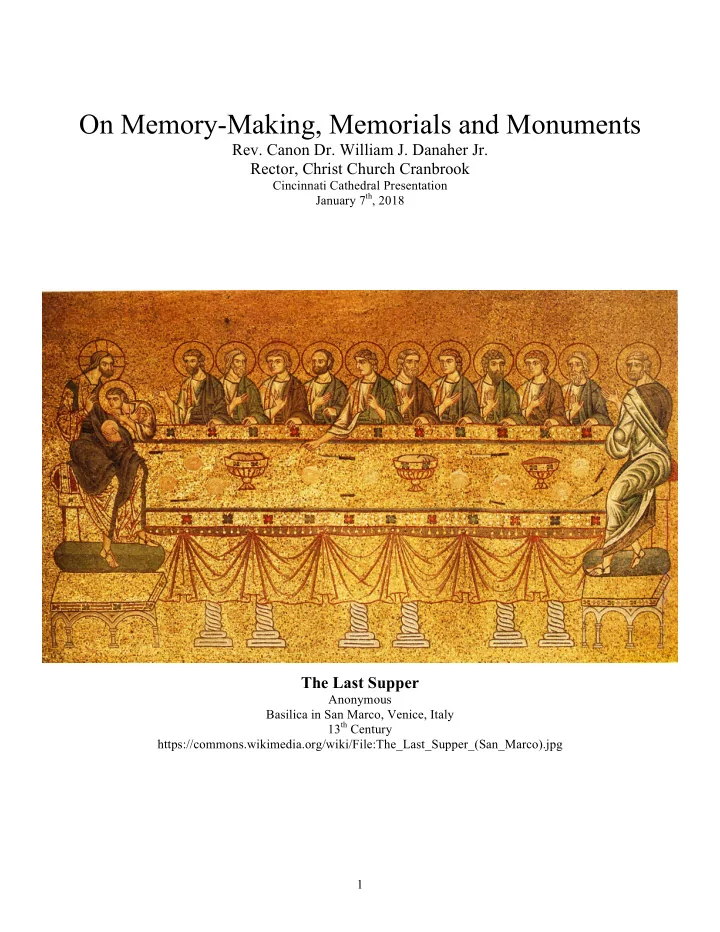
On Memory-Making, Memorials and Monuments Rev. Canon Dr. William J. Danaher Jr. Rector, Christ Church Cranbrook Cincinnati Cathedral Presentation January 7 th , 2018 The Last Supper Anonymous Basilica in San Marco, Venice, Italy 13 th Century


slide-1
SLIDE 1

1

On Memory-Making, Memorials and Monuments

  • Rev. Canon Dr. William J. Danaher Jr.

Rector, Christ Church Cranbrook

Cincinnati Cathedral Presentation January 7th, 2018

The Last Supper

Anonymous Basilica in San Marco, Venice, Italy 13th Century https://commons.wikimedia.org/wiki/File:The_Last_Supper_(San_Marco).jpg

slide-2
SLIDE 2

2

Part 1: Memorials, Monuments, and Memory-Making

  • A. Looking Back, Looking Forward: “Monuments” and “Memorials” are often taken as interchangeable

terms, but they capture different approaches to representing and interpreting of the past. Arthur Danto (1924-2013), an enormously influential philosopher of Art, offers the following way to think of the two: “we erect monuments so that we shall always remember and build memorials so that we shall never forget.” The tension between “always remembering” and “never forgetting” is reflected in the fact that we have the “Washington Monument” [Fig. 1] and the “Lincoln Memorial” [Fig. 2] the latter being the site of the majority of demonstrations that appeal to the founding values and guiding virtues of our

  • nation. From this nuance, the following rough-and-ready definitions emerge:
  • 1. Monuments look back. They stabilize and crystallize the myths around a nation’s beginning.

They make heroes and triumphs, victories and conquests, perpetually present.

  • 2. Memorials look forward. They ritualize remembrance and point to ambitious projects and

unfinished ends reached by values and virtues that require unending vigilance.

  • B. Coded Messages: Whether lifting up mythic beginnings or ultimate endings, monuments and memorials

both play the same cultural role in a community. Their stability, solidity, composition, and design are meant to communicate a coded message that holds together narratives, histories, memories, values, virtues, and identities.

  • 1. James Young, who has written an enormously important book on Holocaust memorials and

their meaning, offers the following description of this work: “By themselves monuments [and memorials] are of little value, mere stones in the landscape. But as part of a nation’s rites or the objects of a people’s national pilgrimage, they are invested with national soul and memory. For traditionally, the state-sponsored memory of a national past aims to affirm the righteousness of a nation’s birth, even its divine election. The matrix of a nation’s monuments [and memorials] emplots the story of ennobling events, of triumphs over barbarism, and recalls the martyrdom of those who gave their lives in the struggle for existence – who, in the martyrological refrain, died so that a country might live. In assuming the idealized forms and meanings assigned to this era by the state, memorials tend to concretize particular historical interpretations. They suggest themselves as indigenous, even geological outcroppings in a national landscape; in time, such idealized memory grows as natural to the eye as the landscape in which is stands. Indeed, for memorials to do otherwise would be to undermine the very foundations of national legitimacy, of the state’s seemingly natural right to exist.” (The Texture of Memory, 1993, 2).

  • 2. Because of this communicative function, memorials and monuments tend to obscure much of

the past they try to retain and reveal. Consider, for example, Jacques-Louis David’s portraits

  • f Napoleon crossing the Alps [Fig. 3]. Painted between 1801-1805, when Napoleon was at

the height of his power, the artist depicts Napoleon with the athletic body of a young man (the model of which was the artist’s son) on a powerful charger confidently leading his troops into battle with the Austrian army. The Neo-classical style of the painting is meant to recall the strong, one-way messages made by monuments of the ideals and heroism of Napoleon as he leads the nation in its transition from Republic to Empire.

slide-3
SLIDE 3

3

A very different depiction of this same event was painted by Paul Delaroche in 1850, which tries to tell a more truthful story [Fig. 4]. Here, instead of confident and youthful, Napoleon’s figure is painted as he was at that time – a middle aged man with over half his life over. The horse he is riding is exhausted, and on the verge of collapse – its hind legs are buckling. The troops, which were included among the viewers in David’s painting are now depicted as miserably following their leader as he gambles with their lives and their nation. Painted during the Second Republic (1848-1851), this painting is meant to instill in its audience a healthy suspicion of imperial designs and charismatic leaders – Delaroche’s intention, in

  • ther words, is to generate art that is counter-monumental.
  • C. Memory-Making: Memorials and Monuments also become powerful forces of memory-making. They

create – to use the title of a famous French sociologist, Maurice Halbwachs – a “collective memory” that in some ways is more important than the past that such landmarks validate.

  • 1. Indeed, Halbwachs argues that it is only through their membership in religious, national, or

class groups that people are able to acquire, recall, and share their memories at all. This social function, however, can mislead as much as lead. Halbwachs writes: “Society from time to time obligates people not just to reproduce in thought previous events of their lives, but also to touch them up, shorten them, or to complete them so that, however, convinced we are that our memories are exact, we give them a prestige that reality did not possess” (On Collective Memory, 1992, 51)

  • 2. For example, consider Ron MacDowell’s “The Foot Soldier,” a statue in Kelly Ingram Park

in Birmingham, Alabama [Fig. 5]. Based on an iconic photograph taken by Bill Hudson on May 4, 1963, during the Birmingham Campaign for Civil Rights, the stature shows a menacing white police officer turning loose a ferocious, wolf-like dog on a young African American teenager. Commissioned by Richard Arrington, the first African American mayor

  • f Birmingham, the statue bears an inscription by Arrington that reads: “This sculpture is

dedicated to the foot soldiers of the Birmingham Civil Rights Movement. With gallantry, courage and great bravery they faced the violence of attack dogs, high powered water hoses, and bombing. They were the fodder in the advance against injustice, warriors of a just cause; they represent humanity unshaken in their firm commitment to liberty and justice for all.” However, the history of the photograph that inspired this memorial is complex and convoluted [Fig.6]. Published on May 4, 1963 in the New York Times, Hudson’s photograph seemed to depict the brutal and inhuman tactics being deployed by the Birmingham Police on the Nonviolent demonstrators led by The Rev. Dr. Martin Luther King Jr. However, a close examination of the photograph, and the meeting it captured, in comparison to MacDowell’s statue reveal important differences. The actual encounter Hudson photographed was not of a protestor being attacked by a police

  • dog. Rather it was of Walter Gadsden, who was not a foot soldier or activist, but a bystander

who came to watch the demonstrations. The officer in the photograph, Richard Middleton, was – according to Gadsden and others – trying to restrain his dog, Leo, from biting Gadsden, as is evidenced by the fact that his left hand is trying to restrain his police dog to the point that Leo’s forelegs are off the ground. Finally, the relative size between Gadsden (6’4”) and Middleton (5’11”) in the photograph are reversed in the McDowell’s statue, which

slide-4
SLIDE 4

4

depict Gadsden as much smaller and deliberately defenseless – his arms are open in a wide, cruciform manner (Malcom Gladwell, http://revisionisthistory.com/). Of course, regardless of its inspiration, McDowell’s statue depicts the very real suffering and violence (and attacks by Police dogs) that nonviolent protestors experienced during the Birmingham Campaign. His statue is an invitation for viewers to engage in a process of memory-making – of seeing how the historical struggles over civil rights then continue to shape us now. Like all memorials, its purpose is to make sure that we “never forget” this struggle and vigilantly guard the virtues and values is moral power. But his statue also illustrates the tension between memorials, the history they depict, and the process of memory-making.

  • D. Biblical Monuments and Memorials: Perhaps the best way to understand the relationship between

monuments, memorials, and memory-making is by looking at how these practices are depicted in the Scriptures.

  • 1. As a Witness: The first mention of a monument or memorial is found in the book of Genesis

(31:44-50). Jacob and Laban create a heap of stones to demarcate the border between their lands and to bear witness to the peaceful way that they parted company. Laban says to Jacob:

44 Come now, let us make a covenant, you and I; and let it be a witness between you and me.” 45 So Jacob took a stone, and set it up as a pillar. 46 And Jacob said to his kinsfolk, “Gather

stones,” and they took stones, and made a heap; and they ate there by the heap. 47 Laban called it Jegar-sahadutha (Aramaic for “The heap of witness”): but Jacob called it Galeed (Hebrew for “The heap of witness”). 48 Laban said, “This heap is a witness between you and me today.” Therefore he called it Galeed, 49 and the pillar Mizpah, for he said, “The Lord watch between you and me, when we are absent one from the other. 50 If you ill-treat my daughters, or if you take wives in addition to my daughters, though no one else is with us, remember that God is witness between you and me.” (Gen 31:44–50)

  • 2. As a Remembrance: Later in Genesis (35:44-50, when Rachel dies in childbirth, Jacob

erects a memorial pillar: “So Rachel died, and she was buried on the way to Ephrath (that is, Bethlehem), 20 and Jacob set up a pillar at her grave; it is the pillar of Rachel’s tomb, which is there to this day. 21 Israel journeyed on, and pitched his tent beyond the tower of Eder. (Gen 35:19–21)

  • 3. As a Way to Remember our Present and Future: In both of these previous passages, the

memorials/monuments were constructed so that subsequent generations could remember past events and people, as well as the God who acted powerfully in their lives. These memorials were reminders of God’s powerful presence in their present. For Christians, however, the most important act of remembrance and witness in the Bible is not an object but a ritual – the

  • Eucharist. The words of institution – Jesus’ action of taking, blessing and breaking the bread

and sharing the cup of wine as his “body” and “blood” in the Gospels of Matthew (26:17-30), Mark (14:12-26), and Luke (22:7-39) establish a living memorial and collective memory of what it means to be a Christian. By participating in the memory-making of the Eucharist, each of us acknowledges both our sins and Christ’s forgiveness and reconciliation. The fact that this memorial is made of bread and wine, rather than stone, is a reminder to us that the materiality involved in this memorial remains important.

slide-5
SLIDE 5

5

However, because the Eucharist is an ongoing performance, it does something that all good memorials do: create the opportunity for the ongoing cultivation of a shared memory. This is precisely what Paul speaks about in 1 Corinthians (11:23-26): “23 For I received from the Lord what I also handed on to you, that the Lord Jesus on the night when he was betrayed took a loaf of bread, 24 and when he had given thanks, he broke it and said, “This is my body that is for you. Do this in remembrance of me.” 25 In the same way he took the cup also, after supper, saying, “This cup is the new covenant in my blood. Do this, as often as you drink it, in remembrance of me.” 26 For as often as you eat this bread and drink the cup, you proclaim the Lord’s death until he comes.”

  • 4. The Eucharist as a Guide to Memory-Making: This provides us with an important insight

into the best memorials, which are not only moving and powerful pieces of sculpture, but spaces that create and transform communities through encouraging pilgrimages, memorial activities, memorial festivals. Whether mournful or celebratory, the best memorials continue to shape us. Otherwise, as mere physical objects, monuments and memorials do a poor job at doing the memory-work for us. In fact, because so many seem to be complete statements of an event, they actually tend to encourage forgetfulness. As James Young notes: “In shouldering the memory-work, monuments may relieve viewers of their memory burden” (The Texture of Memory, 1993, 3).

  • E. Moving Memorials: Taken as a whole, the foregoing leads me to name what, in my opinion, are the

two best memorials in the United States. Maya Lin’s Vietnam Veterans’ Memorial (1982) [Fig. 7] and her Civil Rights Memorial (1989) [Fig. 8] represent incredibly powerful works that encourage memory- making and community transformation. The memorialization rituals around, for example, the Vietnam Veterans’ Memorial spontaneously developed as the landmark became a place for catharsis and healing by veterans, their friends, their family, and the nation as a whole. Further, by staying with an abstract design, the memorials avoided heroic depictions that communicate a singular message that eliminates any other meanings and interpretations that arise as time marches on. Part 2: Faithfully Responding to the Confederate Memorials at Christ Church Cathedral

  • A. Framing Questions: It is clear that the Dean and the Vestry are faced with a daunting task – one that

many other churches and communities are facing. The context I have provided to this point helps us pose a few questions that can help the discernment process:

  • 1. Monument or Memorial? We need to ask if these representations [Fig. 9 and Fig. 10] count as

monuments or memorials? Although purporting to be memorials, both deliver a message about a heroic past – as monuments do. The stained-glass depiction of Lee does not capture, for example, the quiet way he lived his life after the Civil War, but shows him at the “height of his powers” – wearing the uniform of the Confederacy. The bas relief sculpture of Leonidas Polk does not follow the engraving that was done of him in 1838, when he was consecrated a missionary bishop in this

  • Cathedral. This is clear because, after 1838, Polk seems to prefer turning the left side of his face

toward the viewer – as it appears in the plaque in the Cathedral’s vestibule. Rather the memorial plaque in the vestibule follows a famous photograph and portrait – “Sword over the Gown” by E. F. Andrews in 1900 – that remain his most common visual signature [Fig. 11].

slide-6
SLIDE 6

6

  • 2. Coded Messages? We need to ask what message each of these representations is communicating.

This asks us to inquire not only into the particular, “original” message these two historical figures conveyed in their lives, but why they were erected by members of the church, when, and by whom? Although I have not had the opportunity to do any archival work on either of these portraits, the Polk memorial communicates a very clear message with the epithet, “Called to be an Apostle.” That, along with the particular way that Polk is represented in this memorial, suggests that it is not his work as a missionary Bishop that is being commemorated but his decision to see his own calling as a Bishop and as a Confederate General as one and the same. In a memoir written by Polk’s son, William, the origin of the famous phrase attributed to him, “sword over the gown” (that is, the sword of his commission in the Confederate Army over the gown

  • f his consecration as a Bishop) is explained in the following way: A friend said, ‘What! You, a

Bishop, throw off the gown for the sword!” “No sir,” Polk replied, “I buckle the sword over the gown.” For William, this phrase perfectly sums up his belief that his father saw his commission in the Confederate Army as a necessary, divine calling that temporarily outweighed his call to be a Bishop (Leonidas Polk: Bishop and General, 1893, 326). At the very least, given Polk’s subsequent history, commending him as one “Called to be an Apostle” sends a very confusing message in a memorial celebrating his consecration.

  • 3. Memory-Making? Finally, we need to ask what memory-work do these memorials do in the life

and work of this Cathedral? Do they play a role in any ongoing commemorative festivals or activities, any pilgrimages? Or is it the case that they are shouldering the whole burden of memory for the congregation here so that this history can be crystallized and all but forgotten? More importantly, we need to ask what other memory-making activities have these memorials foreclosed? What other memorials might need to be created to provide a fuller picture of the role memory might play in this Cathedral?

  • B. Strategies for Moving Forward: The Cathedral is not the only community in which decisions

regarding Confederate Memorials are being made. Here, let me review three strategies that the Dean and Vestry might consider:

  • 1. Removal/Elimination. In many cases, the best option is to remove or relocate the monument and

memorial so that it no longer plays the same iconic role it was assigned when it was erected (“Confederate Monuments are Coming Down Across the United States. Here’s a List” New York Times, August 28, 2017). A good example of the multiple and complex reasons for removal/elimination is the Confederate Memorial found on George’s Island in Boston Harbor [Fig. 12 and Fig. 13]. The statue does not commemorate a Confederate “hero” like Leonidas Polk, but the 13 Confederate soldiers who died on the island while they were jailed there as prisoners of war. As such, it conveys a different point – at least at face value – than some of the other very public monuments to Jefferson Davis or Robert E. Lee. However, the memorial was dedicated on May 24, 1963, the same month in which the Birmingham Campaign was being waged in Birmingham, Alabama. In fact, although overlooked in many historical surveys of the Civil Rights Movement, parallel civil rights protests took place in Boston during the same time as they were happening in Birmingham. In Boston, the issue was not segregation – as it was in Birmingham –but police practices and economic inequality. (Audrea Jones Dunham, “Boston’s 1960’s Civil Rights Movement: A Look Back,” http://openvault.wgbh.org).

slide-7
SLIDE 7

7

This context surrounding the Memorial’s establishment needs to play a decisive role in to the decision concerning whether or not it remains. Because the timing of its establishment makes it highly probable that the memorial was created in order to communicate a message about which lives matter and should be mourned by the wider community.

  • 2. Contextualization and Repentance. Another strategy that can be employed is to post other plaques

and monuments that can contextualize – and in some manner destabilize – the messages transmitted by a problematic memorial. A good example of this is the decision that church leaders made regarding plaques inside the Anglican Cathedral in Grahamstown, South Africa. Inside the Cathedral are several plaques commemorating those British settlers and soldiers who were killed during the Xhosa Wars (1779- 1879), a period of immense instability, oppression, and violence in which the indigenous population was decimated with extreme brutality. A number of the monuments employ racist language – the African equivalent of the “N” word – in describing the “heroic” deaths of the soldiers and settlers. After the fall of Apartheid, African South Africans found it difficult to worship in a building where their ancestors were referred to in such derogatory ways and their deaths completely overlooked in favor of celebrating the relatively few deaths by the European settlers and soldiers. As Bishop Brian Castle writes, “church authorities were faced with a dilemma: should they remove the memorials that were commentaries on significant parts of South African history or should the memorials remain, causing offence to many who worship in the Cathedral?” (Reconciliation, 2014, 24). Faced with strong opinions on both sides, the leadership decided to post an additional plaque to help worshippers understand the context of the monuments [Fig. 14]. There, they wrote: "There is a wide variety of memorial tablets and plaques in the cathedral. Not all of them are written in language that would be used today. Some words on them are offensive to us all. They are not conducive to affirming the relationships which lie at the heart of the Christian faith and to which this building and its community witness. But the church has never hidden away its failures and its sins. The church today cannot and should not try to purify its history as if things never happened. The failures and mistakes of the past exist with those of the present. We regret them deeply, but they are there. Just as the failures of the Early Church remain for all to read about in the New Testament. So for the moment the plaques remain as part of our common history, and as a sign of our need for

  • penitence. They exist alongside the signs of our duty to be grateful for the acts of courage and faith
  • f the past as well."

On addition, the offensive words on the plaques were covered with marble strips [Fig 15].

  • 3. Counter-Memorialization. Finally, another strategy is to erect a counter-monument to contest the

authoritarian elements in the original monument. Such interventions are usually artistic exercises that deliberately challenge and question the myths, values, and virtues on display in the original monument. For example, in the Center of Hamburg, Germany, there is Kriegersmahnmahl, or “Warrior Memorial” a large military monument designed by Richard Kuöhl and built by the Nazis in 1936 [Fig. 16]. The monument is a massive cube of granite blocks, and it is encircled by a frieze of

slide-8
SLIDE 8

8

marching German soldiers, four abreast. In Gothic script typical of the Third Reich, the monument is dedicated to the memory of soldiers from Hamburg’s Second Hanseatic Infantry Regiment number 76 who fell in the 19870-71 war and the First World War. On it is an inscription: “Germany must live, even if we have to die.” In the years after the World War II, the monument – and its inscription – became increasingly

  • controversial. Many found the inscription to be an affront to the dead of all wars. However, at the

same time, the monument remained a place that was continually used by the veterans of the Second Hanseatic Infantry Regiment to remember their fallen comrades. Some political leaders wanted to rededicate the memorial to the fallen soldiers of all wars. However, instead, city authorities decided that they would build a contemporary counter-monument right next to it. In 1985, they chose the Austrian sculptor Alfred Hrdlicka, who proposed a series of sculptures that would trace the shape of a broken swastika, two of which was built within 20 steps of the “Warrior Memorial.” The first, “The Hamburg Firestorm” is a broken wall of roughly cast bronze symbolizing the charred timbers of a bombed-out city, against which leans an emaciated figure – either a bombing victim or a concentration camp prisoner. Through the holes in the wall, one can see the “Warrior Memorial,” which therefore forms part of the background of Hrdlicka’s sculpture. Next to “The Hamburg Firestorm” another statue, dedicated in 1986, is placed in which victims from a concentration camp emerge from a stone block, as if they are in the midst of passing from death to

  • life. It is called, “Downfall of a Concentration Camp Prisoner,” which is a final, unfinished gesture

that bears witness to the violence and evil monuments like “Warrior Memorial” have perpetuated.

slide-9
SLIDE 9

9 Part 3: Figures

Figure 1: The Washington Monument

http://mentalfloss.com/article/66045/15-things-you- might-not-know-about-washington-monument

Figure 2: The Lincoln Memorial

https://www.npca.org/parks/lincoln-memorial-national-memorial

slide-10
SLIDE 10

10

Figure 3: Napoleon Crossing the Alps

Jacques-Louis David 1801 Chateau de Malmaison, Rueil-Malmaison https://en.wikipedia.org/wiki/Napoleon_Crossing_the_Alps

slide-11
SLIDE 11

11

Figure 4: Bonaparte Crossing the Alps

Paul Delaroche 1850 Chateau de Malmaison, Rueil-Malmaison https://en.wikipedia.org/wiki/Napoleon_Crossing_the_Alps

slide-12
SLIDE 12

12

Figure 5: The Foot Soldier

Ron MacDowell https://ryandueck.com/2017/07/06/when-the-truth-gets-in-the- way-of-the-story-you-want-to-tell/

Figure 6: The Foot Soldier

Ron MacDowell http://www.al.com/opinion/index.ssf/2017/07/more_than_confedera te_statues.html

slide-13
SLIDE 13

13

Figure 7: Vietnam Veteran’s Memorial

Maya Lin http://www.pbs.org/wgbh/cultureshock/flashpoints/visualarts/thewal l_big.html

Figure 8: Civil Rights Memorial

Maya Lin https://www.splcenter.org/what-we-do/civil-rights-memorial/history

slide-14
SLIDE 14

14

Figure 9: General Lee Stained Glass Window

Washington National Cathedral https://www.cincinnati.com/story/news/2017/09/01/should-confederate- memorials-removed-downtown-cincinnati-church/618252001/

Figure 10: Leonidas Polk

https://www.cincinnati.com/story/news/2017/09/01/should-confederate- memorials-removed-downtown-cincinnati-church/618252001/

slide-15
SLIDE 15

15

Figure 11: Sword over the Gown

E.F. Andrews 1900 Sewanee, Tennessee- University of the South https://civilwartalk.com/threads/educators-in-the-civil-war.115880/

Figures 12 and 13: Confederate Memorial

Boston http://www.wbur.org/artery/2017/08/16/boston-confederate-monument

slide-16
SLIDE 16

16

Figure 14: Plaque

  • St. Michael and St. George Cathedral

South Africa https://en.wikipedia.org/wiki/St_Michael_and_St_George_Cathedral,_Grah amstown#/media/File:GT-Disclaimer.jpg

Figure 15: Plaque

  • St. Michael and St. George Cathedral

South Africa http://www.greatmirror.com/index.cfm?countryid=374&chapterid=1734&pi cid=17&picturesize=mediumhamstown#/media/File:GT-Disclaimer.jpg

slide-17
SLIDE 17

17

Figure 16: Kriegersmahnmahl, or “Warrior Memorial”

Richard Kuoh 1936 Hamburg, Germany https://www.researchgate.net/figure/Kriegersmahnmal-by-Richard-Kuoehl- and-Gegendenkmal-by-Alfred-Hrdlicka-Photo-by_251480400