On providing a CAS for Python Pearu Peterson - - PowerPoint PPT Presentation

on providing a cas for python
SMART_READER_LITE
LIVE PREVIEW

On providing a CAS for Python Pearu Peterson - - PowerPoint PPT Presentation

On providing a CAS for Python Pearu Peterson pearu.peterson@gmail.com Centre for Nonlinear Studies, Estonia Simula Research Laboratory, Norway Introduction What is CAS? Why another CAS? Sympycore development, comparisons, secret


slide-1
SLIDE 1

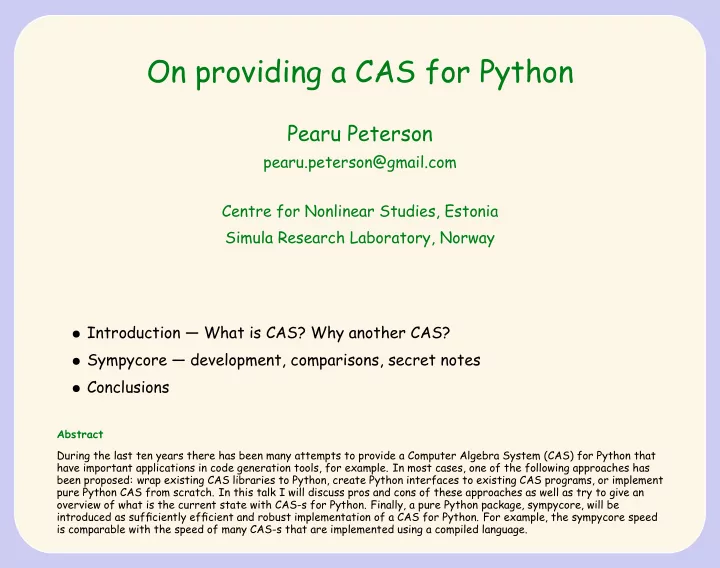
On providing a CAS for Python

Pearu Peterson

pearu.peterson@gmail.com Centre for Nonlinear Studies, Estonia Simula Research Laboratory, Norway

  • Introduction — What is CAS? Why another CAS?
  • Sympycore — development, comparisons, secret notes
  • Conclusions

Abstract During the last ten years there has been many attempts to provide a Computer Algebra System (CAS) for Python that have important applications in code generation tools, for example. In most cases, one of the following approaches has been proposed: wrap existing CAS libraries to Python, create Python interfaces to existing CAS programs, or implement pure Python CAS from scratch. In this talk I will discuss pros and cons of these approaches as well as try to give an

  • verview of what is the current state with CAS-s for Python. Finally, a pure Python package, sympycore, will be

introduced as sufficiently efficient and robust implementation of a CAS for Python. For example, the sympycore speed is comparable with the speed of many CAS-s that are implemented using a compiled language.

slide-2
SLIDE 2

What is CAS? Computer Algebra System (CAS) is a software program that facilitates symbolic mathematics. The core functionality

  • f

a CAS is manipulation

  • f

mathematical expressions in symbolic form. [Wikipedia] Existing tools — Wikipedia lists more than 40 CAS-es:

  • commercial/free,
  • full-featured programs/problem specific libraries,
  • in-house,

C, C++, Haskell, Java, Lisp, etc programming languages.

slide-3
SLIDE 3

Our aim — provide a package to manipulate mathematical expressions within a Python program. Target applications — code generation for numerical applications, arbitrary precision computations, etc in Python. Possible approaches:

  • wrap existing CAS libraries to Python: swiginac[GPL] (SWIG,

GiNaC, 2008), PyGiNaC[GPL] (Boost.Python, GiNaC, 2006), SAGE[GPL] (NTL, Pari/GP, libSingular, etc.)

  • create interfaces to CAS programs: Pythonica (Mathematica,

2004), SAGE[GPL] (Maxima, Axiom, Maple, Mathematica, MuPAD, etc.)

  • write

a CAS package from scratch: Sympy[BSD], Sympycore[BSD], Pymbolic[?] (2008), PySymbolic[LGPL] (2000), etc

slide-4
SLIDE 4

It is almost trivial to implement a simple and efficient Python program for manipulating symbolic expressions but highly non-trivial to generalize it to a full-featured and sufficiently efficient CAS

slide-5
SLIDE 5

Some minimal set of CAS features

  • Symbolic expressions: atomic (symbols, numbers) and composite (operation +
  • perands) expressions, inquire information.
  • Pattern matching, substitutions of sub-expressions.
  • Support for various mathematical concepts: arithmetics, calculus, polynomials,

matrices, sets, logic, functions, operators, etc.

  • Simplifications to some canonical form:

(x + x) -> 2*x, (x and x) -> x, etc.

  • Changes in the form of expressions: expanding, factorizations, rewriting.
  • Simplifications with assumptions:

sqrt(x)**2 -> x iff x>0 is True.

  • Calculus: differentation, integration, series, limits, etc.
  • Arithmetics: booleans, integers, rational numbers, complex numbers, arbitrary

precision numbers

  • Convert symbolic expressions to various forms: C/C++, Fortran, TeX, pretty-

printing, etc.

  • . . .
slide-6
SLIDE 6

A selection of available Python based CAS-es:

CAS Advanatages Disadvantages Sage most full-featured, lots

  • f

developers (20–50), fastest components huge (≥ 800MB), ships more than

  • ne needs, slow components(read:

interfaces) Sympy pure Python, many developers (8– 15), many features slow, core robustness needs work, calculus oriented Sympycore fastest pure Python core (10– 300x faster than Sympy), facilitates various algebras not many features implemented, few developers (2)

slide-7
SLIDE 7

Sympycore — development

  • About 10 000 LOC
  • Test coverage is currently 65%
  • Continuous control over performance
  • Authors: Pearu Peterson, Fredrik Johansson
slide-8
SLIDE 8
slide-9
SLIDE 9

Sympycore versus Sympy and Swiginac

Executed code sympy / sympycore

Add(x,random integer,y), 2000x

39.0

Mul(x,random integer,y), 2000x

26.4

sum(x**i/i,i=1..400)

317

expand((x+z+y)**20 * (z+x)**9)

126

expand((x+2*y+3*z)**20).subs(x,z).subs(y,z)

32.2

f=(x/(1+sin(x**(y+x**2)))**2), f=f.diff(x), 5x

42.3

f=4*x**3+y**2*x**2+x+1, f=integrate(f), 10x

20.8

match((x*y**2)**sin(x+y**2), (v*w)**sin(v+w))

9.87

polynomial division P(1,2,3,4,5)/Q(1,2,3/4)

333

fem_test.py

16.5 swiginac / sympycore

Add(x,random integer,y), 2000x

11.2

Mul(x,random integer,y), 2000x

4.55

sum(x**i/i,i=1..400)

48.5

expand((x+z+y)**20 * (z+x)**9)

0.700

expand((x+2*y+3*z)**20).subs(x,z).subs(y,z)

0.282

f=(x/(1+sin(x**(y+x**2)))**2), f=f.diff(x), 5x

0.633

  • Sympy has lots of features, uses caching
  • Sympycore concentrates on core performance, one small extension module
  • Swiginac has less features, computation is fast (GiNaC), interface is slow

(SWIG)

slide-10
SLIDE 10

Sympycore secret notes — implementation

Things to keep in mind:

  • object creation in Python is slow
  • function/method calls in Python are slow
  • attribute access in Python is slow
  • loops in Python are slow
  • working with builtin types in Python can be fast (C speed)

Things to follow:

  • avoid creating temporary objects, use singletons (is)
  • avoid deep function calls, inline functions
  • use local variables, remember attributes and global names
  • avoid loops in Python
  • take advantage of the speed of Python builtin types (dict, set, list, tuple)
  • use profile results to decide which parts should be written in C
  • with immutable objects: true inplace operations possible until hash calculation
slide-11
SLIDE 11

Sympycore secret notes — design

Things to keep in mind:

  • theories of algebraic structures may seem complex, following their logic

actually simplifies coding

  • algorithms in text-books may be easy-to-understand but not always optimal
  • there exist no ideal representation of mathematical concepts in a computer

program, efficiency depends on a particular application and used algorithms Things to follow:

  • try different data representations for a particular mathematical concept,

consider supporting multiple representation

  • try different algorithms
  • never underestimate the power of mathematics
slide-12
SLIDE 12
slide-13
SLIDE 13

Conclusions

  • Sympycore — a research project, its aim is to seek out new high-performance

solutions to represent and manipulate symbolic expressions in Python language

  • Sympycore — fastest Python based CAS core implementation
  • Our goal is to work in the direction of making Sympycore usable for Sympy