On the enhancement of the Ly equivalent width by a multiphase - - PowerPoint PPT Presentation

on the enhancement of the ly equivalent width by a
SMART_READER_LITE
LIVE PREVIEW

On the enhancement of the Ly equivalent width by a multiphase - - PowerPoint PPT Presentation

On the enhancement of the Ly equivalent width by a multiphase interstellar medium or: debunking the Neufeld scenario Peter Laursen With Florent Duval & Gran stlin (OKC) Dark Cosmology Centre | Niels Bohr Institutet | Kbenhavns


slide-1
SLIDE 1

www.dark-cosmology.dk/~pela

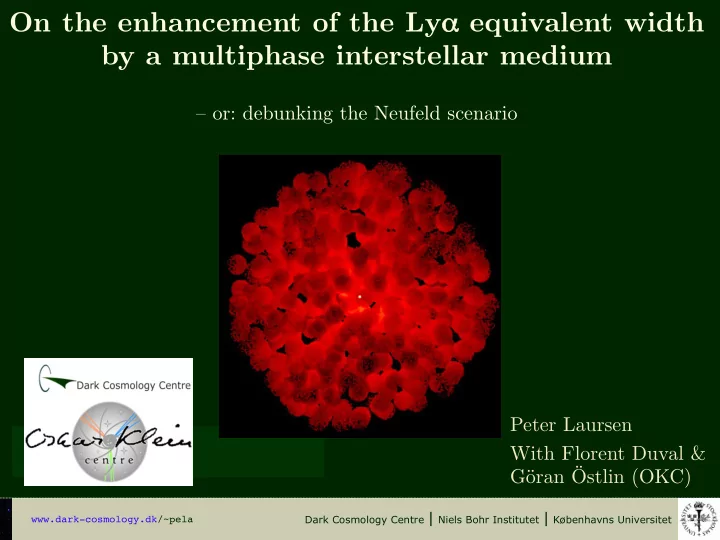
On the enhancement of the Lyα equivalent width by a multiphase interstellar medium

– or: debunking the Neufeld scenario

Dark Cosmology Centre | Niels Bohr Institutet | Københavns Universitet

Peter Laursen With Florent Duval & Göran Östlin (OKC)

slide-2
SLIDE 2

2

Motivation

Lyman α emitting galaxies (LAEs) are important probes of the high-redshift Universe:

  • Epoch of Reionization
  • Baryonic Acoustic Oscillations
  • Luminosity function (faint end)

These are statistical properties. Individual observations are hampered by insufficient knowledge about radiative transfer

  • effects. One way, however, to probe individual galaxies is by

looking at the equivalent width of Lyα.

slide-3
SLIDE 3

3

Equivalent width:

“But… but…”, say Kudritzki et al. (2000), Malhotra & Rhoads (2002), Rhoads et al. (2003), Dawson et al. (2004), Hu et al. (2004), Shimasaku et al. (2006), Ouchi et al. (2008), Nilsson et al. (2009), Kashikawa et al. (2011), etc.

Boost:

“Max 240 Å!”, say Charlot & Fall (1993), and Schaerer (2003). “Clumpiness!”, say Chapman et al. (2005), Finkelstein et al. (2007, 2008, 2009a,b,c, 2011a,b), Dayal et al. (2008, 2009, 2010, 2011), Niino et al. (2009), Yuma et al. (2010), Kobayashi et al. (2010), Blanc et al. (2011), Nakajima et al. (2012), etc.

Motivation
slide-4
SLIDE 4

4

Lyman α radiative transfer

HI

slide-5
SLIDE 5

5

Gas density and temperature Dust density and cross-section

T = 104 K, NHI = 1019 cm-2, E(B–V) = 0.1

Neufeld (1990)

Lyman α escape

slide-6
SLIDE 6

6

Multiphase medium

Neufeld (1991); Hansen & Oh (2006)

slide-7
SLIDE 7

7

Neufeld 1991

Enter Hansen & Oh (2006)

slide-8
SLIDE 8

8

MOCALATA

(Laursen et al. 2009)

Systematic approach

slide-9
SLIDE 9

9

  • Covering factor, fc
  • Cloud HI density, nHI,cl
  • Cloud dust density ( metallicity, Zcl)
  • Cloud velocity dispersion, σV,cl
  • Galactic outflow velocity, Vout
  • Intercloud HI density, nHI,ICM
  • Intercloud dust density ( ZICM)
  • Emission scale length, H
  • Emission/cloud correlation factor, Pcl
  • Intrinsic line width, σline
  • Gas temperature, Tcl; TICM
  • Cloud size distribution, rcl,min; rcl,max; β

Varying the input parameters

3 1 cm-3 Z 0 km s-1 0 km s-1 0 cm-3 Central 104 K; 106 K 100 pc “Fiducial” model:

slide-10
SLIDE 10

10

  • Covering factor, fc
  • Cloud HI density, nHI,cl
  • Cloud dust density ( metallicity, Zcl)
  • Cloud velocity dispersion, σV,cl
  • Galactic outflow velocity, Vout
  • Intercloud HI density, nHI,ICM
  • Intercloud dust density ( ZICM)
  • Emission scale length, H
  • Emission/cloud correlation factor, Pcl
  • Intrinsic line width, σline
  • Gas temperature, Tcl; TICM
  • Cloud size distribution, rcl,min; rcl,max; β

Varying the input parameters

(on at a time)

slide-11
SLIDE 11

11

Varying the input parameters

  • Covering factor, fc
  • Cloud HI density, nHI,cl
  • Cloud dust density ( metallicity, Zcl)
  • Cloud velocity dispersion, σV,cl
  • Galactic outflow velocity, Vout
  • Intercloud HI density, nHI,ICM
  • Intercloud dust density ( ZICM)
  • Emission scale length, H
  • Emission/cloud correlation factor, Pcl
  • Intrinsic line width, σline
  • Gas temperature, Tcl; TICM
  • Cloud size distribution, rcl,min; rcl,max; β
slide-12
SLIDE 12

12

Varying the input parameters

  • Covering factor, fc
  • Cloud HI density, nHI,cl
  • Cloud dust density ( metallicity, Zcl)
  • Cloud velocity dispersion, σV,cl
  • Galactic outflow velocity, Vout
  • Intercloud HI density, nHI,ICM
  • Intercloud dust density ( ZICM)
  • Emission scale length, H
  • Emission/cloud correlation factor, Pcl
  • Intrinsic line width, σline
  • Gas temperature, Tcl; TICM
  • Cloud size distribution, rcl,min; rcl,max; β
slide-13
SLIDE 13

13

Varying the input parameters

  • Covering factor, fc
  • Cloud HI density, nHI,cl
  • Cloud dust density ( metallicity, Zcl)
  • Cloud velocity dispersion, σV,cl
  • Galactic outflow velocity, Vout
  • Intercloud HI density, nHI,ICM
  • Intercloud dust density ( ZICM)
  • Emission scale length, H
  • Emission/cloud correlation factor, Pcl
  • Intrinsic line width, σline
  • Gas temperature, Tcl; TICM
  • Cloud size distribution, rcl,min; rcl,max; β
slide-14
SLIDE 14

14

Varying the input parameters

  • Covering factor, fc
  • Cloud HI density, nHI,cl
  • Cloud dust density ( metallicity, Zcl)
  • Cloud velocity dispersion, σV,cl
  • Galactic outflow velocity, Vout
  • Intercloud HI density, nHI,ICM
  • Intercloud dust density ( ZICM)
  • Emission scale length, H
  • Emission/cloud correlation factor, Pcl
  • Intrinsic line width, σline
  • Gas temperature, Tcl; TICM
  • Cloud size distribution, rcl,min; rcl,max; β
slide-15
SLIDE 15

15

Varying the input parameters

  • Covering factor, fc
  • Cloud HI density, nHI,cl
  • Cloud dust density ( metallicity, Zcl)
  • Cloud velocity dispersion, σV,cl
  • Galactic outflow velocity, Vout
  • Intercloud HI density, nHI,ICM
  • Intercloud dust density ( ZICM)
  • Emission scale length, H
  • Emission/cloud correlation factor, Pcl
  • Intrinsic line width, σline
  • Gas temperature, Tcl; TICM
  • Cloud size distribution, rcl,min; rcl,max; β
slide-16
SLIDE 16

16

Varying the input parameters

  • Covering factor, fc
  • Cloud HI density, nHI,cl
  • Cloud dust density ( metallicity, Zcl)
  • Cloud velocity dispersion, σV,cl
  • Galactic outflow velocity, Vout
  • Intercloud HI density, nHI,ICM
  • Intercloud dust density ( ZICM)
  • Emission scale length, H
  • Emission/cloud correlation factor, Pcl
  • Intrinsic line width, σline
  • Gas temperature, Tcl; TICM
  • Cloud size distribution, rcl,min; rcl,max; β
slide-17
SLIDE 17

17

Varying the input parameters

  • Covering factor, fc
  • Cloud HI density, nHI,cl
  • Cloud dust density ( metallicity, Zcl)
  • Cloud velocity dispersion, σV,cl
  • Galactic outflow velocity, Vout
  • Intercloud HI density, nHI,ICM
  • Intercloud dust density ( ZICM)
  • Emission scale length, H
  • Emission/cloud correlation factor, Pcl
  • Intrinsic line width, σline
  • Gas temperature, Tcl; TICM
  • Cloud size distribution, rcl,min; rcl,max; β
slide-18
SLIDE 18

18

Varying the input parameters

  • Covering factor, fc
  • Cloud HI density, nHI,cl
  • Cloud dust density ( metallicity, Zcl)
  • Cloud velocity dispersion, σV,cl
  • Galactic outflow velocity, Vout
  • Intercloud HI density, nHI,ICM
  • Intercloud dust density ( ZICM)
  • Emission scale length, H
  • Emission/cloud correlation factor, Pcl
  • Intrinsic line width, σline
  • Gas temperature, Tcl; TICM
  • Cloud size distribution, rcl,min; rcl,max; β
slide-19
SLIDE 19

19

Varying the input parameters

  • Covering factor, fc
  • Cloud HI density, nHI,cl
  • Cloud dust density ( metallicity, Zcl)
  • Cloud velocity dispersion, σV,cl
  • Galactic outflow velocity, Vout
  • Intercloud HI density, nHI,ICM
  • Intercloud dust density ( ZICM)
  • Emission scale length, H
  • Emission/cloud correlation factor, Pcl
  • Intrinsic line width, σline
  • Gas temperature, Tcl; TICM
  • Cloud size distribution, rcl,min; rcl,max; β
slide-20
SLIDE 20

20

Varying the input parameters

  • Covering factor, fc
  • Cloud HI density, nHI,cl
  • Cloud dust density ( metallicity, Zcl)
  • Cloud velocity dispersion, σV,cl
  • Galactic outflow velocity, Vout
  • Intercloud HI density, nHI,ICM
  • Intercloud dust density ( ZICM)
  • Emission scale length, H
  • Emission/cloud correlation factor, Pcl
  • Intrinsic line width, σline
  • Gas temperature, Tcl; TICM
  • Cloud size distribution, rcl,min; rcl,max; β
slide-21
SLIDE 21

21

Varying the input parameters

  • Covering factor, fc
  • Cloud HI density, nHI,cl
  • Cloud dust density ( metallicity, Zcl)
  • Cloud velocity dispersion, σV,cl
  • Galactic outflow velocity, Vout
  • Intercloud HI density, nHI,ICM
  • Intercloud dust density ( ZICM)
  • Emission scale length, H
  • Emission/cloud correlation factor, Pcl
  • Intrinsic line width, σline
  • Gas temperature, Tcl; TICM
  • Cloud size distribution, rcl,min; rcl,max; β
slide-22
SLIDE 22

22

From ideal to semi-realistic

(varying in unison)

slide-23
SLIDE 23

23

From ideal to semi-realistic

(each dot is the result of a model)

slide-24
SLIDE 24

24

From ideal to semi-realistic

slide-25
SLIDE 25

25

From ideal to semi-realistic

slide-26
SLIDE 26

26

From ideal to semi-realistic

slide-27
SLIDE 27

27

Line profiles

Average spectrum of boost-yielding (extreme) models — not realistic (too narrow)

slide-28
SLIDE 28

28

  • Top-heavy IMF (Malhotra & Rhoads 02)
  • Population III stars (Schaerer 03, Tumlinson 03)
  • Delayed escape of Lyα (Roy+ 10, Xu+ 11)
  • AGN activity (<5%, Wang+ 04, Gawiser+ 06)
  • Viewing angle (Laursen 07/09, Verhamme 12)
  • Cooling radiation (Dijkstra+ 09, Laursen+ 09, Dayal+ 10)
  • Measuring errors (Henry+ 10)
  • Star formation stochasticity (Forero-Romero & Dijkstra 12)
  • Inhomogeneous escape (Hayes+ 07)

Alternative scenarios

slide-29
SLIDE 29

29

  • Top-heavy IMF (Malhotra & Rhoads 02)
  • Population III stars (Schaerer 03, Tumlinson 03)
  • Delayed escape of Lyα (Roy+ 10, Xu+ 11)
  • AGN activity (<5%, Wang+ 04, Gawiser+ 06)
  • Viewing angle (Laursen 07/09, Verhamme 12)
  • Cooling radiation (Dijkstra+ 09, Laursen+ 09, Dayal+ 10)
  • Measuring errors (Henry+ 10)
  • Star formation stochasticity (Forero-Romero & Dijkstra 12)
  • Inhomogeneous escape (Hayes+ 07)

Alternative scenarios

slide-30
SLIDE 30

30

Viewing angle

(even in a homogeneous medium, without dust, a “boost” can be measured)

slide-31
SLIDE 31

31

  • Top-heavy IMF (Malhotra & Rhoads 02)
  • Population III stars (Schaerer 03, Tumlinson 03)
  • Delayed escape of Lyα (Roy+ 10, Xu+ 11)
  • AGN activity (<5%, Wang+ 04, Gawiser+ 06)
  • Viewing angle (Laursen 07/09, Verhamme 12)
  • Cooling radiation (Dijkstra+ 09, Laursen+ 09, Dayal+ 10)
  • Measuring errors (Henry+ 10)
  • Star formation stochasticity (Forero-Romero & Dijkstra 12)
  • Inhomogeneous escape (Hayes+ 07)

Alternative scenarios

slide-32
SLIDE 32

32

Conclusion:

No astrophysically realistic scenario can boost the Lyα equivalent width by clumpiness alone. Rather, a combination of clumpiness, orientation, top-heavy IMF, cooling radiation, etc. adds to create a boost.

  • c o

l

  • i

n g radiation

  • ri

ent at i

  • n

Whereas in the scenario originally proposed by Neufeld the boost increases with cloud covering factor, even a small cloud velocity dispersion inverts this relation.