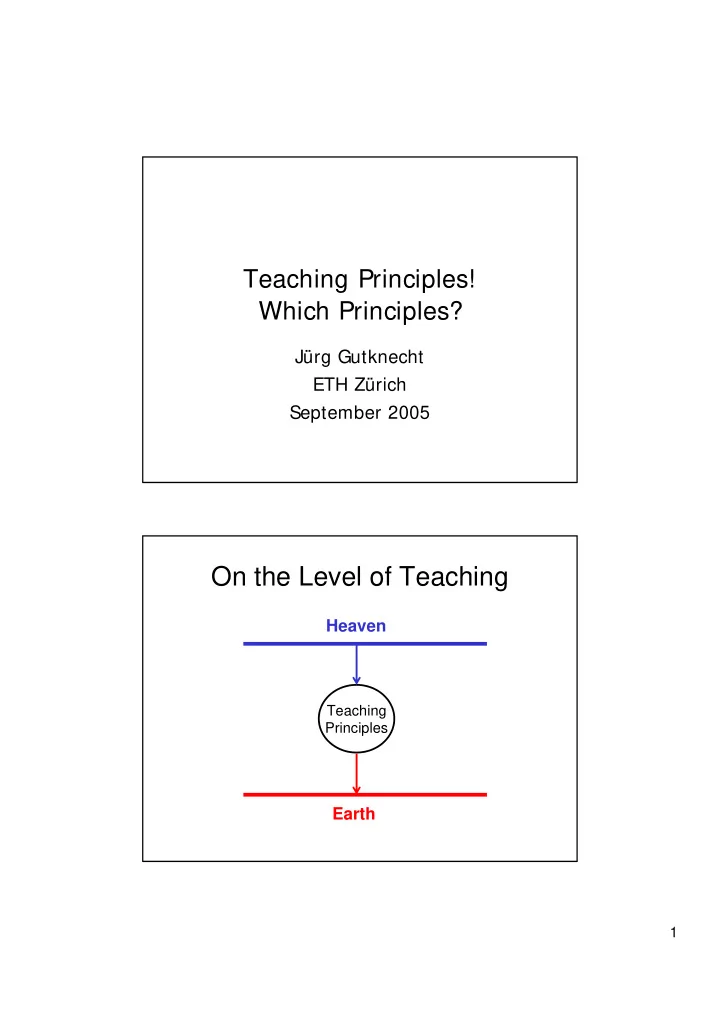
On the Level of Teaching Heaven Teaching Principles Earth 1 - - PDF document
Teaching Principles! Which Principles? Jrg Gutknecht ETH Zrich September 2005 On the Level of Teaching Heaven Teaching Principles Earth 1 Four Principles Stepwise refinement Information hiding Software composition
2
Four Principles
- Stepwise refinement
- Information hiding
- Software composition
- Programming model
Four Principles
- Stepwise refinement
- Information hiding
- Software composition
- Programming model
3
“With a new computer language,
- ne not only learns a new
vocabulary and grammar but one
- pens oneself to an new world of
thought”
Niklaus Wirth
The Pascal Language Family
- Guiding Principle: „Make it as simple as possible
but not simpler“
- The Zonnon project has emerged from
MS Project 7/7+ initiative http://zonnon.ethz.ch
Activity Type Extension Module Pointer
New Feature
Concurrency OOP Systems A&D
Concept
Oberon
1990
Zonnon
2005
Modula
1980
Pascal
1970 Language
4
Spectrum of Programming
- Algorithms &
Data Structures
- Operating Systems
- Embedded Systems
- Simulations
- GUIs
- Interactive Systems
P M O Z
- Active Systems
- Distributed Systems
Traditional OOP Large Scale Small Scale Zonnon
A Simple A&D Zonnon Program
- module Zeller;
procedure { public } getWeekDay; var d, m, y, c, n: integer; wd: array 7 of string; begin readln(d, m, y); c := y div 100; y := y mod 100; m := m – 2; n := entier(2.62*m – 0.2) + d + y + y div 4 + c div 4 – 2*c writeln(wd[n mod 7]) end getWeekDay; begin wd[0] := "Sunday"; wd[1] := "Monday"; wd[2] := "Tuesday"; wd[3] := "Wednesday"; wd[4] := "Thursday"; wd[5] := "Friday"; wd[6] := "Saturday" end Zeller.
no classes, no objects, no inheritance, no virtual methods, no overriding, no static fields
5
The Challenge of Concurrency
- Moore's Law
Double performance each 1.5 years
- Achieved via
Until now: # FLOPS
- 10 MHz 100 MHz 1 GHz 3.2 GHz
- Power, Heat ⇒ Stop at ≈ 3.5 GHz
From now: Multi CPU cores
- 1 CPU 2 CPU 8 CPU
- Challenge of exploiting multiple CPU
Support needed from programming language
The Zonnon Programming Model: A Structured Approach to Concurrency
6
Procedural Paradigm
- Directed at single CPU configurations
- The same paradigm used in different
cases
Local procedure call Method call Remote procedure call
Working
tCPU
Working Idle Working
Caller Callee
New Concept: Activities
- Procedure call as dialog
- Activities as generalized procedures
tCPU1
Caller Callee
Send parameters Receive parameters Receive result Send result Wait Wait
tCPU1
Caller Callee
Send message Receive message Send message Receive message
tCPU2 tCPU2
7
Scenario 1: Independent Actions
- activity A ( … );
var … begin … end A;
- activity B ( … );
var … begin … end B;
- begin { barrier }
new A(…); new B(…) end
Example 1: Quicksort
- activity Sort (l, h: integer)
var i, j: integer; begin { barrier } … (*partition array l, j & i, h*) if l < j then new Sort(l, j) end; if i < h then new Sort(i, h) end end Sort;
- (*start Quicksort*)
begin new Sort(1, N) end
8
Example 2: Active Objects
- type X = object
activity A (…); … (*intrinsic behavior*) end A; activity B (…); … (*intrinsic behavior*) end B; procedure new (…); … (*constructor*) end new; begin { barrier } new A(…); new B(…) end X;
Passive vs. Active
put item get item set time get time
9
Scenario 2: Object Dialogs
- type Y = object (*callee*)
activity D (…): …; var t, u: T; begin (*dialog*) … return t; … u := *; … end end Y;
- var y: Y; d: Y.D; t, u: T;
begin (*caller*) y := new Y; d := new y.D; (*active link*) t := d(…); … d(u); … end
Example 1: World of Monkeys
10
The Rope as Shared Resource
- module { shared } Rope; (*global view*)
type Monkey = object; (*active*) MonkeyMsg = (claim, release); var cur, i: integer; (*number of monkeys on rope > 0 South-North traversal < 0 North-South traversal*) activity MonkeyDialog (): MonkeyMsg; begin for i := 0 to 99 do new Monkey () end end Rope;
Monkeys as Active Objects
- type Monkey = object
activity LiveOnTheRocks (); var res: MonkeyMsg; d: Rope.MonkeyDialog; begin (*story of life*) d := new Rope.MonkeyDialog; loop passivate(Random.Next()); (*eat/dr*) res := d(MonkeyMsg.claim); end end LiveOnTheRocks; begin { barrier } new LiveOnTheRocks() end Monkey;
11
- activity MonkeyDialog (): MonkeyMsg;
var req: MonkeyMsg; begin loop req := *; (*South-North request*) await (0 <= cur) & (cur < m); inc(cur); passivate(100); dec(cur); return MonkeyMsg.release; req := *; (*North-South request*) await (0 >= cur) & (cur > -m); dec(cur); passivate(100); inc(cur); return MonkeyMsg.release end end MonkeyDialog;
The Monkey Dialog Activity Example 2: Next Meeting Time
Coord Manager Manager Manager
proposal T next avail t
12
- module { shared } Coordinator;
type Manager = object; (*active*) var T, i: integer; activity ManagerDialog (); var next: integer; begin loop return T; t := *; if t > T then T := t end; await T > t; end end ManagerDialog; begin T := 0; for i := 0 to 9 do new Manager() end end Coordinator.
The Coordinator Managers as Active Objects
- type Manager = object
activity Check (); var t: integer; d: Coordinator.ManagerDialog; begin d := new Coordinator.ManagerDialog; loop t := d(); (*check agenda and update t*) d(t) end end begin new Check() end Manager;
13
Example 3: Frisbee Fun
Player Player Player
Frisbee Frisbee
dialog behavior
Starting the Game
- module Game;
type Player = object; (*active*) var i: integer; p, q, last: Player; begin last := new Player(); q := last; for i := 0 to 9 do p := new Player (); p.Init(q, Random.Next() mod 2); q := p end; last.Init(q, 0) end Game.
14
Player as Dual Activity Object
- type Player = object { shared }
FrisbeeMsg = (request, catch); var nofFrisbees: integer; d: Player.FrisbeeDialog; procedure Init (q: Player; f: integer); begin d = new q.FrisbeeDialog; nofFrisbees = f; end Init; activity Play (); activity FrisbeeDialog (): FrisbeeMsg; begin { barrier } new Play () end Player;
The Playing Activity
- activity Play ();
var msg: FrisbeeMsg; begin d := new Player.FrisbeeDialog; loop await nofFrisbees # 0; msg := d(); d(FrisbeeMsg.catch); nofFrisbees := 0 end end Play;
15
The Frisbee Dialog Activity
- activity FrisbeeDialog ();
var msg: FrisbeeMsg; begin loop await nofFrisbees = 0; return FrisbeeMsg.request; msg := *; nofFrisbees := 1 end end FrisbeeDialog;
Example 4: Santa Claus
- Invented by John
Trono in „J. A. Trono. A new exercise in
- concurrency. SIGCSE
Bulletin, 1994“
- Discussed and solved
later by Ben-Ari with Rendez-Vous (in Ada95) and monitors (in Java)
16
The Original Story
- Santa Claus sleeps at the North pole until awakened by
either all of the nine reindeer, or by a group of three out
- f ten elves. He performs one of two indivisible actions:
If awakened by the group of reindeer, Santa
harnesses them to a sleigh, delivers toys, and finally unharnesses the reindeer who then go on vacation.
If awakened by a group of elves, Santa shows them
into his office, consults with them on toy R&D, and finally shows them out so they can return to work constructing toys.
- A waiting group of reindeer must be served by Santa
before a waiting group of elves. Since Santa's time is extremely valuable, marshalling the reindeer or elves into a group must not be done by Santa.
Our Extension: Negotiation
- Before joining, elves should be informed about
the expected waiting time and be given the
- pportunity to withdraw
- Dialog as formal syntax in EBNF
Messages from callee to caller marked " ↓ "
HandleElf = join ( Negotiate | ↓ reject ). Negotiate = [ ↓ wait join ] ↓ done |
↓ wait done.
17
The Model
Management Reindeer Santa Elf
↓ done ↓ done
join
↓ wait ↓ reject ↓ done
deliver consult join done
„Active link“ (stateful)
Management as Active Server
- module { shared } Management;
type ElfMsg = (join, reject, delay, done); ReindeerMsg = (join, done); SantaMsg = (deliver, consult, done); Elf = object; (*active*) Reindeer = object; (*active*) Santa = object; var r0, r, R, e0, e, E: integer; santa: Santa; activity Work (); activity ElfDialog (): ElfMsg; activity ReindeerDialog (): ReindeerMsg; begin { barrier } new Work () end Management.
18
Manager as Active Server
- activity Work ();
var res: SantaMsg; d: Santa.Dialog; begin d := new santa.Dialog; loop await (r > r0) & (e > e0); if r > r0 then res := d(SantaMsg.deliver); inc(r0) else res := d(SantaMsg.consult); inc(e0) end end end Work;
The Elf Handling Activity
- activity ElfDialog ();
var myGroup: integer; req: ElfMsg; begin loop req := *; if (*too soon*) then return ElfMsg.reject else if e0 < e then return ElfMsg.wait; req := * end; if req = ElfMsg.join then myGroup = e; inc(E); if E = 3 then E := 0; inc(e) end; await e0 > myGroup; return ElfMsg.done end end end end ElfDialog;
19
Elves as Active Objects
- type Elf = object
activity Work (); var res: ElfMsg; d: Manager.ElfDialog; begin d := new Manager.ElfDialog; loop passivate(Random.Next()); res := d(ElfMsg.join); if res = ElfMsg.wait then if (*impatient*) then d(ElfMsg.done) else res := d(ElfMsg.join) end end end end Work; begin { barrier } new Work() end Elf;
Santa Dialog Controlled
- type Santa = object
activity Dialog (): SantaMsg; var req: SantaMsg; begin loop req := *; if req = SantaMsg.deliver then passivate(10000) else (*consult*) passivate(500) end; return SantaMsg.done end end Dialog; end Santa.
20
Summary (1)
- The presented concept of activity
upgrades the ordinary object-oriented model in three respects by adding
An option of orchestrating multiple
concurrent activities according to programmed „launch logic“
Optional intrinsic encapsulated behavior of
- bjects
A new way of dialog-oriented and stateful
interoperability based on „active links“
Summary (2)
- The concept of activity has proved its