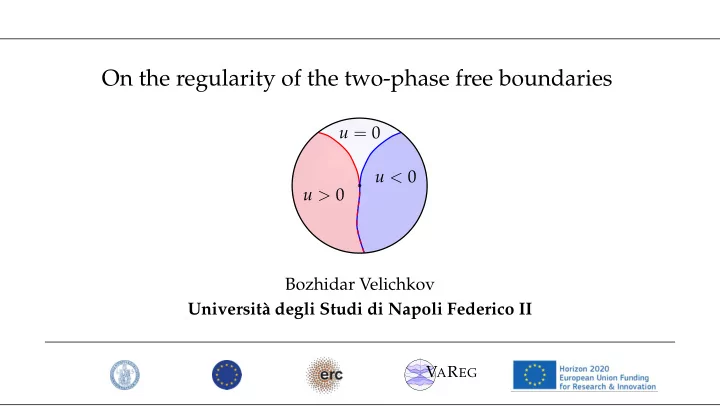
On the regularity of the two-phase free boundaries u = 0 u < 0 u - - PowerPoint PPT Presentation

on the regularity of the two phase free boundaries
SMART_READER_LITE
LIVE PREVIEW

On the regularity of the two-phase free boundaries u = 0 u < 0 u - - PowerPoint PPT Presentation

On the regularity of the two-phase free boundaries u = 0 u < 0 u > 0 Bozhidar Velichkov Universit degli Studi di Napoli Federico II V A R EG T HE TWO - PHASE B ERNOULLI PROBLEM Given: g = 0 a domain D R d (we assume D = B 1 ), g


slide-1
SLIDE 1

On the regularity of the two-phase free boundaries

u > 0 u < 0 u = 0 Bozhidar Velichkov Università degli Studi di Napoli Federico II

VAREG

slide-2
SLIDE 2

THE TWO-PHASE BERNOULLI PROBLEM Given: − a domain D ⊆ Rd (we assume D = B1), − positive constants λ+, λ− , and λ0, − a boundary datum g : ∂D → R, minimize the TWO-PHASE functional JTP(u, D) =

  • D

|∇u|2 dx + λ2

+

  • {u > 0} ∩ D
  • +λ2

  • {u < 0} ∩ D
  • u

< u > u = g = 0 g = 0 g > 0 g < λ+ λ− λ0 +λ2

  • {u = 0} ∩ D
  • ,

among all functions u : D → R such that u = g on ∂D.

slide-3
SLIDE 3

THE TWO-PHASE BERNOULLI PROBLEM First considerations:

  • 1. The solutions u are harmonic in the set {u = 0}.
  • 2. Is there an equation for u in the entire D = B1?

< ∆u, ϕ >:=

  • D

∇u · ∇ϕ =

  • {u=0}

ϕ ∆u+

  • ∂{u=0}

∂u ∂nϕ =

  • ∂{u=0}

∂u ∂nϕ Then u < u > u = g = 0 g = 0 g > 0 g < ∆ u = ∆ u = ∆u = |∇u+|

  • Hd−1

∂{u > 0}

  • − |∇u−|
  • Hd−1

∂{u < 0}

  • in

D Solution u ⇆ Free boundary ∂{u > 0} ∪ ∂{u < 0}

slide-4
SLIDE 4

REGULARITY OF THE MINIMIZING FUNCTION u 1981 Alt-Caffarelli (J. Reine Agnew. Math.) − u ∈ C0,1

loc (D) − for u ≥ 0,

1984 Alt-Caffarelli-Friedman (Trans. Amer. Math. Soc.) − u ∈ C0,1

loc (D) − for any u.

The Lipschitz continuity of u is optimal. In fact, for every λ+ > λ0 = 0 and e ∈ ∂B1, the function h(x) =

  • λ2

+ − λ2

1/

2 max{0, x · e}

is a local minimizer in Rd. −e h = 0 ∆h = 0 |rh| = q λ2

+ − λ2

Corollary: • Ω+

u = {u > 0}

and Ω−

u = {u < 0}

are open sets ;

  • ∆u = 0 in Ω+

u

and ∆u = 0 in Ω−

u .

Question: What is the regularity of the free boundary ∂Ω+

u ∪∂Ω− u ∩D ?

slide-5
SLIDE 5

On the regularity of the two-phase free boundaries PART I Known results, main theorem, and applications

u > 0 u < 0 u = 0

slide-6
SLIDE 6

STRUCTURE OF THE TWO-PHASE FREE BOUNDARIES Suppose that dist

  • {g > 0}, {g < 0}
  • > 0 on the sphere.

...and consider the following three cases. u > 0 u < 0 u = 0 u > 0 u < 0 u = 0 u = 0

branching point

u > 0 u < 0 ∆u = 0 ∆u = 0 λ+ > > λ0 and λ− > > λ0 λ+ > λ0 and λ− > λ0 λ+ ≥ λ0 and λ− = λ0

slide-7
SLIDE 7

STRUCTURE OF THE TWO-PHASE FREE BOUNDARIES Suppose that dist

  • {g > 0}, {g < 0}
  • > 0 on the sphere.

...and consider the following three cases. u > 0 u < 0 u = 0 u > 0 u < 0 u = 0 u = 0

branching point

u > 0 u < 0 ∆u = 0 ∆u = 0 λ+ > > λ0 and λ− > > λ0 λ+ > λ0 and λ− > λ0 λ+ ≥ λ0 and λ− = λ0 λ+ > > λ0 and λ− > > λ0

slide-8
SLIDE 8

REGULARITY OF THE ONE-PHASE FREE BOUNDARIES Recall that dist

  • {g > 0}, {g < 0}
  • > 0 on the sphere.

Suppose that λ+ > > λ0 and λ− > > λ0. u > 0 u < 0 u = 0 g = 0 g = 0 g > 0 g < 0 JTP(u, B1) =

  • B1

|∇u|2 dx +λ2

+

  • {u > 0} ∩ B1
  • +λ2

  • {u < 0} ∩ B1
  • +λ2
  • {u = 0} ∩ B1
  • u > 0

u < 0 u = 0 g = 0 g = 0 g > 0 g < 0 B0 In the small ball B′ the positive part u+ minimizes the one-phase functional JOP(u, B1) =

  • B1

|∇u|2 dx +

  • λ2

+ −λ2

{u > 0}∩B1

slide-9
SLIDE 9

REGULARITY OF THE ONE-PHASE FREE BOUNDARIES u > 0 ∂B0 u = 0 the graph of u over B0 the graph of u over ∂B0 ∂Ωu \ B0 Definition: We say that u is a local minimizer of JOP in B′ if JOP(u, B′) ≤ JOP(v, B′) for every v : B′ → R such that u = v on ∂B′. Theorem (Alt-Caffarelli’81, Weiss’00). There is d∗ ∈ {5, 6, 7} such that: If u is a (nonnegative) local minimizer of JOP in B′ ⊆ Rd, then the free boundary decomposes as: ∂Ω+

u ∩ B′ = Reg (∂Ω+ u ) ∪ Sing (∂Ω+ u )

  • Reg (∂Ω+

u ) is a C1,α-regular manifold;

  • Sing (∂Ω+

u ) is empty (d < d∗), discrete (d = d∗), of dimension d − d∗ (d > d∗).

slide-10
SLIDE 10

STRUCTURE OF THE TWO-PHASE FREE BOUNDARIES Suppose that dist

  • {g > 0}, {g < 0}
  • > 0 on the sphere.

...and consider the following three cases. u > 0 u < 0 u = 0 u > 0 u < 0 u = 0 u = 0

branching point

u > 0 u < 0 ∆u = 0 ∆u = 0 λ+ > > λ0 and λ− > > λ0 λ+ > λ0 and λ− > λ0 λ+ ≥ λ0 and λ− = λ0

slide-11
SLIDE 11

REGULARITY OF THE TWO-PHASE FREE BOUNDARIES − THE EXTREMAL CASE u > 0 u < 0 ∆u = 0 ∆u = 0 |ru+|2 − |ru−|2 = λ2

+ − λ2 −

Theorem (Alt-Caffarelli-Friedman’84). Let d = 2 , λ+ ≥ λ0 and λ− = λ0. If u minimizes JTP in B1, then:

  • ∂Ω+

u = ∂Ω− u ;

  • ∂Ω+

u is C1,α-regular curve ;

  • |∇u+|2−|∇u−|2 = λ2

+−λ2 −

  • n

∂Ω+

u ∩B1.

Regularity of free boundaries satisfying a transmission condition: 1987 - 1989 Caffarelli (Comm. Pure Appl. Math.,...) − Harnack inequality approach; 2005 Caffarelli-Salsa − A geometric approach to free boundary problems (book); 2014-2018 De Silva-Ferrari-Salsa − Partial Boundary Harnack approach (2010 De Silva − Partial Boundary Harnack for the one-phase pb).

slide-12
SLIDE 12

STRUCTURE OF THE TWO-PHASE FREE BOUNDARIES Suppose that dist

  • {g > 0}, {g < 0}
  • > 0 on the sphere.

...and consider the following three cases. u > 0 u < 0 u = 0 u > 0 u < 0 u = 0 u = 0

branching point

u > 0 u < 0 ∆u = 0 ∆u = 0 λ+ > > λ0 and λ− > > λ0 λ+ > λ0 and λ− > λ0 λ+ ≥ λ0 and λ− = λ0

slide-13
SLIDE 13

REGULARITY OF THE TWO-PHASE FREE BOUNDARIES − THE MAIN RESULT

u > 0 u < 0 u = 0 u = 0

branching point

Decomposition of the free boundary:

  • one-phase points:

Γ+

OP = ∂Ω+

u \ ∂Ω− u

and Γ−

OP = ∂Ω−

u \ ∂Ω+ u

  • two-phase points: ΓTP = ∂Ω+

u ∩ ∂Ω− u

Assume λ+ > λ0 and λ− > λ0. W.l.o.g. λ0 = 0.

  • Theorem. Let d ≥ 2. Let u be a minimizer of JTP with λ0 = 0, λ+ > 0 and λ− > 0.

Then, in a neighborhood of any x0 ∈ ∂Ω+

u ∩ ∂Ω− u ∩ D,

the free boundaries ∂Ω+

u and ∂Ω− u are C1,α-regular manifolds.

2017 Spolaor-Velichkov (Comm. Pure Appl. Math.) − the case d = 2 ; 2018 Spolaor-Trey-Velichkov (Comm. PDE) − almost-minimizers in R2 ; 2019 De Philippis-Spolaor-Velichkov (to appear) − any d ≥ 2.

slide-14
SLIDE 14

REGULARITY OF THE TWO-PHASE FREE BOUNDARIES - THE COMPLETE RESULT Corollary (Alt-Caffarelli; Weiss; Spolaor-Trey-V.; De Philippis-Spolaor-V.). Let d ≥ 2 and D ⊆ Rd be an open set. Let u be a local minimizer of JTP in D with λ0 = 0, λ+ > 0 and λ− > 0. Then, for each of the sets Ω+

u and Ω− u , the free boundary ∂Ω± u ∩ D

can be decomposed as ∂Ω±

u ∩ D = Reg (∂Ω± u ) ∪ Sing (∂Ω± u ), where:

  • the regular part Reg (∂Ω±

u ) is a C1,α manifold;

  • Sing (∂Ω±

u ) is a (possibly empty) closed set of one-phase singularities, and

− Sing (∂Ω±

u ) is empty, if d < d∗;

− Sing (∂Ω±

u ) is discrete, if d = d∗;

− Sing (∂Ω±

u ) has Hausdorff dimension d − d∗, if d > d∗;

− Sing (∂Ω±

u ) ∩ ∂Ω+ u ∩ ∂Ω− u = ∅.

slide-15
SLIDE 15

APPLICATION: A MULTIPHASE SHAPE OPTIMIZATION PROBLEM Minimize

n

  • k=1
  • λ1(Ωk) + mk|Ωk|
  • among

all n-uples of sets (Ω1, . . . , Ωn) such that:

  • Ωk ⊆ D, where D is a C1,α-regular box;
  • Ωk ∩ Ωj = ∅, whenever k = j.

*Numerical simulations by Beniamin Bogosel (http://www.cmap.polytechnique.fr/ beniamin.bogosel/)

  • Theorem. Let d = 2. Let (Ω1,..., Ωn) be a solution of the multiphase problem in a

C1,α-regular box D. Then each of the sets Ωk is C1,α-regular. 2015 Bogosel-Velichkov (SIAM Numer. Anal.) 2019 Spolaor-Trey-Velichkov (Comm. PDE)

slide-16
SLIDE 16

A MULTIPHASE SHAPE OPTIMIZATION PROBLEM - REGULARITY IN Rd Theorem (regularity in higher dimension - part I). Let d ≥ 2. Let (Ω1,..., Ωn) be a solution of the multiphase problem in the C1,α-regular box D ⊆ Rd. Then:

  • each of the sets Ωk is open and has finite perimeter

2014 Bucur-Velichkov (SIAM Contr. Optim.) ;

  • there are no triple points: ∂Ωi ∩ ∂Ωj ∩ ∂Ωk = ∅

2014 Bucur-Velichkov, 2014 Velichkov − three-phase monotonicity formula, 2015 Bogosel-Velichkov (SIAM Numer. Anal.) - new proof in 2D;

  • there are no two-phase points on the boundary of the box: ∂Ωi ∩∂Ωj ∩∂D = ∅

2015 Bogosel-Velichkov;

slide-17
SLIDE 17

A MULTIPHASE SHAPE OPTIMIZATION PROBLEM - REGULARITY IN Rd Theorem (regularity in higher dimension - part I). Let d ≥ 2. Let (Ω1,..., Ωn) be a solution of the multiphase problem in the C1,α-regular box D ⊆ Rd. Then:

  • each of the sets Ωk is open and has finite perimeter

2014 Bucur-Velichkov (SIAM Contr. Optim.) ;

  • there are no triple points: ∂Ωi ∩ ∂Ωj ∩ ∂Ωk = ∅

2014 Bucur-Velichkov, 2014 Velichkov − three-phase monotonicity formula, 2015 Bogosel-Velichkov (SIAM Numer. Anal.) - new proof in 2D;

  • there are no two-phase points on the boundary of the box: ∂Ωi ∩∂Ωj ∩∂D = ∅

2015 Bogosel-Velichkov; Theorem (regularity in higher dimension - part II).

  • the one-phase parts of the free boundaries ∂Ωk are as regular as the solutions
  • f the one-phase (Alt-Caffarelli) problem:

2009 Briançon-Lamboley (Ann. IHP) − 1981 Alt-Caffarelli (Crelle). Regularity of the sets Ω that minimize λ1(Ω) with measure constraint |Ω| = c.

  • in a neighbourhood of ∂D ∩ ∂Ωk the free boundary ∂Ωk is a C1,α-manifold:

2019 Russ-Trey-Velichkov − 2018 Chang Lara-Savin; Regularity for minimizers of λ1(Ω) under the constraints |Ω| = c and Ω ⊆ D.

  • in a neighbourhood of ∂Ωj ∩ ∂Ωk the free boundary ∂Ωk is a C1,α-manifold:

‘ 2019 De Philippis-Spolaor-Velichkov.

slide-18
SLIDE 18

A MULTIPHASE SHAPE OPTIMIZATION PROBLEM - THE COMPLETE RESULT Minimize

n

  • k=1
  • λ1(Ωk) + mk|Ωk|
  • among

all n-uples of sets (Ω1, . . . , Ωn) such that:

  • Ωk ⊆ D, where D is a C1,α-regular box;
  • Ωk ∩ Ωj = ∅, whenever k = j.
  • Theorem. Let d ≥ 2. Let (Ω1,..., Ωn) be a solution of the multiphase problem

in a C1,α-regular box D. Then, for each of the sets Ωk, the free boundary can be decomposed as ∂Ωk = Reg (∂Ωk) ∪ Sing (∂Ωk), where: Reg (∂Ωk) is a C1,α manifold,

  • Sing (∂Ωk) is a closed set of one-phase singularities, such that:

− Sing (∂Ωk) is empty, if d < d∗, and discrete, if d = d∗; − Sing (∂Ωk) has Hausdorff dimension d − d∗, if d > d∗; − Sing (∂Ωk) lies on a positive distance from ∂D and ∂Ωj, for j = k.

slide-19
SLIDE 19

On the regularity of the two-phase free boundaries PART II About the proof,

  • f the main theorem

u > 0 u < 0 u = 0

slide-20
SLIDE 20

THE MAIN THEOREM

  • Theorem. Let d ≥ 2. Let u : B1 → R be a local minimizer (in B1) of the functional

JTP(u, B1) =

  • B1

|∇u|2 dx + λ2

+

  • {u > 0} ∩ B1
  • + λ2

  • {u < 0} ∩ B1
  • .

with λ+ > 0 and λ− > 0. Then, in a neighborhood of any two-phase point x0 ∈ ∂Ω+

u ∩ ∂Ω− u ∩ D,

the free boundaries ∂Ω+

u and ∂Ω− u are C1,α-regular manifolds.

the free boundaries ∂Ω+

u and ∂Ω− u are C1,α-regular manifolds.

2017 Spolaor-Velichkov (Comm. Pure Appl. Math.) − the case d = 2 ; 2018 Spolaor-Trey-Velichkov (Comm. PDE) − almost-minimizers in R2 ; 2019 De Philippis-Spolaor-Velichkov (to appear) − any d ≥ 2.

slide-21
SLIDE 21

OPTIMALITY CONDITION Heuristics. u > 0 u < 0 ∆u = 0 ∆u = 0 u = 0 |ru+| = λ+ |ru−| = λ− |ru+|2 − |ru−|2 = λ2

+ − λ2 −

|ru+| ≥ λ+ |ru−| ≥ λ− Γ+

  • p

Γ−

  • p

Γtp Decomposition of u and JTP. JTP(u, B1) = Jλ+

OP (u+) + Jλ− OP (u−),

where Jλ

OP(ϕ) =

  • B1

|∇ϕ|2 dx + λ2 {ϕ > 0} ∩ B1

  • .
slide-22
SLIDE 22

OPTIMALITY CONDITION 2. SHAPE DERIVATIVE Heuristics. u > 0 u < 0 ∆u = 0 ∆u = 0 u = 0 |ru+| = λ+ |ru−| = λ− |ru+|2 − |ru−|2 = λ2

+ − λ2 −

|ru+| ≥ λ+ |ru−| ≥ λ− Γ+

  • p

Γ−

  • p

Γtp Variation of JOP. Let ξ be a smooth vector field. Then δ Jλ+

OP (u+)[ξ] = d

dt

  • t=0 Jλ+

OP

  • u+
  • x−tξ(x)
  • =
  • ∂{u>0}
  • −|∇u+|2 +λ2

+

  • (ξ ·n).
slide-23
SLIDE 23

OPTIMALITY CONDITION 3. BLOW-UP Let x0 ∈ ∂Ω+

u ∩ ∂Ω+ u ∩ B1. Let rn → 0.

Let ux0,rn(x) := 1

rn u(x0 + rnx).

u > 0 x0 u < 0 ∆u = 0 ∆u = 0 u = 0 ux0,rn > 0 ux0,rn < 0 ux0,rn = 0 B1 rn → 0 α(x · e)+ −β(x · e)− B1 ux0,rn converges uniformly to α(x · e)+ − β(x · e)−

  • α2 − β2 = λ2

+ − λ2 −

α ≥ λ+ and β ≥ λ−

slide-24
SLIDE 24

REGULARITY OF THE FREE BOUNDARY ∂Ω+

u

Startegy of the proof (in any dimension). Show that:

(a) Differentiability. ∇u+ exists at every x0 ∈ ∂Ω+

u ∩ ∂Ω+ u .

(b) OP-TP transition. |∇u+| is Hölder continuous on ∂Ω+

u .

(c) Flatness. u+ is flat around every x0 = 0 ∈ ∂Ω+

u ∩ ∂Ω+ u :

u > 0 x0 ∆u = 0 u = 0 |ru+| 2 C0,α

α(x · e − εr)+ ≤ u+(x) ≤ α(x · e + εr)+ in Br. for some e ∈ ∂B1, r > 0 and ε > 0. Apply the following Theorem (De Silva. Interf. Free Bound. 2010). If (a) , (b) and (c) do hold, then ∂Ω+

u is C1,α regular in Br/

2.

slide-25
SLIDE 25

REMARK: Differentiability ⇔ UNIQUENESS OF THE BLOW-UP LIMIT Let x0 ∈ ∂Ω+

u ∩ ∂Ω+ u ∩ B1. Let rn → 0.

Let ux0,rn(x) := 1

r u(x0 + rnx).

u > 0 x0 u < 0 ∆u = 0 ∆u = 0 u = 0 ux0,rn > 0 ux0,rn < 0 ux0,rn = 0 B1 rn → 0 α(x · e)+ −β(x · e)− B1 ux0,rn converges uniformly to α(x · e)+ − β(x · e)−

  • α2 − β2 = λ2

+ − λ2 −

α ≥ λ+ and β ≥ λ−

slide-26
SLIDE 26

STEP 1. Differentiability

  • Remark. The blow-up limit (a priori) depends
  • n the blow-up sequence.

This happens at the tip of a spiral: Spirals => no differentiability! We have to exclude this spiraling behavior!

u > 0 u < 0 u = 0 u > 0 u < 0 ur > 0 ur < 0

Br

Lemma (Improvement of flatness). If u − Hα,eL∞(B1) ≤ ε0, then ur − Hα′,e′L∞ ≤ (1 − δ)u − Hα,eL∞ where |e−e′| and |α−α′| are small.

slide-27
SLIDE 27

IMPROVEMENT OF FLATNESS ⇒ Differentiability

u > 0 u < 0 ur > 0 ur < 0

Br

Lemma (Improvement of flatness). If u − Hα,eL∞(B1) ≤ ε0, then ur − Hα′,e′L∞ ≤ (1 − δ)u − Hα,eL∞ where |e−e′| and |α−α′| are small. Corollary 1 (Uniqueness of the blow-up limit). If u − Hα,eL∞(B1) ≤ ε0, then there are constants γ > 0 and C > 0 such that ur − Hα,eL∞(B1) ≤ Crγ for every r ∈ (0, 1). Corollary 2 (Differentiability). Fixed x0 ∈ ∂Ω+

u ∩ ∂Ω− u ,

u+(x) = α e · (x − x0) + C|x − x0|1+γ for every x ∈ Ω+

u .

slide-28
SLIDE 28

STEP 2. HÖLDER CONTINUITY OF THE GRADIENT ON ∂Ω+

u ∩ ∂Ω− u .

Take any x0 ∈ ∂Ω+

u ∩ ∂Ω− u

and y0 ∈ ∂Ω+

u ∩ ∂Ω− u .

Then ur,x0 − Hα,e ≤ Crγ and ur,y0 − Hα′,e′ ≤ Crγ for all r > 0.

  • ∇u+(x0) − ∇u+(y0)
  • =
  • α e − α′ e′
  • Hα,e − Hα′,e′

≤ ur,x0 − Hα,e + ur,y0 − Hα′,e′ + ur,x0 − ur,y0 ≤ Crγ + Crγ + Lip(u) |x0−y0|

r

. Choose r such that |x0 − y0| = r1+γ. Then

  • ∇u+(x0) − ∇u+(y0)
  • |x0 − y0|

γ 1+γ .

· = ·L∞(B1)

slide-29
SLIDE 29

STEP 3. HÖLDER CONTINUITY OF THE GRADIENT ON ∂Ω+

u

  • |∇u| = λ+ on the one-phase free boundary ∂Ω+

u \ ∂Ω− u ;

  • |∇u| is Hölder continuous on the two-phase free boundary ∂Ω+

u ∩ ∂Ω− u .

u > 0 u < 0 ∆u = 0 ∆u = 0 u = 0 u > 0 u < 0 u = 0 Γ

TP

BRANCHING POINT

u > 0 u < 0 Γ

TP

BRANCHING POINTS

BRANCHING POINT: x0 ∈ ∂Ω+

u ∩ ∂Ω− u such that

  • Br(x0) ∩ {u = 0}
  • > 0

for every r > 0.

slide-30
SLIDE 30

STEP 3. HÖLDER CONTINUITY OF THE GRADIENT ON ∂Ω+

u

Let xn be a sequence of one-phase points converging to the branching point 0 ∈ ∂Ω+

u ∩ ∂Ω− u .

Aim: Prove that |∇u+(0)| = λ+. u > 0 u < 0 xn yn |∇u+(0) − ∇u+(yn)| |yn|γ and so, |α(0) − α(yn)| |yn|γ

  • u(x) − Hα(yn)(x)
  • r1+γ

n

in B4rn(yn), where rn = |xn − yn|. But then

  • u+(x) − H+

λ+(x)

  • = o(rn) in Brn(xn)

and so, α(0) = λ+.