SLIDE 1
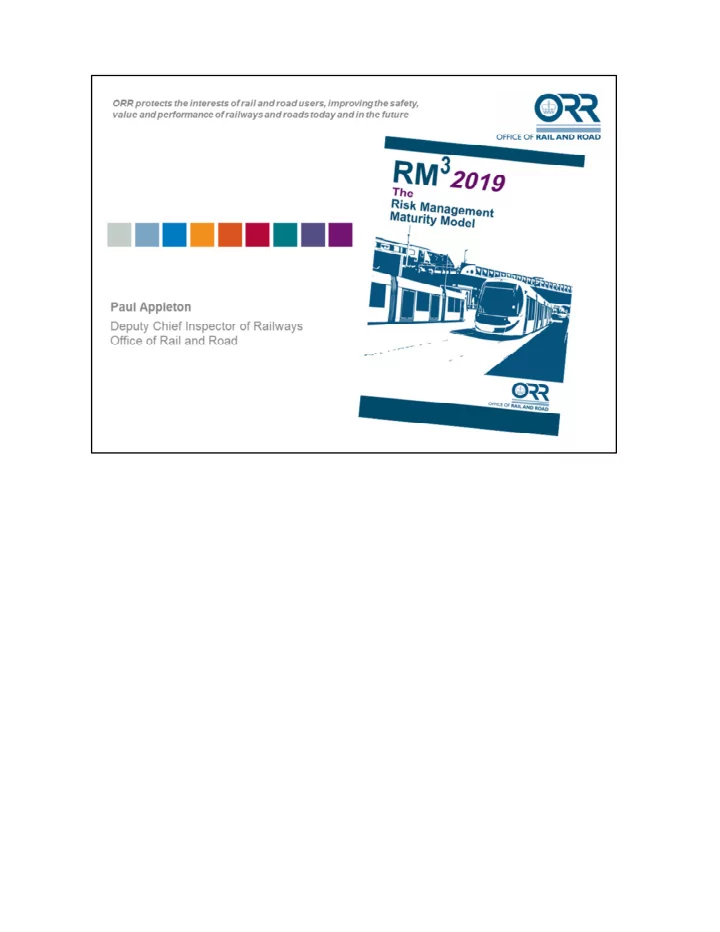
SLIDE 2 One click and the letters move around and expand into words Then continue with RM3 is the Risk Management Maturity Model. ORR developed RM3, in collaboration with the rail industry, as a tool for assessing an
- rganisation’s ability to successfully manage health and safety risks, to help identify areas
for improvement and provide a benchmark for year on year comparison. RM3 sets out criteria for key elements of a health and safety risk management system. It identifies the steps to evaluate a company’s progress through the five levels of maturity, from ad‐ hoc to excellent health and safety management capability. This edition of RM3, written for and with the support of the rail industry, embraces the developments in risk control which have taken place since we first published the model in
- 2011. It reinforces the importance of organisational culture in successful health and safety
management. Click for next slide
SLIDE 3
The image builds automatically on start of slide starting with 25 criteria and then enveloping with organisational culture. The model comprises 5 main themes Yellow – Health & safety policy, leadership and board governance Orange – Organising for control and communication Green – Securing co‐operation and competence Blue – Planning and implementing Purple – Monitoring, audit and review Within each theme, there are criteria, 26 in total. 25 of the criteria constitute good practice in relation to health and safety management systems and defined ‘evidence factors’ are given in each maturity level, for each criteria. As the whole RM3 model is an indicator of organisational culture, the final criterion OC6 is now used to collate the indicators of organisational culture identified in the other 25 criteria. RM3 is based on the original HSG 65 ‘POPMAR’ model, but sits comfortably alongside the ‘plan‐do‐check‐act’ approach in the latest HSG65 model and ISO 45001. Click for next slide
SLIDE 4 We based the maturity descriptors in RM3 on the Capability Maturity Model developed by the US Department of Defense. The Capability Maturity Model was originally developed as a tool for
- bjectively assessing the ability of government contractors' processes to implement a contracted
software project. So the maturity levels with their generic descriptors are: Click to reveal Ad hoc It is characteristic of processes at the adhoc that they are (typically) undocumented and in a state of dynamic change, tending to be driven in an ad‐hoc, uncontrolled and reactive manner by users or
- events. This provides a chaotic or unstable environment for the processes.
Click to reveal Managed At the managed level some processes are repeatable, possibly with consistent results. Process discipline is unlikely to be rigorous, but where it exists it may help to ensure that existing processes are maintained during times of stress. Click to reveal Standardised At the standardised level there are sets of defined and documented standard processes established and subject to some degree of improvement over time. These standard processes are in place (i.e. they are the AS‐IS processes) and used to establish consistency of process performance across the
Click to reveal Predictable At the predictable level, management can effectively control the AS‐IS process , the current state of the
SLIDE 5
business process in an organisation. In particular, management can identify ways to adjust and adapt the process to particular projects, without measurable losses of quality or deviations from specifications. Process capability is established from this level. Click to reveal Excellence With excellence, the the focus is on continually improving process performance through both incremental and innovative technological changes/ improvements. Click for next slide
SLIDE 6 In respect of health and safety, our role is to make sure that the health and safety of everyone associated with the rail industry is controlled. We achieve this by encouraging railway businesses to achieve excellent health and safety management, and ensuring that they identify and assess risks properly, control them effectively, and comply with the law. This will be enabled through the industry achieving excellence in:
- Culture;
- Health, safety and asset management, and;
- Risk control.
Click We believe that organisations should strive for excellent in risk control, through their health and safety management system, because that system will rely on individuals to manage those controls and the performance of those managers varies Click they will have days when they will be on top of their game… …and not so good days, maybe they have been distracted by something going on outside of work. The next graph illustrates what I mean. Click to move to the graph
SLIDE 7
The graph builds up automatiically with y axis indicating risk management maturity and time on the x axis. A horizontal line appears above ad hoc and then the words compliance and non‐compliance appear. Here we have risk control on the y axis against time. RM3 is not a compliance tool, but if the organisations risk control is largely in the Ad hoc region it is more likely that the they will not be complying with health and safety legislation. So we want risk control and managers performance at a much higher level Click….. and a performance line will appear with peaks and troughs This line indicates how a manager’s application of the risk controls (i.e. performance) might vary over time ‐ So even on an off day, the managers dip in performance is less likely to be critical. Click….. and the graph moves down. But see what happens when risk control and manager performance is generally at a lower level. Click to move to next slide
SLIDE 8 Click and the ROGS text will appear in 2 stages The Railways and Other Guided Transport System (Safety) Regulations 2006 – ROGS – looks for the health and safety management system to show how continuous improvement of the system and, therefore, risk control is ensured, through schedule 1. Click and MHSWR text will appear in 3 stages and continuous improvement is implied by the Management Regs,
- through risk assessment
- and their review
- and control using the principles of prevention in schedule 1, which we commonly
refer to as the hierarachy of risk control. So as I said previously, we use RM3 as a tool for assessing an organisation’s ability to successfully manage health and safety risks, but we also use it to determine if the
- rganisations health and safety management system is continuously improving.
Where an organisation has adopted RM3, it demonstrates to us the commitment to continuously its risk control
SLIDE 9
So we want to see excellence in risk control, but what do we believe are the priority areas for risk control? Click to fade into slide on strategic risk chapters
SLIDE 10 The slide reveals the text automatically in 3 stages To help prioritise ours and the industry’s strategic focus we issue chapters, which we update as part of a rolling process. These chapters, and there are now 14, with the recent publication of the tramways chapter, are focused on the key risks from across the sector and based on
- incident data,
- risk trend analysis
- and the findings from our inspections, investigations and audits.
The strategic risk chapters along with :
- any matters from permissioning work such as safety certificates and authorisations,
ECM
- interoperability work
- RAIB recommendations and
- emerging findings from other incident investigations and activities, domestically and
internationally, within and beyond the rail industry …inform our plan of work and so should be of interest to the organisations we regulate. Click next slide
SLIDE 11
The slide reveals the text automatically in 2 stages
SLIDE 12
The slide reveals the text automatically in two stages Leading Health and Safety on Britain’s Railway was resissued by the Rail Delivery Group in May 2017. Supported by RSSB, this strategy centres on continuous improvement, through leadership and collaboration and identifies 12 priority risk areas. As you can see, these priority areas are consistent with our Strategic Risk Chapters and, throughout, Leading Health and Safety on Britain’s Railway refers to and is consistent with the criteria and philosophy of RM3. And the latest version of RM3, RM3 2019 has embedded the importance of effective collaboration within the evidence factors particularly to achieve the higher levels of maturity. Click to unveil Ian Prosser’s endorsement of LHSBR Ian Prosser, Chief Inspector of Railways has personally, and on behalf or ORR endorsed this first industry health and safety strategy.
SLIDE 13 The graphic and first bullets appear automatically on opening the slide In 2011, we published the first version of RM3 as the Railway Management Maturity Model developed in house by a team of inspectors, with specialist knowledge of assessing safety management systems. It was a simple word document, hard to navigate, but there was enthusiasm for model and adoption by both the TOC community and the TfL organisations, early on. Over the next few years, we undertook extensive training of our inspectors and
- rganisations in the UK and oversees.
Click for 2015 By 2015, our ability to support training was outstripped by demand and we entered into a collaborative arrangement with the Health and Safety Laboratory and the RM3 Governance Board was formed to oversee the arrangement. Click for next slide
SLIDE 14
First bullets appear automatically In 2016, we ran an industry workshop with the aim of sharing experiences and identifying what industry needed to secure wider take‐up of the RM3 approach. And we welcomed additional members to the governance board from TfL, Amey, Network Rail and Cross Country. Click for 2017 A revised edition of RM3 was released, essentially the same evidence factors but in an more accessible format... But it still had many of the issues that frustrated people. Including Evidence factors not matching the maturity levels there were assigned to, evidence not building through the levels, some maturity levels without meaningful evidence. Remember words such as see level 4 below? Organisational culture evidence being very limited and so seldom used. And above all the criticsm that the model seemed to run out of steam towards was still entirely valid…. Nevertheless the new format went down well. Click for 2018 So In 2018, the Governance Board agreed it was time to undertake a full review of RM3 and set out a plan for this work to be completed by April 2019.
SLIDE 15
We were dissappointed that HSL decided to leave the enthusiastic and collaborative Governance Board at this time, but delighted to welcome RSSB, the Rail Safety Standards Board early in 2018 and the Institution of Occupational Safety and Health, the Light Rail Safety Standards Board, Heritage Rail Association and DeutscheBahn, later in the year. Click for next slide
SLIDE 16 No animation on this slide After a series of Governance Board workshops, an invaluable public consultation, And trialling the model in ORR and Governance Board member organisations, we met our target and published RM3 2019, as we are calling this version, on 1st April. Thank you to everyone who took part in the consultation – Nothing was ignored and we plan to respond to you on how we have addressed your issues. In RM3 2019, our aim is that:
- evidence in criteria is relevant and meaningful;
- evidence is mapped to the most appropriate maturity level;
- there is a clear build on lower levels;
- it is clear what needs to be done to continuously improve; and
- that collaboration is key to achieving excellence.
We have gone back to basics with all of the criteria and, systematically, for each maturity level looked at:
- what happens in practice;
- what processes are in place;
- the impact of these processes;
- how standards are applied; and
- the beliefs and behaviours which indicate the organisational culture.
SLIDE 17
- and we tested our findings against the generic maturity descriptors for consistency
We have enhanced the introduction and sections describing how the criteria are developed and how to use them, we believe that this change will make the model more accessibe to those just starting out with RM3. So what does it look like and what has changed? Click for next slide.
SLIDE 18
SLIDE 19 So here is the general layout for a typical criterion Click to highlight colour coding Each of the 5 main themes is colour coded to match the RM3 wheel, with side tabs for easy
- navigation. Each theme and criterion have some introductory text and explanation to guide the
user. In RM3 2019, we have introduced new expected evidence, as well as the evidence from previous editions. Some evidence previously found in higher levels of maturity has dropped down a level and some in lower levels has moved up. This will mean that assessors may find that some maturity determinations made using the revised criteria included in this document are different to assessments made using previous versions. These evidence factors are the colour coded bullets in each maturity level Click to highlight culture call‐outs and there are also organisational culture call out boxes to highlight the typical beliefs and behaviours at each level, greatly increasing the number of evidence factors in the model associated with organisational culture. Click for guidance and further reading We also direct you to any other reference materials relevant to the criterion. Click for next slide
SLIDE 20
No animation on this slide And there is a big change in how Organisational Culture is assessed. RM3 is not intended to be a substitute for other safety culture assessment tools, but in this version we suggest how you might get a picture of the organisational culture from your assessed levels using the 'culture call‐outs’. We propose using the template on the right to collate the culture assessed levels, and more information on how to do this can be found in OC6 in RM3 2019.
SLIDE 21
Click for next slide
SLIDE 22
Animation starts automatically A major milestone in improving health and safety risk management has been the development and publication of BS ISO 45001:2018 ‐ Occupational health and safety management systems. Governance Board members have been involved in the development of this standard and we validated the revised RM3 criteria against it. Many of the requirements of ISO 45001 have been included in RM3 2019, and typically mapped to the standardised maturity levels of critieria. ISO45001 and RM3 2019 sit comfortably together as you would expect for models aligned to a plan‐do‐check‐act approach. Organisations achieving ISO45001 accreditation should reasonably expect to be aligned with at least standardised maturity levels in RM3.
SLIDE 23 Going forward, we recognise that we face challenges ourselves in how we use RM3. Click to remove challenges text and four challenge boxes appear in turn with consistency challenge highlighted We have used RM3 with the TOC community since 2011, FOCs more recently. We have 6 years of assessments for Network Rail, but we are only just starting this year with the light rail and heritage
- sectors. Even within a sector, we are not consistent in how we use RM3.
Click for assessment principles We need to remind ourselves on the assessment principles of consistency, quantity, quality and currency when reviewing evidence against the evidence factors. For example, if evidence on document control for a small depot revealed an ‘ad‐ hoc’ level of achievement, is that sufficient to form an opinion on the document‐control system for thirty other, much larger depots? Click for engagement RM3 is about discussions, identifying what has been done in one area that may improve another and what could be done to increase maturity. We need to make sure that when we come to an assessment view we discuss that with our dutyholders, and explore evidence they have collected before reporting. Aligning programmes of work could help. Click for impact We need to think about the impact of RM3 2019 – what about comparing assessment findings next year against earlier assessments made with the old version of RM3, we know that some levels might change,
- How will we report this in a year on year comparison?
- How will we work with the culture call‐outs?
SLIDE 24
Click for next slide which builds on this one
SLIDE 25 Building on the previous slide All four boxes appear automatically So how will we at ORR go about meeting these challenges? We will introduce an RM3 assessment process in our quality management system. This will require:
- seeking to align our intervention activities with our dutyholders plans
- moderation of the results involving the ORR RM3 team who are independent of the operational
teams,
- Discussing our findings with our dutyholders, considering any wider evidence they may have and how
this affects consistency, quantity, quality and currency derterminations, before making any final recommendations and reporting.
- Consider all sources of evidence, from all our interactions and interventions, including inspection,
investigation, audit and safety certificate and authorisation work. We do not always look beyond our proactive activities. We will also roll‐out refreshing training for all inspectors from October. And on the impact of RM3 2019, we have an opportunity in the workshop later to work together and work on an action plan. Click for next slide
SLIDE 26 For a number of years now we have reported our RM3 determinations in our Annual Health and Safety Report. Last year we stated that ‘The Risk Management Maturity Model (RM3) remains a critical tool for assessing Health and Safety Management System capability. This year saw greater use of the tool in industry, with Network Rail embracing its use.” RM3 assessments provide a picture of the safety management system and the maturity of risk
- control. And so we use‘radar diagrams’ to illustrate our assessments. Now is a good time to say
that RM3 is not about coming up with an overall score, it doesn’t aide the essential discussions.
SLIDE 27
When we report on the TOC sector, our findings are a composite of the assessments made and we do not report on individual dutyholder performance. It seems sensible that we report like this in future annual reports on the RM3 assessments we will start to make this year on other sectors.
SLIDE 28
By comparison here is an RM3 picture for NetworkRail from last years report. The grey shaded area represents the spread of evidence… and the blue line the determination we made looking at the consistency, quantity, quality and currency of that evidence. Click for year on year The second radar diagram is the year on year comparison, which is valuable in identifying trends and continuous improvement. Click to highlight regresssion From this we can see ,in green, that 7criteria are higher in 2017‐18 than the previous year. Click to highlight progression But we can also see, that 3 criteria are lower in the year on year comparison. We need to think about how we will show this year‐on‐year comparison in the 2020 annual report, as RM3 2019 is more stretching it may also draw down some maturity assessments. Click for next slide
SLIDE 29
Final slide before questions So our next steps will be Click for further work by governance board When the Governance board meets in May they will develop the forward programme for RM3. We are committed to developing a training syllabus as there are a number of organisations hoping to deliver training in RM3. To maintain oversight of training delivery, there will be a training sub‐group to the governance board, which these training organisations will need to be part of. Click for workshop info And later of course we have our workshop where we will have time to talk about RM3 and draw up an action plan on collaborating with RM3 to drive forward continuous improvement. Click for any questions and ideas slide.
SLIDE 30
The first bold heading and 3 bullets reveal automatically Read through each in turn as they are important statements. Then add and since publishing the first edition of RM3 in 2011, we have gained considerable experience in using the model to assess the businesses we regulate and holding structured and meaningful discussions to identify strengths and improvements in their health and safety management systems. In producing this new edition, we have worked closely with duty holders to ensure that RM3 has matured and adapted to embrace the developments in risk control over the last eight years since it was launched. Then click and add From the evidence from consultation and trials of this new edition we are confident it will be more accessible to new users but will also push the boundaries of excellence for experienced users.
SLIDE 31
Any questions or thoughts