
SLIDE 1
Only three bedrock samples in the Hawera Patea region Gravelly - - PowerPoint PPT Presentation
Only three bedrock samples in the Hawera Patea region Gravelly sand, particularly coarse over the rolling ground The map shows the variability in the STB seafloor. These variations offer a different habitat for species. E.g.
The map shows the variability in the STB seafloor. These variations offer a different habitat for species. E.g. gravel and shell ‘encourages’ diversity – whereas mudstone less so. Only three ‘bedrock’ samples in the Hawera Patea region Gravelly sand, particularly coarse over the rolling ground
A map showing the area which will receive the highest levels of sediment from the plume, when mining is at point A. Note the importance of shell hash to the area. It is important to note the Project site will not have this shell hash layer. Note the importance of shell hash to the region that falls under most exposure to the sediment plume from mining at site A. The replaced sand at the project site will not have this shell hash cover, the shell will be all mixed up. Benthic Joint Witness Statement mentions sediment grain size important in structuring benthic
15) but fails to note shell hash!
The following is a list of deficiencies (reported on by Dr Paavo, 24 February 2014,) with the reports and methodologies on the benthic ecology. I had also identified a number of these in my
PAAVO CANNOT SIGN OFF ON THE BENTHIC ECOLOGY JOINT STATEMENT BECAUSE OF A WHOLLY INAPPROPRIATE EDITING JOB Macro-faunal abundance can change 2-3 fold over seasons – NIWA sampling didn’t account for Gross design error – inadequate measures to mitigate the dredge samples, but not the core NIWA used methods with very low likelihood of recording the important community of certain shell species – T laticostata and Panopea Sampling methods would not enable the detection and quantification of communities most likely to be negatively impacted Using a single core sample for faunal and sediment analysis is outmoded and unacceptable practise & extraction of data from imagery well below internationally accepted standard and international practise MEIO-FAUNAL – IMPORTANT COMMUNITY, WHICH OFTEN PROVIDE THE READILY DETECTABLE ANIMAL COMMUNITY RESPONSE TO TRACE METALS AND NUTRIENTS – sampling from a small subset with a RESTRICTED BATHYMETRIC RANGE COLONISATION EXPERIMENT must be entirely withdrawn from DMC consideration. The authors draw conclusions from inappropriate data. Scientifically egregious. The investigators did not do due diligence on re-colonisation studies of subtidal sandy
Dr Paavo disagrees that re-colonisation of de-ored sediments will be primarily through juvenile planktonic recruitment.
IMPACT ON ‘PRIMARY PRODUCTION’, the ‘Euphotic zone’ – THE START OF THE FOODCHAIN
NUTRIENTS LIGHT NIWA approach to finding the percentage of reduction in ‘primary production’ PP – due to the reduced light. (point 16: 18th March report) Average water column ‘primary production’ PP reduction across the STB due to the shading by sediment – is half the change of light. The logic PHYTO PLANKTON – which needs light for photosynthesis ALGAE ON THE SEABED – which needs light for photosynthesis *seaweed (macro-ALGAE) & *micro-ALGAL cells (benthic-ALGAE) Energy/primary production (PP) Post-grind tailings sediment (PGT) Filtered ‘run
sediment (NSC) The start of the FOOD CHAIN The sediment reduces the amount of light reaching the plankton in the sea and the algae on the seafloor At the mining site the ‘euphotic zone’ goes from 30m – 3m 10km from the mining site the ‘euphotic zone’ goes from 25m to 12m They live and die within a few km, and
a day or two. So STB pyto- plankton have been produced in the STB
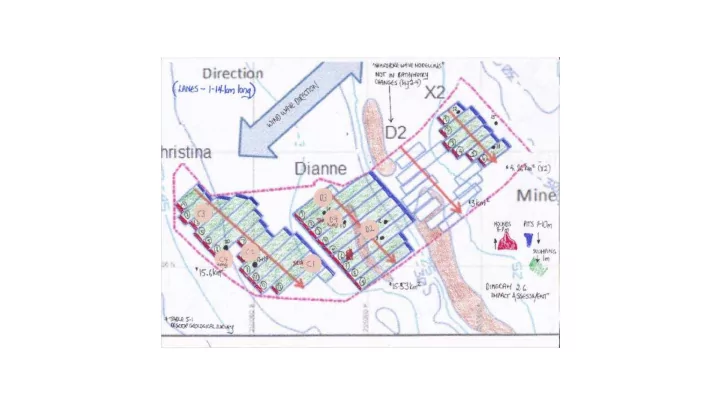
Perhaps in future there could be a ‘standardised tick box’ where experts acknowledge they have read which reports. Their findings can then be read in light of this. i.e. limitations to their findings understood. FPSO Ship MOUNDS 8 – 9 metres high, without shell hash Total approx. 14km long BRINE from de- salination plant – changes sea from 35pt to 37pt Fine sediment, 2.4 million tonnes p.a into the water column Sulphur dioxide emissions from burning heavy fuel
Fine plume from suction head Concentrated metals from rinsing and grinding sand PITS 9-10m De-salination chemicals Sea floor without shell hash layer (important for biota) and metal concentrations, e.g chromium, copper and nickel considerably greater e.g. mg kg̅¹ chromium <0.34 goes 8.23, 15.92, 27.75 etc Recovery time from the tens to hundreds of years. As saline denser than seawater – forms a plume 5- 10m from the seafloor Chemicals added to desalination process; Souter pt 17
WITH MINING at site A (close by the EEZ border of 12nautical miles). WITH MINING at site B (getting towards the bottom area of the Project site). RECOMMENDATIONS TO THE DMC
The picture illustrates the ecological importance of the area close to and including the project site for primary productivity 650 km ² is the area getting more than 1% of surface light – a mere
4.9% of the STB A reduction of 48% from 650 km ²
to 316km² due to mining at site A.
A reduction of 57% from 650
km² to an area of 263km² due to mining at site B.
GRAHAM BANK – EUPHOTIC ZONE – SIGNIFICANT CHANGE FOR THIS ECOLOGICAL NICHE Euphotic depth 24.2m Euphotic depth 12.7m/site A 16.7m/site B Days that euphotic depth is more than 1% : 213 days 31% / 47% reduction 74 days/site A 133 days/site B 65% / 37% reduction
"Social License Community Trust -clarify ecological compensation
Experts in commercial fishing recommend that EPA be provided with further information on uptake of heavy metals within fish and shellfish flesh, any human risks, and market acceptability risks 26 March 2014
Need to publish concentrated metal testing on site available to the public. Metallurgy testing and bio-assays.
When Impact Assessment issued, TRC, the local fishing community and Nelson fisheries were unaware of a 'metals issue'. Letter issued by TTR in 2009 to Maori tribes and Councils about underwater work showing the sands are toxic to sea life because of the presence of Vanadium, the seabeds in these areas containing no shellfish or vegetation
No subsequent letter to Maori tribes or Council retracting the issues of Vanadium and the lack
"open door policy' Bill Bisset - yet K Pratt's e-mail in November regarding necessary dilution for metals was acknowedged by TTR but no further information provided Reports on metal toxicity effects not done at at March 2014