Ontology Domain (world) = a network of states S4 S3 S6 S2 S1 - - PDF document

ontology
SMART_READER_LITE
LIVE PREVIEW

Ontology Domain (world) = a network of states S4 S3 S6 S2 S1 - - PDF document

Control In Data In Data Out Functional Core Meta data Out Meta data In Control Out Contextor: a Computational Model for Contextual Information Jolle Coutaz, Gatan Rey CLIPS-IMAG, Universit Joseph Fourier, Grenoble, France James L.


slide-1
SLIDE 1

1

Concepts&Models for Ubicomp, Ubicomp02, Goteborg, Sept. 29th, 2002

1

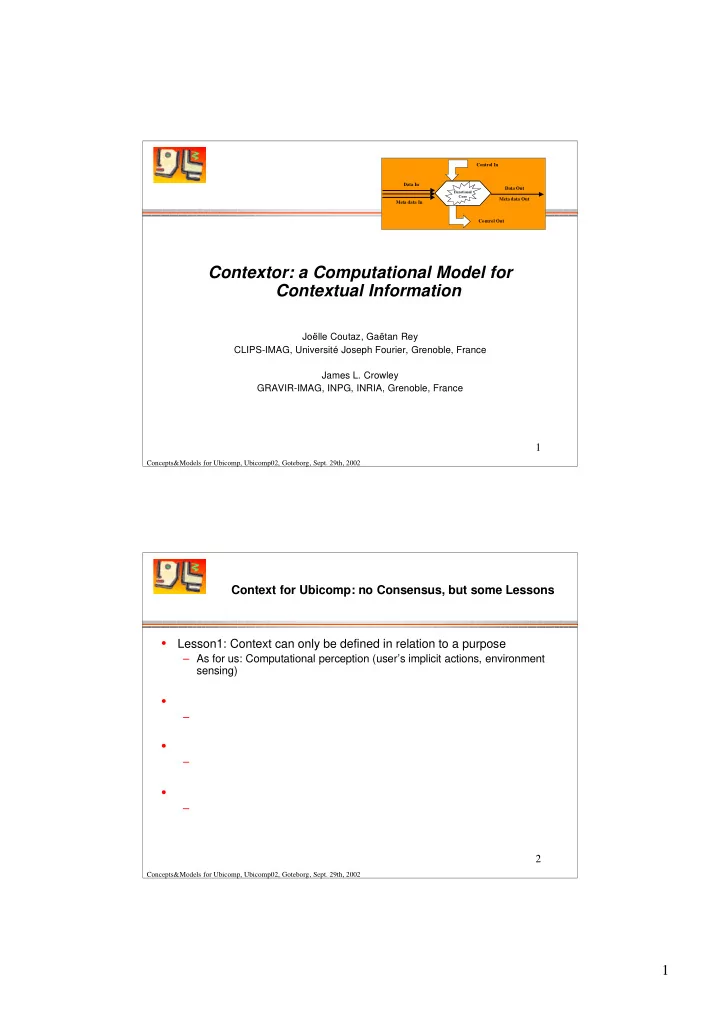
Contextor: a Computational Model for Contextual Information

Joëlle Coutaz, Gaëtan Rey CLIPS-IMAG, Université Joseph Fourier, Grenoble, France James L. Crowley GRAVIR-IMAG, INPG, INRIA, Grenoble, France

Data Out Meta data Out Data In Meta data In

Functional Core

Control In Control Out

Concepts&Models for Ubicomp, Ubicomp02, Goteborg, Sept. 29th, 2002

2

Context for Ubicomp: no Consensus, but some Lessons

  • Lesson1: Context can only be defined in relation to a purpose

– As for us: Computational perception (user’s implicit actions, environment sensing)

  • Lesson 2: Context is an information space that serves interpretation

– As for us: Interpretation by the system for serving users

  • Lesson 3: Context is an information space that is shared

– As for us: Common ground between a system and a user

  • Lesson 4: Context is an ever-ending information space: it evolves

– As for us: Distinction between a situation and composition of situations

slide-2
SLIDE 2

2

Concepts&Models for Ubicomp, Ubicomp02, Goteborg, Sept. 29th, 2002

3

Context for Ubicomp: no Consensus, but some Lessons

  • Lesson1: Context can only be defined in relation to a purpose

– As for us: Computational perception (user’s implicit actions, environment sensing)

  • Lesson 2: Context is an information space that serves interpretation

– As for us: Interpretation by the system for serving users

  • Lesson 3: Context is an information space that is shared

– As for us: Common ground between a system and a user

  • Lesson 4: Context is an ever-ending information space: it evolves

– As for us: Distinction between a situation and composition of situations User’s Context System’s Context

Concepts&Models for Ubicomp, Ubicomp02, Goteborg, Sept. 29th, 2002

4

Context for Ubicomp: no Consensus, but some Lessons

  • Lesson1: Context can only be defined in relation to a purpose

– As for us: Computational perception (user’s implicit actions, environment sensing)

  • Lesson 2: Context is an information space that serves interpretation

– As for us: Interpretation by the system for serving users

  • Lesson 3: Context is an information space that is shared

– As for us: Common ground between a system and a user

  • Lesson 4: Context is an ever-ending information space: it evolves

– As for us: Distinction between a situation and composition of situations User’s Context System’s Context

slide-3
SLIDE 3

3

Concepts&Models for Ubicomp, Ubicomp02, Goteborg, Sept. 29th, 2002

5

Context for Ubicomp: no Consensus, but some Lessons

  • Lesson1: Context can only be defined in relation to a purpose

– As for us: Computational perception (user’s implicit actions, environment sensing)

  • Lesson 2: Context is an information space that serves interpretation

– As for us: Interpretation by the system for serving users

  • Lesson 3: Context is an information space that is shared

– As for us: Common ground between a system and a user

  • Lesson 4: Context is an ever-ending information space: it evolves

Concepts&Models for Ubicomp, Ubicomp02, Goteborg, Sept. 29th, 2002

6

Outline

  • Ontology for computational perception
  • Computational model: contextor
slide-4
SLIDE 4

4

Concepts&Models for Ubicomp, Ubicomp02, Goteborg, Sept. 29th, 2002

7

Ontology …

  • Domain (world) = a network of states

S2 S6 S1 S S3 S4

Concepts&Models for Ubicomp, Ubicomp02, Goteborg, Sept. 29th, 2002

8

Ontology …

  • Domain (world) = a network of states linked by actions

S2 S6 S1 S S3 S4

a1 a2 a3 a2 a3

slide-5
SLIDE 5

5

Concepts&Models for Ubicomp, Ubicomp02, Goteborg, Sept. 29th, 2002

9

Ontology …

  • Domain (world) = a network of states linked by actions
  • State = a predicate function over observables

S2 S6 S1 S

P(O1, O2, …, On)

S3 S4

a1 a2 a3 a2 a3

O1 O2 Om

Concepts&Models for Ubicomp, Ubicomp02, Goteborg, Sept. 29th, 2002

10

Ontology …

  • Domain (world) = a network of states linked by actions
  • State = a predicate function over observables
  • Goal state = a desired state

S2 S6

Goal state

S1 S

P(O1, O2, …, On)

S3 S4

a1 a2 a3 a2 a3

O1 O2 Om

slide-6
SLIDE 6

6

Concepts&Models for Ubicomp, Ubicomp02, Goteborg, Sept. 29th, 2002

11

Ontology …

  • Domain (world) = a network of states linked by actions
  • State = a predicate function over observables
  • Goal state = a desired state
  • Task = <current state, goal state>, i.e., no plan

S2

Current state

S6

Goal state

S1 S

P(O1, O2, …, On)

S3 S4

a1 a2 a3 a2 a3

O1 O2 Om

Concepts&Models for Ubicomp, Ubicomp02, Goteborg, Sept. 29th, 2002

12

Ontology …

  • Domain (world) = a network of states linked by actions
  • State = a predicate function over observables
  • Goal state = a desired state
  • Task = <current state, goal state>, i.e., no plan
  • Activity = <active tasks> = <current task, background tasks>

S2

Current state

S6

Goal state

S1 S

P(O1, O2, …, On)

S3 S4

a1 a2 a3 a2 a3

O1 O2 Om

slide-7
SLIDE 7

7

Concepts&Models for Ubicomp, Ubicomp02, Goteborg, Sept. 29th, 2002

13

Ontology …

  • Tasks involve entities (e.g., a table, pen, color)

Entity

E1 Table

Entity

E2 Pen

Concepts&Models for Ubicomp, Ubicomp02, Goteborg, Sept. 29th, 2002

14

Ontology …

  • Tasks involve entities (e.g., a table, pen, color)
  • Entity = a grouping of observables

Entity

E1 Table

O1 O2 Om Ol Ok On

Entity

E2 Pen

slide-8
SLIDE 8

8

Concepts&Models for Ubicomp, Ubicomp02, Goteborg, Sept. 29th, 2002

15

Ontology …

  • Tasks involve entities (e.g., a table, pen, color)
  • Entity = a grouping of observables
  • Entities may have a role = a function relative to a task that is satisfied by an entity,

e.g., sitting surface Role pointer

{E2}

Entity

E1 Table Role Sitting surface {E1}

O1 O2 Om Ol Ok On

Entity

E2 Pen

Concepts&Models for Ubicomp, Ubicomp02, Goteborg, Sept. 29th, 2002

16

Ontology …

  • Tasks involve entities (e.g., a table, pen, color)
  • Entity = a grouping of observables
  • Entities may have a role = a function relative to a task that is satisfied by an entity,

e.g., sitting surface

  • Entities may have relations

Role pointer

{E2}

Entity

E1 Table Role Sitting surface {E1}

O1 O2 Om Ol Ok On

Entity

E2 Pen On top

slide-9
SLIDE 9

9

Concepts&Models for Ubicomp, Ubicomp02, Goteborg, Sept. 29th, 2002

17

Ontology…

  • Context(U,T) = a set of roles and relations between entities for the performance of T by U

C1 R1 R2 r

Concepts&Models for Ubicomp, Ubicomp02, Goteborg, Sept. 29th, 2002

18

Ontology…

  • Context(U,T) = a set of roles and relations between entities for the performance of T by U
  • Context change = the set of roles changes

C2 R1 R2 r C1 R1 R2 r New role

R3

slide-10
SLIDE 10

10

Concepts&Models for Ubicomp, Ubicomp02, Goteborg, Sept. 29th, 2002

19

Ontology…

  • Context(U,T) = a set of roles and relations between entities for the performance of T by U
  • Context change = the set of roles changes and/or the set of relations changes

C2 R1 R2 r C1 R1 R2 r C3 R1 R2 r New role

R3

New relation

r’

Concepts&Models for Ubicomp, Ubicomp02, Goteborg, Sept. 29th, 2002

20

Ontology…

  • Context(U,T) = a set of roles and relations between entities for the performance of T by U
  • Context change = the set of roles changes and/or the set of relations changes
  • Tasks and activities happen in a network of contexts

C2 R1 R2 r C1 R1 R2 r C3 R1 R2 r

R3 r’

slide-11
SLIDE 11

11

Concepts&Models for Ubicomp, Ubicomp02, Goteborg, Sept. 29th, 2002

21

Ontology…

  • Context(U,T) = a set of roles and relations between entities for the performance of T by U
  • Context change = the set of roles changes and/or the set of relations changes
  • Tasks and activities happen in a network of contexts
  • Context (U,T) = a network of situations that share the same set of Roles and Relations

C2

R1 R2

r C1 R1 R2 r C3 R1 R2 r

R3 r’ Network of Situations

Concepts&Models for Ubicomp, Ubicomp02, Goteborg, Sept. 29th, 2002

22

Ontology …

  • Within a context, a situation is a configuration of

– A set of entities – Assignments of roles to entities – Relations between these entities S1 R1 R2 e2 e1 r e2 e1

C1

slide-12
SLIDE 12

12

Concepts&Models for Ubicomp, Ubicomp02, Goteborg, Sept. 29th, 2002

23

Ontology …

  • Within a context, a situation changes when

– assignments of entities to roles changes S2 R1 R2 e1 e2 e2 e1 Assignment to Role has changed S1 R1 R2 e2 e1 r e2 e1

C1

Concepts&Models for Ubicomp, Ubicomp02, Goteborg, Sept. 29th, 2002

24

Ontology …

  • Within a context, a situation changes when

– assignments of entities to roles changes – relations between the entities change S2 R1 R2 e1 e2 r e2 e1 S3 R1 R2 e2 e1 r e1 e2 Assignment to Role has changed Relation has changed S1 R1 R2 e2 e1 r e2 e1

C1

slide-13
SLIDE 13

13

Concepts&Models for Ubicomp, Ubicomp02, Goteborg, Sept. 29th, 2002

25

Ontology …

  • Within a context, a situation changes when

– assignments of entities to roles changes – relations between the entities change – The set of entities changes S2 R1 R2 e1 e2 r e2 e1 S4 R1 R2 e2 e1 r e2 e1 S3 R1 R2 e2 e1 r e1 e2 Assignment to Role has changed Relation has changed New entity S1 R1 R2 e2 e1 r e2 e1

e3

C1

Concepts&Models for Ubicomp, Ubicomp02, Goteborg, Sept. 29th, 2002

26

Computational model: the Contextor …

  • A computational abstraction

– Two functional facets

  • Transformation: Data (Type X) +meta-data -> Data (Type Y) +meta-data
  • Control: adaptation of behavior

– Synchronous and asynchronous ports

Data Out Meta data Out Data In Meta data In

Functional Core

Control In Control Out

slide-14
SLIDE 14

14

Concepts&Models for Ubicomp, Ubicomp02, Goteborg, Sept. 29th, 2002

27

Computational model: the Contextor …

  • Instantiation 1: data as observables

State and capabilities Control Skin Color Detection Color Image Skin Probability Control in

Concepts&Models for Ubicomp, Ubicomp02, Goteborg, Sept. 29th, 2002

28

Computational model: the Contextor …

  • Instantiation2: from Observables to Entity

tate and apabilities Control Grouping Detected Pixels Probability Image Blob, ID,x, y, sx, sy, θ) Control in

slide-15
SLIDE 15

15

Concepts&Models for Ubicomp, Ubicomp02, Goteborg, Sept. 29th, 2002

29

Computational model: the Contextor …

  • Instantiation3: from entities to relation between entities

Eye-pair(Left, Right) Control Relation Detection Eye1 … Eyem State and Capabilities Control in

Concepts&Models for Ubicomp, Ubicomp02, Goteborg, Sept. 29th, 2002

30

Contextors composition

  • Data flow model
  • Hierarchical levels (HL)
  • Dependency chain

Application 1 Application 2 HL = 0 HL = 1 HL = 2

slide-16
SLIDE 16

16

Concepts&Models for Ubicomp, Ubicomp02, Goteborg, Sept. 29th, 2002

31

Contextors: properties

  • Reflexivity

– Ability to describe its behavior – Ability tomodify its behavior

  • Remanence

– Ability to sleep, to be saved then to restart execution

  • Context => federation of contextors
  • New situation => reconfiguration of the contextors within the

federation

  • New context => new federation of contextors

Concepts&Models for Ubicomp, Ubicomp02, Goteborg, Sept. 29th, 2002

32

Contextors: global architectural picture

  • Extension of the ARCH model (D.Salber)

DC LP PP FC FCA Capture Transformation Identification Exploitation

Process style (Contextor) Data style (Blackboard)

slide-17
SLIDE 17

17

Concepts&Models for Ubicomp, Ubicomp02, Goteborg, Sept. 29th, 2002

33

Contextor: a Computational Model for Contextual Information

Joëlle Coutaz, Gaëtan Rey CLIPS-IMAG, Université Joseph Fourier, Grenoble, France James L. Crowley GRAVIR-IMAG, INPG, INRIA, Grenoble, France

Data Out Meta data Out Data In Meta data In

Functional Core

Control In Control Out