OpenCL on FPGAs Contains material from Hands On OpenCL by Simon - - PowerPoint PPT Presentation

opencl on fpgas
SMART_READER_LITE
LIVE PREVIEW

OpenCL on FPGAs Contains material from Hands On OpenCL by Simon - - PowerPoint PPT Presentation

OpenCL on FPGAs Contains material from Hands On OpenCL by Simon McIntosh-Smith, Tom Deakin, James Price, Tim Mattson and Benedict Gaster under the "attribution CC BY" creative commons license. What are FPGAs? Reprogrammable hardware


slide-1
SLIDE 1

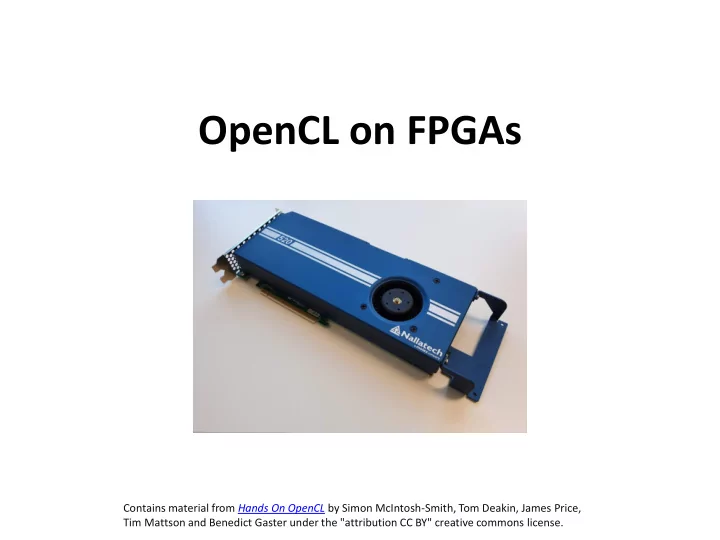
OpenCL on FPGAs

Contains material from Hands On OpenCL by Simon McIntosh-Smith, Tom Deakin, James Price, Tim Mattson and Benedict Gaster under the "attribution CC BY" creative commons license.
slide-2
SLIDE 2

What are FPGAs?

  • Reprogrammable hardware
  • Integrate huge numbers of lookup tables

(LUTs), registers, on-chip memories, and arithmetic hardware (e.g. DSP blocks)

  • These on-chip resources are connected

through a reconfigurable network

  • Traditionally programmed through a very low-

level hardware description language

– VHDL or Verilog

2

slide-3
SLIDE 3

Why FPGAs?

  • Prototyping hardware designs

– Application-Specific Integrated Circuit (ASIC): customized circuit for a specialized application e.g. aerospace microcontroller, Bitcoin miner – Application-Specific Standard Product (ASSP): customized for application market e.g. automotive microcontrollers, smart phone chips

  • Production systems

– Reconfigurable = can modify electronics in situ – As cheap and power efficient as ASICs (except for very large volumes)

3

slide-4
SLIDE 4

OpenCL on FPGAs

  • FPGA architectures are very different from GPUs and

CPUs

  • Requires a completely different approach to achieve

good performance

  • On CPUs/GPUs, you want lots of parallelism: i.e. lots of

work-items and work-groups

  • For FPGAs, you want just a few work-items, each

representing a long pipeline

  • Base-level for programming FPGAs is hardware

definition language (HDL): Verilog or VHDL

– Detailed; low-level; highly-specialized

  • OpenCL makes programming FPGAs more accessible

4

slide-5
SLIDE 5

FPGA Architecture

Source: http://www.fpga-site.com/faq.html

5

slide-6
SLIDE 6

FPGA Hard Blocks

6

Source: Intel FPGA for OpenCL SDK Pro Edition: Best Practices Guide

Most FPGA packages include blocks of predefined hardware (hard blocks) to implement commonly required functions

  • Digital signal processor

(DSP)

  • Arithmetic units
  • I/O logic
  • Memory blocks
slide-7
SLIDE 7

Compiling OpenCL into Hardware

size_t index = get_global_id(0); C[index] = (A[index] >> 5) + B[index]; F[index] = (D[index] – E[index]) << 3; G[index] = C[index] + F[index]; The Intel FPGA SDK for OpenCL Offline Compiler provides a custom pipeline structure that speeds up computation by allowing operations within a large number of work-items to

  • ccur concurrently. The offline

compiler can create a custom pipeline that calculates the values for variables C, F and G every clock cycle, as shown

  • below. After a ramp-up phase,

the pipeline sustains a throughput of one work-item per cycle.

7

Source: Intel FPGA for OpenCL SDK Pro Edition: Best Practices Guide

slide-8
SLIDE 8

OpenCL Design Components

8

An OpenCL system design provides kernels with access to local and global memory (just like in a regular OpenCL program)

Source: Intel FPGA for OpenCL SDK Pro Edition: Best Practices Guide

slide-9
SLIDE 9

FPGA Optimisation Tips

  • Create single work-item kernels if:

– You cannot break down an algorithm into separate work-items easily because of data dependencies that arise when multiple work-items are in flight. – You organize your OpenCL application in multiple kernels, you use channels to transfer data among the kernels, and the data processing sequence is critical to your application. – Equivalent to an NDRange size of (1, 1, 1)

9

slide-10
SLIDE 10

Single Work-Item Kernels

  • In this approach, the FPGA OpenCL compiler

will attempt to pipeline the work-item

  • Special care needed to ensure the compiler

can pipeline loops

10

slide-11
SLIDE 11

More Tips for FPGA Optimisation

  • Optimize each kernel to target a single compute unit first
  • Then scale the number of compute units up until you've

filled the FPGA

– Compiling with fewer compute units takes much less FPGA compilation time

  • Consider moving data between kernels using OpenCL pipes
  • r vendor extensions such as channels
  • Unrolling loops can help FPGA OCL compilers

– e.g. #pragma unroll 8

  • Optimise floating point operations
  • Avoid expensive operations
  • Allocate memory aligned to at least 64 bytes
  • Use restrict to avoid pointer aliasing
  • Avoid work-item ID-dependent backward branching

11

slide-12
SLIDE 12

Using Pipes and Channels

12

Source: Intel FPGA for OpenCL SDK Pro Edition: Best Practices Guide

slide-13
SLIDE 13

Optimising Floating Point

  • Giving the FPGA OpenCL compiler more freedom

regarding IEEE compliance can make a huge difference in performance

  • Key compiler flags include:

– --fp-relaxed : compiler can change order of operations – --fpc : minimise type conversions and combine multiple rounding operations into one. Results in use

  • f fused multiple-accumulate (FMAC) instructions
  • Fixed point even better than floating point on

FPGAs, can pack in more execution units

– OpenCL supports 8, 16, 32 and 64-bit fixed point

13

slide-14
SLIDE 14

Operation costs on FPGAs

  • Expensive operations include:

– Integer division and modulo (remainder) operators – Most floating-point operators except addition, multiplication, absolute value, and comparison – Atomic functions

  • In contrast, cheap operations include:

– Binary logic operations such as AND, NAND, OR, NOR, XOR, and XNOR – Logical operations with one constant argument – Shift by constant – Integer multiplication and division by a constant that is a power of two

14

Source: Intel FPGA for OpenCL SDK Pro Edition: Best Practices Guide

slide-15
SLIDE 15

Other FPGA Kernel Tips

  • Use well-formed loops

– These have an exit condition that compares against an integer bound, and have a simple induction increment

  • f one per iteration
  • Avoid pointer arithmetic, use simple array

indexing instead

  • Avoid complex loop exit conditions
  • Convert nested loops into a single loop
  • Declare variables in the deepest scope possible

15

slide-16
SLIDE 16

OpenCL on FPGA Summary

  • You'll probably need completely different

kernels for optimal performance on an FPGA

  • Still uses the same overall OpenCL host

infrastructure though

  • In theory, OpenCL supports using CPUs, GPUs,

DSPs and FPGAs all at the same time…

16

slide-17
SLIDE 17

Useful Resources

Intel (formerly Altera):

  • https://www.intel.com/content/www/us/en/programma

ble/support/support-resources.html

  • https://www.intel.com/content/dam/www/programmab

le/us/en/pdfs/literature/hb/opencl-sdk/aocl-best- practices-guide.pdf

Xilinx:

  • http://www.xilinx.com/products/design-tools/software-

zone/sdaccel.html#documentation

17