OPENING BUDGET DEBATE PRESENTATION MARCH 8, 2018 HON. AUDLEY SHAW, - - PDF document

opening budget debate presentation
SMART_READER_LITE
LIVE PREVIEW

OPENING BUDGET DEBATE PRESENTATION MARCH 8, 2018 HON. AUDLEY SHAW, - - PDF document

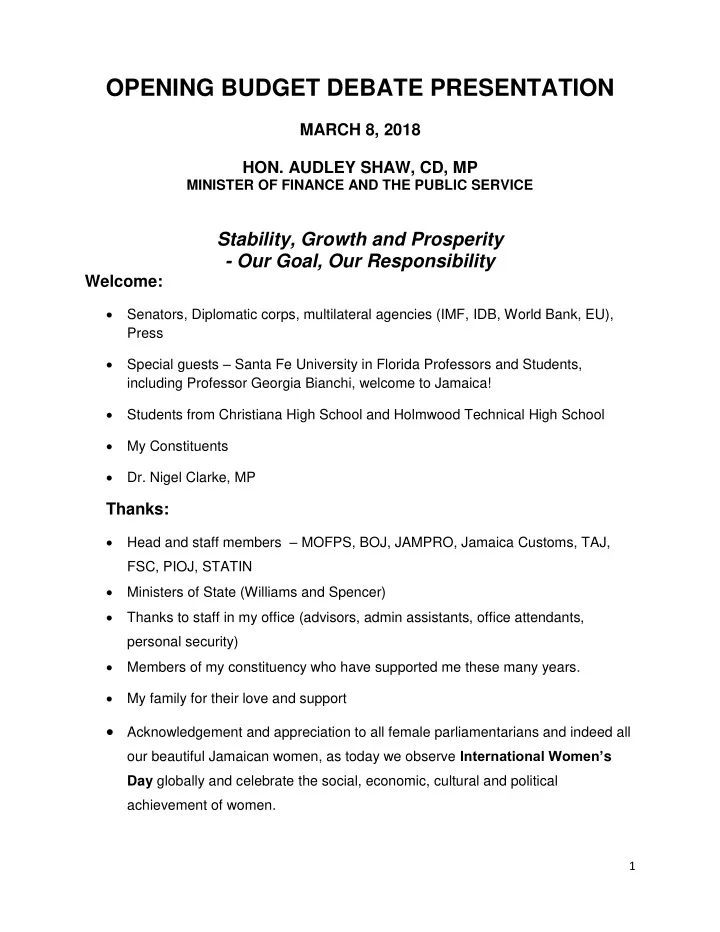
OPENING BUDGET DEBATE PRESENTATION MARCH 8, 2018 HON. AUDLEY SHAW, CD, MP MINISTER OF FINANCE AND THE PUBLIC SERVICE Stability, Growth and Prosperity - Our Goal, Our Responsibility Welcome: Senators, Diplomatic corps, multilateral agencies


slide-1
SLIDE 1

1

OPENING BUDGET DEBATE PRESENTATION

MARCH 8, 2018

  • HON. AUDLEY SHAW, CD, MP

MINISTER OF FINANCE AND THE PUBLIC SERVICE

Stability, Growth and Prosperity

  • Our Goal, Our Responsibility

Welcome:

 Senators, Diplomatic corps, multilateral agencies (IMF, IDB, World Bank, EU), Press  Special guests – Santa Fe University in Florida Professors and Students, including Professor Georgia Bianchi, welcome to Jamaica!  Students from Christiana High School and Holmwood Technical High School  My Constituents  Dr. Nigel Clarke, MP

Thanks:

 Head and staff members – MOFPS, BOJ, JAMPRO, Jamaica Customs, TAJ, FSC, PIOJ, STATIN  Ministers of State (Williams and Spencer)  Thanks to staff in my office (advisors, admin assistants, office attendants, personal security)  Members of my constituency who have supported me these many years.  My family for their love and support

 Acknowledgement and appreciation to all female parliamentarians and indeed all

  • ur beautiful Jamaican women, as today we observe International Women’s

Day globally and celebrate the social, economic, cultural and political achievement of women.

slide-2
SLIDE 2

2

 Thank Most Honourable Prime Minister for your leadership of the country at this

critical time in Jamaica’s development. We know Mr. PM it is a hard road to travel and a mighty long way to go; but with God’s help we will achieve success.

INTRODUCTION

  • Mr. Speaker, today I want to share with you the significant progress we have made

together in our journey towards growth and prosperity and to outline the path forward. Through great sacrifice, we have achieved levels of fiscal stability not seen in Jamaica for many decades. However, we must remember why this matters. It is about improving lives; and stability on its own is not enough to do that. We have many more rivers to cross to achieve prosperity for all Jamaicans. Attaining and sustaining fiscal stability, economic growth, and prosperity must become the shared goal and responsibility of all! I am pleased to report that, as at the end of December 2017, the Government of Jamaica has successfully met all the quantitative performance criteria and indicative targets agreed with the International Monetary Fund (IMF) under the current Precautionary Stand-By Arrangement. Passing these tests is important and necessary, but it is also insufficient. It is our focus and priority to ensure that we also pass the even more important test set by the people of Jamaica – I call it the People’s Test. Mr. Speaker, I define the People’s Test as the test for a more prosperous society that the people can see, feel, and touch which includes a growing economy with high levels of investment, safer communities, higher standards of living, more and better job

  • pportunities, improved roads and infrastructure – particularly in our rural areas, a lower

tax burden, a stable exchange rate, increased opportunities for personal and professional advancement, and meaningful access to affordable housing as well as high-quality education and healthcare.

slide-3
SLIDE 3

3

This is our focus and priority for the future – to build on the foundation of fiscal stability to achieve greater economic growth and prosperity, so as to ensure that we meet and exceed the targets set under the People’s Test!

  • Mr. Speaker, with this brief introduction, I want to turn your attention to the structure of

my presentation today: I. Review of the Economy for Fiscal Year 2017/18 II. Policy Priorities and Targets for Fiscal Year 2018/19 III. Highlights of the Expenditure Budget for Fiscal Year 2018/19 IV. Highlights of the Financing of the Budget for Fiscal Year 2018/19 V. Conclusion

I. REVIEW OF ECONOMY FOR FISCAL YEAR 2017/18

  • Mr. Speaker, I am pleased to report that we have advanced the strong foundation of

fiscal stability and are making significant progress on our path towards greater economic growth and prosperity. I would like to publicly acknowledge the responsible and laudable actions and efforts by many of our public sector workers to support our economic programme. This year we fulfilled our promise to raise the income tax threshold while meeting all fiscal targets. That policy created a significant increase in take-home pay of the labour force. What this means Mr. Speaker is that more Jamaicans were able to keep more money in their pockets! To summarize our track record on behalf of the Jamaican people and a review of the economy over the past fiscal year, Mr. Speaker:

  • We committed to the Jamaican people we would grow the economy. I am

pleased to report that Fiscal Year 2017/18 represents the fifth consecutive year

  • f positive growth in the Jamaican economy, with real GDP estimated to have

grown by 0.9% in Fiscal Year 2017/18 relative to the preceding Fiscal Year.

slide-4
SLIDE 4

4

This growth is notwithstanding a record breaking level of tourist arrivals; a construction boom; historically high job creation; a fast-growing stock market; positive business confidence; and the strongest economic buffers in decades.

  • I must add, Mr. Speaker, that the PIOJ has analyzed the reasons why our

reported economic growth rate is not as high as projected, and they have found that is it due mainly to the negative effects of unexpectedly high rainfall on agriculture and delays in restarting the production of bauxite and alumina. Without these issues, the PIOJ estimates that economic growth would have been between 2.0% and 2.5%. This is still not enough, Mr. Speaker, and we still have important work to do! Mr. Speaker, we have to restructure our economy to reduce our vulnerability to weather-related events. I also believe, Mr. Speaker, that the time has come to review the methodology of how we measure economic growth and ensure that it is in line with international standards.

  • We also committed to the Jamaican people we would create new jobs and

reduce unemployment. I am pleased to report that an additional 43,000 persons have been employed over the past two years and the unemployment rate, according to the Statistical Institute of Jamaica, has fallen from 12.9% in October 2016 to 10.4% in October 2017. We have listened to the people of Jamaica – and we have kept our commitment!

  • Mr. Speaker, this is significant progress. In fact, private employers are reporting

growing difficulties in finding skilled workers. This indicates that to get the unemployment rate lower in the short term, it will be necessary to increase

  • training. Of course, the ultimate goal is to steadily increase the proportion of

‘good’ and ‘higher-paying’ jobs. This will require higher productivity of labour as a necessary prerequisite to higher overall wages.

  • Despite this good news, Mr. Speaker, as a Government it is clear that we must

accelerate the current pace of human development and training for our

  • population. Looking ahead, the United Nations projects a decline in Jamaica’s
slide-5
SLIDE 5

5

working-age population by 2030 — just twelve years from now! Thus, labour shortages could become an obstacle to faster growth. Mr. Speaker, what this means is that the medium and long-term prosperity of Jamaica requires that we urgently accelerate our strategy of focused human resource development and training programmes to increase productivity. We have a lot of work to do!

  • We also committed to the Jamaican people to reduce our national debt-to-GDP

ratio which was as high as 147% in Fiscal Year 2012/13. I am pleased to report

  • Mr. Speaker that we have surpassed the target of 111% for Fiscal Year 2017/18.

We have also decided to adopt the IMF’s definition of Public Debt. This re- definition plus our continued fiscal discipline means that we expect to close this fiscal year with a Public Debt to GDP ratio of 105%. We are well on track to bring the ratio down to at least 60% of GDP by Fiscal Year 2025/26. We remained disciplined in our debt reduction strategy – and we kept our commitment!

  • We also committed to the Jamaican people to achieve a primary surplus target of

at least 7.0% of GDP. I am pleased to report that in Fiscal Year 2016/17 our concerted efforts yielded a primary surplus of 7.7% and we expect to achieve the 7% target again this fiscal year.

  • Our tax revenues are estimated to over-perform by $5.0 billion. Mr. Speaker, this

is the best tax revenue performance relative to budget since fiscal year 2002/03, sixteen years ago. And, Mr. Speaker, PAYE is also performing well, despite the increase in the tax threshold for personal income taxes – the $1.5 million plan! The PAYE outturn since the start of the fiscal year through to January 2018 was $47.8 billion compared with a budgeted figure of $46.5 billion. Mr. Speaker, despite the critics who said we could not meet our fiscal targets while also reducing income taxes for working Jamaicans; we did it and we kept our commitment!

slide-6
SLIDE 6

6

  • We also committed to the Jamaican people that we would reduce the cost of our

national debt in the local markets. I am pleased to report that GOJ Treasury bill yields today are at the lowest levels in recent history. Mr. Speaker, the yield at the auction of the 180-day Treasury Bill in February 2018 was 3.6%, well below the 6.1% recorded in February 2017. In January 2018, we auctioned $23 billion in three-year Treasury Bills that resulted in an average yield of just 5.3%; and this included bids as low as 3.2%. We acted strategically, carefully, and responsibly – and we kept our commitment!

  • In addition, the Central Bank’s signal rate – the interest rate on its monetary

policy instruments – was lowered four times during this past fiscal year. This rate is coming down from 3.75% to the rate today of 2.75%. The Bank of Jamaica through this action of reducing its signal rate is saying to Jamaicans, the financial sector, and investors, that monetary policy is accommodative, meaning, the Bank

  • f Jamaica wants money to be cheaper to help to stimulate economic growth. So

we take it seriously when the Bank of Jamaica, at its recent quarterly press briefing, said that banks are taking too long to pass on the reduction in rates.

  • Mr. Speaker, we also committed to the Jamaican people that we would reduce

the cost of the GOJ’s international debt. You will recall, Mr. Speaker, in order to raise the US$300 million required for budgetary support, we went on an investor roadshow in June of last year to sell the story of Jamaica to the international bond market. As a result of our efforts, our debt offering was ten times over- subscribed with total orders of US$3 billion at favorable rates. With this massive

  • versubscription, we decided to accept US$1 billion instead and used the
  • pportunity to simultaneously redeem more expensive local and overseas debt.

The yields were 5% on bonds due in 2028 and 6.45% for those due in 2045. These are historical lows for Jamaica in the international capital markets on long- term dated instruments, well below the double-digit interest rates Jamaica has been used to in the past. Further, Mr. Speaker, on January 24 of this year, we re-opened our Benchmark Investment Note due in 2021 with an auction for J$5.0

  • billion. The Offer was almost 5 times oversubscribed with an average yield of
slide-7
SLIDE 7

7

5.4%; another historical low! Mr. Speaker, we made the right decisions, we took the right actions – and we kept our commitment!

  • We also committed to the Jamaican people we would keep inflation low, under a

target of 6%. I am pleased to report that annual inflation in Jamaica was recorded at 4.8% in January 2018, the latest data that we have from the Statistical Institute of Jamaica. This inflation target was achieved despite an almost 40% increase in the international price of oil as well as the significant increase in agricultural food prices resulting from excessive rainfall last year. We kept on track – and we kept our commitment!

  • We also committed to the Jamaican people we would reform our public sector

entities and tighten our own belts as part of the comprehensive public sector transformation programme. As you know, Mr. Speaker, we divested the Caymanas Track Limited and are in the process of merging three regulatory agencies – the Betting, Gaming and Lotteries Commission, the Casino Gaming Commission, and the Jamaica Racing Commission, into a single regulatory

  • body. During the last fiscal year, the HEART Trust-NTA, the Jamaica

Foundation for Lifelong Learning and the National Youth Service were also merged into a single entity. Several public entities were closed including the Road Maintenance Fund – whose activities were transferred into its portfolio ministry; the Board of Supervision; Kingston Waterfront Hotel Company; Montego Shopping Centre Limited; and Portmore Commercial Development

  • Limited. We also wound up the Self-Start Fund while the Agricultural Credit

Board was closed and its functions transferred to the Department of Cooperatives and Friendly Societies.

  • Mr. Speaker, the Self-financed Public Bodies, as part of the overall public sector,

continue to contribute to the Government’s development and growth objectives. As a group they are expected to generate an estimated $344 billion in revenue for Fiscal Year 2017/18. The group will also transfer a net $45 billion to the Central Government in terms of financial distribution, taxes and other programme

slide-8
SLIDE 8

8

  • support. This group has also continued to contribute to the development of the

country’s infrastructure, with capital expenditure of $52 billion during fiscal year 2017/18. We have continued to tighten our belts – and we kept our commitment!

  • We also committed to the Jamaican people we would increase access to credit

by the private sector. Mr. Speaker, I am pleased to report that lending to the private sector has in fact continued to increase. Annual growth in loans was 14.0% in 2017 following an expansion of 14.1% in 2016. This is the second year

  • f strong growth and is evidence that our economic management is yielding
  • benefits. We responded to the private sector – and we have kept our

commitment! I am compelled to add Mr. Speaker, that while this is encouraging, we are still a long way off when we compare our private sector credit to GDP in Jamaica of 26.4% at December 2017 against that of approximately 46% for other Latin America and Caribbean countries, approximately 95% for other middle income countries globally, and well over 100% in the USA. We still have more work to do, and we intend to do it!

  • Mr. Speaker, while I am pleased with the increased access of the private sector

to credit, I must once again publicly register my disappointment with the continued high interest rates. The Bank of Jamaica estimates weighted average lending rates of 15% in the banking sector at the end of December 2017. Although blue chip borrowers can obtain rates below 10%, this is still too high a burden on the Jamaican economy. We expect that these rates will continue to trend down and we will continue to do what we can to make this possible. We do not share the high interest rate policy of previous governments. That policy gutted the Jamaican private sector and led to the extreme levels of public debt that choked off growth and increased misery. It also led to the collapse of the financial sector in the 1990s. Mr. Speaker, the FINSAC Commission of Enquiry report will shortly be presented to the Governor-General and tabled in the House

  • f Parliament. We will not rest until rates to the real sector are in the low single

digits!

slide-9
SLIDE 9

9

  • We also committed to the Jamaican people to maintain a competitive and flexible

exchange rate. The relative stability of the exchange rate that we have experienced is in significant part a result of the implementation of the Bank of Jamaica’s Foreign Exchange Intervention and Trading Tool, known as B-FXITT, in July 2017. This, as well as other related initiatives, have led to more efficiency in the foreign exchange market and has strengthened confidence of the business sector and wider population in the Jamaican Dollar. We have taken swift and decisive action, and we kept our commitment!

  • We also committed to reduce the level of dollarization in deposit-taking
  • institutions. I am pleased to report Mr. Speaker that the trend toward a growing

proportion of liabilities being held in US dollars has abated. At the end of 2016, the percentage of deposits held in US dollars was 46.0% and this fell to 42.5% by the end of October 2017. We acted prudently, and we kept our commitment!

  • We also committed to the Jamaican people to increase net foreign exchange
  • reserves. Mr. Speaker, we are pleased to report that at end-December 2017, the

stock of non-borrowed international foreign exchange reserves amounted to US$2.5 billion, which was US$753 million above the floor agreed under the Stand-By Arrangement with the IMF, and close to the highest levels ever. At end- March 2018, the projection is for the non-borrowed NIR to be US$2.4 billion, also well above the agreed floor. We kept our commitment!

  • It is important to note, Mr. Speaker, that both the international and local business

communities have applauded the improvements in the Jamaican economy. In fact, Mr. Speaker, Jamaica received positive ratings action during Fiscal Year 2017/18. Moody’s Ratings Agency upgraded the country’s sovereign rating by two notches from Caa2 to B3 in November 2016 and Standard and Poor’s Global Rating and Fitch Ratings both affirmed the country’s ‘B’ rating in September 2016 and February 2017, respectively. In February 2018, Fitch affirmed Jamaica’s ‘B’ rating and upgraded the outlook from ‘Stable’ to ‘Positive.’ I should also add that in the Survey of Consumer and Business Confidence for the Fourth Quarter of

slide-10
SLIDE 10

10

2017, conducted by Don Anderson, Business Confidence hit a high of 142.6 points, compared to 135.2 in the third quarter, and the index of Business Expectation for the future hit 135 points, the highest level ever recorded in the history of the surveys!

  • Mr. Speaker, the Jamaican people are saying that we have done well on the path

towards greater economic growth and prosperity. Our fiscal and monetary buffers are robust, employment is increasing, and the stability achieved has protected incomes and reduced uncertainty for wage earners and investors. Jamaica’s credentials on international markets are rock solid, our public sector is more efficient and modern, and it is now easier to do business in Jamaica. The stock market performance is

  • utstanding; credit to the real sector has reached record levels; interest rates are at

historic lows; foreign exchange reserves are at all-time highs, and tourism, construction, mining, BPO and the financial sectors are all booming and creating new jobs.

II. POLICY PRIORITIES AND TARGETS FOR FISCAL YEAR 2018/19

FISCAL STABILITY AND TARGETS

  • Mr. Speaker, the Budget for fiscal year 2018/19 is designed to achieve the targets

entrenched in Jamaica’s Fiscal Rule legislation and within the context of the current Precautionary Stand-by Arrangement with the IMF. I am pleased to report to this Honorable House, Mr. Speaker, that for the first time ever, the Ministry of Finance and the Public Service has strategically included in its annual Estimates of Expenditure for FY 2018/19 forward expenditure estimates for the following three fiscal years: 2019/20, 2020/21, and 2021/22. These forward estimates are aligned with the medium-term aggregate expenditure ceilings as reflected in the Fiscal Management Strategy. Although these forward estimates are only indicative and are not voted by Parliament, they represent a critical step forward in our ability to help investors and businesses with their long-term planning and to signal our continued fiscal discipline.

slide-11
SLIDE 11

11

Importantly, this new budget will be the last full year under the Standby Agreement with the IMF. We will continue to meet all commitments and we will meet all targets for reducing the debt-to-GDP ratio, modernizing the public sector, increasing the social safety net, and strengthening fiscal and monetary buffers on our economy. Our programme has now advanced to the point where IMF support is essentially an insurance policy. Jamaica has had no need to access any of the US$1.64 billion of financing available since the SBA was agreed in 2016. Furthermore, the IMF shares our assessment that there is no indication of a need to access their financial support for the remainder of the SBA period that concludes in the last quarter of 2019. As we reap the benefits of our sustained fiscal discipline, the new budget will also usher in a concerted campaign to support actions that boost growth and increase incomes.

  • Mr. Speaker, in fiscal year 2017/18, 46% percent of the budget was allocated to meet

debt service payments. In 2018/19, we plan to bring it down further to 37%. That means that fiscal discipline is working and that we are increasing the proportion of the budget that can be assigned to improving social services and productive infrastructure. The 2018/19 budget will be smaller than last year; however, we have allocated more funds to national security, social services, wages, and productive infrastructure – we are focused on making sure we pass the People’s Test!

  • Mr. Speaker, Productive Infrastructure is not just physical; it is also human and includes

the rules of the game for doing business. Growth calls for better telecommunications, roads and ports; but it also requires improved skills-training, value-chain linkages, access to finance, and enabling legislation. We intend to table specific initiatives to advance the development of Jamaica’s productive infrastructure.

slide-12
SLIDE 12

12

  • Mr. Speaker, the growth in optimism is unmistakable. Business confidence is strong;

lending to the real sector is at an all-time high; the stock market is booming, international lenders are offering rates normally reserved for investment grade clients; and job growth is at record levels. This trend is expected to continue, as stability becomes ingrained. The main macroeconomic assumptions upon which the fiscal year 2018/19 Budget was cast are real GDP growth of 2.4%, continued low inflation and a competitive and flexible exchange rate. The passive forecasts for Revenue and Grants and the Expenditure requirements for fiscal year 2018/19 generate a Primary Surplus of $141.1 billion, which will ensure the 7.0% of GDP target. GROWTH PROMOTING REFORMS AND PROJECTS Permit me, Mr. Speaker, to highlight several investment projects and reform initiatives intended to accelerate our economic growth and job creation agenda: a) Jiuquan Iron and Steel (JISCO)

  • Mr. Speaker, JISCO has already resumed production at the ALPART alumina plant

following an 8-year shutdown. JISCO plans further investments that could amount to as much as US$6.0 billion, the largest investment made by a single private sector company in Jamaican history. These investments include substantial linkages with the agricultural sector. The investment programme also includes construction of a new 230MW power plant using LNG. Currently, 960 persons are employed at ALPART. b) North-South Highway Development Projects The North-South Highway Development Projects are expected to exceed over US$2

  • billion. These are commercial investments by China Harbour Engineering Company
slide-13
SLIDE 13

13

Limited (CHEC). Mr. Speaker, it is important to note that no GOJ counterpart resources are required for these investments. This is a model that must be replicated. c) South Coast Highway Improvement Project

  • Mr. Speaker, the South Coast Highway Improvement Project is expected to represent

an investment of approximately US$385 million. The Project will upgrade the highway from Harbour View to Port Antonio; repair access roads in St. Thomas; and construct the next leg of the East-West toll road to Manchester. The completed road works is expected to boost our productivity and create new investment opportunities. d) Montego Bay Perimeter Road Project There is a plan, Mr. Speaker, to build a US$220 million perimeter road to relieve the extreme congestion in the heart of the Second City. Mr. Speaker, in addition to these road projects, work continues on the improvement of Mandela Highway as well as the commencement this year of work to Constant Spring Road and Hagley Park Road. e) Naggo Head Technology Park The GOJ has committed to the provision of a state-of-the-art Business Process Outsourcing, or BPO, facilities through the construction of the first major BPO Technology Park in the Caribbean, with special economic zone status, in Naggo Head,

  • St. Catherine, comprising over 800,000 square feet.

f) Morant Bay Town Revitalization The Factories Corporation of Jamaica has been mandated to establish the Morant Bay Urban Center at the site of the former Goodyear Tyre Factory. The Morant Bay Urban Center will be a 500,000 square foot integrated business center housing both public and private sector entities. g) Public Bodies Investment Programme

  • Mr. Speaker, in relation to the public bodies investment programme, total capital

expenditure is projected at $68.4 billion with three (3) public bodies accounting for

slide-14
SLIDE 14

14

almost 80% of the planned expenditure. This is focused on meeting the People’s Test by providing increased access to housing, water, investment, and job opportunities. The National Housing Trust will accelerate its initiatives to increase affordable housing solutions in the medium term. The National Water Commission will expand its initiatives to improve efficiency and the quality of its services to the public. The Port Authority of Jamaica intends to launch new and transformative development projects. Tourism

  • Mr. Speaker, since we are on the topic of growth initiatives, I feel compelled to speak

briefly about Jamaica’s tourism sector, which is a vital contributor to our economy, foreign exchange reserves, employment, and fiscal revenue. Last year, visitors to Jamaica grew by over 12% to achieve a record level of 4.3 million visitors, resulting in a 12% increase earnings and 11% in foreign exchange earnings. We expect this trend to continue in 2018. In 2017, over 1,200 new hotel rooms were added and we expect that at least another 670 are expected to be added in 2018. The success of our Tourism Sector is dependent upon the priority we assign to environmental sustainability and human development. We must therefore forge partnerships with the private sector to mitigate the risks posed by climate change. The Ministry of Tourism will advance initiatives for greater inclusion of local businesses and individuals in the sector. This will be guided by the public/private Tourism Linkages Council which is charged with increasing commercial linkages between the tourism sector and other productive sectors of the economy — such as agriculture, manufacturing and the creative industries including entertainment. We must increase the local retention of each dollar spent by tourists and we intend to do so!

slide-15
SLIDE 15

15

RELATED PRIORITY AREAS OF FOCUS Technological Advancement

  • Mr. Speaker, I would like to make a few comments about technology. It is essential that

we take note of a phenomenon that is changing the way countries are governed and how economies are structured. Technological advance is occurring at an ever increasing pace. Countries that fail to keep up will certainly be relegated to lower productivity levels and lower incomes. This means that Jamaica is vulnerable to a new exogenous risk that is no less dangerous than a category five hurricane or a massive oil price spike. Our failure to keep abreast of key technological advances will certainly have a palpable, negative impact on our productivity, incomes and growth prospects. To this end, Mr. Speaker, we were pleased to host an Inter-American Development Bank (IDB) conference of Caribbean Ministers of Finance to discuss these issues as well as to sign a US$68.0 million loan agreement with the IDB to finance the development of the National Identification System (NIDS). Public Sector Transformation We remain committed to reducing red tape and improving the efficiency of government

  • services. This includes issuing licenses, permits, regulatory approval, tax payment,

public safety and security, the administration of justice, road maintenance, waste disposal, and efficient public transportation. This will reduce the cost of doing business, facilitate planning, and accelerate response times. While we improve the quality of service, we are also committed to reducing the overall cost of Government.

  • Mr. Speaker, it is understandable that some may be distracted from the long term

transformation strategy by the short term work to reduce the cost of financing the public

  • sector. I will speak in detail about the wage negotiations later in this presentation.

However, let us be clear: Public Sector Transformation is much more than a wage

slide-16
SLIDE 16

16

  • negotiation. It is about structural changes to the public sector that make it more efficient

and reduces the bite it takes out of the budget. This will create more space for Jamaica to invest in becoming more efficient and competitive. Importantly, the GOJ has also met all fourteen structural benchmarks for public sector transformation, public bodies and public service reform under the IMF Stand-By Arrangement through end-November 2017, including a compensation review and employee census for central government, new recruitment rules for the public sector, and a time-bound plan to reintegrate eligible public bodies into central government.

  • Mr. Speaker, it is important to also note that this process will require constant and

extensive consultation with stakeholders. This includes not only public sector workers, but also private sector clients and international development partners.

  • Mr. Speaker, I would like to briefly mention the Special Early Retirement Programme, or
  • SERP. The main objective of SERP is to make the public sector more efficient.

Approximately 800 persons have applied to the Programme so far. Banking Fees

  • Mr. Speaker, I now want to focus your attention on a most important issue; that is the

spreads, fees and charges in the commercial banking sector.

  • Mr. Speaker, average spreads in Jamaica (the difference between what is paid on

deposits and the interest rate charged on loans) is 16%; while the international norm is half that number! The fees and charges for simple transactions and standard services are also well above international norms. Not only is this not fair, it is not consistent with higher productivity and growth.

slide-17
SLIDE 17

17

  • Mr. Speaker, this Government has taken several steps to increase competition. We

have approved two new commercial banking licenses, with the intention of increasing competition in the banking sector and providing more options for depositors and

  • borrowers. If fees and charges are too high at one bank, then it should be easy to move

your deposit accounts to the bank that is charging reasonable rates. However, more has to be done to make switching deposit accounts between banks easy and hassle-free. As a government, we are committed to ensuring that we remove all obstacles to switching your deposit account from your current bank, if you are not satisfied, to the bank of your choice. It is not beyond us to envision bank customers being able to sign a single form (paper or electronic) authorizing the new bank of their choice to execute the related processing work on your behalf without a need to repeat the “know your customer” process, having already completed it at the bank from which you are

  • switching. We are well aware that principles and standards to govern bank switching

would need to be formulated by the Bank of Jamaica so as not to diminish the integrity

  • f the financial system. We believe this to be a better and more sustainable approach to

increasing competition among banks, thus resulting in lower fees and charges, than the proposed one-size-fits-all regulation of banking fees. We know, Mr. Speaker, that when you regulate one set of fees, the banks will simply increase another set of fees. You will be running behind them trying to catch up with the regulation. The banks will simply change the name of the fee and we will have to come back to Parliament with more regulation to regulate the new fees. Mr. Speaker, again, we believe that making it easier for customers and small businesses to walk down the road and get a better deal if they are not happy with their current financial provider is a better approach.

  • Mr. Speaker, you may not be aware, but the Government of Jamaica has also suffered

from onerous policies on the part of several commercial banks. When we took office, we confirmed the existence of many dormant accounts of public entities with large cash balances at commercial banks. We also confirmed that the banks were also applying charges to those balances. We have written to the banks to cease and desist from this

  • nerous policy both for the public and for the Government.
slide-18
SLIDE 18

18

We are committed to implementing a time-bound action plan to stop the predatory charges and fees by financial institutions. This plan will include a review of the Banking Services Act, the entrenchment of the Bank of Jamaica Code of Conduct for deposit- taking institutions which was introduced in September 2017, and the formal establishment of a financial consumer protection entity either as a separate agency or as a division of the consumer affairs commission.

  • Mr. Speaker, there are some vocal critics against bank fees today who had the
  • pportunity to take action in the past and, when they were in a position to pass

legislation, failed to address this banking fee issue. There is a big difference between maliciously publishing photographs in the newspaper, on one hand, and taking serious, thoughtful, and deliberate action to promote competition and protect consumers, on the

  • ther. This administration believes in action, not a bag a mout’!

Anti-Money Laundering/Combating the Financing of Terrorism (AML/CFT)

  • Mr. Speaker, while we work to increase competition in the banking sector, we note that

during 2017/18 Jamaica advanced significantly in its efforts to resolve the process whereby our correspondent banks were curtailing their services to Jamaica in order to reduce their risk of being associated with transactions that are inconsistent with the anti- money laundering/combating the financing of terrorist control standards. This was reflected by the low incidence of reduced access to correspondent banking services. These advances are important, but we should not lose sight of the need to remain vigilant in this regard. The battle continues! Financial Inclusion

  • Mr. Speaker, I now turn to the important topic of financial inclusion. The Development

Bank of Jamaica and the EXIM Bank will expand their efforts to provide micro, small and medium sized enterprises with new financial services not currently available to

slide-19
SLIDE 19

19

them from the commercial financial institutions. This includes assistance with single digit interest rates, venture capital, factoring, and leasing. It also will expand the assistance given to Small and Medium-Sized Enterprises (SMEs) to meet the collateral requirements of commercial banks.

  • Mr. Speaker, I am obliged to emphasize the absolute importance of reducing the high

proportion of our economy that operates in the informal sector. This group includes the businesses that are the backbone of our economy and a primary source of employment. However, their very informality locks them out from programmes like those offered by the DBJ. It forces them to turn to lenders who charge exorbitant rates. It prevents them from forging business alliances. They cannot enter into formal supply contracts so they are excluded from the value chain with formal enterprises. They cannot export legally. This is an important reason for our stagnant productivity.

  • Mr. Speaker, our informal entrepreneurs work hard, but they have a cap on their
  • productivity. To do business they must find accomplices who are also willing to operate

below the radar. The actions supported by the fiscal year 2018/19 budget, like the DBJ initiatives, are designed to encourage our informal businesses to seek partners instead

  • f accomplices. The DBJ assistance program is designed to encourage informal

businesses to join the formal sector and to help make their projects more financially viable.

  • Mr. Speaker, our Multilateral Development Partners have been resolute in their support

for our push for Financial Inclusion. A World Bank loan of US$15 million loan was signed last week for the Government of Jamaica to improve access to finance for micro, small and medium sized-enterprises. This will bolster the initiative supported by the Inter-American Development Bank to assist businesses to meet the collateral requirements of commercial lenders and to build business acumen of micro enterprises. This year will also see the implementation of a programme financed by the European Investment Bank which made a local currency loan to the DBJ to provide additional credit to micro entrepreneurs.

slide-20
SLIDE 20

20

Tax Compliance

  • Mr. Speaker, I now turn to tax compliance. We still continue to face a significant

challenge with tax compliance. Tax arrears now stand at $234 billion inclusive of interest and penalties. Property tax arrears are also estimated at almost $14 billion. We are, however, making significant progress to improve tax administration. We are also painfully aware of the difficulties and bureaucracy associated with paying

  • taxes. As such, Tax Administration Jamaica (the TAJ) has developed a flexi-time policy

with staff to implement a policy of opening the most heavily-trafficked offices earlier. In addition, the TAJ is in advanced stages of introducing an automated queuing system in its offices that will involve tracking of service demand and provide real time information to allow for improved queue management. Other initiatives include introducing an

  • nline banking option to make payments, integrating NIDS into the TAJ when it comes
  • n stream, and producing interest withholding tax certificates online to facilitate easier

refunds processing for pension contributions. In January 2017, I commissioned a new Tax Reform Working Group comprising representatives from both major private sector organizations and key ministries. The mandate was to review and recommend tax policy reforms for both Customs and Tax Administration, with a particular focus on tax compliance. We are now working to implement the first set of recommendations, which include a new penalty and interest structure that encourages compliance. In the meantime, we want to commend the work

  • f Tax Administration Jamaica. During the period April to December 2017, a total of

15,106 new taxpayers were registered. Some of this can be attributed to their compliance drive. We also plan to implement scanners with advanced technology in Customs at our various ports of entry to reduce revenue leakage and also to increase the protection of

  • ur borders.
slide-21
SLIDE 21

21

Human Development

  • Mr. Speaker, I now turn to human development. This Government has remained

consistent in its commitment to strengthening and improving education and human development in our nation. As such, once again, the largest allocation in the fiscal year 2018/19 budget to a single ministry is to the Ministry of Education, Youth and Information, an amount of $101.6 billion, up from $98.9 billion in fiscal year 2017/18.

  • Mr. Speaker, I must bring to your attention a little recognised risk to our long term

growth and prosperity. We call can agree that human development is essential to sustained growth and high living standards in Jamaica. We must all do our best to improve education services and student performance. However, there is an insidious challenge that begins even before our children go to school. Studies have shown that failure to invest in our population during the formative first two years of life reduces the effectiveness of subsequent investments in education. I would like to take this opportunity to highlight Jamaica’s landmark “Reach Up and Learn Programme”. It is acknowledged internationally as “the most influential home visit programme ever carried out in a developing country”. It is now best practice for similar programs in other developing countries around the world. The unique approach, spearheaded by University of the West Indies, targeted low income children between 9 and 24 months. Health workers helped mothers to stimulate their children. Then their progress was followed for over two decades. This created a unique opportunity to measure the impact of that simple intervention.

  • Mr. Speaker the results were extremely impressive. The adults had higher IQ’s, better

mental health, less violent behaviour and higher incomes. Accordingly, the initiatives to be undertaken in fiscal year 2018/19 will build on this landmark research to the betterment of society.

slide-22
SLIDE 22

22

  • Mr. Speaker, when this Government came to power, there were no basic schools that

were certified to meeting quality standards. I am pleased to announce that since that time, the Government has certified over 100 Basic Schools to all 12 standards of quality established by the Ministry. The goal for the next two years is to certify an additional 300 early childhood institutions. In addition, Mr. Speaker, I am also pleased to announce that for fiscal year 2018/19, this Government plans to begin the construction of five new secondary schools as part of a five year plan to finally eliminate the shift system in Jamaica once and for all. Finally, Mr. Speaker, the Ministry of Finance is in advanced discussions with the Ministry of Education with the objective of enhancing the Student Loan Bureau in an effort to increase financing accessibility for eligible students.

III. HIGHLIGHTS OF EXPENDITURE BUDGET FISCAL YEAR 2018/19

  • Mr. Speaker, I now turn to the budget for fiscal year 2018/19. The total Central

Government expenditure outlay for fiscal year 2018/19 is programmed at $773.7 billion and includes: (i) Non Debt Expenditure of $484.7 billion; and (ii) Public Debt Service of $289.0 billion.

  • Mr. Speaker, it is important to note that for fiscal year 2018/19, debt service has been

reduced by $89 billion due to proactive liability management activities – or smarter borrowing! In addition, Mr. Speaker, non-debt spending has been increased in this year’s budget by $54 billion including $15 billion more in capital expenditure, $13 billion more on programmes such as PATH, and $21 billion to support Petrojam and to begin the recapitalization and modernization of the Bank of Jamaica.

slide-23
SLIDE 23

23

Given their national importance, I would now like to elaborate on four areas of spending that we consider are expenditure priorities for FISCAL YEAR 2018/19. 1. National Security In order to improve public safety and citizen security, the government has identified national security and the rule of law as among the main strategic priorities for fiscal year 2018/19 and for the medium term. This is reflected in an increase in the level of public spending for these programme areas, with emphasis being placed on physical infrastructure, machinery and equipment, and social intervention programmes. For fiscal year 2018/19, the allocation to Ministry of National Security is $78.5 billion, up from $63.6 billion in fiscal year 2017/18, an increase of 23.4%. National security projects in the new fiscal year include construction of new facilities for the Jamaica Defence Force and Jamaica Constabulary Force; expansion of crime- fighting training facilities; construction and improvement of several Correctional Facilities; procurement of motor vehicles and other specialized equipment to respond to both physical threats and cyber-attacks; and continuation of social intervention programmes. 2. Physical Infrastructure

  • Mr. Speaker, regarding infrastructure, which continues to be crucial to our growth

agenda, for Fiscal Year 2018/19, $16.7 billion or 81% of the $20.6 billion allocated to the Ministry of Economic Growth and Job Creation is earmarked for works-related projects aimed at developing and improving the country’s physical infrastructure.

  • Mr. Speaker, 95% percent of the allocation under the works portfolio is attributed to two

major road works projects: the Major Infrastructure Development Programme (MIDP) and the commencement of civil works under the Southern Coastal Highway

slide-24
SLIDE 24

24

Improvement Project. The remaining 5%, or approximately $759 million, is to facilitate works in relation to the completion of two construction projects, the construction of the Ministry of Foreign Affairs Head Office, and, more importantly, the continuation of the Road Rehabilitation Project II. These expenditures reflect the significant and substantive focus of this Government to ensure that more roads are built and

  • maintained. These include farm roads and roads in the rural and urban areas of

Jamaica. 3. Social Programmes This Government is also committed to protecting the poor and vulnerable in our society. Social programmes for protected groups will continue to receive priority with respect to the allocation of resources, to ensure that overall spending in these areas is not eroded by inflation. Included are programmes for youth employment, poor relief, children homes and places of safety, school feeding, and the PATH programme targeting the elderly, pregnant and lactating women and children attending school. Thus, we will continue in fiscal year 2018/19 to strengthen the Social Safety Net to ensure that these vulnerable persons are ‘not left behind.’ As a result, special attention is being placed on PATH - the programme which targets some of the most vulnerable segments of the population - children/students ages 0 – 19 years; the adult poor including the disabled, elderly, pregnant and lactating mothers and the destitute and the Steps-to-Work Initiative, which targets working age members of PATH-eligible households for referral to relevant support services to enable them to seek and retain employment.

  • Mr. Speaker, this is more than a social safety net, it also has the goal of breaking the

chain of inter-generational poverty. This is being achieved by ensuring that the next generation has better tools and better health prospects than their parents. It also provides for support for those parents who need targeted social interventions to improve their living standards.

slide-25
SLIDE 25

25

4. Wages

  • Mr. Speaker, I will now turn to the issue of public sector wages. As you know, Mr.

Speaker, public sector wages account for $201 billion dollars and represents 34% of the taxes and grants budgeted for this fiscal year 2018/19. This is a full one-third of what we expect to collect. Over the years, successive governments have sought to contain the public sector wages in recognition of the concerns that taxpayers have for a growing wage bill and the higher taxes that are needed to support that wage bill. We fully recognize the sacrifice of Jamaicans, including our public sector workers, who have lived with wage restraint and we want to thank the unions that have signed on to the current wage offer. These unions are the JCTU, the Junior Doctors, the Senior Doctors, and certain categories of nurses. We also want to thank the unions for working with the government to reshape the offer from the 3% increase on salaries per year for two years, plus an increment in the range

  • f 2.5% – 3% and 0% on allowances over 2 years, which was our initial offer. Mr.

Speaker, we have entered into a four-year arrangement with several of the unions so far that would provide public sector workers with an increase of:

  • 5% in year 1
  • 2% in year 2
  • 4% in year 3, and
  • 5% in year 4.
  • Mr. Speaker, let it be clearly known that this offer, when combined with annual

performance-based increments of 2.5%, represents a combined increase of 26% over four years, compared with the previous four years of wage freezes and a cumulative 17% increase over that prior four-year period, which also had a higher rate of inflation. We therefore believe this to be a fair offer compared to previous offers, in the context of

slide-26
SLIDE 26

26

the current budget, and in keeping with our commitment to achieve a 9% wage-to-GDP ratio by the end of fiscal year 2018/19.

  • Mr. Speaker, we also want to note that instead of requiring public sector workers to

contribute 2.5% in year 1 and another 2.5% in year 2 to get to the 5% pension contribution, we have allowed a 1% per year for 5 years to ease the burden of this contribution. Additionally, Mr. Speaker, while many would have us forget about the increase in the income tax threshold to $1.5 million that benefited many Jamaicans, including public sector workers, we have to be reminded that this was a significant increase in the net pay of many. In fact, Mr. Speaker, when we looked across the various public sector groups, in the healthcare sector, the increase in the PAYE threshold to $1.5 million resulted in an average 7.6% more in net pay. For the Police, the increase in the PAYE threshold to $1.5 million resulted in an average 8% more in net pay. For the Teachers, the increase in the PAYE threshold resulted in an average 10% more in net pay. And for the monthly-paid Civil Servants, the increase in the PAYE threshold resulted in an average 14% more in net pay. Mr. Speaker, we simply want to put these percentage increases in net pay on the table as a result of the increase in the threshold to $1.5 million lest they are forgotten.

  • Mr. Speaker, let us also remember as well that these increases are in the context of a

low inflation environment. We want to say as well that in all our conversations with the unions, we have maintained a spirit of respect and openness.

  • Mr. Speaker, we all would like to receive more but we cannot do more than what the

budget will allow us in the context of our commitments to fiscal responsibility and levels

  • f economic growth.
slide-27
SLIDE 27

27

IV. FINANCING OF THE BUDGET FOR FISCAL YEAR 2018/19

  • Mr. Speaker, I now turn to financing the budget.

Revenue and Grants for fiscal year 2018/19 are passively forecast at $590.6 billion, or 29.3% of GDP, similar to the projected Revenue and Grants outturn of GDP for fiscal year 2017/18. The forecast for fiscal year 2018/19 represents a 6.8% increase over the projected outturn for fiscal year 2017/18. Tax Revenue is budgeted at $518.4 billion (25.7% of GDP) and is expected to account for 87.8% of total Revenue and Grants, compared with 88.8% of the projected outturn for fiscal year 2017/18. Non-tax Revenue for FISCAL YEAR 2018/19 is projected to be $60.9 billion or 3.0% of

  • GDP. This represents a 14.0% increase over the Revised Estimates for FISCAL YEAR

2017/18, which amounted to 2.8% of GDP. The Non-tax Revenue projection includes: receipts of $5.4 billion from the Customs Administration Fees; transfers of $12.7 billion from the de-earmarked entities: The CHASE Fund, the Tourism Enhancement Fund and Jamaica Civil Aviation Authority; and a special distribution of US$101.0 million from PetroCaribe Development Fund. Mr Speaker, capital revenue is programmed to be $2.1 billion, representing a 45.1% decline relative to the projected inflows for fiscal year 2017/18. The higher capital revenue in fiscal year 2017/18 was associated with a one-time loan repayment by the Airports Authority of Jamaica during the fiscal year. Grants are projected to total $9.1 billion, which is 0.4% of GDP. This reflects an increase of 101%. The amount includes EU grant inflows totaling $3.6 billion, of which $1.4 billion is budgeted to support the Justice Sector Reform Programme while $2.3 billion represents the second tranche budget support receipts under the Accompanying Measures for Sugar (AMS) Protocol Countries 2013 Financing Agreement. We are

slide-28
SLIDE 28

28

particularly grateful to our global partners who have provided grants including the European Union, the Global Fund, the IDB, USAID, CDB, and the World Bank. Debt Financing The borrowing requirement of the Central Government for fiscal year 2018/19 amounts to $103.2 billion. Of the budgeted Loan Receipts, $78.1 billion is programmed to be raised domestically and $25.1 billion is to be raised externally. This borrowing requirement represents a 48.4% reduction in total Loan Receipts when compared with fiscal year 2017/18. The lower borrowing (year-over-year) requirement reflects the significantly lower amortization costs for fiscal year 2018/19 and the planned utilization

  • f existing cash resources.

Tax Package

  • Mr. Speaker, I now turn to the part of my speech entitled Tax Package.

Each year, with the exception of Fiscal Year 2004/05, the Jamaican people have had to shoulder more and more taxes. We decided in our first year in government to give back to working Jamaicans by implementing an increase in the PAYE threshold to $1.5

  • million. We have seen that along with increased compliance measures, there has been

tax revenue buoyancy. Along with our continued fiscal discipline, we have also been able to contain expenditures. As a result, Mr. Speaker, I am pleased to announce to this Honorable House that there will no revenue measures for Fiscal Year 2018/2019. No new taxes!

  • Mr. Speaker, for the first time in fourteen years, there is some relief for the Jamaican
  • people. This administration has taken the decision that there will be no new taxes

imposed on the people of Jamaica in our budget for the Fiscal Year 2018/19 budget year.

slide-29
SLIDE 29

29

We will continue our work on tax reform. There is still much to be done to realign the composition of our taxes to make sure we move obstacles to growth and compliance. This work has commenced and will continue. Again, Mr. Speaker, we are pleased not to be placing any new taxes on Jamaicans in the Fiscal Year 2018/19 budget year.

V. CONCLUSION

  • Mr. Speaker, this Government is one of action, performance, and results. But we are

also a Government of heart and compassion that listens to the people. We made several commitments to the people of Jamaica, and we have done our best to honor those commitments. We have maintained fiscal discipline and have been effective in meeting the macroeconomic targets and various IMF tests. As a result of the tremendous sacrifice by the people of Jamaica, we have successfully reduced our debt/GDP, generated a primary surplus, reduced our international and local borrowing costs, continued to modernize our public sector, and maintained historically high foreign exchange reserves. We are proud of these achievements, and intend to continue on this path of fiscal

  • stability. At the same time, however, we are also focused on the People’s Test. We

have increased employment, maintained a competitive and flexible exchange rate, kept inflation low, increased credit to the private sector, provided a social safety net, and maintained positive economic growth – although we still have more to do. We are focused on several major investment projects involving billion dollars of investment over the next 3 to 5 years that will play a critical role in helping us achieve

  • ur targeted economic growth rates. We have also been able in our budget to address

and meet the critical People’s Tests:

slide-30
SLIDE 30

30

  • The People’s Test for more resources available to our police and crime-

prevention agencies, in order to help reduce crime;

  • The People’s Test for more resources to build, improve, and repair our roads,

primarily farm roads and roads in residential areas;

  • The People’s Test for more investments across the island in tourism,

manufacturing, mining, business process outsourcing, and other industries to help grow our economy and generate more jobs, particularly for our young people;

  • The People’s Test for increased availability of housing solutions and access to

water; and, finally, Mr. Speaker, in what is a historic activity,

  • The People’s Test for reducing the burden of taxation on the backs of the

Jamaican people by not implementing any new taxes in our annual budget.

  • Mr. Speaker, we will be steadfast in our commitment to fiscal and social stability.

We will put our hands, hearts, and minds to work to improve the lives of all Jamaicans. We will continue to pass the People’s Test. Our Government is fully committed and determined to continue the hard work and efforts necessary to ensure that we build on

  • ur successes to date as we seek to create a stronger, safer, and more prosperous

society in our country, Jamaica, land we love. Despite our many trials and tribulations, we are a blessed country and a great people. The Book of Job tells us “For there is hope of a tree, if it be cut down, that it will sprout again, and that the tender branch thereof will not cease.” Mr. Speaker, Jamaica is sprouting again, and together, in unity and with mutual respect, we will move from poverty to prosperity. Thank you. God Bless You. And God Bless Jamaica, land we love.

slide-31
SLIDE 31

31