Opening remarks Strucure of presentation I believe that the - - PDF document

opening remarks strucure of presentation
SMART_READER_LITE
LIVE PREVIEW

Opening remarks Strucure of presentation I believe that the - - PDF document

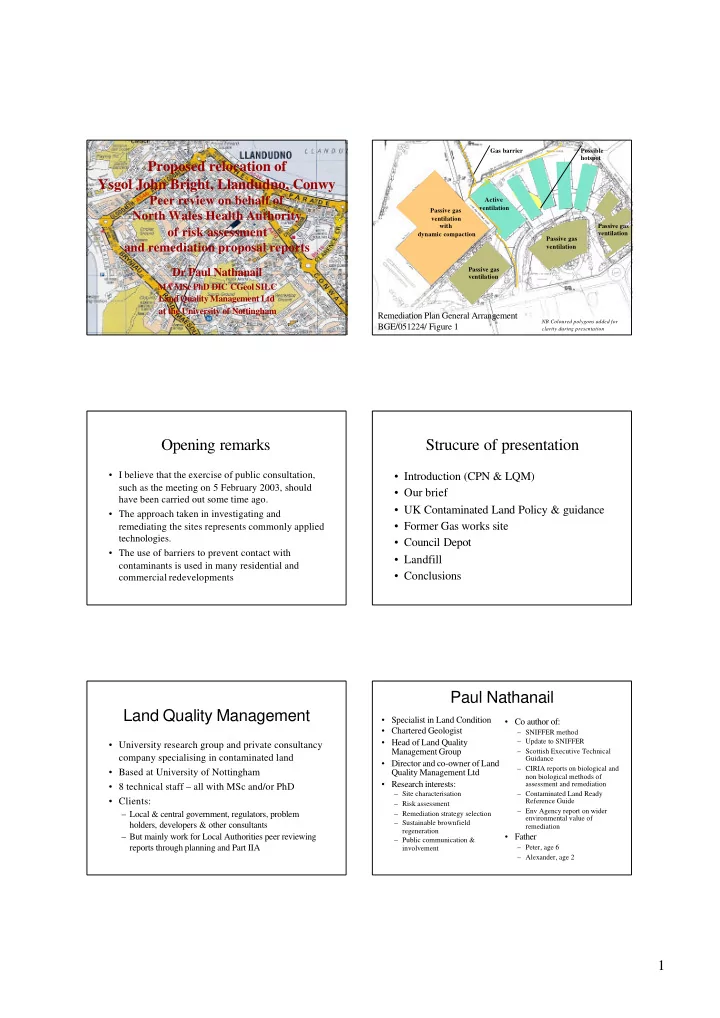
Gas barrier Possible hotspot Proposed relocation of Ysgol John Bright, Llandudno, Conwy Peer review on behalf of Active ventilation Passive gas North Wales Health Authority ventilation with Passive gas of risk assessment dynamic


slide-1
SLIDE 1

1 Proposed relocation of Ysgol John Bright, Llandudno, Conwy

Peer review on behalf of North Wales Health Authority

  • f risk assessment

and remediation proposal reports

Dr Paul Nathanail

MA MSc PhD DIC CGeol SILC Land Quality Management Ltd at the University of Nottingham Remediation Plan General Arrangement BGE/051224/ Figure 1

NB Coloured polygons added for clarity during presentation

Passive gas ventilation with dynamic compaction Passive gas ventilation Passive gas ventilation Passive gas ventilation Active ventilation Possible hotspot Gas barrier

Opening remarks

  • I believe that the exercise of public consultation,

such as the meeting on 5 February 2003, should have been carried out some time ago.

  • The approach taken in investigating and

remediating the sites represents commonly applied technologies.

  • The use of barriers to prevent contact with

contaminants is used in many residential and commercial redevelopments

Strucure of presentation

  • Introduction (CPN & LQM)
  • Our brief
  • UK Contaminated Land Policy & guidance
  • Former Gas works site
  • Council Depot
  • Landfill
  • Conclusions

Land Quality Management

  • University research group and private consultancy

company specialising in contaminated land

  • Based at University of Nottingham
  • 8 technical staff – all with MSc and/or PhD
  • Clients:

– Local & central government, regulators, problem holders, developers & other consultants – But mainly work for Local Authorities peer reviewing reports through planning and Part IIA

Paul Nathanail

  • Specialist in Land Condition
  • Chartered Geologist
  • Head of Land Quality

Management Group

  • Director and co-owner of Land

Quality Management Ltd

  • Research interests:

– Site characterisation – Risk assessment – Remediation strategy selection – Sustainable brownfield regeneration – Public communication & involvement

  • Co author of:

– SNIFFER method – Update to SNIFFER – Scottish Executive Technical Guidance – CIRIA reports on biological and non biological methods of assessment and remediation – Contaminated Land Ready Reference Guide – Env Agency report on wider environmental value of remediation

  • Father

– Peter, age 6 – Alexander, age 2

slide-2
SLIDE 2

2

Extract from our commission

The Welsh Assembly, who are providing PFI finance, have requested the County to provide an assurance that "the necessary independent technical expertise will be applied to setting and delivering the appropriate standard for remediation of the site" in response to local concerns. In order to progress this, the Health Authority Director of Public Health has reached an agreement with the CEO of Conwy County for the Authority to procure an independent review of the proposals. While the Director of Public Health would commission and receive the report, the intention is that the report would then be made available to all interested parties including the local community. All fees would be met by Conwy County.

Scope of works

  • Review risk assessment report to assess whether:
  • a. the correct pollutant linkages have been identified and

the conceptual model of the site is robust;

  • b. the assessment criteria are authoritative, scientifically

based and relevant (the tests in Part IIA for guideline values)

  • Review Remediation Proposal report - to assess whether

the proposed remediation will demonstrably break the identified pollutant linkages

  • Prepare letter report on the above
  • Present findings to local liaison group/ public meeting.

A pollutant linkage

Contamination that could cause harm In this case the schoolchildren How the contaminants can travel to and be taken up by the school children

Conceptual model

a "picture" of the site showing where the sources, pathways and receptors are in relation to one another and what significant gaps in understanding remain to be plugged by further site investigation

Contaminated land management in the UK

  • Part IIA, Environmental Protection Act 1990 (inserted by

s57 of Environment Act 1995)

http://www. hmso .gov.uk /acts/acts1995/Ukpga_19950025_en_5.htm#mdiv57

  • DETR Circular 2/2000

http://www.defra.gov.uk/environment/landliability/circ2-2000/index.htm

  • Planning Policy Guidance Note 23
  • Development on Land Affected by Contamination

Consultation Paper on Draft Planning Technical Advice

http://www.planning.odpm.gov.uk/consult/contamin/index.htm

UK Policy on land contamination

  • Risk based
  • Suitable for use
  • Source-pathway-receptor pollutant linkage

framework

  • Aim is to ensure no unacceptable risk given

the current or intended land use

  • Cf DETR Circular 2/2000
slide-3
SLIDE 3

3 Key technical guidance

http://www.defra.gov.uk/environment/landliability/pubs.htm#new

  • CLR 7 – gives general overview of

technical guidance and legislation

  • CLR 9 – basis for selecting health criteria

values

  • CLR 10 – algorithms and default data for

human health risk assessment

ICRCL 59/83 1987

  • Long term basis for many contaminated

land assessments

  • Methodology essentially sound
  • Numerical trigger values were realistic but

not scientifically derived

  • Withdrawn on 20 Dec 2002
  • Other ICRCL documents have NOT been

withdrawn

Contaminants associated with former gas works

  • Heavy metals: Cd, Cr, Cu, Pb, Hg, V, Zn,
  • Semi metals/ non metals: As, S0
  • Cyanide: Complex, free/ liberatable
  • Others: SO4

2-, S2-, asbestos, pH

  • Organics: Phenol, aromatics, PAH,

Contaminated land issues at landfill sites

  • Landfill gas generation
  • Leachate generation
  • Complex mixture of waste potentially

containing wide variety of contaminants

Remediation

  • Should demonstrably break all source-

pathway-receptor pollutant linkages

  • Options adopted for Ysgol John Bright:

– remove source (excavated & off site disposal) – Interrupt pathway (hard standing, passive & active venting & in ground gas barrier)

Proposed school location

slide-4
SLIDE 4

4

The Secondsite (LPG) parcel

  • Made ground and gasworks structures over

alluvial/ estuarine deposits

  • Shallow perched groundwater over non

aquifer; general GW flow to the east

  • Will:

– Contain part of school building, predominantly hard surface car park/ footpaths & some landscaping

Komex Environmental Assessment SI Report to LPH

50067-7 July 2001

  • Covers desk study & intrusive investigations
  • Contains assessment criteria, qualitative risk

assessment and proposed remediation

  • Overall a detailed competent report that identifies the

key issues expected on a site of this type

  • General levels of contamination were low with local

hotspots (free cyanide & PAH) associated with specific structures and post decommissioning waste disposal

  • Water levels in & out tanks differs showing they did

not leak / leaked very slowly

50067-7 July 2001

Komex Report Comments

  • Poor QA – missing & ‘pp’ signatures
  • Site investigation rationale poorly explained
  • No conceptual model as such but the

information on sources & pathways is there, poor focus on future site users, greater emphasis given to nearby residents.

50067-7 July 2001

Assessment criteria (Table G)

  • Poorly justified and now out of date

– ICRCL 18/79 1986 cited in references – ICRCL 59/83 withdrawn Dec 2002 but considered out

  • f date for some time

– No UK guidelines exist even today for many of these substances – No use of risk assessment models to calculate site specific parameters (cf Council Land report)

  • On inspection: PAH, easily liberatable cyanide &

TEX seem high

50067-7 July 2001

Remediation proposals

  • Excavation and off site disposal is most

common remediation technique in UK

  • Use of caps to break pathway is probably

second most common

  • Extent of remediation areas poorly justified
  • No proposed removal of gas holder contents

50067-7 July 2001

The Council owned parcel of land - Council Depot, Cwm Road

  • Formerly part of gas works and an asphalt works
  • Thin Made Ground in a depression over Alluvium
  • Locally elevated total PAH and TPH associated

with Garage & Gas Holder A

  • Will:

– Contain part of school building, soft landscaping & car parking

50067-8 July 2001

slide-5
SLIDE 5

5

Komex Environmental Assessment SI Report to CCBC

50067-8 July 2001

  • Site investigation rationale poorly explained
  • Location of diesel/ petrol tank found by EAC not

shown or apparently considered; no extract from EAC report provided

  • Poor logging practice
  • Inconsistencies in report
  • No conceptual model as such; information on

sources & pathways is there

  • Recommendation for further SI after demolition of

buildings - ??none done

50067-8 July 2001

Assessment criteria

  • Drawn from various sources:

– Soil: Current practice, Canadian MUST, ICRCL 59/83 – Groundwater: EQS, DWS, PNEC

  • Apparently use of different ICRCL report than for

LPH site

  • Use of total PAH does not represent ‘best practice’

in 2001

  • Canadian MUST 1991 not best practice in 2001

(TPH CWG more up to date)

  • Unclear why guidelines for residential use

presented here but not for LPH site

50067-8 July 2001

Remediation proposals

  • Excavation and off site disposal is most common

remediation technique in UK

  • Use of caps to break pathway is probably second

most common

  • Extent of remediation areas poorly justified

– How was extent of Area A & B determined? – Extent of area C (around tar pit) not shown on remediation plan – How were depths to remediate determined?

50067-8 July 2001

The Council owned parcel of land –Landfill

Babtie Site remediation statement

  • Waste transfer station
  • Playing field
  • Refuse destructor
  • Partially infilled clay pits
  • Will:

– Contain most of school buildings (small part

  • ver known landfill); playing fields (Mainly
  • ver landfill), soft landscaping

Babtie Site remediation statement

Analytes

  • Includes TPH – were BTEX and

Chlorinated solvents tested for?

Babtie Site remediation statement

Landfill gas regime

  • LFG at high concentrations (69% CH4; 21.5%

CO2)

  • Inconsistent interpretation of consequences
  • f LFG (p9 no change at perimeter due to

redevelopment; p19 need for gas migration barrier between 2 schools as gas may migrate to junior school after redevelopment.)

Babtie Site remediation statement

slide-6
SLIDE 6

6

Assessment criteria

  • Use of SNIFFER & RBCA represented

good practice at time of report, but no longer current

  • Dutch guidelines for groundwater
  • PAH based on BaP only – underestimates

toxicity of other PAH

Babtie Site remediation statement

Remediation Plan General Arrangement BGE/051224/ Figure 1

NB Coloured polygons added for clarity during presentation

Passive gas ventilation with dynamic compaction Passive gas ventilation Passive gas ventilation Passive gas ventilation Active ventilation Possible hotspot Gas barrier

Remediation proposal

  • Excavation and off site disposal is most

common remediation technique in UK

  • Use of caps to break pathway is probably

second most common

  • Use of landfill gas barrier is common

Babtie Site remediation statement

Conclusions

  • Have the correct pollutant linkages been

identified? - YES

  • Is the conceptual model of the site robust? - No

conceptual model seen.

  • Are the assessment criteria are authoritative,

scientifically based and relevant (the tests in Part IIA for guideline values)? – NO

  • Will the proposed remediation demonstrably

break the identified pollutant linkages? - Not all

  • f them

Is the conceptual model of the site robust? – NO

  • There are no conceptual models in the sense

meant by BS 10175:2001

  • The spatial relationship between

contaminants and receptors can however be determined from the information available

Are the assessment criteria are authoritative, scientifically based and relevant (the tests in Part IIA for guideline values)?

  • ICRCL has been withdrawn & are not

scientifically based

  • SNIFFER is out of date
  • RBCA without modification is

inappropriate and is not authoritative

  • Dutch guideline values are not

authoritative

slide-7
SLIDE 7

7

Will the proposed remediation demonstrably break the identified pollutant linkages? – Not all of them

  • ☺ Cover system will break pathway
  • ☺ Gas protection measures are adequate and industry

standard (key is maintenance)

  • ☺ Most of school buildings not above landfill
  • Some high methane concentrations beneath school
  • ☺ Gas migration barrier to prevent lateral migration
  • f gas to underneath school buildings
  • Assume ignition sources will be present
  • The use of inappropriate assessment criteria could

result in unsuitable material being replaced or left in place at/ near the surface

How close to a residential standard is the proposed remediation?

  • Car park

– pathway interrupted; most volatile contaminants removed

  • Playing fields

– pathway interrupted; uncertain if pathway recreated by replacement of material below site assessment criteria

  • School:

– Barriers proposed: incorporated on many residential developments – Active venting and alarm systems will interrupt pathway. Not acceptable in new housing (long term cannot be enforced).

  • Landscaped areas

– Potential for unacceptable material to be left in place or deposited there due to out of date assessment criteria

Closing remarks

  • The site has been adequately investigated but

reports good have been better compiled

  • Assessment criteria are out of date
  • Remediation scheme is commonly applied in UK
  • Remediation standard is not far off that needed for

residential use (active gas venting and alarms not appropriate for residential)

  • Council should liase with public better

recommendations

  • Assessment criteria should be reviewed in

light of CLR 9 & 10

  • site visit for local residents
  • technical consensus meeting
  • remediation verification proposals should

be reviewed prior to remediation completion

  • remediation completion reports should be

reviewed to ensure site is demonstrably safe for use as a school