Operating Systems , a 240 view Processes barely scraping the - - PowerPoint PPT Presentation

operating systems a 240 view processes
SMART_READER_LITE
LIVE PREVIEW

Operating Systems , a 240 view Processes barely scraping the - - PowerPoint PPT Presentation

Operating Systems , a 240 view Processes barely scraping the surface Key abstractions provided by kernel Program = code (static) process Process = a running program instance (dynamic) virtual memory code + state (contents of registers, memory,


slide-1
SLIDE 1

Operating Systems, a 240 view

Key abstractions provided by kernel

process virtual memory

Virtualization mechanisms and hardware support:

context-switching exceptional control flow address translation, paging, TLBs

barely scraping the surface

Processes

Program = code (static) Process = a running program instance (dynamic)

code + state (contents of registers, memory, other resources)

Key illusions:

Logical control flow

Each process seems to have exclusive use of the CPU

Private address space

Each process seems to have exclusive use of full memory

Why? How? T

  • d

a y N e x t W e e k s

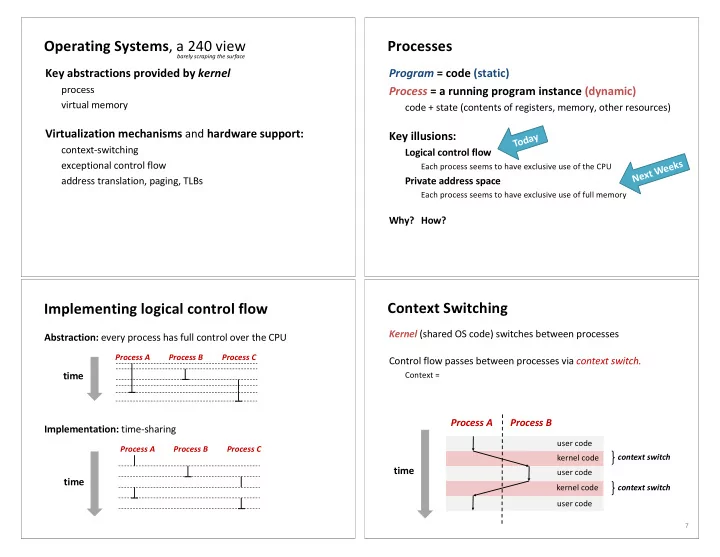
Implementing logical control flow

Abstraction: every process has full control over the CPU Implementation: time-sharing time

Process A Process B Process C Process A Process B Process C

time

Context Switching

Kernel (shared OS code) switches between processes Control flow passes between processes via context switch.

Context =

7

Process A Process B

user code kernel code user code kernel code user code context switch context switch

time

slide-2
SLIDE 2

fork

pid_t fork()

1.

Clone current parent process to create identical* child process, including all state (memory, registers, program counter, …).

2.

Continue executing both copies with one difference:

  • returns 0 to the child process
  • returns child’s process ID (pid) to the parent process

fork is unique: called in one process, returns in two processes!

(once in parent, once in child)

9

pid_t pid = fork(); if (pid == 0) { printf("hello from child\n"); } else { printf("hello from parent\n"); }

*almost. See man 3 fork for exceptions.

Creating a new process with fork

10

pid_t pid = fork(); if (pid == 0) { printf("hello from child\n"); } else { printf("hello from parent\n"); }

Process n Child Process m

pid_t pid = fork(); if (pid == 0) { printf("hello from child\n"); } else { printf("hello from parent\n"); }

à m

pid_t pid = fork(); if (pid == 0) { printf("hello from child\n"); } else { printf("hello from parent\n"); }

à 0

pid_t pid = fork(); if (pid == 0) { printf("hello from child\n"); } else { printf("hello from parent\n"); } pid_t pid = fork(); if (pid == 0) { printf("hello from child\n"); } else { printf("hello from parent\n"); }

hello from parent hello from child

Which prints first?

1 2 3 fork again

Parent and child continue from private copies of same state.

Memory contents (code, globals, heap, stack, etc.), Register contents, program counter, file descriptors…

Only difference: return value from fork() Relative execution order of parent/child after fork() undefined

11

void fork1() { int x = 1; pid_t pid = fork(); if (pid == 0) { printf("Child has x = %d\n", ++x); } else { printf("Parent has x = %d\n", --x); } printf("Bye from process %d with x = %d\n", getpid(), x); }

fork-exec

fork() clone current process execv() replace process code and context (registers, memory) with a fresh program. See man 3 execv, man 2 execve

12

// Example arguments: path="/usr/bin/ls”, // argv[0]="/usr/bin/ls”, argv[1]="-ahl", argv[2]=NULL void fork_exec(char* path, char* argv[]) { pid_t pid = fork(); if (pid != 0) { printf("Parent: created a child %d\n”, pid); } else { printf("Child: exec-ing new program now\n"); execv(path, argv); } printf("This line printed by parent only!\n"); }

slide-3
SLIDE 3

Exec-ing a new program

13

Stack Code: /usr/bin/bash Data Heap Stack Code: /usr/bin/bash Data Heap Stack Code: /usr/bin/bash Data Heap Stack Code: /usr/bin/ls Data

fork(): exec(): When you run the command ls in a shell:

parent child child Code/state of shell process. Copy of code/state

  • f shell process.

Replaced by code/state of ls. Code/state of shell process.

1 2 2 3

execv: load/start program

int execv(char* filename, char* argv[]) loads/starts program in current process:

Executable filename With argument list argv

  • verwrites code, data, and stack

Keeps pid, open files, a few other items

does not return

unless error Also sets up environment. See also: execve.

14 Null-terminated env var strings

unused

Null-terminated argument strings

envp[n] == NULL envp[n-1] envp[0] … Linker vars argv[argc] == NULL argv[argc-1] argv[0] … envp argc argv Stack bottom Stack frame for main Stack top

wait for child processes to terminate

pid_t waitpid(pid_t pid, int* stat, int ops) Suspend current process (i.e. parent) until child with pid ends. On success: Return pid when child terminates. Reap child.

If stat != NULL, waitpid saves termination reason where it points.

See also: man 3 waitpid

16

waitpid example

18

void fork_wait() { int child_status; pid_t child_pid == fork(); if (child_pid == 0) { printf("HC: hello from child\n"); } else { if (-1 == waitpid(child_pid, &child_status, 0) { perror("waitpid"); exit(1); } printf("CT: child %d has terminated\n”, child_pid); } printf("Bye\n"); exit(0); }

HCBye CTBye