Operation of Anaerobic Digestion Jeanette Brown, Manhattan College - - PDF document

operation of anaerobic digestion
SMART_READER_LITE
LIVE PREVIEW

Operation of Anaerobic Digestion Jeanette Brown, Manhattan College - - PDF document

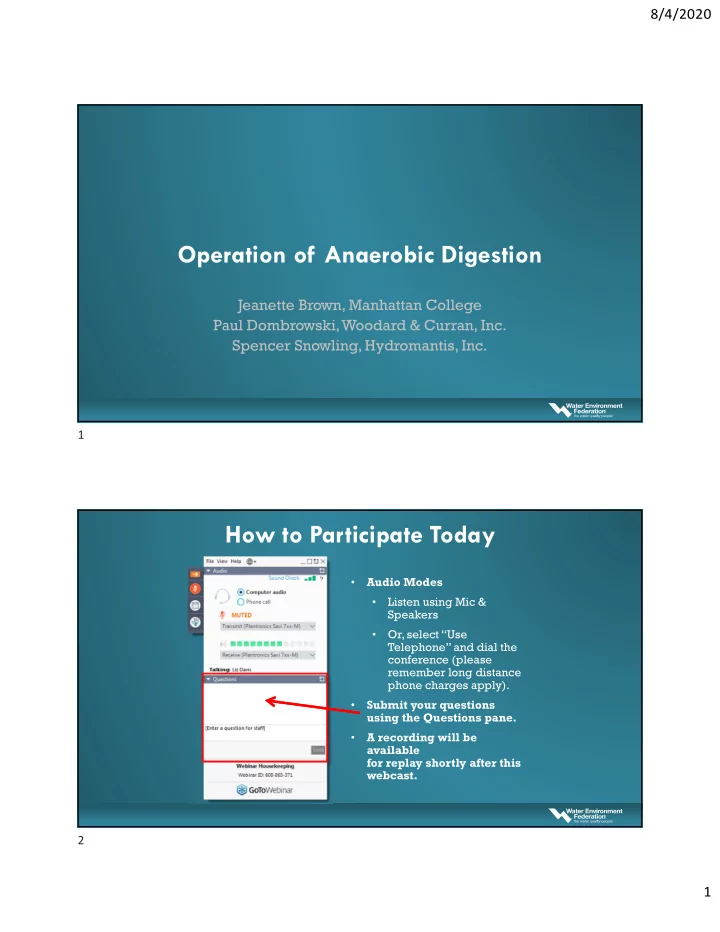
8/4/2020 Operation of Anaerobic Digestion Jeanette Brown, Manhattan College Paul Dombrowski, Woodard & Curran, Inc. Spencer Snowling, Hydromantis, Inc. 1 How to Participate Today Audio Modes Listen using Mic & Speakers


slide-1
SLIDE 1

8/4/2020 1

Operation of Anaerobic Digestion

Jeanette Brown, Manhattan College Paul Dombrowski, Woodard & Curran, Inc. Spencer Snowling, Hydromantis, Inc.

How to Participate Today

  • Audio Modes
  • Listen using Mic &

Speakers

  • Or, select “Use

Telephone” and dial the conference (please remember long distance phone charges apply).

  • Submit your questions

using the Questions pane.

  • A recording will be

available for replay shortly after this webcast.

1 2

slide-2
SLIDE 2

8/4/2020 2

Jeanette Brown, PE, BCEE, D.WRE, Dist.M.ASCE, F.WEF

Research Assistant Professor Manhattan College

Paul Dombrowski, PE, BCEE, F.WEF, Grade 6 Operator (MA)

Chief Technologist Woodard & Curran, Inc.

3 4

slide-3
SLIDE 3

8/4/2020 3

Spencer Snowling, Ph.D, P.Eng

V.P ., Product Development Hydromantis Environmental Software Solutions, Inc.

Webinar Agenda

  • Introductions
  • Fundamental Concepts of Anaerobic Digestion Process Theory
  • Simulator Overview
  • Types of Anaerobic Digestion Processes
  • Anaerobic Digestion Process Control
  • Simulator Case Study
  • Questions

5 6

slide-4
SLIDE 4

8/4/2020 4

Anaerobic Digestion Process Theory

Jeanette Brown, Manhattan College

Anaerobic digestion

  • Anaerobic Digestion is a
  • complex biochemical process which converts organic

compounds to methane and carbon dioxide (biogas).

  • Reduces odor, pathogens, and volatile solids
  • Can produce Class A or B biosolid as per 40CFR503
  • Recover nutrients in the form of fertilizer
  • Recovers energy in the form of biogas
  • Heat
  • Electricity

7 8

slide-5
SLIDE 5

8/4/2020 5

Advantages/Disadvantages of Anaerobic Digestion

  • Advantages
  • Can accept high strength

wastes

  • Useful end product-CH4
  • Lower cell yield-less

residual sludge

  • BOD removal about 0.45 lbs
  • f biomass per lb of BOD
  • AD about 0.08 lb/lb
  • Lower N/P requirements
  • Disadvantages
  • Optimum temperature

requires heat input

  • Presence of oxidizing

agents is toxic (oxygen)

  • Low growth rate-start-up

and recovery from adverse conditions is slow

  • Digester supernatant high

in nitrogen and phosphorus

Terms

  • Anaerobic processes
  • Biological processes occur in the absence of free dissolved
  • xygen and oxidized compounds
  • Digestate
  • Solid material remaining after digestion
  • Supernatant/centrate/filtrate
  • Liquid from separated from digestate

9 10

slide-6
SLIDE 6

8/4/2020 6

Overview of Anaerobic Digestion Process

Volatile Solids Soluble Organics, Gases Volatile Solids Reduction (VSR)

Step 1 - Hydrolysis

11 12

slide-7
SLIDE 7

8/4/2020 7

Hydrolysis

  • The chemical breakdown of compounds due to reaction

with water

  • Particulates made soluble
  • Large molecules (polymers) broken down into smaller

molecules (monomers)

  • Allow passage through bacterial cell wall
  • Rate limiting step
  • Driving new pretreatment technologies such as thermal

hydrolysis

Carbohydrates

  • A macromolecule (polymer)

starch cellulose common carbohydrates a simple sugar

13 14

slide-8
SLIDE 8

8/4/2020 8

OH H R H H N O C C H R` H N C O C OH H H R` H N C O C OH

Protein

Peptide Bond

  • A macromolecule (polymer)

Amino Acid

Fats (Lipids)

  • Molecule composed of fatty acids

Fatty Acids: Long-chain hydrocarbon (~C5 to C24) molecule capped by a carboxyl group (COOH)

C2:0 Acetic acid C2H4O2 CH3COOH C3:0 Propionic acid C3H6O2 CH3CH2COOH C4:0 Butyric acid C4H8O2 CH3(CH2)2COOH C4:0 Isobutyric acid C4H8O2 (CH3)2CHCOOH C5:0 Valeric acid C5H10O2 CH3(CH2)3COOH C5:0 Isovaleric acid C5H10O2 (CH3)2CHCH2COOH C6:0 Caproic acid C6H12O2 CH3(CH2)4COOH C8:0 Caprylic acid C8H16O2 CH3(CH2)6COOH C10:0 Capric acid C10H20O2 CH3(CH2)8COOH C12:0 Lauric acid C12H24O2 CH3(CH2)10COOH

15 16

slide-9
SLIDE 9

8/4/2020 9

Step 2 – Acidogenesis (Fermentation) Step 2 – Acidogenesis (Fermentation)

  • Sugars, amino acids, and long-chain fatty acids

converted to short-chain volatile fatty acids (76%), H2 (4%), and some acetic acid (20%)

  • Optimum growth rate occurs near pH 6
  • Volatile fatty acids generally not significant consumer of

alkalinity

  • CO2 significant consumer of alkalinity
  • NH3 produced from amino acids

17 18

slide-10
SLIDE 10

8/4/2020 10

Step 2 – Acidogenesis (Fermentation

  • Principal fermentation products are
  • Propionic and Butyric Acid (plus some Acetic Acid)
  • CO2 , and
  • H2

C2:0 Acetic acid C2H4O2 CH3COOH C3:0 Propionic acid C3H6O2 CH3CH2COOH C4:0 Butyric acid C4H8O2 CH3(CH2)2COOH C4:0 Isobutyric acid C4H8O2 (CH3)2CHCOOH C5:0 Valeric acid C5H10O2 CH3(CH2)3COOH C5:0 Isovaleric acid C5H10O2 (CH3)2CHCH2COOH C6:0 Caproic acid C6H12O2 CH3(CH2)4COOH C8:0 Caprylic acid C8H16O2 CH3(CH2)6COOH C10:0 Capric acid C10H20O2 CH3(CH2)8COOH C12:0 Lauric acid C12H24O2 CH3(CH2)10COOH

Acetogenesis

19 20

slide-11
SLIDE 11

8/4/2020 11

Step 3 - Acetogenesis

  • Propionic and butyric acids are converted to acetic acid

H2, and CO2

  • Sensitive to H2 concentration
  • Syntrophic (mutually beneficial) relationship with the

methanogens

  • Final products (acetic acid, hydrogen, and CO2 ,
  • precursors of methane formation.

ethanoic acid (acetic acid / vinegar) CH3 — C O — H O

Step 4 - Methanogenesis

21 22

slide-12
SLIDE 12

8/4/2020 12

Methanogenesis

  • Methanogens
  • Obligate anaerobes
  • Tend to have slower growth rates
  • H2 utilizing methanogens use H2 to produce methane
  • Acetic acid utilizing methanogens us acetic acid to produce methane
  • Limited pH range 6.7 to 7.4
  • importance of alkalinity in system
  • Sensitive to temperature change
  • Produce methane

Routes to Formation of Methane

Hydrogenotrophic methanogens

CO2 + 4 H2  CH4 + 2 H2O

Acetotrophic methanogens

4 CH3COOH + 2 H2  4 CH4 + 4 CO2 + 2 H2

23 24

slide-13
SLIDE 13

8/4/2020 13

Products of Digestion

  • Beneficial
  • Biogas
  • Digestate
  • Nuisance
  • Scum
  • Sidestream

Biogas

  • Biogas
  • Methane-CH4 (Typically 60 to 65 %)
  • Carbon Dioxide-CO2 (Typically 30 to 35%)
  • Energy Content
  • CH4 -1000 BTU/ft3
  • @60% methane-biogas is ~600 BTU/ft3
  • Gas production rate
  • 12 to 18 ft3 per pound of VS destroyed

25 26

slide-14
SLIDE 14

8/4/2020 14

Biogas

  • Used to
  • Heat the digester and incoming sludge
  • Heat building
  • Generate electricity
  • Requires clean-up
  • Remove moisture
  • Remove H2S
  • Remove soloxanes

Digestate

  • Digestate are stabilized biosolids
  • Reduced volatile solids and pathogens
  • Meets Class A or B standards-typically Class B
  • Digestate
  • Used as a fertilizer in land application to recover
  • nutrients,
  • carbon, and
  • water

27 28

slide-15
SLIDE 15

8/4/2020 15

Scum

  • Scum
  • Lighter solids which float to the top of the digester
  • Foam
  • Problems
  • material is not digested because it is floating
  • reduces digester capacity
  • plugs piping
  • plugs vents and flame traps

Sidestreams

  • Supernatant if using two-stage digestion
  • Filtrate or Centrate produced by dewatering
  • Characteristics
  • High solids concentration
  • High BOD concentration
  • High nutrient concentration
  • Especially ammonia-nitrogen
  • Phosphorus

29 30

slide-16
SLIDE 16

8/4/2020 16

Anaerobic Digestion Processes

  • Defined by temperature range
  • Mesophilic Range 30-38oC (85 to 100oF) ; typical 35oC (95oF)
  • Thermophilic Range 50-57oC (122 to 135oF); typical; 55oC (131oF)
  • pH
  • Optimum 7.0 to 7.1
  • General Limits 6.7 to 7.4
  • Gas Production
  • 12 to 18 ft3 of gas per pound of volatile solids destroyed

Bacteria: Environmental Conditions

strict aerobes Dissolved Oxygen strict anaerobes facultative anaerobes tolerant anaerobes thermophilic Temperature mesophilic 30 – 35 oC 50 – 60 oC Toxicity (NH3, H2S, metals) Functional Fatal Inhibitory methanogens acidogens 6.8 - 7.2 pH 5.0 6.2

31 32

slide-17
SLIDE 17

8/4/2020 17

Process Simulators

Paul Dombrowski, Woodard & Curran, Inc.

Simulator Overview

  • Model = Series of equations that defines a process or plant
  • Model based on mass balances and biological conversions of
  • rganics (COD), nitrogen, phosphorus and solids
  • Simulator = Program that uses a process model to

experiment with a plant configuration

  • OpTool SimuWorks Overlay = Plant-specific layout that

provides graphical interface for plant operational testing and training

33 34

slide-18
SLIDE 18

8/4/2020 18

GPS-X Biosolids Model Layout

8,250 lbs/d 8,250 lbs/d 14,025 lbs/d 2,475 lbs/d 403 lbs/d 8,052 lbs/d 7,649 lbs/d At SRT of 20 days and 35oC 5,973 lbs/d VSS converted to gas 2,878 lbs/d 17% of PS+WAS

SimuWorks Biosolids Layout

35 36

slide-19
SLIDE 19

8/4/2020 19

Digester Performance vs. Changing Temperature

Exercise –

37 38

slide-20
SLIDE 20

8/4/2020 20

Anaerobic Digestion Processes and Process Control Digesters

Biogas Sludge Sludge Feed Heat Digestate

39 40

slide-21
SLIDE 21

8/4/2020 21

Digester Geometry-Cylindrical Digester Geometry-Egg-Shaped

Mixer Biogas Digestate Sludge Feed Mixing Nozzles Heat

41 42

slide-22
SLIDE 22

8/4/2020 22

Advantages and Disadvantages of Shape

Cylindrical

  • shape results in large volume for gas storage
  • can be equipped with gas holder covers
  • Low profile
  • Conventional construction techniques can be applied;

construction costs can be competitive Egg Shaped

  • Minimum grit accumulation
  • Reduced scum formation • Higher mixing efficiency
  • More homogeneous biomass is obtained
  • Lower operating and maintenance costs; cleaning

frequency significantly reduced

  • Smaller footprint; less land area is required
  • Foaming is minimized

Cylindrical

  • Shape results in inefficient mixing and dead spaces
  • Poor mixing results in grit accumulation
  • Large surface area provides space for scum accumulation

and foam formation

  • Cleaning is required for removal of grit and scum

accumulation; digester may be required to be taken out of service Egg Shaped

  • Very little gas storage volume; external gas storage is

required if as is recovered

  • High profile structures; may be aesthetically objectionable
  • Difficult access to top-mounted equipment; installation

requires a high stair tower or an elevator

  • Greater foundation requirements and seismic considerations
  • Higher construction costs
  • Construction limited to specialty contractors

43 44

slide-23
SLIDE 23

8/4/2020 23

Mixing and Heating

  • Digesters must be
  • Heated
  • Incoming sludge is cold
  • Requires heat exchanger
  • Mixed
  • Organisms must contact substrate
  • Releases gas from sludge

45

Source: HRS Heat Exchangers, 2018

Types of Digestion Processes

  • Single-Stage High Rate Digestion
  • Two-Stage Digestion
  • Temperature-Phased Digestion
  • Acid/Gas Phased Digestion

45 46

slide-24
SLIDE 24

8/4/2020 24

High Rate, Continuous-Flow, Stirred Tank Single Stage Digester

Sludge inlets Fixed cover Gas Storage Sludge heater Digestate Mixer CH4 + CO2 To Dewatering

High-Rate Digestion

  • Contents are heated and mixed completely
  • Mesophilic
  • Detention time typically 15 to 20 days
  • Uniform feeding required for optimum performance
  • No supernatant separation
  • Either egg or cylindrical with fixed or floating covers

47 48

slide-25
SLIDE 25

8/4/2020 25

Two-Stage Anaerobic Digester

Sludge inlet Fixed cover Gas Storage Sludge heater Sludge outlets Mixer Digester Gas outlet First stage (completely mixed) Sludge inlets Second stage (stratified) Gas Storage Scum layer Supernatant layer Digested sludge Supernatant

  • utlets

Sludge

  • utlets

Floating cover

Characteristics of Two-Stage Digestion

  • High-rate digester coupled in series with a second

digestion tank

  • First stage used for digestion
  • heated and mixed
  • Second stage used to separate the digested solids from

the supernatant

  • not heated or mixed
  • some additional digestion and gas production may occur.

49 50

slide-26
SLIDE 26

8/4/2020 26

Temperature Phased Digestion

  • Temperature Phased
  • Various combinations of mesophilic (35o C) and thermophilic

(55o C) staged digesters

Thermophillic Digestion Mesophillic Digestion Waste Solids To Dewatering

3 to 5 day detention time >10 day detention time

Temperature Phased Digestion

  • Advantage
  • Thermophilic-greater hydrolysis and biological activity
  • greater VS destruction and gas production
  • Mesophilic-additional VS destruction
  • destruction of odorous compounds (mostly fatty acids)
  • improved stability of the digestion operation.

51 52

slide-27
SLIDE 27

8/4/2020 27

Waste Solids To Dewatering

Acid / Gas Phased Digestion

  • Acid/Gas Digestion
  • First Stage is low pH (5 to 6) fermentation step
  • Second Stage is normally conventional Mesophilic (pH=7)

Acid Phase Digestion Methanogenic Digestion

1 to 3 day detention time >10 day detention time

Acid / Gas Phased Digestion

  • Acid phase digester
  • Hydrolysis and acidogenesis
  • pH of 6 or less and at a short SRT
  • produces high concentrations of volatile acids (> 6000 mg/L)
  • Gas phase digester
  • neutral pH and a longer SRT
  • maximize gas production

53 54

slide-28
SLIDE 28

8/4/2020 28

Important Process Variables

  • Volatile solids reduction/destruction
  • HRT/SRT
  • Temperature

Volatile Solids Reduction and Destruction

  • % VS Reduction

𝑊𝑇𝑆 𝑊𝑇 𝑊𝑇 𝑊𝑇 𝑊𝑇𝑦𝑊𝑇 𝑦100

  • VS Destruction (lbs/d VS destroyed per ft3)

𝑊𝑇𝐸 𝑊𝑇 𝑊𝑇𝑆 𝑊𝑝𝑚

55 56

slide-29
SLIDE 29

8/4/2020 29

Hydraulic and Solids Retention Time

  • Digester sizing based on
  • Sufficient residence time for significant reduction of VS
  • HRT-average time liquid is held in the process
  • Digester volume/volume of sludge removed per day
  • SRT-average time solids are in digestion process
  • mass in reactor/mass per day removed
  • For most AD processes HRT=SRT

Solids Retention Time

  • Hydrolysis, Fermentation, and methanogenesis directly related

to SRT

  • An increase or decrease in SRT results in an increase of

decrease in the extent of each reaction.

  • If SRT is less than the minimum SRT for each reaction, bacteria will

not grown rapidly enough and the process will fail.

57 58

slide-30
SLIDE 30

8/4/2020 30

Temperature

  • Influences
  • Metabolic activity
  • Gas transfer
  • Settling characteristics
  • Digestion rate
  • Minimum SRT for VS destruction

Response of Mesophilic Bacterial Growth to Temperature

10 20 30 40 50 Temperature (oC) 1.0 0.8 0.6 0.4 0.2 Specific growth rate

dormant but viable ↔ lethal 35 o optimum CH4 production sour digester

59 60

slide-31
SLIDE 31

8/4/2020 31

Digester SRT vs. Volatile Solids Reduction Exercise –

35oC 30oC 25oC

61 62

slide-32
SLIDE 32

8/4/2020 32

Exercise –

35oC with increasing load

Process Monitoring and Control-sampling

  • Process control and monitoring require sampling and

testing of the

  • digester feed,
  • biogas, and
  • digested solids

63 64

slide-33
SLIDE 33

8/4/2020 33

Process Monitoring and Control

Solids (feed and digestate)

  • COD
  • pH
  • Alkalinity
  • Volatile Acids
  • TS/VS
  • Nitrogen/Phosphorus

Temperature

Gas

  • Methane
  • CO2
  • H2S
  • Siloxanes (if electrical

generation is used) Supernatant/Centrate/Filtrate

  • NH4-N/TKN
  • Ortho and total P
  • TS/VS
  • COD/BOD

Sampling and Monitoring Locations

Sludge heater Sludge inlets Fixed cover

Gas Storage

Digestate Biogas To Dewatering Sludge Feed (after thickening)

COD pH Alkalinity Volatile Acids TS/VS Nitrogen/Phosphorus CH4 CO2 H2S Siloxanes Temperature Temperature Temperature COD pH Alkalinity Volatile Acids TS/VS Nitrogen/Phosphorus

65 66

slide-34
SLIDE 34

8/4/2020 34

Process Monitoring and Control-temperature

  • Each group methanogens has an
  • ptimum temperature for growth
  • If temperature fluctuates, methane

formers cannot develop a large, stable population

  • Temperature should not vary more

that ±1o F for optimum performance

  • Temperature should be continually

monitored

Process Monitoring and Control-COD

  • By measuring COD coming in and COD going out
  • Calculate a COD balance
  • Accounts for changes in COD in the reactor
  • COD loss in anaerobic reactor is accounted for by methane

production

  • CH4 equivalent of COD equals 0.35 L CH4/g COD

67 68

slide-35
SLIDE 35

8/4/2020 35

Process Monitoring and Control-pH

  • Best pH operating range: 6.8 to 7.2
  • below 6.0-unionized volatile acids become toxic to methane-

forming microorganisms

  • Above 8.0-unionized dissolved ammonia becomes toxic to

methane-forming microorganisms.

  • pH of the digester contents is controlled by the ratio of

volatile acids to alkalinity

Process Monitoring and Control-Alkalinity

  • Digesters typically have sufficient alkalinity
  • breakdown of protein and amino acids to produces NH3,

which combines with CO2 and H2O to form alkalinity as NH4(HCO3), Ca(HCO3)2 and Mg(HCO3)2 also present

  • A well operated digester
  • total alkalinity of 2000 to 5000 mg/L
  • The higher the alkalinity, the more stable the digester

(supplemental alkalinity can be supplied by sodium

bicarbonate, lime, or sodium carbonate)

  • 69

70

slide-36
SLIDE 36

8/4/2020 36

Process Monitoring and Control-Alkalinity

  • Volatile acids are intermediate digestion byproducts
  • Typically C2 to C4 (acetic, propionic, butyric)
  • Typical total volatile acid concentrations range from 50 to 300

mg/L

  • Unstable digester operation can develop where VA production

rate exceeds methanogenic VA utilization rate

  • VA concentration increases
  • Causes pH to drop, depending on the amount of alkalinity available to

buffer the organic acid concentration increase

Process Control-Volatile Acid to Alkalinity Ratio

  • VA:ALK ratio
  • indicates progress of digestion and
  • balance between the acid fermentation and methane

utilization microorganisms

  • need for balance between volatile acids and alkalinity
  • VA:ALK ratio is an excellent indicator of digester health
  • Careful monitoring of the rate of change in this ratio can

indicate a problem before a pH change occurs.

71 72

slide-37
SLIDE 37

8/4/2020 37

Process Control-Volatile Acid to Alkalinity Ratio

  • VA:ALK ratio should be approximately 0.05 to 0.25.
  • Digester pH depression and inhibition of methane production
  • ccur if the ratio exceeds 0.8;
  • Ratios higher than 0.3 to 0.4 indicate upset conditions and the

need for corrective action.

  • Add alkalinity
  • Check temperature measurements
  • Check heat exchanger

𝑊𝐵 𝐵𝑀𝐿 𝑊𝐵, 𝑛𝑕/𝑀 𝐵𝑀𝐿, 𝑛𝑕/𝑀

Digester SRT vs. pH, VA/ALK and Gas Produced

73 74

slide-38
SLIDE 38

8/4/2020 38

Exercise – Exercise –

75 76

slide-39
SLIDE 39

8/4/2020 39

Exercise – Biosolids Handling Case Study

Spencer Snowling, Hydromantis, Inc.

77 78

slide-40
SLIDE 40

8/4/2020 40

Biosolids Handling Case Study

  • Little Patuxent Water

Reclamation Plant, Savage, MD

  • ENR - BOD, Nitrogen and

Phosphorus Removal

  • Biosolids Handling Facility
  • WAS Gravity Thickener
  • Primary Sludge GBT
  • 3 Anaerobic Digesters

Biosolids Case Study

  • Little Patuxent Water Reclamation Plant, Savage, MD

79 80

slide-41
SLIDE 41

8/4/2020 41

  • Little Patuxent Water Reclamation Plant, Savage, MD

Biosolids Case Study Biosolids Case Study

  • Little Patuxent Water Reclamation Plant, Savage, MD

81 82

slide-42
SLIDE 42

8/4/2020 42

Biosolids Case Study

  • Standard Operation (WAS + Primary Sludge)
  • 2 Primary Digester and 1 Secondary Digester

Biosolids Case Study #1

  • GBT Off-line (WAS unthickened)

GBT On-line GBT Off-line

83 84

slide-43
SLIDE 43

8/4/2020 43

Biosolids Case Study

  • GBT Off-line (WAS unthickened)

Biosolids Case Study #2

  • Increased Digester Temperature

Base Temp (95ºF) 3ºF Increase (98ºF)

85 86

slide-44
SLIDE 44

8/4/2020 44

Biosolids Case Study

  • Increased Digester Temperature

Case Study Summary

  • Sludge thickening has a significant impact on digester

performance

  • Little Patuxent WRF has significant digester capacity, can

absorb small changes in loading

  • Increased temperature produces more gas, which can

then be captured to supply heat to digesters

87 88

slide-45
SLIDE 45

8/4/2020 45

Questions?

Jeanette Brown jeanette.brown@manhattan.edu (203) 309-8768 Paul Dombrowski pdombrowski@woodardcurran.com (860) 253-2665 Spencer Snowling snowling@hydromantis.com (905) 522-0012 x223

89