Operation of Biological and Chemical Phosphorus Removal Systems - - PDF document

operation of biological and chemical phosphorus removal
SMART_READER_LITE
LIVE PREVIEW

Operation of Biological and Chemical Phosphorus Removal Systems - - PDF document

7/22/2020 Operation of Biological and Chemical Phosphorus Removal Systems Paul Dombrowski, Woodard & Curran, Inc. Spencer Snowling, Hydromantis, Inc. 1 How to Participate Today Audio Modes Listen using Mic & Speakers


slide-1
SLIDE 1

7/22/2020 1

Operation of Biological and Chemical Phosphorus Removal Systems

Paul Dombrowski, Woodard & Curran, Inc. Spencer Snowling, Hydromantis, Inc.

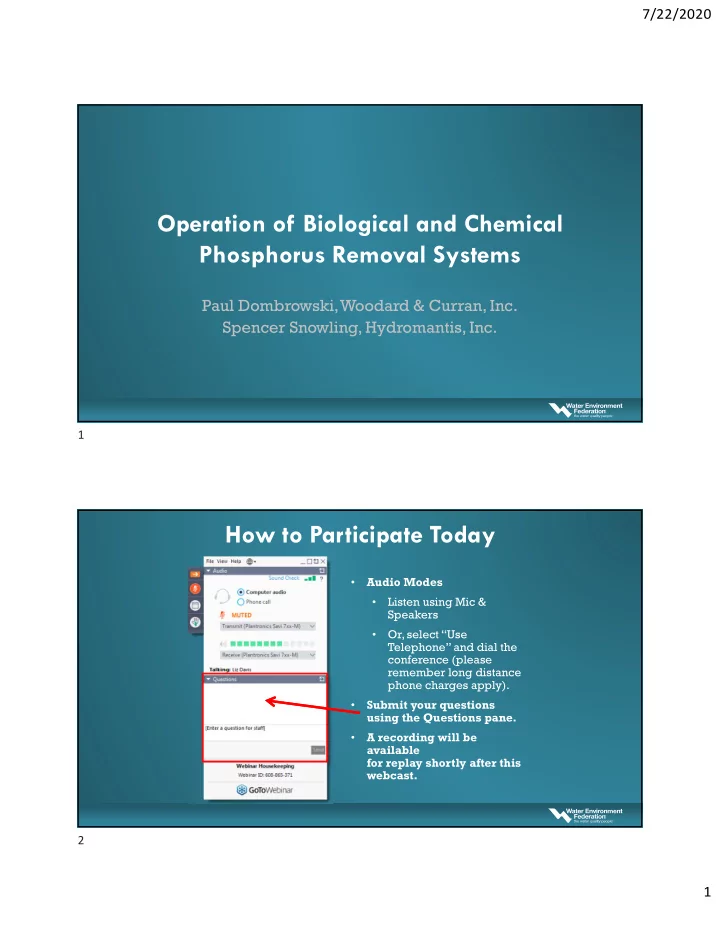
How to Participate Today

  • Audio Modes
  • Listen using Mic &

Speakers

  • Or, select “Use

Telephone” and dial the conference (please remember long distance phone charges apply).

  • Submit your questions

using the Questions pane.

  • A recording will be

available for replay shortly after this webcast.

1 2

slide-2
SLIDE 2

7/22/2020 2

Paul Dombrowski, PE, BCEE, F.WEF, Grade 6 Operator (MA)

Chief Technologist Woodard & Curran, Inc.

Spencer Snowling, Ph.D, P.Eng

V.P ., Product Development Hydromantis Environmental Software Solutions, Inc.

3 4

slide-3
SLIDE 3

7/22/2020 3

Webinar Agenda

  • Introductions
  • Fundamental Mechanisms of Phosphorus Removal
  • Simulator Description and Overview
  • Biological Phosphorus Removal
  • EBPR Simulator Examples
  • Chemical Phosphorus Removal
  • Chemical-P Simulator Examples
  • Hydromantis Case Studies
  • Questions

Biological Phosphorus Removal

5 6

slide-4
SLIDE 4

7/22/2020 4

Phosphorus Removal

Biologically Chemically

STEP 1: Convert soluble P to solid form

Clarifier , Filter

  • r Membrane

STEP 2: Remove solids from wastewater

AND DON’T LET THE PHOSPHORUS RE-SOLUBILIZE!

Forms of Phosphorus

Total Phosphorus Reactive Phosphorus Total Soluble Phosphorus Particulate Organic - P Dissolved Meta & Polyphosphate Orthophosphate Dissolved Organic - P Total Particulate Phosphorus

Always consider potential for non-reactive, soluble-P , especially when stringent effluent limits are required

Particulate Meta & Polyphosphate

7 8

slide-5
SLIDE 5

7/22/2020 5

Solids Removal Impacts

  • Effluent TSS contains:
  • Secondary Effluent – 2% as P
  • Chemical P Effluent – 4% as P
  • Enhanced Bio-P Effluent – 6%+ as P

The treatment technology and effluent TP limits will dictate if Advanced TSS Removal will be required to meet permit.

Stringent P Limits require low TSS

Chem P Removal Typical AS Bio P Removal Chem P Removal Typical AS Bio P Removal 0.2 mg/L increase for every 2% more P in TSS at 10 mg/L 0.1 mg/L increase for every 2% more P in TSS at 5 mg/L

9 10

slide-6
SLIDE 6

7/22/2020 6

Process Simulators Simulator Overview

  • Model = Series of equations that defines a process or plant
  • Model based on mass balances and biological conversions of
  • rganics (COD), nitrogen, phosphorus and solids
  • Simulator = Program that uses a process model to

experiment with a plant configuration

  • OpTool SimuWorks Overlay = Plant-specific layout that

provides graphical interface for plant operational testing and training

11 12

slide-7
SLIDE 7

7/22/2020 7

GPS-X Process Simulator Process Simulator Layout

13 14

slide-8
SLIDE 8

7/22/2020 8

Biological Phosphorus Removal Conventional Biological P Removal

  • Happens with any biological treatment process:
  • As new bacterial cells are formed,

P is removed as a requirement for cell growth

  • Roughly 1% of the BOD5 removed
  • 1% - 3% P in sludge

Concord, MA WWTF CoMag Process

15 16

slide-9
SLIDE 9

7/22/2020 9

PAO’s vs. GAO’s

  • Phosphorus Accumulating Organisms (PAO)
  • Can store soluble substrate under anaerobic conditions to accumulate

excess phosphorus

  • Glycogen Accumulating Organisms (GAO)
  • Can store soluble substrate under anaerobic conditions BUT DO NOT

accumulate phosphorus

  • Conditions that favor GAO’s
  • Low pH
  • Excessive carbon
  • High temperature
  • Longer SRT (5+ days)

Aerobic

PHBs

PAO

Enhanced Biological Phosphorus Removal (EBPR)

  • Requires absence of Oxygen
  • Requires absence of Nitrate
  • Requires readily degradable

carbon in form of short chain volatile fatty acids (VFA)

  • Prefers a distinct O2 gradient

for P-uptake

  • Removal occurs through

waste sludge

VFA

(soluble substrate)

PAO P Anaerobic

Poly-Ps PHBs Poly-Ps

O2 CO2+H2O

Growth Phase

P P Anaerobic

Anaerobic Phase “Batteries” Carbon (PHB) – Charging Phosphorus- Discharging Aerobic Phase “Batteries” Carbon (PHB) – Discharging Phosphorus- Charging

17 18

slide-10
SLIDE 10

7/22/2020 10

Enhanced Biological P Removal (AO)

Anaerobic Tank Influent Aeration Tank

BOD Removal & EBPR

RAS Pump Secondary Clarifier

No DO No NOx >>DO

Enhanced Biological P Removal

5 10 15 20 25 2 4 6 8 10 12 14 16 18 Soluble Phosphorus Concentration (mg/L) Location in Tank ANAEROBIC ZONE AEROBIC ZONE

19 20

slide-11
SLIDE 11

7/22/2020 11

Keys to EBPR

  • Ratio of Carbon: P (BOD/TP or COD/TP Ratio)
  • COD/TP of >40:1 preferred, rbCOD/TP of >15:1
  • Initial Anaerobic Zone
  • BOD available
  • Exclude oxygen, nitrate
  • Nature of Carbon Source (soluble, readily biodegradable)
  • Make it yourself – VFA formation in PC, sludge holding
  • Buy it – Chemical addition of VFA’s
  • Downstream Aerobic & Anoxic Zones
  • Not allowed to go anaerobic again until WAS removed – “secondary release”
  • Sludge Handling System

A2O Process

RAS Pump Aeration Tank (fully aerobic) Secondary Clarifier Effluent Influent

BOD Removal, Nitrification, Denitrification & Phosphorus

Anoxic Tank Nitrified Recycle Waste Sludge Anaerobic Tank

21 22

slide-12
SLIDE 12

7/22/2020 12

5-Stage Bardenpho Process

RAS Pump Aeration Tank (fully aerobic) Secondary Clarifier Effluent Influent

BOD Removal, Nitrification, Denitrification & Phosphorus

Anoxic Tank Anoxic Tank Aeration Tank Nitrified Recycle

Carbon (optional)

Waste Sludge Anaerobic Tank

Process Simulator – EBPR Examples

23 24

slide-13
SLIDE 13

7/22/2020 13

Limitations of Conventional EBPR

  • Reliant on influent conditions
  • Changes in influent conditions or operation can result in

inconsistent performance

  • Minimal process control options
  • Potential competition of GAOs with PAOs

25 26

slide-14
SLIDE 14

7/22/2020 14

Conventional EBPR

Anaerobic Tank Influent Aeration Tank

BOD Removal & EBPR

RAS Pump Secondary Clarifier

DO? Sufficient Carbon? DO? NOx?

Sidestream EBPR is the next wave…

  • S2EBPR is a fairly recent development in nutrient removal
  • Europe: in use for more than 10 years
  • USA: in use at a few facilities in recent years
  • S2EBPR conditions a portion of the RAS or MLSS to grow PAOs
  • S2EBPR requires:

Holding the solids under “deep” anaerobic conditions to ferment the activated sludge solids to make VFA’s, allowing release and then P uptake in downstream anoxic and aerobic zones.

27 28

slide-15
SLIDE 15

7/22/2020 15

Conventional EBPR

Anaerobic Tank Influent Aeration Tank RAS Pump Secondary Clarifier

BOD Removal & EBPR

10-30% RAS to Anaerobic 70-90% RAS To Aerobic

Anaerobi c Tank

Sidestream EBPR (S2EBPR) with Anoxic Zone

Anaerobic Tank Influent Aeration Tank RAS Pump Secondary Clarifier

BOD Removal, TN Removal & EBPR

10-30% RAS to Anaerobic 70-90% RAS to Aerobic

Anoxic Tank Nitrified Recycle

29 30

slide-16
SLIDE 16

7/22/2020 16

Why Use S2EBPR?

  • More reliable than conventional EBPR
  • Less sensitive to influent carbon quantity and quality
  • Less impacted by DO and NO3-N recycles
  • Selects against GAO’s
  • Uses similar or less tank volume as standard EBPR
  • Can be readily incorporated into existing tanks
  • Allows more influent C for denitrification

Biological Phosphorus Removal Case Study

Spencer Snowling, Hydromantis, Inc.

31 32

slide-17
SLIDE 17

7/22/2020 17

Biological Phosphorus Removal Case Study

  • South Mesquite Regional

WWTP , Mesquite, TX

  • 33 MGD Capacity
  • BOD, Nitrogen and

Phosphorus Removal

  • Biological Nutrient Removal
  • A2O System
  • anaer/anox/aer zones

Biological Phosphorus Removal Case Study

  • South Mesquite Regional WWTP

, Mesquite, TX

33 34

slide-18
SLIDE 18

7/22/2020 18

Biological Phosphorus Removal Case Study

  • South Mesquite Regional WWTP

, Mesquite, TX

Biological Phosphorus Removal Case Study

  • A2O Biological Phosphorus Removal

Anaerobic Aerobic Anoxic NO3 O2 NO3 O2 NO3 O2 NO3

Recycle (RAS) flow rate impacts BioP performance

35 36

slide-19
SLIDE 19

7/22/2020 19

Biological Phosphorus Removal Case Study

  • Aeration Basin 1-6 BNR:

Biological Phosphorus Removal Case Study

  • Aeration Basin 1-6 BNR:

Recycle Rate (MGD) Nitrate in Anaerobic Zone (mgN/L) Soluble P in Aerobic Zone (mgP/L) 1.66 0.04 0.10 2.5 0.05 0.12 4 0.08 0.20 6 0.12 0.81 10 0.19 1.85 20 0.34 2.63

37 38

slide-20
SLIDE 20

7/22/2020 20

Case Study Summary

  • Bio-P systems (like A2O) are sensitive to the loss of

anaerobic zone volume

  • Makeup of biomass population can shift (decrease in

PAO population)

  • Recycle (RAS) rates can bring NO3 back to the anaerobic

zone and reduce Bio-P removal performance

Chemical Phosphorus Removal

39 40

slide-21
SLIDE 21

7/22/2020 21

Chemical P Removal

  • Form an insoluble precipitate
  • Aluminum (Alum, PAC, others)
  • Iron (Ferric or Ferrous)
  • Flocculation key step
  • Physical separation process
  • Clarifiers
  • Filters
  • Membranes

Keys to Chemical P Removal

  • Proper chemical dose
  • Optimized pH control
  • Multi-point dosing
  • Excellent flocculation
  • Efficient solids removal
  • Once you make the metal-phosphate particle

handle with care until it’s removed

41 42

slide-22
SLIDE 22

7/22/2020 22

pH impacts on Metal Salt Solubility Multi-Point Chemical Addition

Primary Clarifiers Secondary Clarifiers Influent Wastewater Effluent Biological Reactors Primary Sludge Waste Activated Sludge Disinfection Grit & Screenings Headworks Return Activated Sludge Tertiary Treatment

Me+ Me+ Me+ Me+ Me+ Indicates Metal Salt Addition (Al, Fe)

Chemical Sludge

43 44

slide-23
SLIDE 23

7/22/2020 23

Chemical P Removal

soluble P residual metal salt: phosphorus ratio

stoichiometric region equilibrium region

Chemical P Removal

soluble P residual metal salt: phosphorus ratio

stoichiometric region equilibrium region

  • more hydroxide sludge
  • less responsive control

<0.2 mg/L 0.75 mg/L

45 46

slide-24
SLIDE 24

7/22/2020 24

Chemical Sludge Considerations

  • Sludge production is a function of coagulant dose
  • Alum generates ~ 0.33 lb sludge/lb added
  • Ferric generates ~ 0.6 lb sludge/lb added
  • Sludge production per unit P removed depends on limit,

lower limit increases sludge produced

  • More alkalinity may be required
  • Extra care required to limit impact on nitrogen removal

Process Simulator – Chem P Example

47 48

slide-25
SLIDE 25

7/22/2020 25

49 50

slide-26
SLIDE 26

7/22/2020 26

Conventional wisdom on P removal technology

Effluent TP Target Conventional Approach <1.0 mg/L EBPR or chemical addition + good clarification + chem addition (backup for EBPR) <0.5 mg/L EBPR or chemical addition + filtration + chem addition (backup for EBPR) <0.1 mg/L EBPR + chem addition to clarifiers + filtration (or tertiary process) < 0.05 mg/L EBPR + chem addition + high-level filtration < 0.01 mg/L EBPR + chem addition + membrane filtration

Chemical Phosphorus Removal Case Study

Spencer Snowling, Hydromantis, Inc.

51 52

slide-27
SLIDE 27

7/22/2020 27

Chemical Phosphorus Removal Case Study

  • Nobleton WRF

Nobleton, Ontario, Canada

  • Extended Aeration System
  • BOD, Nitrogen and Phosphorus

Removal

  • 0.75 MGD (2.9 MLD) Capacity
  • Extended Aeration
  • Chemical Phosphorus Removal
  • pH Control
  • Filtration/UV Disinfection

Chemical Phosphorus Removal Case Study

  • Small facility – receiving

relatively small load

  • Only one half of the plant in

service

  • Influent from pump station

53 54

slide-28
SLIDE 28

7/22/2020 28

Chemical Phosphorus Removal Case Study

  • Low influent Phosphorus:
  • Total P ≈ 4 mgP/L
  • Soluble P ≈ 1.8 mgP/L
  • Effluent objective:
  • Total P < 0.15 mgP/L
  • Dual-point chemical dosage

(alum) in bioreactor, and prior to filters

Case Study – Alum Dosage

  • Influent:
  • BOD5 = 107 mg/L
  • TSS = 120 mg/L
  • TKN = 32 mgN/L
  • Total P = 4 mgP/L
  • Soluble P = 3 mgP/L
  • pH = 6.5
  • Effluent – no alum dosage:
  • BOD5 = 1 mg/L
  • TSS = 1.3 mg/L
  • TKN = 2.7 mgN/L
  • Total P = 3.5 mgP/L
  • Soluble P = 3.4 mgP/L
  • pH = 6.9

Target: < 0.15 mgP/L

55 56

slide-29
SLIDE 29

7/22/2020 29

Case Study – Alum Dosage

  • No Alum Dosage:
  • Increase dosage in

bioreactor

Case Study – Alum Dosage

Primary Alum Dosage (mg/L) Effluent Total Phosphorus (mgP/L) pH 3.5 7.0 15 2.3 6.8 30 1.1 6.7 45 0.6 6.5 60 0.52 6.4 75 0.53 6.2 90 0.75 5.9

MLSS increases from 1640 to 2290 mg/L

57 58

slide-30
SLIDE 30

7/22/2020 30

Case Study – Alum Dosage

  • Efficiency of alum dosage is dependent on pH
  • Bring up pH with NaOH dosage
  • Chemical dosing can have significant effect on MLSS
  • Secondary alum dosage to polish effluent

Case Study Summary

  • Nobleton, Ontario achieves their phosphorus limit

through alum dosage

  • It can sometimes be a challenge to manage both effluent

TP and effluent pH in systems with chemical dosage

59 60

slide-31
SLIDE 31

7/22/2020 31

Questions?

Paul Dombrowski pdombrowski@woodardcurran.com (860) 253-2665

61