Operations in C Have the data, what now? Bit-wise boolean - - PDF document

operations in c
SMART_READER_LITE
LIVE PREVIEW

Operations in C Have the data, what now? Bit-wise boolean - - PDF document

10/11/2018 Operations in C Have the data, what now? Bit-wise boolean operations Logical operations Operations and Arithmetic Arithmetic operations 2 In C Boolean Algebra Algebraic representation of logic Operators the


slide-1
SLIDE 1

10/11/2018 1 Operations and Arithmetic

– 2 –

Operations in C

Have the data, what now?

 Bit-wise boolean operations  Logical operations  Arithmetic operations – 3 –

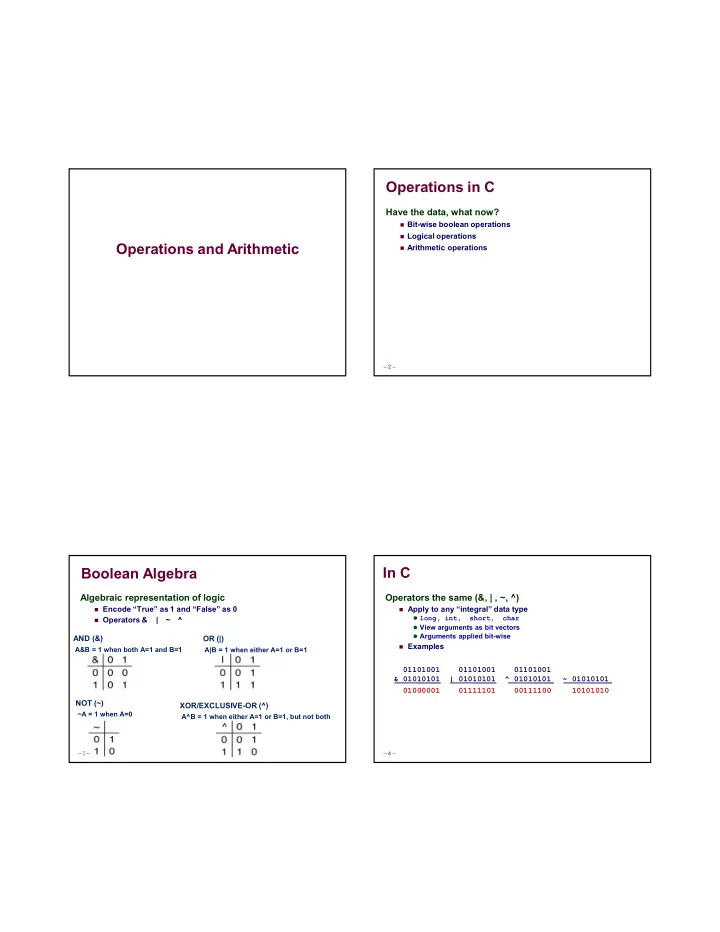
Boolean Algebra

Algebraic representation of logic

 Encode “True” as 1 and “False” as 0  Operators &

| ~ ^ AND (&)

A&B = 1 when both A=1 and B=1

OR (|)

A|B = 1 when either A=1 or B=1

NOT (~)

~A = 1 when A=0

XOR/EXCLUSIVE-OR (^)

A^B = 1 when either A=1 or B=1, but not both

– 4 –

In C

Operators the same (&, | , ~, ^)

 Apply to any “integral” data type  long, int, short, char  View arguments as bit vectors  Arguments applied bit-wise  Examples

01101001 & 01010101 01000001 01101001 | 01010101 01111101 01101001 ^ 01010101 00111100 ~ 01010101 10101010 01000001 01111101 00111100 10101010

slide-2
SLIDE 2

10/11/2018 2

– 5 –

Practice problem

0x69 & 0x55 0x69 | 0x55 0x69 ^ 0x55 ~0x55

– 6 –

Practice problem

0x69 & 0x55

01101001 01010101 01000001 = 0x41

0x69 | 0x55

01101001 01010101 01111101 = 0x7D

0x69 ^ 0x55

01101001 01010101 00111100 = 0x3C

~0x55

01010101 10101010 = 0xAA

– 7 –

Shift Operations

Left Shift: x << y

 Shift bit-vector x left y positions  Throw away extra bits on left  Fill with 0’s on right

Right Shift: x >> y

 Shift bit-vector x right y

positions

 Throw away extra bits on right  Logical shift  Fill with 0’s on left  Arithmetic shift  Replicate most significant bit on

left

 Recall two’s complement integer

representation

 Perform division by 2 via shift

01100010 Argument x 00010000 x << 3 10100010 Argument x 00101000

  • Log. x >> 2

11101000

  • Arith. x >>2

00010000 00010000 00101000 11101000 00101000 11101000

– 8 –

Practice problem

x x<<3 x>>2 (Logical) x>>2 (Arithmetic) 0xf0 0x0f 0xcc 0x55 0x80 0x3c 0xfc 0x78 0x03 0x03 0x60 0x33 0xf3 0xa8 0x15 0x15

slide-3
SLIDE 3

10/11/2018 3

– 9 –

Logic Operations in C

Operations always return 0 or 1 Comparison operators

 > >= < <= == !=

Logical Operators

 &&

|| !

 Logical AND, Logical OR, Logical negation  In C (and most languages), 0 is “False”, anything nonzero is “True”

Examples (char data type)

 !0x41 --> 0x00  !0x00 --> 0x01  !!0x41 --> 0x01

What are the values of:

 0x69 || 0x55  0x69 | 0x55  What does this expression do? (p && *p) – 10 –

Logical vs. Bitwise operations

Watch out

 Logical operators versus bitwise boolean operators  && versus &  || versus |  == versus = https://freedom-to-tinker.com/blog/felten/the-linux-backdoor-attempt-of-2003/ – 11 –

Using Bitwise and Logical operations

Two integers x and y For any processor, independent of the size of an integer, write C expressions without any “=“ signs that are true if:

 x and y have any non-zero bits in common in their low order byte  x has any 1 bits at higher positions than the low order 8 bits  x is zero  x == y

0xff & (x & y) ~0xff & x (x & 0xff)^x (x >> 8) !x !(x^y)

– 12 –

Arithmetic operations

Signed/unsigned

 Addition and subtraction  Multiplication  Division

slide-4
SLIDE 4

10/11/2018 4

– 13 –

Unsigned addition

Suppose we have a computer with 4-bit words What is the unsigned value of 7 + 7?

 0111 + 0111

What about 9 + 9?

 1001 + 1001

With w bits, unsigned addition is regular addition, modulo 2w

 Bits beyond w are discarded

= 1110 (14) = 0010 (2 or 18 % 24), % == modulo

– 14 –

Unsigned addition

With 32 bits, unsigned addition is modulo 232 What is the value of 0xc0000000 + 0x70004444 ?

#include <stdio.h> unsigned int sum(unsigned int a, unsigned int b) { return a+b; } main () { unsigned int i=0xc0000000; unsigned int j=0x70004444; printf("%x\n",sum(i,j)); } Output: 30004444 – 15 –

Two’s-complement numbers have a range of Their sum has the range Both signed and unsigned addition use the same adder

 Bit representation for signed and unsigned addition is the

same

 But, truncation of result for signed addition is not modular as

in unsigned addition

Two’s-Complement Addition

  • 2w-1  x, y  2w-1 -1
  • 2w  x + y  2w -2

– 16 –

Two’s-Complement Addition

Since we are dealing with signed numbers, we can have negative overflow or positive overflow

x + y =

t w

w+1 bit result range w-bit result 2w-1  x + y x + y – 2w

  • 2w-1  x + y < 2w-1

x + y x + y < -2w-1 x + y + 2w

2w-1 2w x + y

t

Positive overflow 2w-1

  • 2w-1
  • 2w-1
  • 2w

Negative overflow x + y

Case 4 Case 3 Case 2 Case 1

slide-5
SLIDE 5

10/11/2018 5

– 17 –

Example (w=4)

x y x + y x + y

  • 8

[1000]

  • 5

[1011]

  • 13

[10011] 3 [0011]

  • 8

[1000]

  • 8

[1000]

  • 16

[10000] [0000]

  • 8

[1000] 5 [0101]

  • 3

[1101]

  • 3

[1101] 2 [0010] 5 [0101] 7 [0111] 7 [0111] 5 [0101] 5 [0101] 10 [1010]

  • 6

[1010]

t 4

Case 1 Case 1 Case 2 Case 3 Case 4 x + y = x + y – 2w, 2w-1  x + y (Case 4) x + y,

  • 2w-1  x + y < 2w-1

(Case 2/3) x + y + 2w, x + y < -2w-1 (Case 1)

– 18 –

Pointer arithmetic

Always unsigned Based on size of the type being pointed to

 Incrementing an (int *) adds 4 to pointer  Incrementing a (char *) adds 1 to pointer – 19 –

Pointer addition exercise

Consider the following declaration on char* cp=0x100; int* ip=0x200; float* fp=0x300; double* dp=0x400; int i=0x500; What are the hexadecimal values of each after execution of these commands? cp++; ip++; fp++; dp++; i++; C Data Type Typical 32-bit x86-64 char 1 1 short 2 2 int 4 4 long 4 8 float 4 4 double 8 8 pointer 4 8 0x101 0x204 0x304 0x408 0x501

– 20 –

Unsigned Multiplication

For unsigned numbers: 0  x, y  2w-1 -1

 Thus, x and y are w-bit numbers

The product x*y: 0  x * y  (2w-1 -1)2

 Thus, product can require 2w bits

Only the low w bits are used

 The high order bits may overflow

This makes unsigned multiplication modular x * y = (x * y) mod 2w

u w

slide-6
SLIDE 6

10/11/2018 6

– 21 –

Two’s-Complement Multiplication

Same problem as unsigned The bit-level representation for two’s-complement and unsigned is identical

 This simplifies the integer multiplier

As before, the interpretation of this value is based on signed vs. unsigned Maintaining exact results

 Need to keep expanding word size with each product

computed

 Must be done in software, if needed  e.g., by “arbitrary precision” arithmetic packages – 22 –

Security issues with multiplication

SUN XDR library

Widely used library for transferring data between machines

void* copy_elements(void *ele_src[], int ele_cnt, size_t ele_size);

ele_src

malloc(ele_cnt * ele_size)

– 23 –

XDR Code

void* copy_elements(void *ele_src[], int ele_cnt, size_t ele_size) { /* * Allocate buffer for ele_cnt objects, each of ele_size bytes * and copy from locations designated by ele_src */ void *result = malloc(ele_cnt * ele_size); if (result == NULL) /* malloc failed */ return NULL; void *next = result; int i; for (i = 0; i < ele_cnt; i++) { /* Copy object i to destination */ memcpy(next, ele_src[i], ele_size); /* Move pointer to next memory region */ next += ele_size; } return result; } Not checked for overflow Can malloc 4096 when 232+4096 needed

– 24 –

XDR Vulnerability

What if:

ele_cnt = 220 + 1 ele_size = 4096 = 212 Allocation = 232 + 4096

How can this function be made secure?

 Input parameter validation  Add assertions (Power of Ten rules)  Use product in for loop after check

malloc(ele_cnt * ele_size)

slide-7
SLIDE 7

10/11/2018 7

– 25 –

Multiplication by Powers of Two

What happens if you shift a binary number left one bit? What if you shift it left N bits?

000010002 << 2 = 001000002 (810) << 2 = (3210) 111110002 << 2 = 111000002 (-810) << 2 = (-3210)

Examples

u << 3 == u * 8

 Most machines shift and add faster than multiply  Compiler may generate this code automatically  Example

(u << 5) – (u << 3) == u * 24

– 26 –

Dividing by Powers of Two (unsigned)

For unsigned numbers, performed via logical right shifts Quotient of unsigned division by power of 2

 u >> k gives  u / 2k   Rounds towards 0

Division Computed Hex Binary x 15213 15213 3B 6D 00111011 01101101 x >> 1 7606.5 7606 1D B6 00011101 10110110 x >> 4 950.8125 950 03 B6 00000011 10110110 x >> 8 59.4257813 59 00 3B 00000000 00111011 0 1 0 0 0

  • u

2k / u / 2k Division: Operands:

  • k
  • 0 •••
  •  u / 2k 
  • Result:

. Binary Point 0 •••

– 27 –

Dividing by Powers of Two (signed)

For signed numbers, performed via arithmetic right shifts Quotient of signed division by power of 2

 x >> k gives  x / 2k   Rounds away from 0!

0 1 0 0 0

  • x

2k / x / 2k Division: Operands:

  • k
  • 0 •••
  • RoundDown(x / 2k)
  • Result:

. Binary Point 0 ••• Division Computed Hex Binary y

  • 15213
  • 15213

C4 93 11000100 10010011 y >> 1

  • 7606.5
  • 7607

E2 49 11100010 01001001 y >> 4

  • 950.8125
  • 951

FC 49 11111100 01001001 y >> 8

  • 59.4257813
  • 60

FF C4 11111111 11000100

– 28 –

Why rounding matters

German parliament (1992)

 5% law before vote allowed to count for a party  Rounding of 4.97% to 5% allows Green party vote to count  “Rounding error changes Parliament makeup” Debora Weber-Wulff,

The Risks Digest, Volume 13, Issue 37, 1992

Vancouver stock exchange (1982)

 Index initialized to 1000, falls to 520 in 22 months  Updates to index value truncated result instead of rounding  Value should have been 1098