Opioid Epidemic Compared to Past Drug Crises 2000 Greater magnitude - - PowerPoint PPT Presentation

opioid epidemic compared to past drug crises
SMART_READER_LITE
LIVE PREVIEW

Opioid Epidemic Compared to Past Drug Crises 2000 Greater magnitude - - PowerPoint PPT Presentation

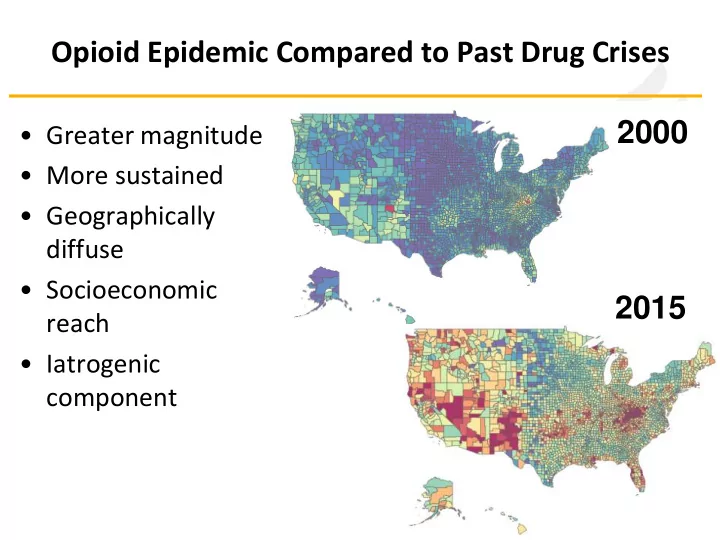
Opioid Epidemic Compared to Past Drug Crises 2000 Greater magnitude More sustained Geographically diffuse Socioeconomic 2015 reach Iatrogenic component Source: CDC NCHS and Samkoff and Baker, AJPH 1982. Deaths per 100,000


slide-1
SLIDE 1

Opioid Epidemic Compared to Past Drug Crises

  • Greater magnitude
  • More sustained
  • Geographically

diffuse

  • Socioeconomic

reach

  • Iatrogenic

component

2000 2015

slide-2
SLIDE 2

Sustained Impact of the Opioid Crisis

2 4 6 8 10 12 14 16 18 1970 1971 1972 1973 1974 1975 1976 1977 1978 1980 1981 1982 1983 1984 1985 1986 1987 1988 1989 1990 1991 1992 1993 1994 1995 1996 1997 1998 1999 2000 2001 2002 2003 2004 2005 2006 2007 2008 2009 2010 2011 2012 2013 2014 2015

Deaths per 100,000 population Drug Overdoses Opioid-Involved Overdoses

Opioids Cocaine Heroin

Source: CDC NCHS and Samkoff and Baker, AJPH 1982.

slide-3
SLIDE 3

Epidemic Continues to Evolve

5,000 10,000 15,000 20,000 25,000 10,000 20,000 30,000 40,000 50,000 60,000 70,000 Jan 15 Feb 15 Mar 15 Apr 15 May 15 Jun 15 Jul 15 Aug 15 Sep 15 Oct 15 Nov 15 Dec 15 Jan 16 Feb 16 Mar 16 Apr 16 May 16 Jun 16 Jul 16 Aug 16 Sep 16 Oct 16 Nov 16 Dec 16 Jan 17 Feb 17 Number of Deaths Involving Select Drug Categories Number of Drug Overdose Deaths Drug Overdoses Synthetic Opioids Heroin Natural/Semi-Synthic Opioids Methadone Cocaine Psychostimulants Source: CDC NHCS

slide-4
SLIDE 4

Impacted Populations and Health Consequences Continue to Expand

HCV HIV

slide-5
SLIDE 5

Origins of the Epidemic and a Path to Solutions

Increases in opioid-related harms fundamentally tied to two primary issues

  • Significant rise in opioid prescribing that began in the mid-to-late 1990s

– Prescribing opioids for different types of chronic pain conditions that we now know do not often benefit from opioids in the long-term – Prescribing higher doses and for longer durations – Prescribing opioids in combination with medications like benzodiazepines which can substantially increase risk for overdose

  • Lack of health system and provider capacity to identify, engage, and provide

high-quality, evidence-based opioid addiction treatment, in particular mediation- assisted treatment with naltrexone, buprenorphine, or methadone

– Majority of people with opioid addiction in the U.S. do not receive treatment – Even among those who do get treatment, many do not receive evidence-based care – Lack of access to and provision of treatment is a significant contributor to rising rates

  • f heroin and fentanyl use, rates of injection drug use, and overdose death