Optical Fiber Madhuri Jash 07/03/2015 What is Optical Fiber? An - - PowerPoint PPT Presentation

optical fiber
SMART_READER_LITE
LIVE PREVIEW

Optical Fiber Madhuri Jash 07/03/2015 What is Optical Fiber? An - - PowerPoint PPT Presentation

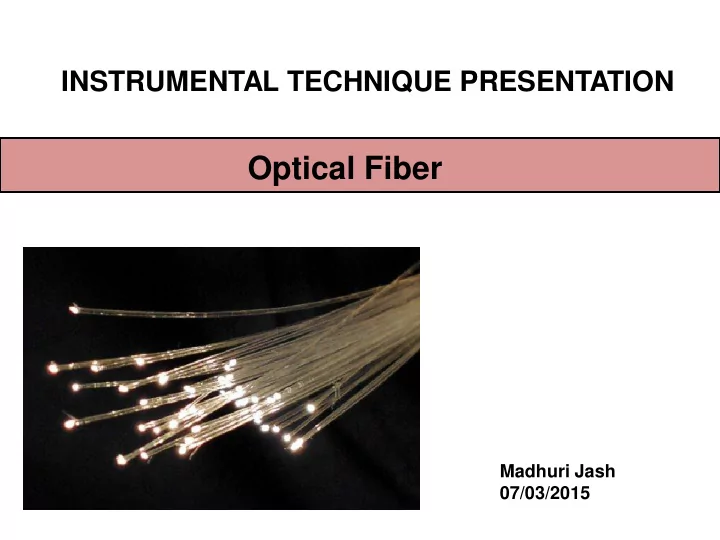
INSTRUMENTAL TECHNIQUE PRESENTATION Optical Fiber Madhuri Jash 07/03/2015 What is Optical Fiber? An optical fiber is a flexible, transparent fiber made of glass (silica) or plastic, which can function as a light pipe and capable of


slide-1
SLIDE 1

INSTRUMENTAL TECHNIQUE PRESENTATION

Optical Fiber

Madhuri Jash 07/03/2015
slide-2
SLIDE 2

What is Optical Fiber?

An optical fiber is a flexible, transparent fiber made of glass (silica) or plastic, which can function as a light pipe and capable of transmitting messages modulated into light waves.

History of Fiber Optics

Guiding of light by refraction, the principle that makes fiber optics possible, was first demonstrated by Daniel Colladon and Jacques Babinet in the early 1840s. John Tyndall included a demonstration of it in 1870.

slide-3
SLIDE 3

Fiber optics has several advantages over traditional metal communications lines:

  • Fiber optic cables have a much greater bandwidth than metal cables and they permit

transmission over longer distance.

  • Fiber optic cables are less susceptible than metal cables to interference.
  • Fiber optic cables are much thinner and lighter than metal wires.
  • Data can be transmitted digitally (the natural form for computer data) rather than

analogically and this optical fibers are used for a variety of applications.

Fiber optic cable construction:

slide-4
SLIDE 4

Basic Principle

  • Optical fibers work on the principle of total

internal reflection

  • With light, the refractive index is listed
  • The angle of refraction at the interface between

two media is governed by Snell’s law:

฀ n

1sin1  n2 sin2

  • The numerical aperture of the fiber is

closely related to the critical angle and is often used in the specification for

  • ptical fiber and the components that

work with it

  • The numerical aperture is given by the

formula:

  • The angle of acceptance is twice that

given by the numerical aperture

2 2 2 1

. . n n A N  

slide-5
SLIDE 5

Optical Fiber Architecture

Transmitter Input Signal Coder or Converter Light Source Source-to-Fiber Interface Fiber-to-light Interface Light Detector Amplifier/Shaper Decoder Output Fiber-optic Cable Receiver

TX, RX, and Fiber Link

slide-6
SLIDE 6

Here there is a multiplexing of a number of optical carrier signals onto a single

  • ptical fiber by using different wavelengths (i.e., colors) of light.
slide-7
SLIDE 7

Types Of Optical Fiber

slide-8
SLIDE 8

Single-mode step-index Fiber

  • Minimum dispersion: all rays take same path, same time to travel down

the cable. A pulse can be reproduced at the receiver very accurately.

  • Less attenuation, can run over longer distance without repeaters.
  • Larger bandwidth and higher information rate.

Multi Mode

  • Multimode step-index Fibers:

– inexpensive – easy to couple light into Fiber – result in higher signal distortion

  • Multimode graded-index Fiber:

– intermediate between the other two types of Fibers

slide-9
SLIDE 9

What do the fiber terms 9/125, 50/125 and 62.5/125 (micron)

slide-10
SLIDE 10

Fiber Alignment Impairments

Axial displacement Angular displacement Causes of power loss as the light travels through the fiber

Disadvantage

  • Higher initial cost in installation
  • Interfacing cost
  • Strength

– Lower tensile strength

  • More expensive to repair/maintain
slide-11
SLIDE 11

THANK YOU