
SLIDE 1
Optical Flow: Horn-Schunck
16-385 Computer Vision (Kris Kitani)
Carnegie Mellon University
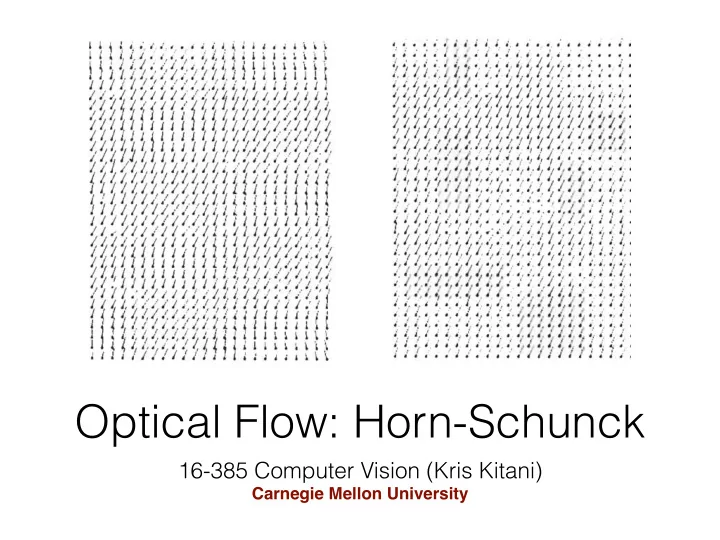
Optical Flow: Horn-Schunck 16-385 Computer Vision (Kris Kitani) - - PowerPoint PPT Presentation
Optical Flow: Horn-Schunck 16-385 Computer Vision (Kris Kitani) Carnegie Mellon University Horn-Schunck Lucas-Kanade Optical Flow (1981) Optical Flow (1981) brightness constancy method of differences small motion smooth flow
16-385 Computer Vision (Kris Kitani)
Carnegie Mellon University
Horn-Schunck Optical Flow (1981) Lucas-Kanade Optical Flow (1981) ‘constant’ flow
(flow is constant for all pixels)
‘smooth’ flow
(flow can vary from pixel to pixel)
brightness constancy method of differences global method (dense) local method (sparse) small motion
(Problem definition)
Estimate the motion (flow) between these two consecutive images I(x, y, t) I(x, y, t0) How is this different from estimating a 2D transform?
(unique to optical flow)
(Brightness constancy for intensity images)
(pixels only move a little bit)
Implication: allows for pixel to pixel comparison (not image features) Implication: linearization of the brightness constancy constraint
I(x, y, t) I(x, y, t0)
(small motion) (color constancy)
I(x, y, t)
(x, y) (x + uδt, y + vδt) (x, y)
(u, v) (δx, δy) = (uδt, vδt)
Optical flow (velocities): Displacement:
I(x, y, t + δt)
For a really small time step…
Solution lies on a straight line The solution cannot be determined uniquely with a single constraint (a single pixel)
Where can we get an additional constraint?
Horn-Schunck Optical Flow (1981) Lucas-Kanade Optical Flow (1981) ‘constant’ flow
(flow is constant for all pixels)
‘smooth’ flow
(flow is smooth from pixel to pixel)
brightness constancy method of differences global method local method small motion
most objects in the world are rigid or deform elastically moving together coherently we expect optical flow fields to be smooth
(of Horn-Schunck optical flow)
(of Horn-Schunck optical flow)
u,v
For every pixel,
u,v
For every pixel,
lazy notation for Ix(i, j)
changes these displacement of object
u v
changes these
Find the optical flow such that it satisfies:
(of Horn-Schunck optical flow)
ui,j+1 ui,j−1
u-component of flow
Which flow field optimizes the objective?
ij
ij
min u (ui,j − ui+1,j)2
small big Which flow field optimizes the objective?
min u (ui,j − ui+1,j)2
(of Horn-Schunck optical flow)
brightness constancy weight
Brightness constancy Smoothness
(uij − ui+1,j)
ij
i, j + 1
i + 1, j
ij
i, j + 1
i + 1, j i − 1, j i, j − 1 i − 1, j i, j − 1
(uij − ui,j+1)
ij
i, j + 1 i + 1, j
ij
i, j + 1
i + 1, j i − 1, j i, j − 1 i − 1, j i, j − 1
(vij − vi+1,j) (vij − vi,j+1)
Ed(i, j) = Ixuij + Iyvij + It 2
Es(i, j) = 1 4 (uij − ui+1,j)2 + (uij − ui,j+1)2 + (vij − vi+1,j)2 + (vij − vi,j+1)2
Compute partial derivative, derive update equations
(gradient decent!)
Compute the partial derivatives of this huge sum!
X
ij
( 1 4 (uij − ui+1,j)2 + (uij − ui,j+1)2 + (vij − vi+1,j)2 + (vij − vi,j+1)2
Ixuij + Iyvij + It 2)
smoothness term brightness constancy
Compute the partial derivatives of this huge sum!
X
ij
( 1 4 (uij − ui+1,j)2 + (uij − ui,j+1)2 + (vij − vi+1,j)2 + (vij − vi,j+1)2
Ixuij + Iyvij + It 2)
∂E ∂ukl =
it’s not so bad… how many u terms depend on k and l?
Compute the partial derivatives of this huge sum!
X
ij
( 1 4 (uij − ui+1,j)2 + (uij − ui,j+1)2 + (vij − vi+1,j)2 + (vij − vi,j+1)2
Ixuij + Iyvij + It 2)
∂E ∂ukl =
it’s not so bad… how many u terms depend on k and l?
ONE from brightness constancy FOUR from smoothness
Compute the partial derivatives of this huge sum!
X
ij
( 1 4 (uij − ui+1,j)2 + (uij − ui,j+1)2 + (vij − vi+1,j)2 + (vij − vi,j+1)2
Ixuij + Iyvij + It 2)
∂E ∂ukl = 2(ukl − ¯ ukl) + 2λ(Ixukl + Iyvkl + It)Ix
it’s not so bad… how many u terms depend on k and l?
ONE from brightness constancy FOUR from smoothness
Compute the partial derivatives of this huge sum!
X
ij
( 1 4 (uij − ui+1,j)2 + (uij − ui,j+1)2 + (vij − vi+1,j)2 + (vij − vi,j+1)2
Ixuij + Iyvij + It 2)
(uij − ui+1,j)
ij
i, j + 1 i + 1, j
i − 1, j i, j − 1
(u2
ij − 2uijui+1,j + u2 i+1,j)
(u2
ij − 2uijui,j+1 + u2 i,j+1)
(variable will appear four times in sum)
Compute the partial derivatives of this huge sum!
X
ij
( 1 4 (uij − ui+1,j)2 + (uij − ui,j+1)2 + (vij − vi+1,j)2 + (vij − vi,j+1)2
Ixuij + Iyvij + It 2)
(uij − ui+1,j)
ij
i, j + 1 i + 1, j
i − 1, j i, j − 1
∂E ∂vkl = 2(vkl − ¯ vkl) + 2λ(Ixukl + Iyvkl + It)Iy ∂E ∂ukl = 2(ukl − ¯ ukl) + 2λ(Ixukl + Iyvkl + It)Ix
¯ uij = 1 4 ⇢ ui+1,j + ui−1,j + ui,j+1 + ui,j−1
local average
(u2
ij − 2uijui+1,j + u2 i+1,j)
(u2
ij − 2uijui,j+1 + u2 i,j+1)
(variable will appear four times in sum)
∂E ∂vkl = 2(vkl − ¯ vkl) + 2λ(Ixukl + Iyvkl + It)Iy ∂E ∂ukl = 2(ukl − ¯ ukl) + 2λ(Ixukl + Iyvkl + It)Ix Where are the extrema of E?
∂E ∂vkl = 2(vkl − ¯ vkl) + 2λ(Ixukl + Iyvkl + It)Iy ∂E ∂ukl = 2(ukl − ¯ ukl) + 2λ(Ixukl + Iyvkl + It)Ix Where are the extrema of E?
(set derivatives to zero and solve for unknowns u and v)
λIxIyukl + (1 + λI2
y)vkl = ¯
vkl − λIyIt (1 + λI2
x)ukl + λIxIyvkl = ¯
ukl − λIxIt
∂E ∂vkl = 2(vkl − ¯ vkl) + 2λ(Ixukl + Iyvkl + It)Iy ∂E ∂ukl = 2(ukl − ¯ ukl) + 2λ(Ixukl + Iyvkl + It)Ix Where are the extrema of E?
(set derivatives to zero and solve for unknowns u and v)
how do you solve this?
λIxIyukl + (1 + λI2
y)vkl = ¯
vkl − λIyIt (1 + λI2
x)ukl + λIxIyvkl = ¯
ukl − λIxIt
this is a linear system
X
ij
( 1 4 (uij − ui+1,j)2 + (uij − ui,j+1)2 + (vij − vi+1,j)2 + (vij − vi,j+1)2
Ixuij + Iyvij + It 2)
We are solving for the optical flow (u,v) given two constraints
smoothness brightness constancy
We need the math to minimize this (back to the math)
∂E ∂vkl = 2(vkl − ¯ vkl) + 2λ(Ixukl + Iyvkl + It)Iy ∂E ∂ukl = 2(ukl − ¯ ukl) + 2λ(Ixukl + Iyvkl + It)Ix Where are the extrema of E?
(set derivatives to zero and solve for unknowns u and v)
how do you solve this?
λIxIyukl + (1 + λI2
y)vkl = ¯
vkl − λIyIt (1 + λI2
x)ukl + λIxIyvkl = ¯
ukl − λIxIt
Partial derivatives of Horn-Schunck objective function E:
Recall λIxIyukl + (1 + λI2
y)vkl = ¯
vkl − λIyIt (1 + λI2
x)ukl + λIxIyvkl = ¯
ukl − λIxIt
Recall
(det A)
λIxIyukl + (1 + λI2
y)vkl = ¯
vkl − λIyIt (1 + λI2
x)ukl + λIxIyvkl = ¯
ukl − λIxIt Same as the linear system: {1 + λ(I2
x + I2 y)}ukl = (1 + λI2 x)¯
ukl − λIxIy¯ vkl − λIxIt {1 + λ(I2
x + I2 y)}vkl = (1 + λI2 y)¯
vkl − λIxIy¯ ukl − λIyIt
(det A)
Rearrange to get update equations:
new value
average
{1 + λ(I2
x + I2 y)}ukl = (1 + λI2 x)¯
ukl − λIxIy¯ vkl − λIxIt {1 + λ(I2
x + I2 y)}vkl = (1 + λI2 y)¯
vkl − λIxIy¯ ukl − λIyIt
x + I2 y
x + I2 y
new value
average
x + I2 y
x + I2 y
When lambda is small (lambda inverse is big)…
min u,v X
i,j
⇢ Es(i, j) + λEd(i, j)
new value
average
x + I2 y
x + I2 y
When lambda is small (lambda inverse is big)…
goes to zero goes to zero
min u,v X
i,j
⇢ Es(i, j) + λEd(i, j)
new value
average
x + I2 y
x + I2 y
When lambda is small (lambda inverse is big)…
goes to zero goes to zero
…we only care about smoothness.
min u,v X
i,j
⇢ Es(i, j) + λEd(i, j)
X
ij
( 1 4 (uij − ui+1,j)2 + (uij − ui,j+1)2 + (vij − vi+1,j)2 + (vij − vi,j+1)2
Ixuij + Iyvij + It 2)
We are solving for the optical flow (u,v) given two constraints
smoothness brightness constancy
We needed the math to minimize this (now to the algorithm)
Compute flow field updates for each pixel:
Ix Iy It
u = 0 v = 0 ˆ ukl = ¯ ukl − Ix¯ ukl + Iy¯ vkl + It λ−1 + I2
x + I2 y
Ix ˆ vkl = ¯ vkl − Ix¯ ukl + Iy¯ vkl + It λ−1 + I2
x + I2 y
Iy Just 8 lines of code!