
SLIDE 1
COMP 520 Fall 2010 Optimization (1)
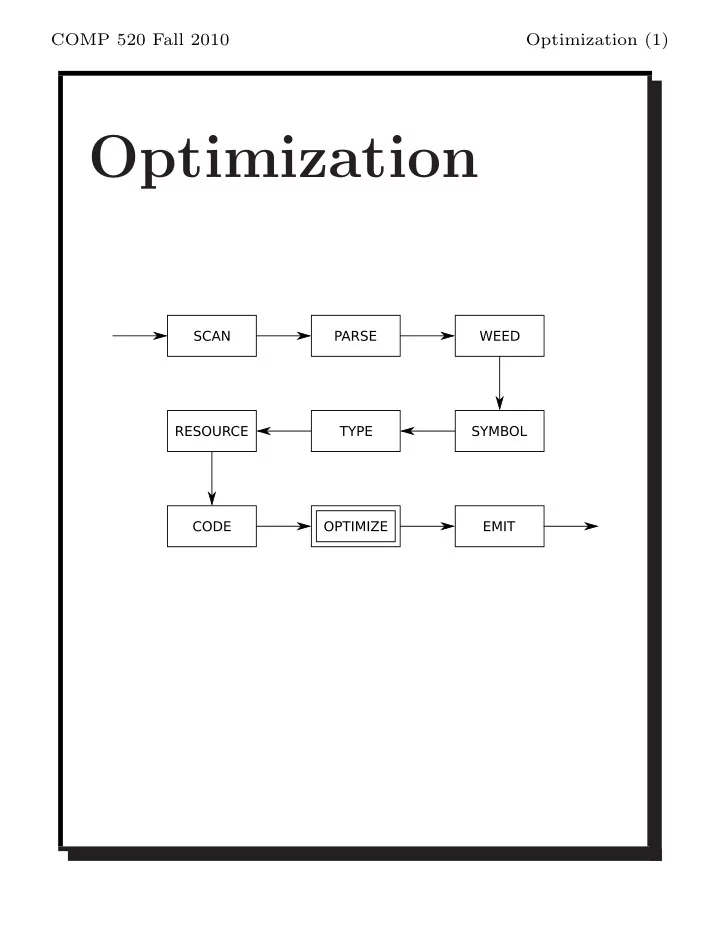
Optimization COMP 520 Fall 2010 Optimization (2) The optimizer - - PDF document
COMP 520 Fall 2010 Optimization (1) Optimization COMP 520 Fall 2010 Optimization (2) The optimizer focuses on: reducing the execution time; or reducing the code size; or reducing the power consumption (new). These goals often
COMP 520 Fall 2010 Optimization (1)
COMP 520 Fall 2010 Optimization (2)
The optimizer focuses on:
These goals often conflict, since a larger program may in fact be faster. The best optimizations achieve both goals.
COMP 520 Fall 2010 Optimization (3)
Optimizations for space:
memory was small and expensive;
but
expensive, so Java compilers optimize for space,
cheaper, so we optimize for speed again. ⇒ Optimizations driven by economy!
COMP 520 Fall 2010 Optimization (4)
Optimizations for speed:
acceptance for high-level languages;
strains the limits of the hardware;
programming languages; and
microprocessor architectures.
COMP 520 Fall 2010 Optimization (5)
Optimizations may take place:
An aggressive optimization requires many small contributions from all levels.
COMP 520 Fall 2010 Optimization (6)
Should you program in “Optimized C”? If you want a fast C program, should you use LOOP #1 or LOOP #2?
/* LOOP #1 */ for (i = 0; i < N; i++) { a[i] = a[i] * 2000; a[i] = a[i] / 10000; } /* LOOP #2 */ b = a; for (i = 0; i < N; i++) { *b = *b * 2000; *b = *b / 10000; b++; }
What would the expert programmer do?
COMP 520 Fall 2010 Optimization (7)
If you said LOOP #2 . . . you were wrong!
LOOP
SPARC MIPS Alpha #1 (array) no opt 20.5 21.6 7.85 #1 (array)
8.8 12.3 3.26 #1 (array) super 7.9 11.2 2.96 #2 (ptr) no opt 19.5 17.6 7.55 #2 (ptr)
12.4 15.4 4.09 #2 (ptr) super 10.7 12.9 3.94
pointers instead of array references.
allocation; don’t try to allocate registers in your C program.
both the programmer and the compiler to understand.
COMP 520 Fall 2010 Optimization (8)
Optimization in JOOS: c = a*b+c; if (c<a) a=a+b*113; while (b>0) { a=a*c; b=b-1; }
COMP 520 Fall 2010 Optimization (9) iload_1 iload_2 imul iload_3 iadd dup istore_3 pop iload_3 iload_1 if_icmplt true_1 iconst_0 goto stop_2 true_1: iconst_1 stop_2: ifeq stop_0 iload_1 iload_2 ldc 113 imul iadd dup istore_1 pop stop_0: start_3: iload_2 iconst_0 if_icmpgt true_5 iconst_0 goto stop_6 true_5: iconst_1 stop_6: ifeq stop_4 iload_1 iload_3 imul dup istore_1 pop iload_2 iconst_1 isub dup istore_2 pop goto start_3 stop_4:
✲
iload_1 iload_2 imul iload_3 iadd istore_3 iload_3 iload_1 if_icmpge stop_0 iload_1 iload_2 ldc 113 imul iadd istore_1 stop_0: start_3: iload_2 iconst_0 if_icmple stop_4 iload_1 iload_3 imul istore_1 iinc 2 -1 goto start_3 stop_4:
COMP 520 Fall 2010 Optimization (10)
Smaller and faster code:
(strength reduction). This is what the JOOS optimizer does. Later, we shall look at:
analysis.
COMP 520 Fall 2010 Optimization (11)
Larger, but faster code: tabulation. The sine function may be computed as: sin(x) = x − x3 3! + x5 5! − x7 7! + . . . ...
sin(0.0) 0.000000 sin(0.1) 0.099833 sin(0.2) 0.198669 sin(0.3) 0.295520 sin(0.4) 0.389418 sin(0.5) 0.479426 sin(0.6) 0.564642 sin(0.7) 0.644218
COMP 520 Fall 2010 Optimization (12)
Larger, but faster code: loop unrolling. The loop:
for (i=0; i<2*N; i++) { a[i] = a[i] + b[i]; }
is changed into:
for (i=0; i<2*N; i=i+2) { j = i+1; a[i] = a[i] + b[i]; a[j] = a[j] + b[j]; }
which reduces the overhead and may give a 10–20% speedup.
COMP 520 Fall 2010 Optimization (13)
The optimizer must undo fancy language abstractions:
so the optimizer must construct and simplify a goto graph;
so the optimizer must find an efficient layout; . . .
procedure calls, so the optimizer must efficiently determine the intended implementations.
COMP 520 Fall 2010 Optimization (14)
Continuing: the OO language BETA unifies as patterns the concepts:
A (hypothetical) optimizing BETA compiler must attempt to classify the patterns to recover that information. Example: all patterns are allocated on the heap, but 50% of the patterns are methods that could be allocated on the stack.
COMP 520 Fall 2010 Optimization (15)
Difficult compromises:
development time cheaper, but the run-time more expensive; however
analyze, which gives optimization potential. Also:
efficient, but compile-time less efficient;
and
COMP 520 Fall 2010 Optimization (16)
The JOOS peephole optimizer:
windows on the code sequence;
inefficient constructions;
and
COMP 520 Fall 2010 Optimization (17)
The optimizer considers the goto graph:
while (a>0) { if (b==c) a=a-1; else c=c+1; }
✲ ✲ ✲ ✲ ✲ ✲ ✲ ✲start 0:
iload 1 iconst 0 if icmpgt true 2 iconst 0 goto stop 3 true 2: iconst 1 stop 3: ifeq stop 1 iload 2 iload 3 if icmpeq true 6 iconst 0 goto stop 7 true 6: iconst 1 stop 7 ifeq else 4: iload 1 iconst 1 isub dup istore 1 pop goto stop 5 else 4 iload 3 iconst 1 iadd dup istore 3 pop stop 5: goto start 0 stop 1:
COMP 520 Fall 2010 Optimization (18)
To capture the goto graph, the labels for a given code sequence are represented as an array of:
typedef struct LABEL { char *name; int sources; struct CODE *position; } LABEL;
where:
the label; and
the label in the code sequence.
COMP 520 Fall 2010 Optimization (19)
Operations on the goto graph:
COMP 520 Fall 2010 Optimization (20)
Inspect a given bytecode:
int is_istore(CODE *c, int *arg) { if (c==NULL) return 0; if (c->kind == istoreCK) { (*arg) = c->val.istoreC; return 1; } else { return 0; } }
Find the next bytecode in the sequence:
CODE *next(CODE *c) { if (c==NULL) return NULL; return c->next; }
Find the destination of a label:
CODE *destination(int label) { return currentlabels[label].position; }
Create a new reference to a label:
int copylabel(int label) { currentlabels[label].sources++; return label; }
COMP 520 Fall 2010 Optimization (21)
Drop a reference to a label:
void droplabel(int label) { currentlabels[label].sources--; }
Ask if a label is dead (in-degree 0):
int deadlabel(int label) { return currentlabels[label].sources==0; }
Ask if a label is unique (in-degree 1):
int uniquelabel(int label) { return currentlabels[label].sources==1; }
Replace a sequence of bytecodes by another:
int replace(CODE **c, int k, CODE *r) { CODE *p; int i; p = *c; for (i=0; i<k; i++) p=p->next; if (r==NULL) { *c = p; } else { *c = r; while (r->next!=NULL) r=r->next; r->next = p; } return 1; }
COMP 520 Fall 2010 Optimization (22)
The expression:
x = x + k
may be simplified to an increment operation, if 0 ≤ k ≤ 127. Corresponding JOOS peephole pattern:
int positive_increment(CODE **c) { int x,y,k; if (is_iload(*c,&x) && is_ldc_int(next(*c),&k) && is_iadd(next(next(*c))) && is_istore(next(next(next(*c))),&y) && x==y && 0<=k && k<=127) { return replace(c,4,makeCODEiinc(x,k,NULL)); } return 0; }
We may attempt to apply this pattern anywhere in the code sequence.
COMP 520 Fall 2010 Optimization (23)
The algebraic rules:
x * 0 = 0 x * 1 = x x * 2 = x + x
may be used to simplify some operations. Corresponding JOOS peephole pattern:
int simplify_multiplication_right(CODE **c) { int x,k; if (is_iload(*c,&x) && is_ldc_int(next(*c),&k) && is_imul(next(next(*c)))) { if (k==0) return replace(c,3,makeCODEldc_int(0,NULL)); else if (k==1) return replace(c,3,makeCODEiload(x,NULL)); else if (k==2) return replace(c,3,makeCODEiload(x, makeCODEdup( makeCODEiadd(NULL)))); return 0; } return 0; }
COMP 520 Fall 2010 Optimization (24)
A part of the goto graph: ✲ ✲
goto L 1 L 1: goto L 2 L 2:
may be simplified by short-circuiting the jump to L 1. Corresponding JOOS peephole pattern:
int simplify_goto_goto(CODE **c) { int l1,l2; if (is_goto(*c,&l1) && is_goto(next(destination(l1)),&l2) && l1>l2) { droplabel(l1); copylabel(l2); return replace(c,1,makeCODEgoto(l2,NULL)); } return 0; }
COMP 520 Fall 2010 Optimization (25)
The JOOS peephole pattern:
int simplify_astore(CODE **c) { int x; if (is_dup(*c) && is_astore(next(*c),&x) && is_pop(next(next(*c)))) { return replace(c,3,makeCODEastore(x,NULL)); } return 0; }
is clearly sound, but will it ever be useful? Yes, the assignment statement:
a = b;
generates the code:
aload_2 dup astore_1 pop return
because of our simpleminded strategy.
COMP 520 Fall 2010 Optimization (26)
Coding assignments:
void codeEXP(EXP *e) { case assignK: codeEXP(e->val.assignE.right); code_dup(); ...... case formalSym: if (e->val.assignE.leftsym-> val.formalS->type->kind==refK) { code_astore(e->val.assignE.leftsym-> val.formalS->offset); } else { code_istore(e->val.assignE.leftsym-> val.formalS->offset); } break;
To avoid the dup, we must know if the assigned value is needed later; this information must then flow back to the code:
void codeSTATEMENT(STATEMENT *s) { case expK: codeEXP(s->val.expS); if (s->val.expS->type->kind!=voidK) { code_pop(); } break;
to decide whether to pop or not. A peephole pattern is simpler and more modular.
COMP 520 Fall 2010 Optimization (27)
Any collection of peephole patterns:
typedef int(*OPTI)(CODE **); #define MAX_PATTERNS 100 int init_patterns() { ADD_PATTERN(simplify_multiplication_right); ADD_PATTERN(simplify_astore); ADD_PATTERN(positive_increment); ADD_PATTERN(simplify_goto_goto); return 1; }
can be applied to a goto graph in a fixed point process:
repeat for each bytecode in succession do for each peephole pattern in succession do repeat apply the peephole pattern to the bytecode until the goto graph didn’t change end end until the goto graph didn’t change
COMP 520 Fall 2010 Optimization (28)
JOOS code for the fixed point driver:
int optiCHANGE; void optiCODEtraverse(CODE **c) { int i,change; change = 1; if (*c!=NULL) { while (change) { change = 0; for (i=0; i<OPTS; i++) { change = change | optimization[i](c); }
} if (*c!=NULL) optiCODEtraverse(&((*c)->next)); } } void optiCODE(CODE **c) { optiCHANGE = 1; while (optiCHANGE) {
} }
COMP 520 Fall 2010 Optimization (29)
Why does this process terminate? Each peephole pattern does not necessarily make the code smaller. To demonstrate termination for our examples, we use the lexicographically ordered measure: < #bytecodes, #imul,
|gotochain(L)| > which can be seen to become strictly smaller after each application of a peephole pattern.
COMP 520 Fall 2010 Optimization (30)
The goto graph obtained as a fixed point is not unique. It depends on the sequence in which the peephole patterns are applied. That does not happen for the four examples given, but consider the two peephole patterns:
A B
✲ ✲
A B C P1 C D D E P2
They clearly do not commute:
A B D E A B D E
✑✑✑✑ ✑ ✸ ✲ ◗◗◗◗ ◗ s ✲
A B C D A B D A B D P ∗
1
P ∗
2
P ∗
2
P ∗
1
COMP 520 Fall 2010 Optimization (31)
The effect of the JOOS A+ optimizer (using 40 peephole patterns):
Program joosa+ joosa+ -O AllComponents 907 861 AllEvents 1056 683 Animator 184 180 Animator2 568 456 ConsumeInteger 164 107 DemoFont 97 89 DemoFont2 213 147 DrawArcs 60 60 DrawPoly 94 90 Imagemap 470 361 MultiLineLabel 526 406 ProduceInteger 149 96 Rectangle2 58 58 ScrollableScribble 566 481 ShowColors 88 68 TicTacToe 1471 1211 YesNoDialog 315 248
COMP 520 Fall 2010 Optimization (32)
The word “optimizer” is somewhat misleading, since the code is not optimal but merely better. Suppose OPM(G) is the shortest goto graph equivalent to G. Clearly, the shortest diverging goto graph is: Dmin = L: goto L We can then decide the Halting problem on an arbitrary goto graph G as: OPM(G) = Dmin Hence, the program OPM cannot exist.
COMP 520 Fall 2010 Optimization (33)
The testing strategy for the optimizer has three phases. First a careful argumentation that each peephole pattern is sound. Second a demonstration that each peephole pattern is realized correctly. Third a statistical analysis showing that the