Orders of Growth def factor_naive(N): def factor_clever(N): - - PDF document

orders of growth
SMART_READER_LITE
LIVE PREVIEW

Orders of Growth def factor_naive(N): def factor_clever(N): - - PDF document

6/30/2016 Theres more than one way to do it Usually, there are many ways to solve the same problem . In jargon: there are many ways to implement the same functional abstraction . e.g. Factoring N: Orders of Growth def factor_naive(N): def


slide-1
SLIDE 1

6/30/2016

Orders of Growth

61A SUMMER 2016 GUEST LECTURER: JONGMIN JEROME BAEK (JBAEK080@BERKELEY.EDU)

There’s more than one way to do it

For the past two weeks, we talked about how to solve a problem correctly. But what if there are multiple ways to solve a problem correctly? For example, square may be implemented in two ways. Are some ways “better” than others?

There’s more than one way to do it

def square(n): a, b, total = 0, n, 0 while b: a, b = a + 1, b - 1 total = total + a + b return total def square(n): return n * n

There’s more than one way to do it

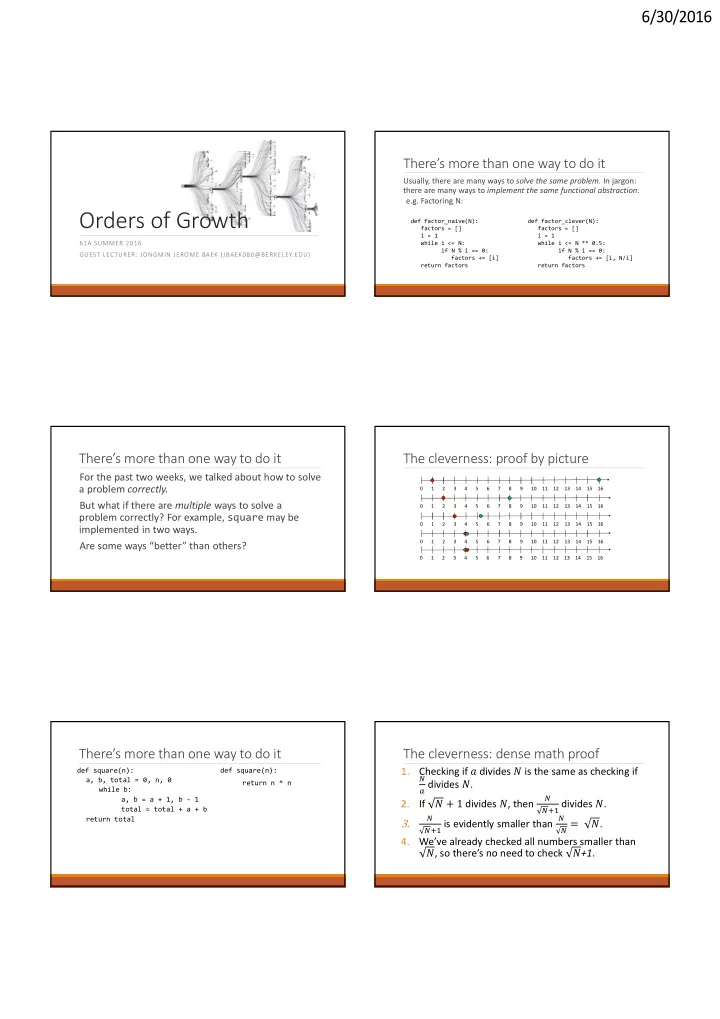
Usually, there are many ways to solve the same problem. In jargon: there are many ways to implement the same functional abstraction. e.g. Factoring N:

def factor_clever(N): factors = [] i = 1 while i <= N ** 0.5: if N % i == 0: factors += [i, N/i] return factors def factor_naive(N): factors = [] i = 1 while i <= N: if N % i == 0: factors += [i] return factors

The cleverness: proof by picture

1 2 3 4 5 6 7 8 9 10 11 12 13 14 15 16 1 2 3 4 5 6 7 8 9 10 11 12 13 14 15 16 1 2 3 4 5 6 7 8 9 10 11 12 13 14 15 16 1 2 3 4 5 6 7 8 9 10 11 12 13 14 15 16 1 2 3 4 5 6 7 8 9 10 11 12 13 14 15 16

The cleverness: dense math proof

1. Checking if divides is the same as checking if

  • divides .

2. If + 1 divides , then

  • divides .

3.

  • is evidently smaller than
  • =

. 4. We’ve already checked all numbers smaller than

  • , so there’s no need to check

+1.

slide-2
SLIDE 2

6/30/2016

Why do we care?

Speed! The naïve way divides N times. The clever way divides √N times. This may not seem like a big deal, but…

Why do we care?

“Amazon calculated that a page load slowdown of just one second could cost it $1.6 billion in sales each

  • year. Google has calculated that by slowing its search

results by just four tenths of a second they could lose 8 million searches per day.” http://www.fastcompany.com/1825005/how-one- second-could-cost-amazon-16-billion-sales

Why do we care?

To take an extreme example, consider the game of Go: Go is a very complicated game. It is probably the most complex board game that is widely played by humans. Two players play each other. Each turn, a player can make one of approximately 200 choices. There are about 150 turns.

Why do we care?

Naïve way: Try all sequences of moves and find the best sequence of moves. There are approximately 150 turns in a game and 200 possible choices per step. This is 200150 possible games. If each atom in the Universe did one step of computation each nanosecond, the Universe would need to start over about four times to try all sequences of moves and find the best sequence of moves.

Why do we care?

Clever way: As far as we know, there is no clever way to solve the game of Go! There are some ways to generate approximate solutions, such as using Google’s AlphaGo,

  • r using the human brain. More on this at

the end of lecture, if we have time. We simply do not know how to solve some really hard but really important

  • problems. (We can find approximations.)

How do we care?

How do we claim mathematically that one function runs faster than another? A function is executed on some input. For example: in the factoring function, the input is the number we want to factor. How long a function takes to run depends on the size

  • f the input.
slide-3
SLIDE 3

6/30/2016

How do we care?

What we want to know: given some function, such as factor, how long will this function take to run? Roughly, how many lines of code will this function need to execute? How does this depend on the size of the input?

How do we care?

For every function f(N), We can find a function g(N): g(N) describes how long f(N) takes to run as a function of N.

We don’t care about…

We don’t need to know exactly how the run-time grows as the size of the input increases. We only want a rough idea. To get a rough idea, we look from a birds-eye view. That is, we look at the shape of g(N) as N gets really, really big.

Mole’s eye view vs. Bird’s eye view We don’t care about…

More precisely, we don’t care about

  • Constant factors
  • Any term that is not the largest term

For example:

  • g1(N) = 3N2 + N vs. g2(N) = N2+ 6: we treat both functions as about

the same; we say both take quadratic time and denote this as Ө(N2).

  • g3(N) = 35N vs. g4(N) = N + 49: we treat both functions as about

the same; we say both take linear time and denote this as Ө(N).

Why the lack of care?

Mathematical rigorousness: it saves you the headache of trivialities and it’s useful to think of g(n) as n approaches infinity Moore’s law: computers are always getting exponentially faster Constant factors/small terms are easier to reduce: even if you reduce constant factors, that doesn’t tell you much about the nature of the problem

slide-4
SLIDE 4

6/30/2016

Mathematical Definition

N: size of the input R(N): how long it takes to run the function on input of size N

R(N) = θ(g(N))

Means that there are positive constants k1 and k2 such that

k1 · g(N) ≤ R(N) ≤ k2 · g(N)

For all n larger than some minimum m

Constant Time

Ө(1)

Fastest Runtime doesn’t depend

  • n size of input

def square(x): return x * x def add(x, y): return x + y

Logarithmic Time

Ө(log N)

Very fast Runtime increases with input, but very little

def exp_decay(x): if x == 0: return 1 else: return exp_decay(x//2) + 1

Linear Time

Ө(N)

Pretty fast Runtime increases linearly with input def sum_all(lst): result = 0 for e in lst: result += e return result

Quadratic Time

Ө(N2)

Not fast Runtime increases quadratically with input

def print_all_pairs(lst): for i in lst: for j in lst: print(i, j)

Exponential Time

Ө(2N)

Intractable Runtime increases extremely fast with input

def fork_bomb(n): if n == 0: return 1 return fork_bomb(n - 1) + fork_bomb(n – 1)

n n-1 n-1 n-2 n-2 n-2 n-2

slide-5
SLIDE 5

6/30/2016

How to determine orders of growth

In CS61A, we particularly care about orders of growth when writing iterative or recursive code. Iteration:

  • How long does each iteration take?
  • How many times do we loop?

Recursion:

  • How long does each call to the function take?
  • How many times do we call the function?

Examples

def mystery1(n): x = 0 for i in range(n): x += 1 return x def mystery2(n): if n == 0: return 0 return mystery2(n-1) + 1 def mystery3(n): x = 0 for i in range(n): for j in range(i): x += 1 return x def mystery4(n): x = 1 while x < n: x *= 2 return x

Ө(N) Ө(N) Ө(N2) Ө(logN)

Examples

def mystery5(n): if n > 0: return mystery5(-n)+ mystery5(-n) else: return 0 def mystery6(n): i = 0 while i > 0: i += 1 return n def mystery7(n): if n == 0: return 1 return mystery8(n-1) + mystery8(n-1) def mystery8(n): if n == 0: return 1 return mystery7(n-1) + mystery7(n-1)

Ө(1) Ө(1) Ө(2N) Ө(2N)

Why do we care?

What seems harder: factoring n, or finding the nth Fibonacci number? Counter to intuition, factoring is a much harder problem! Some problems are inherently harder than others. Theoretical computer science is in the business of classifying problems by how hard they are. P vs. NP and the Computational Complexity Zoo: https://www.youtube.com/watch?v=YX40hbAHx3s