Origins of our Research The Team Helping parents help their - - PDF document

origins of our research
SMART_READER_LITE
LIVE PREVIEW

Origins of our Research The Team Helping parents help their - - PDF document

Origins of our Research The Team Helping parents help their children Director of Student Orientation successfully Director of Student Engagement and transition to college Retention Author of Becoming a Learner


slide-1
SLIDE 1

Helping parents help their children successfully transition to college

familycommlab.com

Kristina M. Scharp Utah State University Elizabeth Dorrance Hall Michigan State University

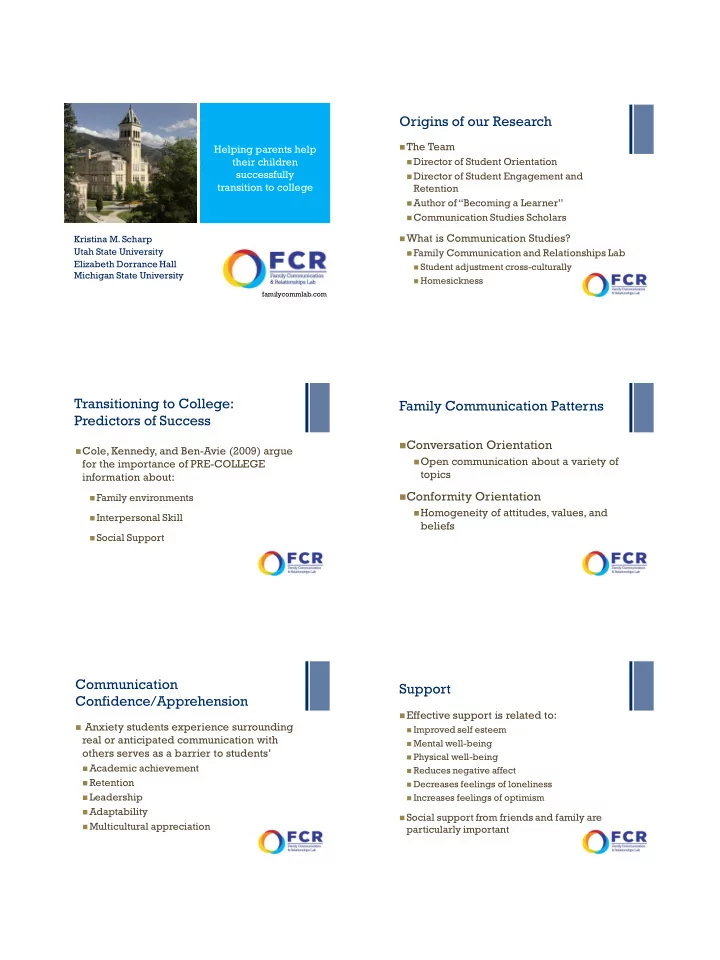
Origins of our Research

The Team Director of Student Orientation Director of Student Engagement and

Retention

Author of “Becoming a Learner” Communication Studies Scholars What is Communication Studies? Family Communication and Relationships Lab  Student adjustment cross-culturally  Homesickness

Transitioning to College: Predictors of Success

Cole, Kennedy, and Ben-Avie (2009) argue

for the importance of PRE-COLLEGE information about:

Family environments Interpersonal Skill Social Support

Family Communication Patterns

Conversation Orientation

Open communication about a variety of

topics

Conformity Orientation

Homogeneity of attitudes, values, and

beliefs

Communication Confidence/Apprehension

 Anxiety students experience surrounding

real or anticipated communication with

  • thers serves as a barrier to students’

Academic achievement Retention Leadership Adaptability Multicultural appreciation

Support

Effective support is related to:

 Improved self esteem  Mental well-being  Physical well-being  Reduces negative affect  Decreases feelings of loneliness  Increases feelings of optimism

Social support from friends and family are

particularly important

slide-2
SLIDE 2

Transitioning to College: Staying Ahead of the Curve

Transitions create chronic uncertainty Reducing concerns can create more Getting a job decreases financial uncertainty Increases academic success uncertainty We were interested in what concerns

students expressed DURING college instead of reasons they gave for leaving after-the-fact

Participants

Pre-test – January 269 first-year students in second semester Time 1 – April-June 2,252 students about to start their first

year of college

Orientation sign up survey 60.4% female, 88.5% White, 11% first

generation students

First-Year Student Stress Categories Label Definition Example Frequency Tests/ Homework Concerns about grades, testing, and

  • homework. Differences in class/test

structure from high school, working

  • n assignments outside of class

“The way classes and tests are structured is very different than the way I was used to in high school” “Figuring out how different professors test!”

204 (76%) Time Not enough time, concerns about being self-guided and motivated, finding a balance between school, social and work, prioritization.

“Time-- I feel like I do not have enough time to do all the things I need to.” “Trying to fit in social time, school time, work, and sleep.”

138 (51%) Friends Not being able to find friends, not having people to go to campus/social events with, Finding your own group (anxiety associated with this), putting yourself out there

“I expected to make a lot of friends since I was living in the dorms but I've only really made friends with my roommates.”

119 (44%) Indepen- dence Detaching yourself from your legal guardians, learning about yourself in a new environment, change in lifestyle and responsibility. Not living at home, having to grow up.

“Getting used to being on your own, you have to grow up and become your own person.”

86 (32%) Finances Paying for school, employment status, not having enough money, navigating financial aid, paying for housing

“Probably expenses. I can handle classes and homework, but it's harder for me to balance paying for my schooling. I need to know when tuition is due, when to accept my scholarship, when to apply for FAFSA etc.”

53 (20%) Room- mates Roommate conflict, not being accepted, negative living situation, having different moral/ethical standards from roommates.

“Difficult roommates who don't respect me, my stuff, or my privacy”

44 (16%)

Measures

 Student Concerns (Belle & Paul, 1989; Zajacova, Lynch, &

Espenshade, 2005)

 Academic environment, academic performance, managing time,

financial, and interpersonal concerns

 Family Communication Patterns (RFCP-SF, Wilson et al., 2014)  Conversation: “I can tell my parents almost anything”  Conformity: “My parents feel it is important to be the boss”  Support (Zimet, Dahlem, Zimet, and Farley, 1988)  Family: “My family really tries to help me.”  Resilience (Smith et al., 2008)  “When I face a challenge I reach out to my social

network for advice”

First Generation Students

10 20 30 40 50 60 70 80 Academic Concerns Managing Time Concerns Social Concerns Growing Up Concerns Financial Concerns Interpersonal Concerns

Differences in Student Concerns

First Gen Other

Students of Color

10 20 30 40 50 60 70 Academic Concerns Managing Time Concerns Social Concerns Growing Up Concerns Financial Concerns Interpersonal Concerns

Differences in Student Concerns

White Non-White
slide-3
SLIDE 3

First Generation Students

0.5 1 1.5 2 2.5 3 3.5 4 4.5 5 Interpersonal Skill PICT Resilience Conversation Conformity

Communication Patterns and Outcome Differences

First Gen Other

Students of Color

0.5 1 1.5 2 2.5 3 3.5 4 4.5 5 Interpersonal Skill PICT Resilience Conversation Conformity

Communication Patterns and Outcome Differences

White Non-White

College Student Support and Resilience Results

Higher resilience  Lower concerns Not true of family support Higher conversation orientation  Lower academic concerns Not true of conformity Higher conversation orientation  higher family support Higher conformity orientation  lower resilience Conversation  higher resilience  lower student concerns Conformity  lower resilience  higher concerns

Transitioning to College: Adjustment Outcomes

Attitudes Matter

 Success depends on how a person interprets that

transition such that those who believe a transition will help them grow are more likely to be satisfied, develop more, and be ultimately more successful.

 Attitudes are a better predictor of academic

success when compared to skill or study habits

Perceived Impact of the College Transition

 Pre-College Students (N= 2,252)

Additional Measures

Communication Apprehension/Confidence

(Wrench et al., 2008)

 “I always feel anxious in social situations”

Perceived Impact of the Transition

(Zinnbauer & Pargament, 1998)

 “I think the transition to college will alter my

general outlook on life”

Model Testing Results: Conversation Orientation

slide-4
SLIDE 4

Model Testing Results: Conformity Orientation Adjustment Outcomes

Resilience is the ability to bounce back

from adversity

More resilient people experience a variety

  • f advantageous outcomes such as:

 Overcoming mental health issues  Persistence in college  Ability to positively adapt to adversity in

marriage

Resilience

 Students (n=436) across time

Additional Survey and Measures

 Time 2 – November  Follow up with first-year students in first semester  436 students who completed T1 and T2  65.1% female, 89.9% White, 7.3% first generation

students

 Support (Zimet, Dahlem, Zimet, and Farley, 1988)  Friend: “I can count on my friends when things

go wrong” (T1 & T2)

Model of Transition Resilience Implications for Student Affairs Professionals

 For Students  Communication apprehension interventions  Assess students’ CA to raise awareness  Communication courses  Visualization intervention  Conflict workshop at USU  Social support training (for faculty, staff, parents)  For Families  Parent orientation  Communicate openly about a wide variety of topics (tends to

encourage lower communication apprehension)

Conflict Workshop at USU: Addressing Communication Skill

 Matt Sanders, Associate Dean for Undergraduate Studies,

College of Humanities and Social Sciences, Utah State University

slide-5
SLIDE 5

Social Support Training for First- Generation Mentors

“Verbal and nonverbal behavior

produced with the intention of providing assistance to others perceived as needing that aid”

 (Mac George, Feng, & Burleson, 2011)

We addressed:

Seeking Supportive Communication Processing Supportive Communication Providing Supportive Communication

Social Support Training

The Costs of Seeking Support Interpersonal and Intrapersonal Costs Types of Social Support Nurturant (Emotional, Esteem, & Network) Action-Facilitating (Informational & Tangible) Celebratory Social Presence Support

Matching Hypothesis

Qualities of Good Providers

High-Person Centeredness

Refers to how much the message behavior

reflects an awareness of and adaptation to the subjective, affective, and relational aspects of communicative contexts.

Explicitly recognize and legitimate other’s

feelings.

Empathetic Good listener

Parent Orientation Intervention

Infographic/Fact sheet

 Emerging adult transition and identity (re)negotiation  Conversation orientation - importance of open

communication

 With parents and other network members  Small talk and relational maintenance  Conformity – reinforcing the belief that college is

important and worthwhile

 MATCHING the support they need  Perceived support availability

Helicopter parenting

 Impact differs by culture

Questions? Contact us!

Kristina.Scharp@usu.edu EDH@msu.edu www.familycommlab.com @familycommlab