
SLIDE 1
OSVGAN: Generative Adversarial Networks for Data Scarce Online Signature Verification
Chandra Sekhar Vorugunti Sai Sasikanth Indukuri Viswanath Pulabaigari Rama Krishna Sai Gorthi IIIT SriCity University of Massachusetts IIIT SriCity IIT Tirupati Chittoor-Dt, 517 646 Amherst Chittoor-Dt, 517 646 Chittoor-Dt, 517 506 Andhra Pradesh, India MA 01003, US. Andhra Pradesh, India. Andhra Pradesh, India. Chandrasekhar.v@iiits.in sindukuri@umass.edu viswanath.p@iiits.ac.in rkg@iittp.ac.in Abstract Impractical to acquire a sufficient number of signatures from the users and learning the inter and intra writer variations effectively with as minimum as one training sample are the two critical challenges need to be addressed by the Online Signature Verification (OSV) frameworks. To address the first challenge, we are generating writer specific synthetic signatures using Auxiliary Classifier GAN, in which a generator is trained with a maximum of 40 signature samples per user. To address the second requirement, we are proposing a Depth wise Separable Convolution based Neural Network, which results in achieving one shot based OSV with reduced parameters. A first of its kind of experimental analysis is done with an increased set of signature samples (five-fold) on two widely used datasets SVC, MOBISIG. The state-of-the-art outcome in almost all categories of experimentation confirms the competence of the proposed OSV framework and qualifies for the real time deployment in limited data applications. 1. Introduction Signatures encompass an aggregation of individual writing characteristics which are a significant source of information to classify the genuineness of a user trying to login into the system. Based on the data acquisition, OSV systems are classified into offline or online [1,2,7,22,23]. In case of offline signatures, only the static information, i.e. X- axis, Y-axis profiles are available in an image format for
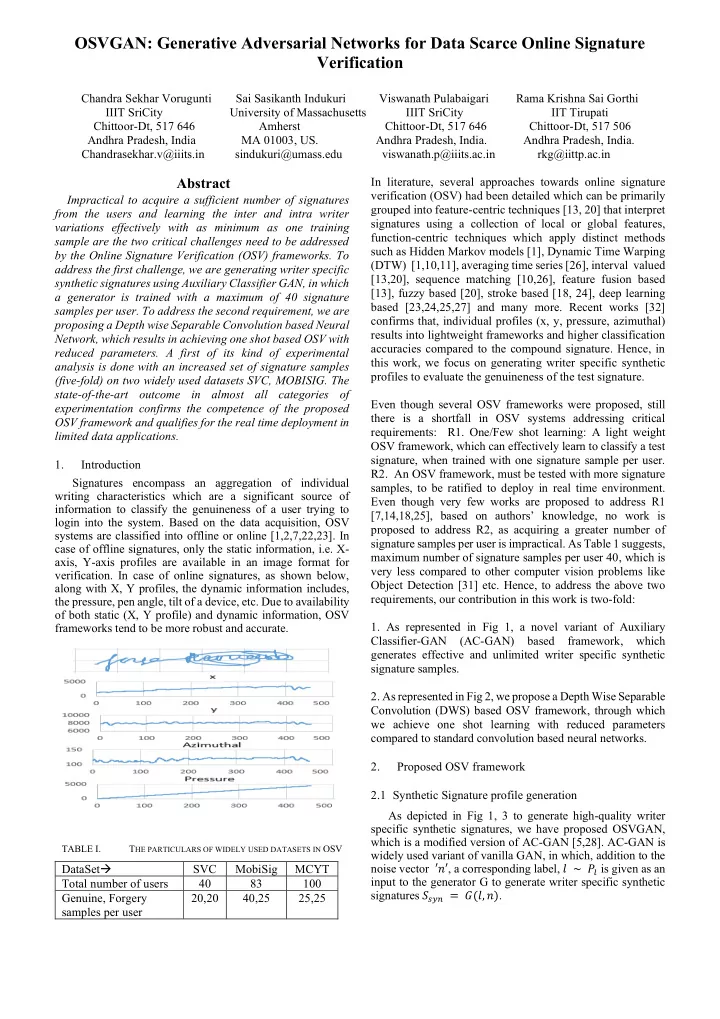
- verification. In case of online signatures, as shown below,
along with X, Y profiles, the dynamic information includes, the pressure, pen angle, tilt of a device, etc. Due to availability
- f both static (X, Y profile) and dynamic information, OSV
frameworks tend to be more robust and accurate.
TABLE I.
THE PARTICULARS OF WIDELY USED DATASETS IN OSV
DataSet→ SVC MobiSig MCYT Total number of users 40 83 100 Genuine, Forgery samples per user 20,20 40,25 25,25 In literature, several approaches towards online signature verification (OSV) had been detailed which can be primarily grouped into feature-centric techniques [13, 20] that interpret signatures using a collection of local or global features, function-centric techniques which apply distinct methods such as Hidden Markov models [1], Dynamic Time Warping (DTW) [1,10,11], averaging time series [26], interval valued [13,20], sequence matching [10,26], feature fusion based [13], fuzzy based [20], stroke based [18, 24], deep learning based [23,24,25,27] and many more. Recent works [32] confirms that, individual profiles (x, y, pressure, azimuthal) results into lightweight frameworks and higher classification accuracies compared to the compound signature. Hence, in this work, we focus on generating writer specific synthetic profiles to evaluate the genuineness of the test signature. Even though several OSV frameworks were proposed, still there is a shortfall in OSV systems addressing critical requirements: R1. One/Few shot learning: A light weight OSV framework, which can effectively learn to classify a test signature, when trained with one signature sample per user.
- R2. An OSV framework, must be tested with more signature
samples, to be ratified to deploy in real time environment. Even though very few works are proposed to address R1 [7,14,18,25], based on authors’ knowledge, no work is proposed to address R2, as acquiring a greater number of signature samples per user is impractical. As Table 1 suggests, maximum number of signature samples per user 40, which is very less compared to other computer vision problems like Object Detection [31] etc. Hence, to address the above two requirements, our contribution in this work is two-fold:
- 1. As represented in Fig 1, a novel variant of Auxiliary
Classifier-GAN (AC-GAN) based framework, which generates effective and unlimited writer specific synthetic signature samples.
- 2. As represented in Fig 2, we propose a Depth Wise Separable
Convolution (DWS) based OSV framework, through which we achieve one shot learning with reduced parameters compared to standard convolution based neural networks. 2. Proposed OSV framework 2.1 Synthetic Signature profile generation As depicted in Fig 1, 3 to generate high-quality writer specific synthetic signatures, we have proposed OSVGAN, which is a modified version of AC-GAN [5,28]. AC-GAN is widely used variant of vanilla GAN, in which, addition to the noise vector ′𝑜′, a corresponding label, 𝑚 ∼ 𝑄
𝑚 is given as an