? Other biological threats Extinct populations Extant populations - - PDF document

other biological threats extinct populations extant
SMART_READER_LITE
LIVE PREVIEW

? Other biological threats Extinct populations Extant populations - - PDF document

Potential consequences of small size and habitat fragmentation on eastern prairie fringed orchid populations Lisa Wallace Potential consequences of small size & habitat Recovery Needs for P. leucophaea fragmentation on Eastern Prairie


slide-1
SLIDE 1

1

Lisa Wallace Department of Biology University of South Dakota

Potential consequences of small size & habitat fragmentation on Eastern Prairie Fringed Orchid (Platanthera leucophaea) populations

Talk Outline

  • I. Ecology of P. leucophaea
  • II. Genetics & rarity
  • III. Reproductive biology & rarity
  • IV. Management trends

Platanthera leucophaea Eastern prairie fringed orchid

Recovery Needs for P. leucophaea Manage for population persistence Status and management of pollinators Population restoration Protection against anthropogenic factors

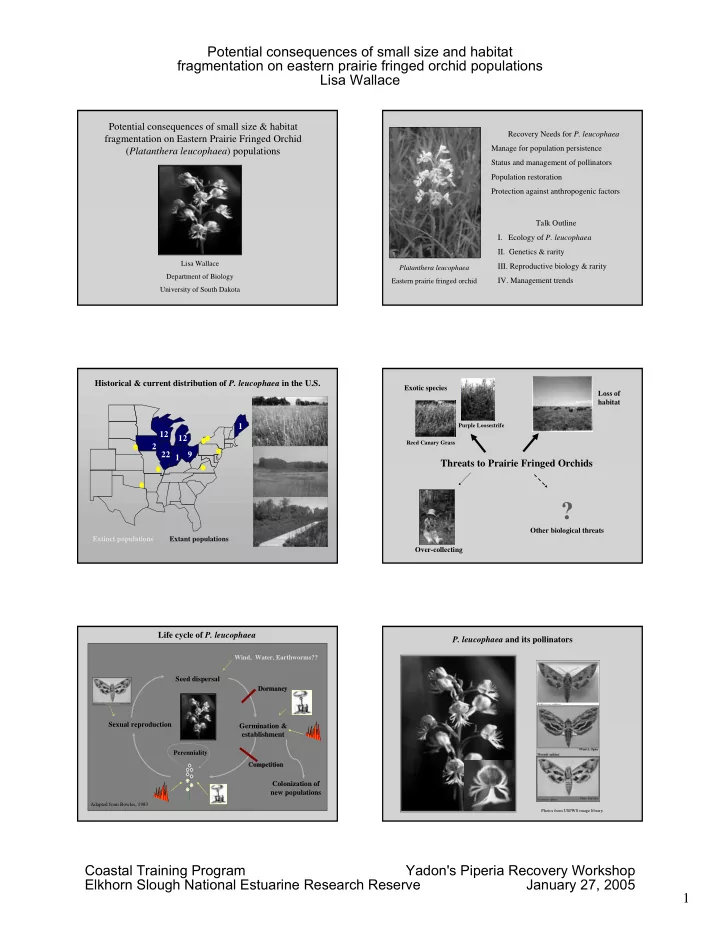
Historical & current distribution of P. leucophaea in the U.S.

Extinct populations Extant populations

12 22 12 9 1 2 1

Threats to Prairie Fringed Orchids

Exotic species Over-collecting Loss of habitat

Reed Canary Grass Purple Loosestrife

Other biological threats

?

Adapted from Bowles, 1983

Sexual reproduction Seed dispersal

Wind, Water, Earthworms??

Germination & establishment

Dormancy Dormancy Perenniality Competition Competition

Colonization of new populations

Life cycle of P. leucophaea

  • P. leucophaea and its pollinators

Photos from USFWS image library.

Potential consequences of small size and habitat fragmentation on eastern prairie fringed orchid populations Lisa Wallace Coastal Training Program Elkhorn Slough National Estuarine Research Reserve Yadon's Piperia Recovery Workshop January 27, 2005

slide-2
SLIDE 2

2

Adapted from Bowles, 1983

Sexual reproduction Seed dispersal

Wind, Water, Earthworms??

Germination & establishment

Dormancy Dormancy Perenniality Competition Competition

Colonization of new populations

Life cycle of P. leucophaea

20 40 60 80 100

Soil moisture

1 2 3 4 5 6 7 8 9

soil pH % infected embryos

20 40 60 80

Nov Jan Mar May June July Sept

Seed germination at Pickerel Creek

Light-inhibited Water-induced Stimulated by burning Mycorrhizae-dependent

5 10 15 20 25 30 35 40 45 50 Abbott Lyons No stratification 8 weeks stratification 16 weeks stratification Wadsworth Pooled Seed Source Stage 1 Germination (%) Stratification Period and Seed Source Effects on Seed Germination

Bowles et al., 2002

Treatment and Seed Age Effect on Germination 10 20 30 40 50 60 70 18 mos. 6 mos. Inoculated/ stratified Inoculated Stratified Treatment Seed Age Mean % Stage 2 Germination

Bowles et al., 2002

Adapted from Bowles, 1983

Sexual reproduction Seed dispersal

Wind, Water, Earthworms??

Germination & establishment

Dormancy Dormancy Perenniality Competition Competition

Colonization of new populations

Life cycle of P. leucophaea

F F

  • F

F 818 NP NP NP NF NF 817 F F Grzd F Grzd 821 F NF

  • F

F 815

  • NP
  • F

F 814 NP NP NP F Grzd 813 NP NF Grzd NF Grzd 812 F NF Grzd F F 811 NF NF Grzd F F 810 F F Grzd F F 809 NF NP NF F F 808

  • NP

Grzd F F 807 NF NF Grzd F Grzd 806 NF NF Grzd F F 805 NF F NF F F 804 NP NP NP F F 803 F NF NF F F 801 1996 1995 1994 1993 1992 Plant

Status of tagged plants in Pickerel Creek Population, 1992-1996. F = flowering plant NF = vegetative plant NP = no plant seen Grazed = grazed by deer

  • = no data collected

Data from J. Windus, Ohio Dept. of Fish & Wildlife

Potential consequences of small size and habitat fragmentation on eastern prairie fringed orchid populations Lisa Wallace Coastal Training Program Elkhorn Slough National Estuarine Research Reserve Yadon's Piperia Recovery Workshop January 27, 2005

slide-3
SLIDE 3

3

Population sizes in Ohio, 1992-1999

Sporadic flowering may be related to:

Soil moisture Lake levels Annual precipitation Burning 1000 2000 3000 4000 5000 6000 1992 1993 1994 1995 1996 1997 1998 1999 Number of Flowering Plants

Data from J. Windus, Ohio Dept. of Fish & Wildlife

Year 20 40 60 80 100 1983 1984 1985 1986 1987 1988 1989 1990 1991 1992 1993 1994 1995 1996

  • 1.5
  • 1
  • 0.5

0.5 1 1.5 2 2.5

Killbuck Wildlife Area

300

  • No. of Flowering Plants

Inches of precipitation relative to average conditions Year

Data from J. Windus, Ohio Dept. of Fish & Wildlife

100 200 300 400 500 600 700 800 900 1000 1984 1985 1986 1987 1988 1989 1990 1991 1992 1993 1994 1995 1996 570 570.5 571 571.5 572 572.5 573 573.5 574

  • No. of Flowering Plants

Average level of Lake Erie (m) Year

Pickerel Creek Wildlife Area

2200 5600

Data from J. Windus, Ohio Dept. of Fish & Wildlife No data

  • II. Genetics & Rarity in P. leucophaea

How much genetic variation, estimated with neutral molecular markers, is detectable in eastern populations

  • f P. leucophaea?

Are the levels and structure of genetic variation comparable to western populations of the species? Is there evidence of fragmentation or small population size in molecular genetic variation?

  • P. leucophaea populations surveyed for genetic variation

2 pops. 3 pops.

Populations surveyed with RAPD’s Populations surveyed with allozymes & RAPD’s 9 allozymes- 12 loci; 7 RAPD primers- 63 bands

Genetic Diversity Compared at Allozyme and RAPD Loci

Allozymes RAPD's

Allozyme data are lacking for Michigan & Maine pops.

0.05 0.10 0.15 0.20 0.25

OH MI ME Gene Diversity

10 20 30 40 50 60 70 80

% P

  • l

y m

  • r

p h i c L

  • c

i OH MI ME

Potential consequences of small size and habitat fragmentation on eastern prairie fringed orchid populations Lisa Wallace Coastal Training Program Elkhorn Slough National Estuarine Research Reserve Yadon's Piperia Recovery Workshop January 27, 2005

slide-4
SLIDE 4

4

How genetically distinct are populations of P. leucophaea?

A comparison across species & markers

1Wallace, 2002; 2Havens and Buerkle, 1999; 3Cowden, 1993; 4Birchenko, 2001; 5Case, 2001

% Differentiation among populations

P. leucophaea1,2,1,3 P. integrilabia4,3 P. ciliaris3 P. blephariglottis3

10 20 30 40 50 60 70 80

Other

  • rchids5

ISSR’s RAPD’s Allozymes

log harmonic mean population size

4.0 3.5 3.0 2.5 2.0 1.5 1.0 0.5 0.0

Index of genetic variation

0.7 0.6 0.5 0.4 0.3 0.2 0.1 r = 0.119; P > 0.05 r = 0.017; P > 0.05

% Polymorphic Loci Gene diversity

Population Size vs. Diversity at RAPD Loci

Genetic Distance from RAPD’s 1.0 .8 .6 .4 .2 Geographic Distance (km) 300 200 100

Genetic vs. Geographic Distances

Maine population excluded; r = 0.467; P > 0.05; Mantel test

Conclusions- Genetic Variation in P. leucophaea

Allozymes and RAPD’s suggest different levels of genetic diversity in P. leucophaea.

Allozyme & RAPD loci follow different evolutionary trajectories

Both data sets also detected significant structure among populations. Is this a consequence of its current rarity or an indication of its ancestry?

Population structure Loss of alleles due to genetic drift and/or fixation of alleles in isolation Population history Founder effects and associated loss of diversity Origin from divergent source populations and fixation of alleles

Is reduced genetic variation likely to lead to population extinction? Are these results useful to the preservation of this species?

Yes, they are useful because… They demonstrate the importance of using multiple criteria to judge the worthiness of populations for preservation. The finding that diversity is not correlated with population size is, perhaps, a positive indication that genetic diversity can be maintained in smaller populations. The identification of genotypic patterns provides a baseline for managers, should they wish to experimentally augment populations.

Potential consequences of small size and habitat fragmentation on eastern prairie fringed orchid populations Lisa Wallace Coastal Training Program Elkhorn Slough National Estuarine Research Reserve Yadon's Piperia Recovery Workshop January 27, 2005

slide-5
SLIDE 5

5

Inbreeding in Ohio populations

G F E D C B A 1.0 0.8 0.6 0.4 0.2

  • 0.2

Population F

IS

( a l l

  • z

y m e s )

Sampled N = 13 24 12 14 38 25 22

Random mating Non-random mating Non-random mating

Outcrossing & inbreeding in P. leucophaea

Outcrossing is promoted by: Sequential opening of flowers Delayed bending of pollinaria Pollinator behavior Inbreeding depression in offspring Inbreeding is possible through: Geitonogamy Mating between closely related genets

~ 40 sec

  • S. Datwyler

200X

PC KB

  • III. Reproductive Biology of P. leucophaea

Sites Pickerel Creek Wildlife Area (large N, high FIS), repeated 1997-1999 Killbuck Wildlife Area (small N, low FIS), repeated 1998-1999 Pollination treatments Outcross Self Open No pollination Variables Seed set Relative seed weight Seed viability

20 40 60 80 100 120 140 160 180 200 Self Outcross Open Self Outcross Open Self Outcross Open Seed set Capsules recovered 1998 1999 2000 Percent Pickerel Creek 20 40 60 80 100 120 140 160 180 200 Self Outcross Open Self Outcross Open Seed set Capsules recovered Percent 1999 2000 Killbuck

Fruit Production

p < 0.05 for all years; G-test

  • f Independence on seed set

p > 0.05 for both years; G-test

  • f Independence on seed set

Reproductive success at Pickerel Creek

Significant differences (p < 0.05) in Bonferroni tests are indicated by unlike symbols.

26 24 23 26 27 27

0.2 0.4 0.6 0.8 1

Relative Seed Weight % Seed Viability

Open OutX Self

1998 a a b NS

0.2 0.4 0.6 0.8 1

Relative Seed Weight % Seed Viability

2000

30 27 27 33 30 33

a b b a b c

N =

Reproductive success at Killbuck

No significant differences in Kruskal-Wallis tests were found among treatments.

7 5 5 8 6 6 9 9 8 9 9 9 0.1 0.2 0.3 0.4 0.5 0.6 0.7

Relative Seed Weight % Seed Viability Open OutX Self

1999

0.1 0.2 0.3 0.4 0.5 0.6 0.7

Relative Seed Weight % Seed Viability

2000

N =

Potential consequences of small size and habitat fragmentation on eastern prairie fringed orchid populations Lisa Wallace Coastal Training Program Elkhorn Slough National Estuarine Research Reserve Yadon's Piperia Recovery Workshop January 27, 2005

slide-6
SLIDE 6

6

Crossing Effect on Percent Seed Viability

0.1 0.2 0.3 0.4 0.5 0.6 0.7 0.8 0.9 1 1 1 2 2 2 3 4

Seed Source Mean % Viable Seeds (*100) Population Cross Between Within Self Bowles et al., 2002

Overall Seed germination Seed production 0.23 0.04 0.03 Selfing angiosperms 0.17 0.03 Killbuck, 2000 0.53 0.15 0.19 Outcrossing angiosperms 0.49 0.17 Killbuck, 1999 0.42 0.05 0.26 Pickerel, 2000 0.74 0.12 0.21 Pickerel, 1998 Percentage of viable seeds Relative seed mass Seed set Population, year

Inbreeding Depression Compared Across Estimators

Husband & Schemske, 1996

IBD = (outcross – self)/outcross

Conclusions – Inbreeding depression Early acting inbreeding depression is possible in P. leucophaea, although the magnitude of IBD can vary temporally and across populations. Higher levels of seed set among open-pollinated capsules at Pickerel Creek compared to Killbuck suggest that smaller populations may be pollinator-limited. Is inbreeding depression a significant threat to this species?

Geitonogamy and matings between related genets allow for

inbreeding.

Allozyme data suggest that inbreeding happens. Selfing is likely to lead to fewer viable seeds. So, inbreeding depression could negatively impact

populations, but…..

Each flower is capable of producing thousands of seeds,

some of which will likely be viable.

Threats to Prairie Fringed Orchids

Exotic Species Limited Reproductive Potential Over-collecting Loss of Habitat

Reed Canary Grass Purple Loosestrife Inbreeding Pollinator behavior

  • IV. Current Management Trends
  • Preserve habitat and size of extant populations

Maintain natural hydrologic cycles and removal of drainage tiles Shrub and invasive species removal by cutting, herbicides, fire Maintain habitats that are ecologically diverse to allow orchids to retreat during years of high lake levels

  • Use of fire to promote flowering
  • Hand-pollination of plants
  • Restoration in protected prairie remnants
  • On-going demographic monitoring
  • Continued research

Demographic costs of hand-pollination Potential for outbreeding depression Measures to control invasive species with minimal harm to the orchids Seed germination and survival within populations

Potential consequences of small size and habitat fragmentation on eastern prairie fringed orchid populations Lisa Wallace Coastal Training Program Elkhorn Slough National Estuarine Research Reserve Yadon's Piperia Recovery Workshop January 27, 2005

slide-7
SLIDE 7

7

Similarities Evolutionary history Habit Method of reproduction Environmental threats Habitat requirements (i.e., need for periodic disturbance) Differences Narrow endemism of Piperia yadonii Different ecological niches Population sizes vs. number and distribution of populations

Platanthera leucophaea Piperia yadonii

F u n d i n g O h i

  • D

e p a r t m e n t

  • f

N a t u r a l R e s

  • u

r c e s T h e N a t u r e C

  • n

s e r v a n c y , O h i

  • C

h a p t e r O h i

  • S

t a t e U n i v e r s i t y , J a n i c e B e a t l e y A w a r d F i e l d a n d l a b a s s i s t a n c e D a n i e l C r a w f

  • r

d D a v i d C u t h r e l l S h a n n

  • n

D a t w y l e r K a y r i H a v e n s P h y l l i s H i g m a n M i c h a e l P e n s k a r K y l e S t

  • c

k w e l l J e n n i f e r W i n d u s O D N R D i v i s i

  • n
  • f

W i l d l i f e M a n a g e r s a t P i c k e r e l C r e e k W A & K i l l b u c k W A

ACKNOWLEDGMENTS

Potential consequences of small size and habitat fragmentation on eastern prairie fringed orchid populations Lisa Wallace Coastal Training Program Elkhorn Slough National Estuarine Research Reserve Yadon's Piperia Recovery Workshop January 27, 2005