Our Path So Far COGS 105 Research Methods for Cognitive Scientists - - PowerPoint PPT Presentation

our path so far cogs 105
SMART_READER_LITE
LIVE PREVIEW

Our Path So Far COGS 105 Research Methods for Cognitive Scientists - - PowerPoint PPT Presentation

Our Path So Far COGS 105 Research Methods for Cognitive Scientists Remember, cognitive science is a radically interdisciplinary field, so we will be covering a diverse array of material. CogSci history philosophy cognitive psychology


slide-1
SLIDE 1

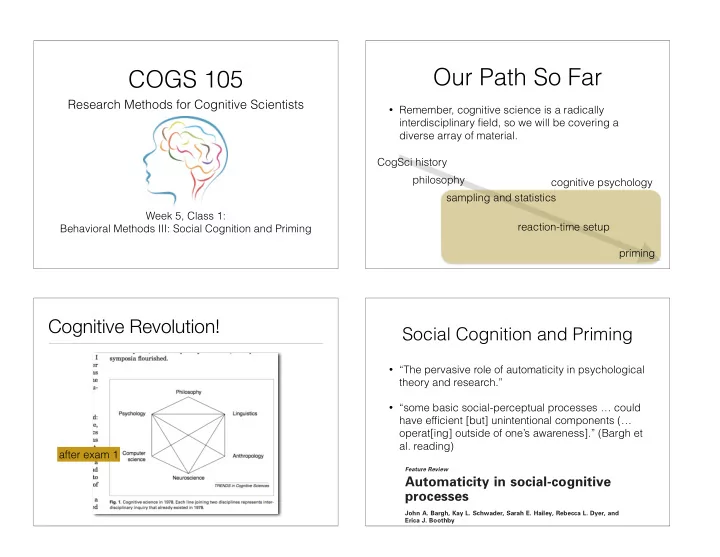
COGS 105

Research Methods for Cognitive Scientists

Week 5, Class 1: Behavioral Methods III: Social Cognition and Priming

Our Path So Far

  • Remember, cognitive science is a radically

interdisciplinary field, so we will be covering a diverse array of material. philosophy CogSci history sampling and statistics reaction-time setup priming cognitive psychology

Cognitive Revolution!

after exam 1

Social Cognition and Priming

  • “The pervasive role of automaticity in psychological

theory and research.”

  • “some basic social-perceptual processes … could

have efficient [but] unintentional components (…

  • perat[ing] outside of one’s awareness].” (Bargh et
  • al. reading)

Feature Review

Automaticity in social-cognitive processes

John A. Bargh, Kay L. Schwader, Sarah E. Hailey, Rebecca L. Dyer, and Erica J. Boothby

slide-2
SLIDE 2

Priming

  • Definition: Priming is a family of methods where we

bias a decision or response through presenting subtle (even sometimes unconscious) information to a participant.

  • For example, classic work with RT has shown that you

can prime related words.

  • E.g., in LDT you can prime a response to “dog” using

“cat” even if “cat” is shown for just milliseconds and subconsciously before the “dog” stimulus appears.

prime

Types of Priming

Prior Priming Concurrent Priming Context Priming prime target prime prime prime target target “bias”

Example Prior Priming

  • Semantic priming. Here, respond to a word with

your right hand only if the word you see relates closely to a semantic category: dogs. leash

  • ven

fetch leaf branch roots bark slowed RT due to priming by tree-related concepts

slide-3
SLIDE 3

Priming Types

  • Not all primes are “unconscious” in the subliminal sense. They may

be unconscious in the sense that they are “not noticed” as affecting participant behavior.

  • Prior priming can be “unconscious” if you present the prime

quickly so that it is not immediately processed (though it may have been implicitly perceived and processed).

  • Concurrent primes can be unconscious in the sense that the

primes may not seem to be related to the outcome of the task; but participants get affected anyway.

  • Context primes may be unconscious in that the participants are

unaware that you have setup a context to prompt them to think

  • f a decision or solution or perception.

Plan

  • Priming in high-level visual perception
  • Priming in social cognition: behavior contagion
  • The embodied nature of social priming
  • Moderators in behavior contagion
  • Developmental issues in social priming
  • Unconscious thought theory

Plan

  • Priming in high-level visual perception
  • Priming in social cognition: behavior contagion
  • The embodied nature of social priming
  • Moderators in behavior contagion
  • Developmental issues in social priming
  • Unconscious thought theory

In Vision

  • You can subtly prime a wide variety of cognitive

processes, including visual ones. What do you see in this picture? dog sniffing left side

slide-4
SLIDE 4

Examples...

cheater dishonest mendacity

Priming experiment...

They chatted The birdies sipped

Priming

https://www.youtube.com/watch?v=QeIrdqU0o9s

Balcetis TEDx Talk

slide-5
SLIDE 5

Priming

  • One reason priming works is that our perceptions

and decisions and judgments are made under great uncertainty.

  • Priming — the subtle influence of related

information — can help our cognitive system resolve some of that uncertainty, even if it is sometimes unconscious.

Plan

  • Priming in high-level visual perception
  • Priming in social cognition: behavior contagion
  • The embodied nature of social priming
  • Moderators in behavior contagion
  • Developmental issues in social priming
  • Unconscious thought theory

Plan

  • Priming in high-level visual perception
  • Priming in social cognition: behavior contagion
  • The embodied nature of social priming
  • Moderators in behavior contagion
  • Developmental issues in social priming
  • Unconscious thought theory

Social Priming

  • You can prime in all sorts of ways. The method is

widespread in social psychology.

  • The study of social cognition seems to often

involve the activation of a source concept (say, a stereotype), and then we see how decisions or behaviors are affected.

slide-6
SLIDE 6

Feature Review

Automaticity in social-cognitive processes

John A. Bargh, Kay L. Schwader, Sarah E. Hailey, Rebecca L. Dyer, and Erica J. Boothby

Yale University, Department of Psychology, 2 Hillhouse Avenue, New Haven, CT 06520, USA

Over the past several years, the concept of automaticity

  • f higher cognitive processes has permeated nearly all

domains of psychological research. In this review, we highlight insights arising from studies in decision-mak- ing, moral judgments, close relationships, emotional processes, face perception and social judgment, motiva- tion and goal pursuit, conformity and behavioral conta- gion, embodied cognition, and the emergence of higher- level automatic processes in early childhood. Taken together, recent work in these domains demonstrates that automaticity does not result exclusively from a process of skill acquisition (in which a process always begins as a conscious and deliberate one, becoming capable of automatic operation only with frequent use) – there are evolved substrates and early childhood learning mechanisms involved as well. The pervasive role of automaticity in psychological theory and research If there is one major trend in research on automaticity of the higher mental processes over the past few years, it is that the concept has now permeated nearly all psychologi- cal domains. What began 30 years ago with some tentative steps into the notion that some basic social-perceptual and prejudice in adults (see [2]); instead we devote attention to the new emerging research on attitudes and prejudice in very young children (see the section on devel-

  • pment).

The second major trend in automaticity research has been the growing recognition that not all higher-level automatic processes are put in place via a process of skill acquisition (e.g., [3]), in which a mental process starts out as conscious and effortful and only with frequent and consistent practice and experience becomes efficient and

  • automatic. Early childhood studies and research on em-

bodied influences have shown how innate processes and those acquired in very early childhood (such as concepts about the physical world and physical experiences) can exert an automatic, nonconscious influence on the higher mental processes, without starting out as a conscious process (see [4]). Several forms of automatic influence are driven by effortless perceptual activity regarding the outside world, such as behavioral contagion or conformity effects trig- gered by the perception of others’ behavior and immediate impressions of others based on their facial features or expressions alone, whereas others are driven by automatic sensory perception and the perception of internal states as

read for broad survey, gist

Behavior Contagion

  • Example: Elderly primes.

https://www.youtube.com/watch?v=5g4_v4JStOU

Behavior Contagion

  • “Behavior contagion” through priming.
  • Sneak subtle meanings inside a language task;

do so in a way that participants cannot notice it.

  • Track the behaviors of the participants
  • Bargh et al. claim that priming is “whole system” —

it is embodied; you can find many types of behavior that are affected.

Plan

  • Priming in high-level visual perception
  • Priming in social cognition: behavior contagion
  • The embodied nature of social priming
  • Moderators in behavior contagion
  • Developmental issues in social priming
  • Unconscious thought theory
slide-7
SLIDE 7

Plan

  • Priming in high-level visual perception
  • Priming in social cognition: behavior contagion
  • The embodied nature of social priming
  • Moderators in behavior contagion
  • Developmental issues in social priming
  • Unconscious thought theory

Embodiment

  • “…strong associations between metaphorically

related physical and psychological concepts.”

  • E.g., “briefly holding a warm cup of coffee

produces feelings of social warmth.” (Williams & Bargh, 2008)

  • And are they bidirectional? Social warmth may lead
  • ne to think room temperature is higher? (IJzerman

& Semin, 2010)

IJzerman & Semin, 2010

  • One participant joined two ‘participants’ (who were

really confederates blind to the experiments’ purpose), in a room where temperature was held constant.

  • Confederates sat either close (50 cm) or far (270

cm) from the target participant.

  • Naturally, they made sure that the temperature

near the participant was actually constant.

Close Sitting!

19.2 19.375 19.55 19.725 19.9

Close sitting Far sitting

Perceived temperature

slide-8
SLIDE 8

Similarities Game

18 18.75 19.5 20.25 21

More similarities Fewer similarities

Perceived temperature

Similarities Game

5.25 10.5 15.75 21

More similarities Fewer similarities

Perceived temperature

start axis at 0, effect does not look so big…

Plan

  • Priming in high-level visual perception
  • Priming in social cognition: behavior contagion
  • The embodied nature of social priming
  • Moderators in behavior contagion
  • Developmental issues in social priming
  • Unconscious thought theory

Plan

  • Priming in high-level visual perception
  • Priming in social cognition: behavior contagion
  • The embodied nature of social priming
  • Moderators in behavior contagion
  • Developmental issues in social priming
  • Unconscious thought theory
slide-9
SLIDE 9

Moderators

  • Bargh et al. argue that social cognition researchers widely

accept that social priming happens, but…

  • Now we want to know about “moderators” — who shows these

effects and who not — what moderates the effects?

  • E.g., self-consciousness may be a moderator.
  • Those who are more self-conscious can be more likely to

show social priming effects (Hull et al., 2002, cited in Bargh et al.).

  • Measured self-consciousness with series of questions: E.g.

“I’m concerned about what other people think of me.”

Hull et al., 2002 Plan

  • Priming in high-level visual perception
  • Priming in social cognition: behavior contagion
  • The embodied nature of social priming
  • Moderators in behavior contagion
  • Developmental issues in social priming
  • Unconscious thought theory

Plan

  • Priming in high-level visual perception
  • Priming in social cognition: behavior contagion
  • The embodied nature of social priming
  • Moderators in behavior contagion
  • Developmental issues in social priming
  • Unconscious thought theory
slide-10
SLIDE 10

What About Kids?

  • Recent work suggests interesting patterns in the

judgments of young children, and has implications for how these priming effects develop.

  • Do kids first explicitly learn social biases, for example, or

do they come about implicitly, possibly even being innate?

  • The latter question (innateness) is highly controversial

and still much debated; we could use your help.

  • Over & Carpenter, 2009: Primed children (18 mos!) with

images to be affiliative; tested whether they were willing to help the experimenter.

Over & Carpenter

60 infants, between-subject design (15 per condition)…

Over & Carpenter

Condition

Together After 10 s Spontaneously

Percentage of Infants Who Helped

Alone Baseline Back-to-Back 10 20 30 40 50 60 70 80 90 100

Plan

  • Priming in high-level visual perception
  • Priming in social cognition: behavior contagion
  • The embodied nature of social priming
  • Moderators in behavior contagion
  • Developmental issues in social priming
  • Unconscious thought theory
slide-11
SLIDE 11

Plan

  • Priming in high-level visual perception
  • Priming in social cognition: behavior contagion
  • The embodied nature of social priming
  • Moderators in behavior contagion
  • Developmental issues in social priming
  • Unconscious thought theory

Decision Making

  • The “unconscious thought theory” (UTT) is a

provocative new idea that decisions made quickly (even unconsciously) are, on average, better than those you make deliberately.

  • Recent theorizing has found more balance,

arguing that some decisions are made better unconsciously, while others may be better made consciously.

scious decision-making seem merited. Briefly, UTT holds that, after a first period of conscious thought in which the judgment relevant information is acquired (such as the relative merits of different products

  • r apartments, across several dimensions, such as price

and quality) and conscious intention is formed to make the best decision (this is why UTT is a form of goal-dependent automaticity), a period of deliberation using unconscious thought (while conscious thought is directed elsewhere) produces better quality judgments than does an equally long period of conscious deliberation. Theoretical reasons for this prediction include the greater efficiency of uncon-

Dijksterhuis & Nordgren

  • Conscious thought can sometimes lead to worse stereotype

activation.

  • Participants were asked to form an impression of a target person.
  • They get a cultural stereotype activation (“this person is

Moroccan”), then read more detailed information.

  • Half of participants were given time to consciously deliberate;

half were distracted for the same period of time.

  • Distracted participants showed less biased evaluation and

memories! Judged the individual in a more balanced way from the information.

slide-12
SLIDE 12

Why?

produces better quality judgments than does an equally long period of conscious deliberation. Theoretical reasons for this prediction include the greater efficiency of uncon- scious thought and the tendency of conscious thought to unequally weigh some dimensions over others, because of the limited focus of conscious thought at any one time. Although space precludes a complete review of the

Schnall et al., 2009

  • Participants who washed their hands (prime)

evaluated a moral violation as less wrong than participants who did not wash their hands! There’s a bit more methodological detail to this…

Results

TABLE 2 Mean Ratings for Moral Vignettes in Experiment 2 Condition Dog Trolley Wallet Plane Crash Re ´sume ´ Kitten Hand washing (n 5 21) 5.33 (1.88) 2.81 (1.08) 4.62 (1.53) 5.38 (1.80) 4.24 (1.67) 6.00 (1.18) No hand washing (n 5 22) 5.73 (0.98) 3.64 (1.05) 5.73 (1.28) 6.05 (1.21) 5.09 (1.15) 6.36 (1.00)

  • Note. Response scales ranged from 1 (nothing wrong at all) to 7 (extremely wrong). Standard deviations are given in

parentheses.

Plan

  • Priming in high-level visual perception
  • Priming in social cognition: behavior contagion
  • The embodied nature of social priming
  • Moderators in behavior contagion
  • Developmental issues in social priming
  • Unconscious thought theory
slide-13
SLIDE 13

Next Time

  • Very important emerging issues regarding research ethics that

we’ve known for quite a long time but need important reminders.

  • Recent “Open Science” agenda to encourage positive research

ethics.

  • Also, some “Jerry Springer” moments…
  • Dramatic outbursts among individuals and swaths of others

gaining enjoyment from the potential misfortunes of others…

  • Study guide will be posted by Thursday, along with all slides.