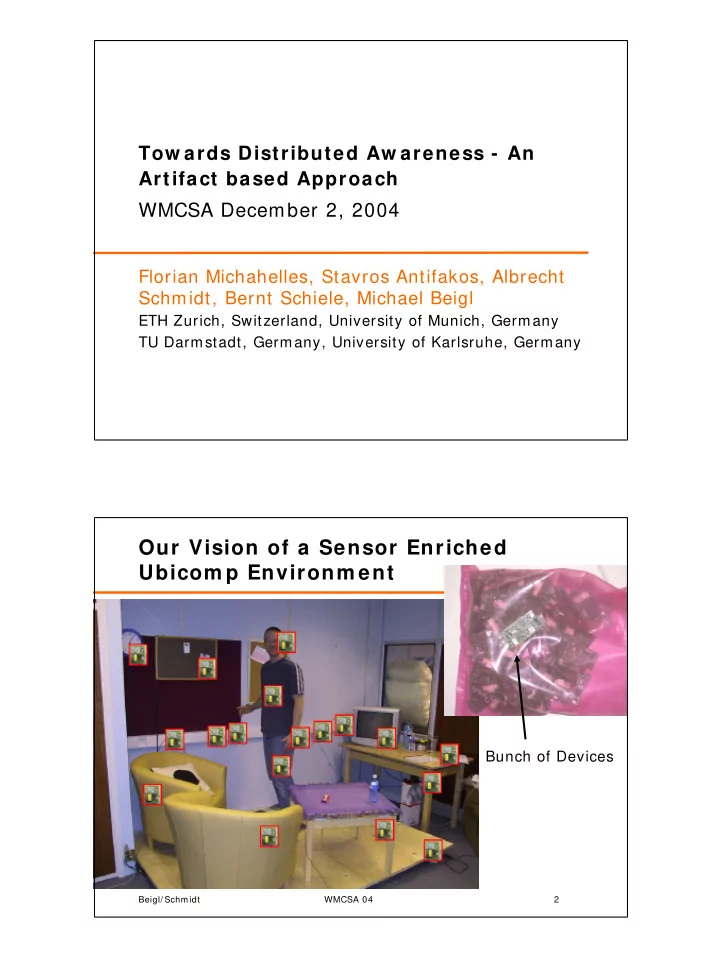
Our Vision of a Sensor Enriched Ubicom p Environm ent Bunch of - - PDF document

our vision of a sensor enriched ubicom p environm ent
SMART_READER_LITE
LIVE PREVIEW

Our Vision of a Sensor Enriched Ubicom p Environm ent Bunch of - - PDF document

Tow ards Distributed Aw areness - An Artifact based Approach WMCSA December 2, 2004 Florian Michahelles, Stavros Antifakos, Albrecht Schmidt, Bernt Schiele, Michael Beigl ETH Zurich, Switzerland, University of Munich, Germany TU Darmstadt,


slide-1
SLIDE 1

Tow ards Distributed Aw areness - An Artifact based Approach WMCSA December 2, 2004

Florian Michahelles, Stavros Antifakos, Albrecht Schmidt, Bernt Schiele, Michael Beigl

ETH Zurich, Switzerland, University of Munich, Germany TU Darmstadt, Germany, University of Karlsruhe, Germany

Beigl/ Schmidt WMCSA 04 2

Our Vision of a Sensor Enriched Ubicom p Environm ent

Bunch of Devices

slide-2
SLIDE 2

Beigl/ Schmidt WMCSA 04 3

Distributed Aw areness Approach

Context perception in a distributed sensing system s

Some requirements:

run several applications on top of these devices reuse implemented parts for new applications change one applications without interfering with another improvement/ changes of the infrastructure should not break

applications

possible to implement on very small device works without backend infrastructure (p2p)

Based on experience gained in the Smart-Its project

Many demos and applications build successfully using this

approach

Having changing environments using this approach

Artifact centric approach

Beigl/ Schmidt WMCSA 04 4

Platform Sm art- I ts

I dea Device as secondary artefact, integrated into the

  • bject

I ndependently operating, local deciding with peers Integrates Computation, Sensing & Communication Post-hoc attachable/ embeddable or integratable Core and add-on boards

Platform

slide-3
SLIDE 3

Beigl/ Schmidt WMCSA 04 5

Sm art-I ts – A Ubiquitous Com puting Platform

Means for exploring applications and new form s of physical interaction

Building scenarios

  • Rapid-prototyping of interactive applications
  • explore interaction with the Ubiquitous Computer

Characteristics

  • Some technical parameters: up to 5 MIPS, 128kbyte

program, 4k+ 512kbyte RAM, battery operated, various RF

  • Down to 1cm³ , lifetime up to several years, simple to

program, simple to build/ extend

Beigl/ Schmidt WMCSA 04 6

Office – Exam ple I m plem entation

Aw are artifacts

Chairs Pens Signs Coffee cups …

slide-4
SLIDE 4

Beigl/ Schmidt WMCSA 04 7

Context Correlation / Tim e and Space Exam ple chair 1: used chair 2: used audio: speaking room:

  • ccupied

projector:

  • n

door: closed activity: meeting

Beigl/ Schmidt WMCSA 04 8

Bottom - up Context Models

Context is Anchored in Artifacts Modeling and acquiring context on entity level More general properties Flexible, extensible, and simple model Exploiting domain knowledge Augm enting Artifacts w ith Sensing (Actuation) Processing Communication Context Related to I nteraction w ith the Artifact Combining context on a higher level Time & space correlation

slide-5
SLIDE 5

Beigl/ Schmidt WMCSA 04 9

Bottom - up Context - Exam ple

sofa

free

  • ccupied with one person
  • ccupied with two people
  • ccupied with three people

door

  • pen

closed degree of openness interaction

briefcase

em pty loaded

  • pen

closed interaction

sofa ( over the top)

… jumping on the sofa motion of people on the sofa temperature on the sofa pouring orange juice on the

sofa

pouring wine on the sofa pouring milk on the sofa cleaning the sofa moving the sofa sofa placed on the stairs sofa upright upside down sofa flying in midair …

Beigl/ Schmidt WMCSA 04 10

Artifact- based Perception Model

perception based on sim ple sensors sensor reading are m eaningful when related to a real world object that are attached to when related to other objects which are aware im plem enting sensing and context recognition for a specific object is simpler than for a complete system more generic and applicable to several applications allows reuse of perceptual components Context-aw are Ubicom p system s can be m odeled as set of networked context-aware artifacts time and space relation between these artifacts

slide-6
SLIDE 6

Beigl/ Schmidt WMCSA 04 11

A layered architecture for distributed context-aw are system s

Artifact layer data collection, perception and recognition for the particular artifact Setting layer tightly coupled group of artifacts all perception and recognition tasks in a group Application layer application-specific perception and recognition context information relevant for the application is combined

Beigl/ Schmidt WMCSA 04 12

Artifact Layer

Modeling a single artifact Usually a single sensing / perception node context prim itives are determ ined by asking what is the artifact and what is its prime use? who are the users of such an artifact and in which situation do they use it? tasks that are accom plished in the artifact layer Sensor data acquisition Artifact centric perception processing History and long term buffers

slide-7
SLIDE 7

Beigl/ Schmidt WMCSA 04 13

Artifact Layer API

Beigl/ Schmidt WMCSA 04 14

Setting Layer

tightly grouped set of artifacts or devices that are cooperating. cooperation between artifacts for the purpose of supporting a particular setting independent of a particular application Questions to establish a setting

What is the relationship among artifacts? What is the purpose of the setting? Who are the users? What perception primitives/ contexts are provided?

Tasks in the setting layer

  • ffering collective perception primitives

collecting and providing setting history

slide-8
SLIDE 8

Beigl/ Schmidt WMCSA 04 15

Setting Layer API

Beigl/ Schmidt WMCSA 04 16

Case Study: Proactive I nstructions

slide-9
SLIDE 9

Beigl/ Schmidt WMCSA 04 17

Case Study: Proactive I nstructions

Boards and screw driver are the artifacts Settings layer infers the current assem bly and activity Application layer

displays embedded

instructions

Compare steps to the plan

Beigl/ Schmidt WMCSA 04 18

Case Studies / Evaluation

Several system s im plem ented / re-im plem ented proactive instructions A-life (avalanche rescue system) Demo of a restaurant with aware items Smart office Smart-Its Friends Load-sensing environment

slide-10
SLIDE 10

Beigl/ Schmidt WMCSA 04 19

Lessons learned

I m plem enting on artifact level allow s separation of concerns Reuse of existing parts in a system Successful hiding of low -level functionality Further functionality and new applications are m uch quicker im plem ented

Beigl/ Schmidt WMCSA 04 20

Conclusions

Artifact centered view easies developm ent of context- aw are applications Layered approach allows separation of concerns enables reuse of perceptual components eases application development I m plem entation Smart-Its and PC similar API, C on the MCU, JAVA on PC Approach successfully applied in several system s

slide-11
SLIDE 11

Beigl/ Schmidt WMCSA 04 21

Questions?

Sm art- I ts Consortium

ETH Zurich, Switzerland, Lancaster University, UK TecO, University of Karlsruhe, Germany FAL, Victoria Institute, Sweden VTT, Oulu, Finland

Funded by the European Disappearing Computer Initiative