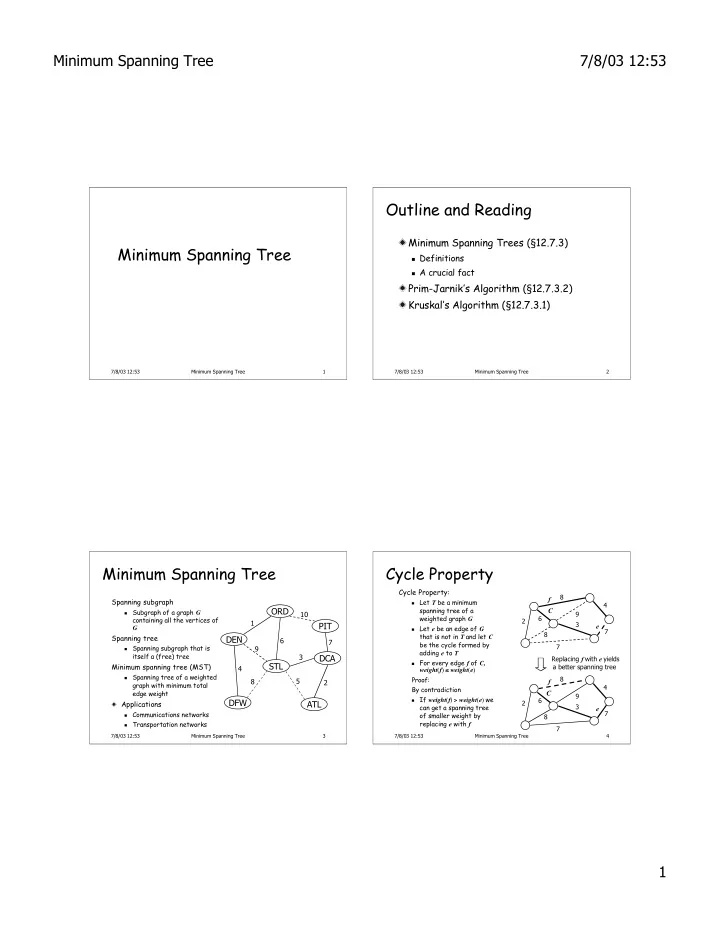
SLIDE 2 Minimum Spanning Tree 7/8/03 12:53 2
7/8/03 12:53 Minimum Spanning Tree 5
U V
Partition Property
Partition Property: Consider a partition of the vertices
- f G into subsets U and V. Let e be
an edge of minimum weight across the partition. There is a minimum spanning tree of G containing edge e Proof:
n Let T be an MST of G n If T does not contain e, consider the
cycle C formed by e with T and let f be an edge of C across the partition
n By the cycle property,
weight(f) £ £ weight(e)
n Thus, weight(f) =
= weight(e)
n We obtain another MST by replacing f
with e 7 4 2 8 5 7 3 9 8 e f 7 4 2 8 5 7 3 9 8 e f Replacing f with e yields another MST U V
7/8/03 12:53 Minimum Spanning Tree 6
Prim-Jarnik’s Algorithm
Prim-Jarnik’s algorithm for computing an MST is similar to Dijkstra’s algorithm We assume that the graph is connected We pick an arbitrary vertex s and we grow the MST as a cloud of vertices, starting from s We store with each vertex v a label d(v) representing the smallest weight of an edge connecting v to any vertex in the cloud (as opposed to
the total sum of edge weights on a path from the start vertex to u).
At each step
n We add to the cloud the vertex u outside the cloud with
the smallest distance label
n We update the labels of the vertices adjacent to u
7/8/03 12:53 Minimum Spanning Tree 7
Use a priority queue Q whose keys are D labels, and whose elements are vertex-edge pairs. Any vertex v can be the starting vertex. We still initialize all the D[u] values to INFINITE, but we also initialize E[u] (the edge associated with u) to null. Return the minimum-spanning tree T.
We can reuse code from Dijkstra’s, and we only have to change a few
- things. Let’s look at the pseudocode....
7/8/03 12:53 Minimum Spanning Tree 8
Algorithm PrimJarnik(G): Input: A weighted graph G. Output: A minimum spanning tree T for G. pick any vertex v of G {grow the tree starting with vertex v} T ¨ {v} D[u] ¨ 0 E[u] ¨ ∅ for each vertex u ≠ v do D[u] ¨ ∞ let Q be a priority queue that contains vertices, using the D labels as keys while Q ≠ ∅ do {pull u into the cloud C} u ¨ Q.removeMinElement() add vertex u and edge E[u] to T for each vertex z adjacent to u do if z is in Q {perform the relaxation operation on edge (u, z) } if weight(u, z) < D[z] then D[z] ¨weight(u, z) E[z] ¨ (u, z) change the key of z in Q to D[z] return tree T