Outline Definition of Information First part based very loosely on - - PowerPoint PPT Presentation

outline definition of information first part based very
SMART_READER_LITE
LIVE PREVIEW

Outline Definition of Information First part based very loosely on - - PowerPoint PPT Presentation

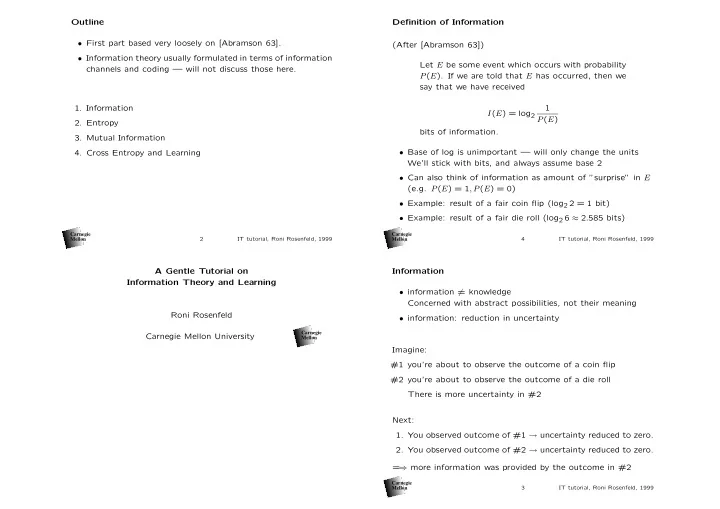
Outline Definition of Information First part based very loosely on [Abramson 63]. (After [Abramson 63]) Information theory usually formulated in terms of information Let E be some event which occurs with probability channels and coding


slide-1
SLIDE 1

A Gentle Tutorial on Information Theory and Learning Roni Rosenfeld Carnegie Mellon University

Carnegie Mellon

Outline

  • First part based very loosely on [Abramson 63].
  • Information theory usually formulated in terms of information

channels and coding — will not discuss those here.

  • 1. Information
  • 2. Entropy
  • 3. Mutual Information
  • 4. Cross Entropy and Learning

Carnegie Mellon 2 IT tutorial, Roni Rosenfeld, 1999

Information

  • information = knowledge

Concerned with abstract possibilities, not their meaning

  • information: reduction in uncertainty

Imagine: #1 you’re about to observe the outcome of a coin flip #2 you’re about to observe the outcome of a die roll There is more uncertainty in #2 Next:

  • 1. You observed outcome of #1 → uncertainty reduced to zero.
  • 2. You observed outcome of #2 → uncertainty reduced to zero.

= ⇒ more information was provided by the outcome in #2

Carnegie Mellon 3 IT tutorial, Roni Rosenfeld, 1999

Definition of Information (After [Abramson 63]) Let E be some event which occurs with probability P(E). If we are told that E has occurred, then we say that we have received I(E) = log2 1 P(E) bits of information.

  • Base of log is unimportant — will only change the units

We’ll stick with bits, and always assume base 2

  • Can also think of information as amount of ”surprise” in E

(e.g. P(E) = 1, P(E) = 0)

  • Example: result of a fair coin flip (log2 2 = 1 bit)
  • Example: result of a fair die roll (log2 6 ≈ 2.585 bits)

Carnegie Mellon 4 IT tutorial, Roni Rosenfeld, 1999

slide-2
SLIDE 2

Information is Additive

  • I(k fair coin tosses) = log

1 1/2k = k bits

  • So:

– random word from a 100,000 word vocabulary: I(word) = log 100, 000 = 16.61 bits – A 1000 word document from same source: I(document) = 16,610 bits – A 480x640 pixel, 16-greyscale video picture: I(picture) = 307, 200 · log 16 = 1, 228, 800 bits

  • =

⇒ A (VGA) picture is worth (a lot more than) a 1000 words!

  • (In reality, both are gross overestimates.)

Carnegie Mellon 5 IT tutorial, Roni Rosenfeld, 1999

Entropy A Zero-memory information source S is a source that emits sym- bols from an alphabet {s1, s2, . . . , sk} with probabilities {p1, p2, . . . , pk}, respectively, where the symbols emitted are statistically indepen- dent. What is the average amount of information in observing the

  • utput of the source S?

Call this Entropy: H(S) =

  • i

pi · I(si) =

  • i

pi · log 1 pi = EP [ log 1 p(s) ] *

Carnegie Mellon 6 IT tutorial, Roni Rosenfeld, 1999

Alternative Explanations of Entropy H(S) =

  • i

pi · log 1 pi

  • 1. avg amt of info provided per symbol
  • 2. avg amount of surprise when observing a symbol
  • 3. uncertainty an observer has before seeing the symbol
  • 4. avg # of bits needed to communicate each symbol

(Shannon: there are codes that will communicate these sym- bols with efficiency arbitrarily close to H(S) bits/symbol; there are no codes that will do it with efficiency < H(S) bits/symbol)

Carnegie Mellon 7 IT tutorial, Roni Rosenfeld, 1999

Entropy as a Function of a Probability Distribution Since the source S is fully characterized byP = {p1, . . . pk} (we don’t care what the symbols si actually are, or what they stand for), entropy can also be thought of as a property of a probability distribution function P: the avg uncertainty in the distribution. So we may also write: H(S) = H(P) = H(p1, p2, . . . , pk) =

  • i

pi log 1 pi (Can be generalized to continuous distributions.)

Carnegie Mellon 8 IT tutorial, Roni Rosenfeld, 1999

slide-3
SLIDE 3

Properties of Entropy H(P) =

  • i

pi · log 1 pi

  • 1. Non-negative: H(P) ≥ 0
  • 2. Invariant wrt permutation of its inputs:

H(p1, p2, . . . , pk) = H(pτ(1), pτ(2), . . . , pτ(k))

  • 3. For any other probability distribution {q1, q2, . . . , qk}:

H(P) =

  • i

pi · log 1 pi <

  • i

pi · log 1 qi

  • 4. H(P) ≤ log k, with equality iff

pi = 1/k ∀i

  • 5. The further P is from uniform, the lower the entropy.

Carnegie Mellon 9 IT tutorial, Roni Rosenfeld, 1999

Special Case: k = 2 Flipping a coin with P(“head”)=p, P(“tail”)=1-p H(p) = p · log 1 p + (1 − p) · log 1 1 − p Notice:

  • zero uncertainty/information/surprise at edges
  • maximum info at 0.5 (1 bit)
  • drops off quickly

Carnegie Mellon 10 IT tutorial, Roni Rosenfeld, 1999

Special Case: k = 2 (cont.) Relates to: ”20 questions” game strategy (halving the space). So a sequence of (independent) 0’s-and-1’s can provide up to 1 bit of information per digit, provided the 0’s and 1’s are equally likely at any point. If they are not equally likely, the sequence provides less information and can be compressed.

Carnegie Mellon 11 IT tutorial, Roni Rosenfeld, 1999

The Entropy of English 27 characters (A-Z, space). 100,000 words (avg 5.5 characters each)

  • Assuming independence between successive characters:

– uniform character distribution: log 27 = 4.75 bits/character – true character distribution: 4.03 bits/character

  • Assuming independence between successive words:

– unifrom word distribution: log 100, 000/6.5 ≈ 2.55 bits/character – true word distribution: 9.45/6.5 ≈ 1.45 bits/character

  • True Entropy of English is much lower!

Carnegie Mellon 12 IT tutorial, Roni Rosenfeld, 1999

slide-4
SLIDE 4

Two Sources Temperature T: a random variable taking on values t P(T=hot)=0.3 P(T=mild)=0.5 P(T=cold)=0.2 = ⇒ H(T)=H(0.3, 0.5, 0.2) = 1.48548 huMidity M: a random variable, taking on values m P(M=low)=0.6 P(M=high)=0.4 = ⇒ H(M) = H(0.6, 0.4) = 0.970951 T, M not independent: P(T = t, M = m) = P(T = t) · P(M = m)

Carnegie Mellon 13 IT tutorial, Roni Rosenfeld, 1999

Joint Probability, Joint Entropy cold mild hot low 0.1 0.4 0.1 0.6 high 0.2 0.1 0.1 0.4 0.3 0.5 0.2 1.0

  • H(T) = H(0.3, 0.5, 0.2) = 1.48548
  • H(M) = H(0.6, 0.4) = 0.970951
  • H(T) + H(M) = 2.456431
  • Joint Entropy: consider the space of (t, m) events H(T, M) =
  • t,m P(T = t, M = m) · log

1 P(T=t,M=m)

H(0.1, 0.4, 0.1, 0.2, 0.1, 0.1) = 2.32193 Notice that H(T, M) < H(T) + H(M) !!!

Carnegie Mellon 14 IT tutorial, Roni Rosenfeld, 1999

Conditional Probability, Conditional Entropy P(T = t|M = m) cold mild hot low 1/6 4/6 1/6 1.0 high 2/4 1/4 1/4 1.0 Conditional Entropy:

  • H(T|M = low) = H(1/6, 4/6, 1/6) = 1.25163
  • H(T|M = high) = H(2/4, 1/4, 1/4) = 1.5
  • Average Conditional Entropy (aka equivocation):

H(T/M) =

m P(M = m) · H(T|M = m) =

0.6 · H(T|M = low) + 0.4 · H(T|M = high) = 1.350978 How much is M telling us on average about T? H(T) − H(T|M) = 1.48548 − 1.350978 ≈ 0.1345 bits

Carnegie Mellon 15 IT tutorial, Roni Rosenfeld, 1999

Conditional Probability, Conditional Entropy P(M = m|T = t) cold mild hot low 1/3 4/5 1/2 high 2/3 1/5 1/2 1.0 1.0 1.0 Conditional Entropy:

  • H(M|T = cold) = H(1/3, 2/3) = 0.918296
  • H(M|T = mild) = H(4/5, 1/5) = 0.721928
  • H(M|T = hot) = H(1/2, 1/2) = 1.0
  • Average Conditional Entropy (aka Equivocation):

H(M/T) =

t P(T = t) · H(M|T = t) =

0.3 · H(M|T = cold) + 0.5 · H(M|T = mild) + 0.2 · H(M|T = hot) = 0.8364528 How much is T telling us on average about M? H(M) − H(M|T) = 0.970951 − 0.8364528 ≈ 0.1345 bits

Carnegie Mellon 16 IT tutorial, Roni Rosenfeld, 1999

slide-5
SLIDE 5

Average Mutual Information I(X; Y ) = H(X) − H(X/Y ) =

  • x

P(x) · log 1 P(x) −

  • x,y

P(x, y) · log 1 P(x|y) =

  • x,y

P(x, y) · log P(x|y) P(x) =

  • x,y

P(x, y) · log P(x, y) P(x)P(y) Properties of Average Mutual Information:

  • Symmetric (but H(X) = H(Y ) and H(X/Y ) = H(Y/X))
  • Non-negative (but H(X) − H(X/y) may be negative!)
  • Zero iff X, Y independent
  • Additive (see next slide)

Carnegie Mellon 17 IT tutorial, Roni Rosenfeld, 1999

Mutual Information Visualized H(X, Y ) = H(X) + H(Y ) − I(X; Y )

Carnegie Mellon 18 IT tutorial, Roni Rosenfeld, 1999

Three Sources From Blachman: (”/” means ”given”. ”;” means ”between”. ”,” means ”and”.)

  • H(X, Y/Z) = H({X, Y } / Z)
  • H(X/Y, Z) = H(X / {Y, Z})
  • I(X; Y/Z) = H(X/Z) − H(X/Y, Z)
  • I(X; Y ; Z)

= I(X; Y ) − I(X; Y/Z) = H(X, Y, Z) − H(X, Y ) − H(X, Z) − H(Y, Z) + H(X) + H(Y ) + H = ⇒ Can be negative!

  • I(X; Y, Z) = I(X; Y ) + I(X; Z/Y ) (additivity)
  • But: I(X; Y ) = 0,I(X; Z) = 0 doesn’t mean I(X; Y, Z) = 0!!!

Carnegie Mellon 19 IT tutorial, Roni Rosenfeld, 1999

A Markov Source Order-k Markov Source: A source that ”remembers” the last k symbols emitted. Ie, the probability of emitting any symbol depends on the last k emitted symbols: P(sT=t|sT=t−1, sT=t−2, . . . , sT=t−k) So the last k emitted symbols define a state, and there are qk states. First-order markov source: defined by qXq matrix: P(si|sj) Example: ST=t is position after t random steps

Carnegie Mellon 20 IT tutorial, Roni Rosenfeld, 1999

slide-6
SLIDE 6

Approximating with a Markov Source A non-Markovian source can still be approximated by one. Examples: English characters: C = {c1, c2, . . .}

  • 1. Uniform: H(C) = log 27 = 4.75 bits/char
  • 2. Assuming 0 memory: H(C) = H(0.186, 0.064, 0.0127, . . .) =

4.03 bits/char

  • 3. Assuming 1st order: H(C) = H(ci/ci−1) = 3.32 bits/char
  • 4. Assuming 2nd order: H(C) = H(ci/ci−1, ci−2) = 3.1 bits/char
  • 5. Assuming large order: Shannon got down to ≈ 1 bit/char

Carnegie Mellon 21 IT tutorial, Roni Rosenfeld, 1999

Modeling an Arbitrary Source Source D(Y ) with unknown distribution PD(Y ) (recall H(PD) = EPD[log

1 PD(Y )] )

Goal: Model (approximate) with learned distribution PM(Y ) What’s a good model PM(Y )?

  • 1. RMS error over D’s parameters ⇒ but D is unknown!
  • 2. Predictive Probability: Maximize the expected log-likelihood

the model assigns to future data from D

Carnegie Mellon 22 IT tutorial, Roni Rosenfeld, 1999

Cross Entropy M∗ = arg max

M

ED[log PM(Y )] = arg min

M

ED[log 1 PM(Y )] = CH(PD; PM) ⇐ = Cross Entropy The following are equivalent:

  • 1. Maximize Predictive Probability of PM
  • 2. Minimize Cross Entropy CH(PD; PM)
  • 3. Minimize the difference between PD and PM (in what sense?)

Carnegie Mellon 23 IT tutorial, Roni Rosenfeld, 1999

A Distance Measure Between Distributions Kullback-Liebler distance: KL(PD; PM) = CH(PD; PM) − H(PD) = EPD[log PD(Y ) PM(Y )] Properties of KL distance:

  • 1. Non-negative. KL(PD; PM) = 0 ⇐

⇒ PD = PM

  • 2. Generally non-symmetric

The following are equivalent:

  • 1. Maximize Predictive Probability of PM for distribution D
  • 2. Minimize Cross Entropy CH(PD; PM)
  • 3. Minimize the distance KL(PD; PM)

Carnegie Mellon 24 IT tutorial, Roni Rosenfeld, 1999