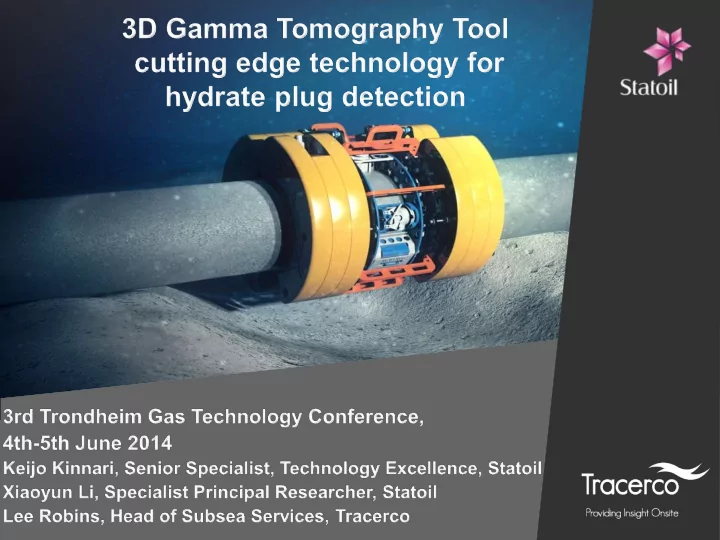
Outline Introduction Flow assurance challenges and needs Initial - - PowerPoint PPT Presentation

outline introduction flow assurance challenges and needs
SMART_READER_LITE
LIVE PREVIEW

Outline Introduction Flow assurance challenges and needs Initial - - PowerPoint PPT Presentation

Outline Introduction Flow assurance challenges and needs Initial Statoil and Tracerco cooperation on developing/testing detection tools Examples of field tests DiscoveryTM - Subsea Pipeline Visualisation Introduction to the


slide-1
SLIDE 1
slide-2
SLIDE 2

2

  • Introduction
  • Flow assurance challenges and needs
  • Initial Statoil and Tracerco cooperation
  • n developing/testing detection tools
  • Examples of field tests
  • DiscoveryTM - Subsea Pipeline

Visualisation

  • Introduction to the technology
  • Trials and scan images
  • Summary and Conclusion

Outline

slide-3
SLIDE 3

3

  • Hydrate restrictions in production systems
  • No reliable detection tools, especially for subsea use
  • Needs for high accuracy detection tools
  • Cooperation between Statoil and Tracerco over last 10 years

– To develop detection technology – Primary goal was FA applications – Application areas have expanded

Introduction

slide-4
SLIDE 4
  • Plug location
  • Plug characteristics

– Liquid pockets, wax depositions, hydrate restrictions, scale etc.?

  • Information important for

– Safety considerations – Evaluation of remediation solutions

4

Flow Assurance challenges

slide-5
SLIDE 5

6

Subsea Subsea template template mimic mimic Flowline Flowline mimic mimic 6 6” ” test test section section Gas/liquid Gas/liquid separator separator KO drum KO drum Flare line Flare line Gas Gas feed feed

Fiber Fiber optics in

  • ptics in

all test sections all test sections

5

Statoil's Flow Assurance Pilot

slide-6
SLIDE 6

Tomography map with liquid filled pipe section

Tomography technique used during hydrate detection trials

Statoil's Flow Assurance Pilot Plant

6

Tomography map after draining

slide-7
SLIDE 7

100 mm

7

Topside field measurements

Tomography applications

slide-8
SLIDE 8

8

Single gamma applications

Subsea field trial

slide-9
SLIDE 9

Discovery The technology

slide-10
SLIDE 10

Discovery Pipeline Visualisation

  • Tracerco DiscoveryTM is the world’s first Subsea CT Scanner, a

revolutionary non-intrusive technology for inspection of subsea pipelines.

  • It is specifically targeted for the inspection of unpiggable,

coated pipelines

10

Subsea Integrity Flow Assurance

slide-11
SLIDE 11

Same principle as medical CAT scanner

  • Reconstructs image of a target from a series of projections
  • One gamma radiation source and a large number of detectors

The same concept has been taken from the medical field to design, implement and deploy a scanner for subsea pipelines

Discovery Principle

slide-12
SLIDE 12

Discovery Initial Prototype Results

slide-13
SLIDE 13

Initial Lab Prototype Results

10-inch Pipe, 20mm wt, 50mm PU coating

SAMPLE

13

slide-14
SLIDE 14

Pipe-in-pipe Systems

Assess integrity of inner and outer pipes

14

slide-15
SLIDE 15

SAMPLE

Caissons and Pipe Bundles

Assess integrity of internal flowlines as well as the outer pipe

Gas Riser Oil Riser

15

slide-16
SLIDE 16

Discovery The Instrument

slide-17
SLIDE 17
  • Completely non intrusive

– No need to remove coating – No need to stop production

  • Wide range of pipes

– 6 to 27 inch. – Integrity and Flow Assurance – Pipe-in-pipe and caissons

  • 10000 ft / ~3000m Depth
  • X/Y resolution close to 1mm
  • Real-time Data Acquisition on

the vessel

– Images continuously updated every 20-30 seconds

Discovery _ specification overview

slide-18
SLIDE 18
  • Crawler

– Instrument automatically advances on the pipe

  • Scanning speed

– ~2-3 ft/h for low resolution – ~0.5 ft/h for high resolution

Discovery _ specification overview

slide-19
SLIDE 19

Discovery Underwater Trials

slide-20
SLIDE 20

First Subsea Trial - Bergen, April 2013

20

slide-21
SLIDE 21

2nd Subsea Trial – Scotland, 08/13

slide-22
SLIDE 22

Customer Trial Results

  • Test pieces supplied by customers, for proof of capability prior to
  • ffshore inspection project
slide-23
SLIDE 23

Tracerco Discovery Customer Trial Results – Flow Assurance

slide-24
SLIDE 24

Flow Assurance Trial 1

24

20-inch Pipe, 22mm wt, with brick, thermalite block, 2 sand bags, half filled with water

Feature Description Dimensional Information 1 Known feature Object of size 100mm wide x 50mm high, density ~2.4g/cc 2 Known feature Object of size 95mm wide x 210mm high, density ~0.9g/cc 3 Known feature Freeform object of approx. size 100mm x 90mm high, density ~1.9g/cc 4 Known feature Freeform object of approx. size 100mm x 90mm high, density ~1.9g/cc 5 Known feature Fluid filled to approx. 50% of volume, density ~1g/cc 6 Unknown feature Gas pocket of approx. size 70mm wide x 35mm high

slide-25
SLIDE 25
  • 273mm OD, 15.9mm

WT

  • 10mm internal plastic

lining

  • Manufactured blister to

simulate damage

Flow Assurance Trial 2

8-inch water injection line with plastic liner

slide-26
SLIDE 26

TEST Detect small gas channel

  • penings in blocked

pipelines WHY Assess possibility of gas communication between different sections MODEL

  • 12 inch Pipe-in-Pipe
  • Blockage and gas as

density-equivalent plastic. Then inserted in the pipe and scanned

Flow Assurance Trial 3

slide-27
SLIDE 27

Trial 3 – 30 seconds (1 lap)

Most channels detected after just 1 lap!

MODEL RECONSTRUCTION

slide-28
SLIDE 28

Trial 3 – 1 minute (2 laps)

Getting Sharper. Now all channels are visible.

MODEL RECONSTRUCTION

slide-29
SLIDE 29

Trial 3 – 5 minutes (10 laps)

Getting Sharper. All channels well visible.

MODEL RECONSTRUCTION

slide-30
SLIDE 30

Trial 3 – 12.5 minutes (25 laps)

All channels completely detected.

MODEL RECONSTRUCTION

slide-31
SLIDE 31

TEST Detecting gas pressure differences in blocked pipelines channels WHY Assess gas communication (HP/LP) between sections

  • f pipeline

MODEL • Same Pipe-in-Pipe

  • Blockage and as density-

equivalent plastic to asphaltene or wax.

  • HP/LP gas as density-

equivalent foam (0.1/0.2 g/cc)

LOW PRESS GAS ~0.1 g/cc HIGH PRESS. GAS ~0.2 g/cc

Flow Assurance Trial 4

slide-32
SLIDE 32

Trial 4 – 12.5minutes (25 laps)

Successful detection of gas density differences in channels.

MODEL RECONSTRUCTION

0.1 g/cc 0.2 g/cc

slide-33
SLIDE 33

Tracerco Discovery Customer Trial Results – Pipeline Integrity

slide-34
SLIDE 34

Integrity Trial 1

TEST Detect wall loss on the inner walls of pipelines WHY

  • Assess safety margins
  • Extend service life

MODEL • 20 inch pipe, ~20mm wall

  • Several defect profiles

machined at different axial positions in the pipe

slide-35
SLIDE 35

DRAWINGS RECONSTRUCTION

6+1 localized defects and 2 scallops to model wall loss

Integrity Trial 1

slide-36
SLIDE 36

DRAWINGS RECONSTRUCTION

Trial 1 – 30 seconds (1 lap)

Early detection of most defects and scallops in 30 seconds.

slide-37
SLIDE 37

DRAWINGS RECONSTRUCTION

Trial 1 – 5 minutes (10 laps)

Image getting sharper. All defects clearly visible.

slide-38
SLIDE 38

DRAWINGS RECONSTRUCTION

Trial 1 – 20 minutes (40 laps)

High resolution image. All defects visible and quantifiable.

slide-39
SLIDE 39

‘Blind test’ with unknown defects in a 20-inch coated pipeline

1 2 3 4 1 2 3 4

Integrity Trial 2

slide-40
SLIDE 40

TEST Detect voids and broken strands in flexible risers WHY

  • Assess safety margins
  • Extend service life

MODEL • 12-inch flexible riser

  • 1 strand segment was

removed from the outer tensile armor.

Integrity Trial 3

slide-41
SLIDE 41

Trial 3 – 30 seconds (1 lap)

MODEL RECONSTRUCTION

Indication of broken strand at the first lap (30 seconds).

slide-42
SLIDE 42

Test 4 – 12.5 minutes (25 laps)

MODEL RECONSTRUCTION

Image getting sharper. More detail on the inner carcass and all other layers.

slide-43
SLIDE 43
  • Tracerco and Statoil have

cooperated to produce the world’s first Subsea CT Scanning device.

  • Truly non intrusive

technology – Through coating – No need to stop production

  • Integrity and Flow

Assurance

  • Real time data
  • Near mm accuracy

Conclusion

43

slide-44
SLIDE 44