Outline of presentation MPS in forensic genetics Developed 3 - - PDF document

outline of presentation
SMART_READER_LITE
LIVE PREVIEW

Outline of presentation MPS in forensic genetics Developed 3 - - PDF document

2017-09-05 Implementing Massively Parallel Sequencing for Forensic DNA Analysis Using In-house PCR Panels Kyoung-Jin Shin, Ph.D. Dept. of Forensic Medicine Yonsei University College of Medicine Seoul, Republic of Korea Outline of


slide-1
SLIDE 1

2017-09-05 1

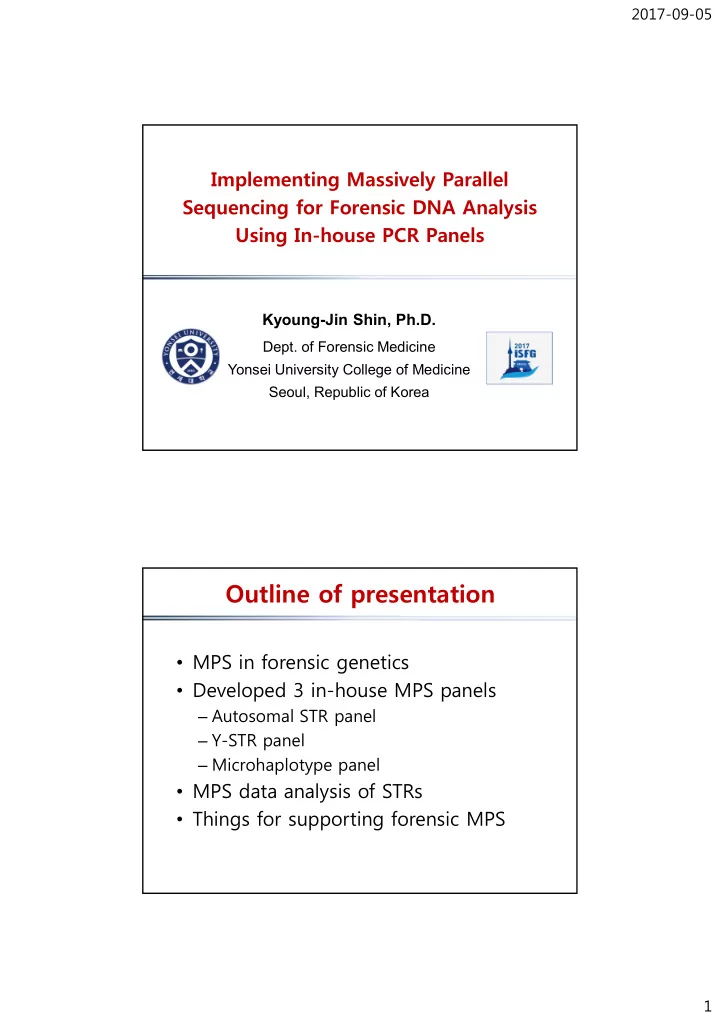
Implementing Massively Parallel Sequencing for Forensic DNA Analysis Using In-house PCR Panels

Kyoung-Jin Shin, Ph.D.

  • Dept. of Forensic Medicine

Yonsei University College of Medicine Seoul, Republic of Korea

Outline of presentation

  • MPS in forensic genetics
  • Developed 3 in-house MPS panels

– Autosomal STR panel – Y-STR panel – Microhaplotype panel

  • MPS data analysis of STRs
  • Things for supporting forensic MPS
slide-2
SLIDE 2

2017-09-05 2

Application of massively parallel sequencing to forensic genetics

Massively parallel sequencing

A B

Length-based genotype Sequence-based genotype

……TCTATCTGTCTGTCTGTCTATCTATCTA…… ……TCTATCTGTCTGTCTATCTATCTATCTA…… 16 allele 16 allele (G>A) A B

……

……TCTATCTGTCTGTCTGTCTATCTATCTA…… ……TCTATCTGTCTGTCTATCTATCTATCTA…… ……TCTATCTGTCTGTCTGTCTATCTATCTA…… ……TCTATCTGTCTGTCTATCTATCTATCTA…… ……TCTATCTGTCTGTCTGTCTATCTATCTA…… ……TCTATCTGTCTGTCTATCTATCTATCTA…… ……TCTATCTGTCTGTCTGTCTATCTATCTA…… ……TCTATCTGTCTGTCTATCTATCTATCTA…… ……TCTATCTGTCTGTCTGTCTATCTATCTA…… ……TCTATCTGTCTGTCTATCTATCTATCTA…… ……TCTATCTGTCTGTCTGTCTATCTATCTA…… ……TCTATCTGTCTGTCTATCTATCTATCTA…… ……TCTATCTGTCTGTCTGTCTATCTATCTA…… ……TCTATCTGTCTGTCTATCTATCTATCTA…… ……TCTATCTGTCTGTCTGTCTATCTATCTA…… ……TCTATCTGTCTGTCTATCTATCTATCTA…… ……TCTATCTGTCTGTCTGTCTATCTATCTA…… ……TCTATCTGTCTGTCTATCTATCTATCTA…… ……TCTATCTGTCTGTCTGTCTATCTATCTA…… ……TCTATCTGTCTGTCTATCTATCTATCTA…… ……TCTATCTGTCTGTCTGTCTATCTATCTA…… ……TCTATCTGTCTGTCTATCTATCTATCTA…… ……TCTATCTGTCTGTCTGTCTATCTATCTA…… ……TCTATCTGTCTGTCTATCTATCTATCTA…… ……TCTATCTGTCTGTCTGTCTATCTATCTA…… ……TCTATCTGTCTGTCTATCTATCTATCTA…… ……TCTATCTGTCTGTCTGTCTATCTATCTA…… ……TCTATCTGTCTGTCTATCTATCTATCTA…… ……TCTATCTGTCTGTCTGTCTATCTATCTA…… ……TCTATCTGTCTGTCTATCTATCTATCTA…… ……TCTATCTGTCTGTCTGTCTATCTATCTA…… ……TCTATCTGTCTGTCTATCTATCTATCTA…… ……TCTATCTGTCTGTCTGTCTATCTATCTA…… ……TCTATCTGTCTGTCTATCTATCTATCTA…… ……TCTATCTGTCTGTCTGTCTATCTATCTA…… ……TCTATCTGTCTGTCTATCTATCTATCTA…… ……TCTATCTGTCTGTCTGTCTATCTATCTA…… ……TCTATCTGTCTGTCTATCTATCTATCTA…… ……TCTATCTGTCTGTCTGTCTATCTATCTA…… ……TCTATCTGTCTGTCTATCTATCTATCTA…… ……TCTATCTGTCTGTCTGTCTATCTATCTA…… ……TCTATCTGTCTGTCTATCTATCTATCTA…… ……TCTATCTGTCTGTCTGTCTATCTATCTA…… ……TCTATCTGTCTGTCTATCTATCTATCTA…… ……TCTATCTGTCTGTCTGTCTATCTATCTA…… ……TCTATCTGTCTGTCTATCTATCTATCTA…… ……TCTATCTGTCTGTCTGTCTATCTATCTA…… ……TCTATCTGTCTGTCTATCTATCTATCTA…… ……TCTATCTGTCTGTCTGTCTATCTATCTA…… ……TCTATCTGTCTGTCTATCTATCTATCTA…… ……TCTATCTGTCTGTCTGTCTATCTATCTA…… ……TCTATCTGTCTGTCTATCTATCTATCTA…… ……TCTATCTGTCTGTCTGTCTATCTATCTA…… ……TCTATCTGTCTGTCTATCTATCTATCTA……

Capillary electrophoresis

Expectations when applying MPS to forensic genetics

  • Increased diversity of STR

– SNPs within repeat region and flaking area – Small sized amplicon not limited to CE lane

  • Simultaneous analysis of different kinds
  • f markers (STR, SNP and InDel, …)
  • Large multiplexing of forensic markers
  • Sequence based mixture deconvolution
slide-3
SLIDE 3

2017-09-05 3

Obstacles in application of MPS to forensic genetics

  • Limited information for currently available

commercial MPS panels

  • Costly and/or time-consuming procedure in

preparing a MPS library

  • The MPS data analysis is somewhat of hassle

Limited information for currently commercial MPS panels

  • Primer sequences not reported

– Ambiguity in flanking region span of markers – Potential mutation in primer binding area

  • Limited flexibility for damaged DNA

– Sometimes qPCR is not enough to QA for library – Need for library visualization

slide-4
SLIDE 4

2017-09-05 4

Costly and/or time-consuming procedure in preparing a MPS library

  • MPS Lib. preparation > $100 / samples
  • Time-consuming in adapter ligation procedure
  • Cumbersome purification step needed for

individual samples

Difficulty in MPS data analysis

  • MPS data analysis for commercial

NGS systems

– Platform specific – Sometimes additional analysis needed

  • Open source software

– TSSV, fdstools – STRinNGS – STRait Razor ※ End-user friendly ?

slide-5
SLIDE 5

2017-09-05 5

Development of In-house PCR panels

  • Open information for PCR primers and

PCR mixture components

  • Small sized amplicon as possible
  • Even read count across markers
  • Economic and simple library preparation
  • No need of special instruments
  • Platform independent data analysis

u Criteria

  • Target marker
  • Basically 20 extended CODIS STR and Amelogenin + additional STRs
  • 23 PowerPlex Y-STRs and Y-M175
  • Microhaplptypes suggested by Kidd et al.
  • Small sized amplicons is adapted as possible
  • while primer is not overlapping with core region
  • finally ranged in 70bp ~ 270bp
  • Avoid SNP with ³ 1% variation reported in primer binding area

u Resource

  • STRBase (http://www.cstl.nist.gov/div831/strbase/)
  • UCSC genome browser (http://genome.ucsc.edu/)
  • Primer 3 v.0.4.0 (http://frodo.wi.mit.edu/primer3/)

Design of multiplex PCR systems

slide-6
SLIDE 6

2017-09-05 6

Step 1. PCR amplification Step 2. Validate Amplicon Step 3. Library preparation Step 4. Validate Library Step 5. Sequencing

  • Template DNA

; 1 ng of Korean DNAs

  • Amplicon purification

: Enzymatic purification using EXO-SAP IT

  • Fluorometer

; Quant-iT™ PicoGreen dsDNA assays (invitrogen)

  • Agilent BioAnalyzer
  • TruSeq Nano DNA LT

Sample preparation Kit * Adjustment of beads ratio for size selection

  • Library Quantification

; KAPA library quantification kit

  • Agilent BioAnalyzer
  • Cluster generation and

sequencing on MiSeq ; 2 x 250 bp (Paired-end)

Current workflow for MPS on a MiSeq system

Simplifed MPS library preparation

Fragment genomic DNA (PCR product) End repairs Beads purifications Adenylate 3’ ends Beads purifications Beads purification Beads purification

① ② ③ ④ ⑤ ⑥ ⑦ ① ②

slide-7
SLIDE 7

2017-09-05 7

Two-step PCR for MPS library preparation

PCR component Volume dH20 4.0 Gold ST*R 10× Buffer 2.0 5× Primer Mix-I 4.0 5× Primer Mix-II 4.0 5× Primer Mix-III 4.0 AmpliTaq Gold (5U/uL) 1.0 Template DNA (1ng/uL) 1.0 Total 20.0 95℃ 11 min 94℃ 20 sec 59℃ 60 sec × 26 cycles 72℃ 45 sec (~ 27) 72℃ 5 min 4℃ forever

u The first PCR using Target specific primers u Thermal Cycle

PCR component Volume dH20 12.5 Gold ST*R 10× Buffer 2.0 Index 1 (i5) 2.0 Index 2 (i7) 2.0 AmpliTaq Gold (5U/uL) 0.5 1/10 diluted PCR product 1.0 Total 20.0 95℃ 15 min 94℃ 20 sec 61℃ 30 sec × 15 cycles 72℃ 45 sec (~ 16) 72℃ 5 min 4℃ forever

u The second PCR using Nextera XT Index primers u Thermal Cycle

MPS library validation using Bioanalyzer

slide-8
SLIDE 8

2017-09-05 8

MPS library verification using CE

Autosomal STR Microhaplotype Y-STR

Simple Workflow of MPS on MiSeq system

Step 1. PCR amplification Step 2. Library preparation Step 3.

Library pooling, purification and QC

Step 4. Sequencing

  • Template DNA

; 1 ng DNA samples

  • Amplicon 1/10 dilution
  • Cluster generation and

sequencing on a MiSeq ; 2 x 300 bp (Paired-end)

  • Nextera XT Index kit

(Illumina)

  • Library pooling with

equal amount (10ng/ul)

  • Beads purification

; X1.1 ~ 1.2X beads ratio to remove non specific amplicons

  • Library Quantification

; KAPA library quantification kit for Illumina platforms

  • Agilent BioAnalyzer
slide-9
SLIDE 9

2017-09-05 9

Allelic size range of 23 autosomal STRs and 2 sex markers

KplexSeq-Auto25

Average depth of coverage (DoC) for the 25 markers

Kim et al. Forensic Sci Int Genet. 2017

slide-10
SLIDE 10

2017-09-05 10

Average allele coverage ratio (ACR) for the 25 markers

Kim et al. Forensic Sci Int Genet. 2017

Locus MPS analysis GlobalFiler PowerPlex Fusion Comments D1S1656 14.4±3.3% 12.2% 14.2% Tetranucleotide, compound D22S1045 13.2±5.9% 16.3% 16.4% Trinucleotide, simple D10S1248 12.9±2.6% 11.5% 12.4% Tetranucleotide, simple D3S1358 12.5±2.7% 11.0% 11.9% Tetranucleotide, compound D18S51 12.0±3.4% 12.4% 14.6% Tetranucleotide, compound D2S1338 11.6±2.7% 11.7% 13.9% Tetranucleotide, compound vWA 11.6±2.7% 10.7% 11.2% Tetranucleotide, compound D19S433 11.6±2.3% 10.0% 11.0% Tetranucleotide, compound D12S391 11.5±2.9% 13.7% 15.8% Tetranucleotide, compound FGA 10.8±2.7% 11.6% 12.1% Tetranucleotide, compound D6S1043 10.6±2.2%

  • Tetranucleotide, compound

D8S1179 9.9±2.2% 9.6% 10.9% Tetranucleotide, compound D16S539 9.6±3.9% 9.5% 10.2% Tetranucleotide, simple CSF1PO 9.5±2.9% 8.8% 9.5% Tetranucleotide, simple D21S11 9.5±2.0% 10.5% 11.6% Tetranucleotide, complex D5S818 8.5±3.0% 9.2% 9.5% Tetranucleotide, simple D7S820 8.4±3.3% 8.3% 11.0% Tetranucleotide, simple D2S441 6.7±2.6% 8.1% 9.2% Tetranucleotide, compound D13S317 6.5±3.3% 9.2% 9.8% Tetranucleotide, simple Penta E 6.1±2.4%

  • 7.6%

Pentanucleotide, simple TPOX 4.5±1.8% 5.6% 5.5% Tetranucleotide, simple TH01 4.4±1.8% 4.5% 4.6% Tetranucleotide, simple Penta D 2.1±1.0%

  • 6.8%

Pentanucleotide, simple

Stutter ratios of the 23 autosomal STRs observed in MPS analysis

Kim et al. Forensic Sci Int Genet. 2017

slide-11
SLIDE 11

2017-09-05 11

Discrepancy of STR genotypes between CE and MPS analysis

Kplex-23 system

1) CE profile 2) MPS reads

Repeat region

Unreported sequence variation in 5' flanking region * Actually, 9 allele with ‘A’ insertion in 5' flanking region

D2S441 9 alleles

Insertion: A

::: 20 samples in 250 Koreans were observed Kim et al. Forensic Sci Int Genet. 2017

Number of observed alleles in 250 Koreans

Kim et al. Forensic Sci Int Genet. 2017

slide-12
SLIDE 12

2017-09-05 12

Loci Method Hobs Hexp MP PD PIC PE D1S1656

CE 0.828 0.843 0.049 0.951 0.823 0.652 MPS (Repeat) 0.848 0.856 0.041 0.959 0.839 0.691 MPS (+Flanks) 0.848 0.856 0.041 0.959 0.839 0.691

D2S441

CE 0.792 0.755 0.100 0.900 0.719 0.584 MPS (Repeat) 0.816 0.788 0.070 0.930 0.763 0.629 MPS (+Flanks) 0.816 0.789 0.069 0.931 0.764 0.629

D2S1338

CE 0.880 0.867 0.037 0.963 0.851 0.755 MPS (Repeat) 0.916 0.987 0.037 0.963 0.851 0.755

CSF1PO

CE 0.772 0.772 0.137 0.863 0.675 0.548 MPS (Repeat) 0.772 0.724 0.136 0.864 0.677 0.548

D3S1358

CE 0.716 0.705 0.137 0.863 0.652 0.453 MPS (Repeat) 0.772 0.770 0.080 0.920 0.742 0.548

D5S818

CE 0.840 0.791 0.085 0.915 0.757 0.675 MPS (Flanks) 0.892 0.851 0.044 0.956 0.832 0.779

D6S1043

CE 0.871 0.874 0.033 0.967 0.858 0.738 MPS (Repeat) 0.871 0.874 0.033 0.967 0.858 0.738

D7S820

CE 0.788 0.765 0.096 0.904 0.727 0.577 MPS (Repeat) 0.784 0.765 0.096 0.904 0.727 0.570 MPS (+Flanks) 0.844 0.825 0.053 0.947 0.804 0.683

D8S1179

CE 0.856 0.843 0.048 0.952 0.821 0.707 MPS (Repeat) 0.912 0.906 0.020 0.980 0.897 0.820

vWA

CE 0.820 0.802 0.074 0.926 0.772 0.637 MPS (Repeat) 0.820 0.814 0.066 0.934 0.788 0.637

D12S391

CE 0.804 0.817 0.061 0.939 0.792 0.606 MPS (Repeat) 0.868 0.874 0.030 0.970 0.862 0.731

D13S317

CE 0.808 0.804 0.072 0.928 0.774 0.614 MPS (Repeat) 0.812 0.807 0.070 0.930 0.777 0.621 MPS (+Flanks) 0.852 0.848 0.044 0.956 0.830 0.699

Penta E

CE 0.928 0.917 0.018 0.982 0.909 0.853 MPS (Repeat) 0.928 0.918 0.018 0.982 0.910 0.853

D16S539

CE 0.799 0.784 0.083 0.917 0.748 0.598 MPS (Flanks) 0.847 0.822 0.061 0.939 0.796 0.690

D21S11

CE 0.800 0.790 0.073 0.927 0.763 0.599 MPS (Repeat) 0.924 0.911 0.017 0.983 0.903 0.845 MPS (+Flanks) 0.924 0.956 0.017 0.983 0.903 0.845

Penta D

CE 0.760 0.785 0.080 0.920 0.755 0.527 MPS (Flanks) 0.764 0.786 0.079 0.921 0.756 0.534

Forensic statistical parameters for the CE and MPS results

Kim et al. Forensic Sci Int

  • Genet. 2017

MPS analysis of Autosomal STRs using In-house and Commercial STR panels

  • MPS run

– For 1ng of 13 Koreans male samples – In-house panel by Kim et al. (FSIG, 2017)

  • Added SE33, D4S2048 and Y-M175
  • Reduced 1st round PCR cycles (29 ⇒ 26)

– Precision ID GlobalFiler NGS STR Panel

  • Ion PGM Hi-Q Chef Kit
  • Ion Chef and PGM
slide-13
SLIDE 13

2017-09-05 13

MPS analysis of Autosomal STRs using In-house and Commercial STR panels

  • Results

– All concordant genotypes with CE result

when using modified in-house panel

– Extra read observed on Precision ID panel – Resolve isometric homozyogotes

Example of Isometric Homozygotes

Sample : NGS011 by STRait Razor v3

slide-14
SLIDE 14

2017-09-05 14

MPS analysis of SE33

Sample : 2800M and Koreans samples by STRait Razor v3 Analyzing sequence variants of SE33 for 315 American and Korean samples

Analysis of MPS data

Config file for autosomal STRs are available

  • n http://forensic.yonsei.ac.kr

Easy and speedy analysis of MPS data Backward compatibility of STR genotypes to CE

slide-15
SLIDE 15

2017-09-05 15

Allelic size range of 23 Y-STRs and Y-M175

KplexSeq-Y24

Average depth of coverage (DoC) for the 23 Y-STRs

Kwon et al. Forensic Sci Int Genet. 2016

slide-16
SLIDE 16

2017-09-05 16

Stutter Noise Locus N−2a N−1b N+1c Average SD Average SD Average SD Average SD DYS19 0.0073 0.0039 0.1064 0.0198 0.0139 0.0268 0.0006 0.0008 DYS385 0.0116 0.0083 0.1211 0.0424 0.0142 0.0110 0.0008 0.0023 DYS389I 0.0067 0.0051 0.0902 0.0241 0.0108 0.0133 0.0007 0.0012 DYS389II 0.0232 0.0061 0.1982 0.0256 0.0160 0.0068 0.0011 0.0015 DYS390 0.0087 0.0085 0.1086 0.0174 0.0064 0.0028 0.0004 0.0009 DYS391 0.0063 0.0066 0.0915 0.0193 0.0111 0.0155 0.0004 0.0024 DYS392 0.0178 0.0068 0.1484 0.0245 0.0682 0.0167 0.0048 0.0049 DYS393 0.0080 0.0052 0.1074 0.0183 0.0224 0.0081 0.0009 0.0032 DYS437 0.0025 0.0016 0.0598 0.0195 0.0107 0.0085 0.0007 0.0032 DYS438 0.0020 0.0046 0.0291 0.0106 0.0051 0.0057 0.0016 0.0043 DYS439 0.0047 0.0057 0.0778 0.0115 0.0170 0.0080 0.0006 0.0023 DYS448 0.0023 0.0044 0.0222 0.0121 0.0090 0.0102 0.0021 0.0035 DYS456 0.0090 0.0028 0.1196 0.0147 0.0269 0.0059 0.0005 0.0003 DYS458 0.0133 0.0046 0.1363 0.0173 0.0165 0.0048 0.0009 0.0025 DYS481 0.0537 0.0122 0.2761 0.0309 0.0636 0.0114 0.0012 0.0019 DYS533 0.0059 0.0120 0.0912 0.0151 0.0188 0.0113 0.0004 0.0008 DYS549 0.0059 0.0065 0.0928 0.0199 0.0176 0.0060 0.0004 0.0008 DYS570 0.0113 0.0035 0.1270 0.0187 0.0244 0.0097 0.0008 0.0024 DYS576 0.0117 0.0042 0.1283 0.0181 0.0241 0.0125 0.0011 0.0038 DYS635 0.0061 0.0028 0.0946 0.0182 0.0121 0.0052 0.0005 0.0014 DYS643 0.0019 0.0030 0.0299 0.0082 0.0047 0.0044 0.0009 0.0024 YGATAH4 0.0021 0.0011 0.0950 0.0235 0.0143 0.0138 0.0008 0.0038

Stutter and noise ratios of the 23 Y-STRs observed in MPS analysis

Kwon et al. Forensic Sci Int Genet. 2016

Number of observed alleles in 250 Koreans

Kwon et al. Forensic Sci Int Genet. 2016

slide-17
SLIDE 17

2017-09-05 17

Resolution of Y-STR MPS Analysis in Mixed DNA

99.50% 100% 100% 96.75% 90.90% 82.00% 52.06% 49.47%

Locus 1:1 1:3 1:6 1:9 1:14 1:19 1:29 1:49 DYS19 9/9 18/18 18/18 18/18 18/18 17/17 11/18 11/18 DYS389I 8/8 16/16 16/16 16/16 14/16 13/15 10/16 7/16 DYS389II 10/10 20/20 20/20 20/20 20/20 16/18 14/20 11/20 DYS390 6/6 12/12 12/12 12/12 11/12 11/12 8/12 7/12 DYS391 5/5 10/10 10/10 10/10 10/10 7/9 7/10 6/10 DYS392 10/10 20/20 20/20 18/20 18/20 14/18 10/20 9/20 DYS393 10/10 20/20 20/20 20/20 17/20 17/18 9/20 8/20 DYS437 6/6 12/12 12/12 11/12 11/12 9/10 7/12 3/12 DYS438 6/6 12/12 12/12 12/12 10/12 10/12 7/12 8/12 DYS439 8/8 16/16 16/16 16/16 14/16 10/15 9/16 6/16 DYS448 8/8 16/16 16/16 16/16 16/16 14/15 8/16 8/16 DYS456 6/6 12/12 12/12 12/12 12/12 11/12 5/12 5/12 DYS458 10/10 20/20 19/20 18/20 15/20 11/18 9/20 8/20 DYS481 10/10 20/20 20/20 17/20 16/20 15/18 13/20 10/20 DYS533 7/7 14/14 14/14 14/14 13/14 11/15 10/14 7/14 DYS549 6/6 12/12 12/12 10/12 10/12 8/11 9/12 6/12 DYS570 10/10 20/20 20/20 20/20 19/20 15/18 14/20 10/20 DYS576 9/9 18/18 18/18 17/18 16/18 14/17 11/18 10/18 DYS635 9/9 18/18 17/18 16/18 15/18 13/18 12/18 10/18 DYS643 10/10 20/20 20/20 20/20 20/20 16/18 13/20 12/20 GATAH4 8/8 16/16 16/16 16/16 15/16 10/16 5/16 7/16

100% ≥90% ≥80% ≥70% ≥60% ≥50% <50%

  • New marker needed

– To infer biogeographic ancestry where the STR data is limited – To aid in mixture deconvolution and avoid the issue of stutter

  • At least three haplotypes (alleles) within a

region smaller than 200 bp

  • Provide useful information when typed using

MPS

Microhaplotype

Kidd et al. FSIG, 2014 and 2017

slide-18
SLIDE 18

2017-09-05 18

Ø Simple SNP vs. Microhaplotype

Microhaplotype

§ Bi-allelic marker § Low heterozygosity § ID or ancestry

Simple SNP Microhaplotype

§ Multi-allelic marker § High heterozygosity § ID and/or ancestry Ø Microhaplotype study

http://medicine.yale.edu/lab/kidd/publications/publications.aspx

Microhaplotype

slide-19
SLIDE 19

2017-09-05 19

Microhaplotype MPS panel

Ø Amplicon sizes of 51 microhaplotypes (KplexSeq-MH51)

§ 1ng of 2800M Standard DNA and 122 Korean samples

Ø DNA samples Ø Single tube multiplex PCR system for 51 microhaplotypes

Results

Ø Observed reads per sample Ø Average depth of coverage (DoC) per marker

상대적 비율(%) Read depth Marker 2.41 13753 ACN9 1.84 10502 ADH7 2.97 16976 ARHGAP27 1.99 11374 ATXN1 2.67 15277 C14ORF43 1.59 9113 CCR2 1.98 11331 CDH4 1.59 9065 CEP104 1.67 9547 COG2 2.28 13051 COL4A1 1.83 10447 COL4A3 2.43 13875 COMT 0.93 5318 CPNE4 상대적 비율(%) Read depth Marker 2.39 13642 D13S169 2.16 12341 D18S1122 2.68 15300 D21S1263 2.17 12394 D22S1159 1.87 10665 D5S1970 1.00 5702 DLEU1 1.64 9363 DRD3 1.92 10958 EDAR 1.76 10063 FAM99A 0.93 5305 FAT1 2.17 12382 FRMD4A 1.77 10136 GATA4 2.41 13795 GFI1B

slide-20
SLIDE 20

2017-09-05 20

Results

Ø Phase-known haplotyping of microhaplotype marker

Example) D13S169

rs1927847 T/C rs9536429 T/C rs7492234 T/C rs9536430 C/T Haplotype 1 - TTTT 2 - CCCT 1 - TTTT 2 - TTCT T C T C T C T T T T T T T C T T

Sample 2800M

Reference seq.

Ø Genotypes of 143 SNPs in 2800M standard DNA

Results

Marker SNPs_Included Haplotype D13S169 rs1927847/rs9536429/rs7492234/rs9536430 1

TTTT

2

CCCT

D5S1970 rs74865590/rs438055/rs370672/rs6555108 1

CAAG

2

CAGA

D21S1263 rs8126597/rs6517970/rs8131148/rs6517971 1

GACT

2

GCTC

LINC00111 rs2838081/rs2838082/rs78902658/rs2838083 1

AACG

2

AACG

FAM99A rs12802112/rs28631755/rs7112918/rs4752777 1

ACTG

2

GCCG

LRRC63 rs9562648/rs9562649/rs2765614 1

GCG

2

GCG

LRRN2 rs17413714/rs2772234/rs1610401/rs1610400 1

CACC

2

CACC

COL4A1 rs1192204/rs1192205/rs3825483/rs3825481 1

CGTT

2

CGCT

IGSF21 rs11810587/rs1336130/rs1533623/rs1533622 1

TTAA

2

TCAG

LINC01233 rs4932999/rs4932769/rs2361019/rs2860462 1

TGAA

2

TGAA

LOC642852 rs6518223/rs2838868/rs7279250/rs8133697 1

TCAG

2

TCTG

COL4A3 rs6714835/rs6756898/rs12617010 1

GTC

2

TCC

SGCG rs8181845/rs679482/rs9510616 1

TCA

2

TCA

PLCG2 rs16956011/rs3934955/rs3934956/rs4073828 1

ACCG

2

GACA

ITGB6 rs3101043/rs3111398/rs72623112 1

TTG

2

CTG

KIF16B rs6044080/rs17674942/rs6044081/rs16997830 1

CTGA

2

CTGA

D18S1122 rs621320/rs621340/rs678179/rs621766 1

AGAA

2

AGAA

D22S1159 rs763040/rs5764924/rs763041 1

GAA

2

GAA

Marker SNPs_Included Haplotype FRMD4A rs10796164/rs10796165/rs17154765/rs10796166 1

GCTG

2

ACTG

GFI1B rs606141/rs8193001/rs56256724/rs633153 1

GTCC

2

GCCT

CPNE4 rs1225051/rs1225050/rs1225049/rs1225048 1

AATA

2

AACA

SUDS3 rs1503767/rs11068953 1

TA

2

TA

ADH7 rs4699748/rs2584461/rs1442492 1

ACA

2

GCA

C14ORF43 rs12717560/rs12878166 1

GT

2

GT

COG2 rs2296796/rs2296797/rs2296798 1

GGG

2

GGG

ARHGAP27 rs1059504/rs8327 1

AA

2

AA

RXRA rs3118582/rs10776839 1

TG

2

TG

OR52S1P1 rs10500616/rs2499936 1

CG

2

CG

GNGT2 rs2233362/rs634370 1

AA

2

AA

CEP104 rs4648344/rs6663840 1

CA

2

CA

FAT1 rs1280100/rs1280099 1

AG

2

GA

PLIN3 rs1055919/rs2271057 1

TA

2

CA

COMT rs4818/rs4680 1

CA

2

GG

LYPD6B rs2170607/rs10497052 1

AG

2

GG

PAH rs2133298/rs3817446 1

TT

2

TC

NCAM1 rs2303377/rs2303378 1

TG

2

CG

Marker SNPs_Included Haplotype TAS2R1 rs41461/rs41462 1

CC

2

TC

DLEU1 rs806301/rs2066700 1

CC

2

TC

TTC12 rs2288159/rs10891537 1

GT

2

TT

CCR2 rs4513489/rs6441961 1

TC

2

TC

GATA4 rs1390950/rs2898295 1

TA

2

TA

NPEPPS rs3760370/rs3760371 1

CT

2

TC

LRRC2 rs6808142/rs17030627 1

CT

2

TG

ACN9 rs17168174/rs10246622 1

CG

2

CG

TYRP1 rs1408800/rs1408801 1

AA

2

AA

CDH4 rs10854214/rs10854215 1

AA

2

GG

PAPD7 rs870348/rs870347 1

TA

2

AA

DRD3 rs3732783/rs6280 1

TT

2

TT

ATXN1 rs4565296/rs4431439/rs179939 1

GCA

2

GTG

EDAR rs260694/rs11123719/rs11691107 1

TTC

2

TTC

USH2A rs4528199/ rs6604596 1

GA

2

AA
slide-21
SLIDE 21

2017-09-05 21

0.508 0.495 0.336 0.664 0.422 0.195 1.02 CDH4 0.525 0.479 0.341 0.659 0.417 0.210 1.05 CEP104 0.549 0.525 0.345 0.655 0.416 0.234 1.11 LRRC2 0.426 0.475 0.370 0.630 0.365 0.131 0.87 PAH 0.402 0.369 0.427 0.573 0.334 0.115 0.84 DRD3 0.385 0.380 0.440 0.560 0.326 0.105 0.81 ADH7 0.344 0.343 0.456 0.544 0.316 0.083 0.76 TYRP1 0.344 0.332 0.492 0.508 0.283 0.083 0.76 EDAR 0.246 0.245 0.592 0.408 0.233 0.044 0.66 ATXN1 0.074 0.103 0.832 0.168 0.100 0.005 0.54 MP PD PIC PE TPI D13S169 0.869 0.875 0.035 0.965 0.857 0.732 3.81 D5S1970 0.885 0.870 0.037 0.963 0.852 0.765 4.36 D21S1263 0.811 0.818 0.060 0.940 0.793 0.621 2.65 LINC00111 0.811 0.819 0.067 0.933 0.790 0.621 2.65 COL4A1 0.779 0.801 0.074 0.926 0.767 0.560 2.26 PLCG2 0.779 0.783 0.080 0.920 0.747 0.560 2.26 LRRN2 0.828 0.780 0.083 0.917 0.748 0.652 2.90 LRRC63 0.787 0.769 0.093 0.907 0.730 0.575 2.35 COL4A3 0.811 0.772 0.098 0.902 0.732 0.621 2.65 KIF16B 0.697 0.759 0.099 0.901 0.715 0.423 1.65 IGSF21 0.664 0.766 0.102 0.898 0.725 0.375 1.49 Hobs Hexp Forensic Statistics Paternity Statistics

  • Results

Ø Forensic statistical parameters for 51 MHs in Koreans

Match Probability

= 3.82 × 1037

Preparing manuscript…

Future works

  • Validation study

– Sensitivity and specificity

  • Resolution in mixture deconvolution
  • Application to complex kinship case
  • Evaluation of biogeographic inference
slide-22
SLIDE 22

2017-09-05 22

Things for supporting forensic MPS

  • For STR analysis

– Automatically extracting repeat structure – Variant calling in the franking region – Database for sequence based allele

  • For Microhaplotype analysis

– Automatic haplotype generation – Cryptic variation consideration – Database for sequence based haplotype

Concluding remarks

  • Three in-house MPS panels were developed
  • Sequence-based genotyping was performed
  • MPS data could be analyzed by open

source software

  • Bioinformatics tools should be upgraded
slide-23
SLIDE 23

2017-09-05 23

Acknowledgements

Eun Young Lee, MS Eun Hye Kim, MS So Yeun Kwon, MS Sang Eun Jung, MS Hwan Young Lee, Ph.D. In Seok Yang, Ph.D. Sora Kim, Ph.D. candidate Sang Woo Kim, Ph.D.

v Yonsei DNA profiling group v Yonsei Genome Center