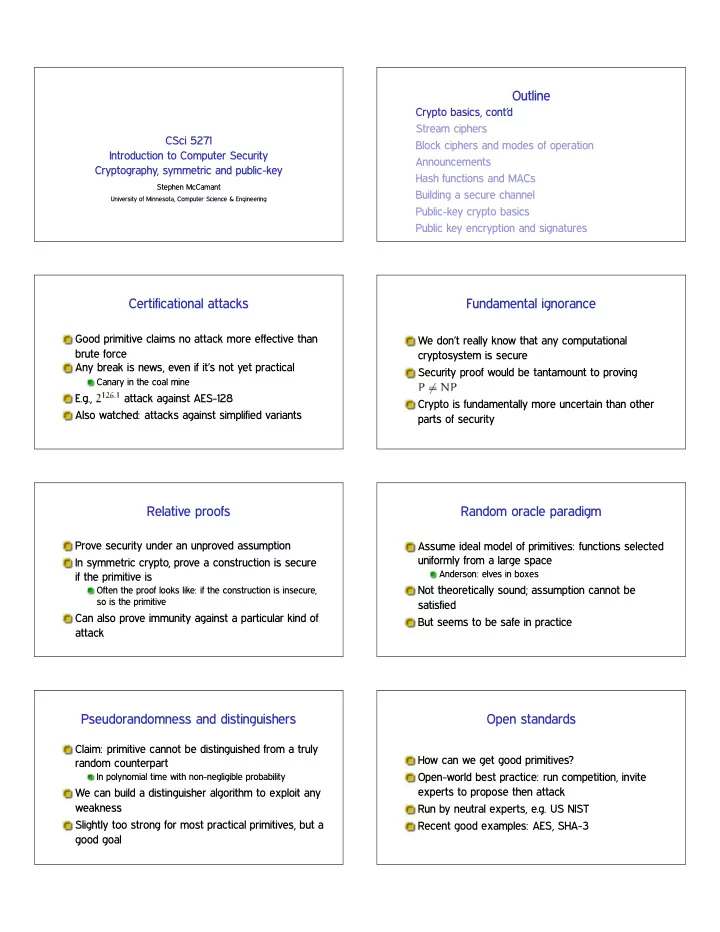
SLIDE 1 CSci 5271 Introduction to Computer Security Cryptography, symmetric and public-key
Stephen McCamant
University of Minnesota, Computer Science & Engineering
Outline
Crypto basics, cont’d Stream ciphers Block ciphers and modes of operation Announcements Hash functions and MACs Building a secure channel Public-key crypto basics Public key encryption and signatures
Certificational attacks
Good primitive claims no attack more effective than brute force Any break is news, even if it’s not yet practical
Canary in the coal mine
E.g., ✷✶✷✻✿✶ attack against AES-128 Also watched: attacks against simplified variants
Fundamental ignorance
We don’t really know that any computational cryptosystem is secure Security proof would be tantamount to proving P ✻❂ ◆P Crypto is fundamentally more uncertain than other parts of security
Relative proofs
Prove security under an unproved assumption In symmetric crypto, prove a construction is secure if the primitive is
Often the proof looks like: if the construction is insecure, so is the primitive
Can also prove immunity against a particular kind of attack
Random oracle paradigm
Assume ideal model of primitives: functions selected uniformly from a large space
Anderson: elves in boxes
Not theoretically sound; assumption cannot be satisfied But seems to be safe in practice
Pseudorandomness and distinguishers
Claim: primitive cannot be distinguished from a truly random counterpart
In polynomial time with non-negligible probability
We can build a distinguisher algorithm to exploit any weakness Slightly too strong for most practical primitives, but a good goal
Open standards
How can we get good primitives? Open-world best practice: run competition, invite experts to propose then attack Run by neutral experts, e.g. US NIST Recent good examples: AES, SHA-3
SLIDE 2
A certain three-letter agency
National Security Agency (NSA): has primary responsibility for “signals intelligence” Dual-mission tension:
Break the encryption of everyone in the world Help US encryption not be broken by foreign powers
Outline
Crypto basics, cont’d Stream ciphers Block ciphers and modes of operation Announcements Hash functions and MACs Building a secure channel Public-key crypto basics Public key encryption and signatures
Stream ciphers
Closest computational version of one-time pad Key (or seed) used to generate a long pseudorandom bitstream Closely related: cryptographic RNG
Shift register stream ciphers
Linear-feedback shift register (LFSR): easy way to generate long pseudorandom sequence
But linearity allows for attack
Several ways to add non-linearity Common in constrained hardware, poor security record
RC4
Fast, simple, widely used software stream cipher
Previously a trade secret, also “ARCFOUR”
Many attacks, none yet fatal to careful users (e.g. TLS)
Famous non-careful user: WEP
Now deprecated, not recommended for new uses
Encryption ✻❂ integrity
Encryption protects secrecy, not message integrity For constant-size encryption, changing the ciphertext just creates a different plaintext How will your system handle that? Always need to take care of integrity separately
Stream cipher mutability
Strong example of encryption vs. integrity In stream cipher, flipping a ciphertext bit flips the corresponding plaintext bit, only Very convenient for targeted changes
Stream cipher assessment
Currently out of fashion as a primitive in software Not inherently insecure
Other common pitfall: must not reuse key(stream)
Currently no widely vetted primitives
SLIDE 3 Outline
Crypto basics, cont’d Stream ciphers Block ciphers and modes of operation Announcements Hash functions and MACs Building a secure channel Public-key crypto basics Public key encryption and signatures
Basic idea
Encryption/decryption for a fixed sized block Insecure if block size is too small
Barely enough: 64 bits; current standard: 128
Reversible, so must be one-to-one and onto function
Pseudorandom permutation
Ideal model: key selects a random invertible function I.e., permutation (PRP) on block space
Note: not permutation on bits
“Strong” PRP: distinguisher can decrypt as well as encrypt
Confusion and diffusion
Basic design principles articulated by Shannon Confusion: combine elements so none can be analyzed individually Diffusion: spread the effect of one symbol around to
Iterate multiple rounds of transformation
Substitution/permutation network
Parallel structure combining reversible elements: Substitution: invertible lookup table (“S-box”) Permutation: shuffle bits
AES
Advanced Encryption Standard: NIST contest 2001
Developed under the name Rijndael
128-bit block, 128/192/256-bit key Fast software implementation with lookup tables (or dedicated insns) Allowed by US government up to Top Secret
Feistel cipher
Split block in half, operate in turn: ✭▲✐✰✶❀ ❘✐✰✶✮ ❂ ✭❘✐❀ ▲✐ ✟ ❋✭❘✐❀ ❑✐✮✮ Key advantage: ❋ need not be invertible
Also saves space in hardware
Luby-Rackoff: if ❋ is pseudo-random, 4 or more rounds gives a strong PRP
DES
Data Encryption Standard: AES predecessor 1977-2005 64-bit block, 56-bit key Implementable in 70s hardware, not terribly fast in software Triple DES variant still used in places
SLIDE 4
Some DES history
Developed primarily at IBM, based on an earlier cipher named “Lucifer” Final spec helped and “helped” by the NSA
Argued for smaller key size S-boxes tweaked to avoid a then-secret attack
Eventually victim to brute-force attack
DES brute force history
1977 est. $20m cost custom hardware 1993 est. $1m cost custom hardware 1997 distributed software break 1998 $250k built ASIC hardware 2006 $10k FPGAs 2012 as-a-service against MS-CHAPv2
Double encryption?
Combine two different block ciphers?
Belt and suspenders
Anderson: don’t do it FS&K: could do it, not a recommendation Maurer and Massey (J.Crypt’93): might only be as strong as first cipher
Modes of operation
How to build a cipher for arbitrary-length data from a block cipher Many approaches considered
For some reason, most have three-letter acronyms
More recently: properties susceptible to relative proof
ECB
Electronic CodeBook Split into blocks, apply cipher to each one individually Leaks equalities between plaintext blocks Almost never suitable for general use
Do not use ECB CBC
Cipher Block Chaining ❈✐ ❂ ❊❑✭P✐ ✟ ❈✐✲✶✮ Probably most popular in current systems Plaintext changes propagate forever, ciphertext changes only one block
CBC: getting an IV
❈✵ is called the initialization vector (IV)
Must be known for decryption
IV should be random-looking
To prevent first-block equalities from leaking (lesser version of ECB problem)
Common approaches
Generate at random Encrypt a nonce
SLIDE 5 Stream modes: OFB, CTR
Output FeedBack: produce keystream by repeatedly encrypting the IV
Danger: collisions lead to repeated keystream
Counter: produce from encryptions of an incrementing value
Recently becoming more popular: allows parallelization and random access
Outline
Crypto basics, cont’d Stream ciphers Block ciphers and modes of operation Announcements Hash functions and MACs Building a secure channel Public-key crypto basics Public key encryption and signatures
Crypto primitive question
Which of these is a cryptographic primitive based on a Feistel cipher design?
- A. DES
- B. AES
- C. DSA
- D. CBC
- E. HMAC
Last week’s midterm
Handing back in class today
May bring leftovers tomorrow, safest is my office hours
Solution set will be available later +12 point adjustment to compensate for excessive difficulty
Visible on Canvas, not shown on paper exams
Midterm raw stem display
✾ ⑤ ✾ ✽ ⑤ ✶✶✶✸✹✺ ✼ ⑤ ✵✶✶✶✷✸✸✺ ✻ ⑤ ✵✵✶✶✷✸✸✸✹✹✺✺✼✽✾✾ ✺ ⑤ ✵✶✶✸✺✺✺✻✻✻✻✻✼✼✽✽✾ ✹ ⑤ ✶✸ ✸ ⑤ ✶✾ ✷ ⑤ ✻✼
Midterm adjusted stem display
✾ ⑤ ✸✸✸✺✻✼ ✽ ⑤ ✵✶✶✷✸✸✸✹✺✺✼ ✼ ⑤ ✵✵✶✷✷✸✸✹✺✺✺✻✻✼✼✾ ✻ ⑤ ✷✸✸✺✼✼✼✽✽✽✽✽✾✾ ✺ ⑤ ✶✸✺ ✹ ⑤ ✸ ✸ ⑤ ✽✾
Outline
Crypto basics, cont’d Stream ciphers Block ciphers and modes of operation Announcements Hash functions and MACs Building a secure channel Public-key crypto basics Public key encryption and signatures
Ideal model
Ideal crypto hash function: pseudorandom function
Arbitrary input, fixed-size output
Simplest kind of elf in box, theoretically very convenient But large gap with real systems: better practice is to target particular properties
SLIDE 6
Kinds of attacks
Pre-image, “inversion”: given ②, find ① such that ❍✭①✮ ❂ ② Second preimage, targeted collision: given ①, ❍✭①✮, find ①✵ ✻❂ ① such that ❍✭①✵✮ ❂ ❍✭①✮ (Free) collision: find ①✶, ①✷ such that ❍✭①✶✮ ❂ ❍✭①✷✮
Birthday paradox and attack
There are almost certainly two people in this classroom with the same birthday ♥ people have ♥
✷
✁ ❂ ✂✭♥✷✮ pairs So only about ♣♥ expected for collision “Birthday attack” finds collisions in any function
Security levels
For function with ❦-bit output: Preimage and second preimage should have complexity ✷❦ Collision has complexity ✷❦❂✷ Conservative: use hash function twice as big as block cipher key
Though if you’re paranoid, cipher blocks can repeat too
Non-cryptographic hash functions
The ones you probably use for hash tables CRCs, checksums Output too small, but also not resistant to attack E.g., CRC is linear and algebraically nice
Short hash function history
On the way out: MD5 (128 bit)
Flaws known, collision-finding now routine
SHA(-0): first from NIST/NSA, quickly withdrawn
Likely flaw discovered 3 years later
SHA-1: fixed SHA-0, 160-bit output. ✷✻✵ collision attack described in 2013
First public collision found (using 6.5 kCPU yr) in 2017
Length extension problem
MD5, SHA1, etc., computed left to right over blocks Can sometimes compute ❍✭❛ ❦ ❜✮ in terms of ❍✭❛✮
❦ means bit string concatenation
Makes many PRF-style constructions insecure
SHA-2 and SHA-3
SHA-2: evolutionary, larger, improvement of SHA-1
Exists as SHA-❢✷✷✹❀ ✷✺✻❀ ✸✽✹❀ ✺✶✷❣ But still has length-extension problem
SHA-3: chosen recently in open competition like AES
Formerly known as Keccak, official standard Aug. 2015 New design, fixes length extension Not yet very widely used
MAC: basic idea
Message authentication code: similar to hash function, but with a key Adversary without key cannot forge MACs Strong definition: adversary cannot forge anything, even given chosen-message MACs on other messages
SLIDE 7
CBC-MAC construction
Same process as CBC encryption, but:
Start with IV of 0 Return only the last ciphertext block
Both these conditions needed for security For fixed-length messages (only), as secure as the block cipher
HMAC construction
❍✭❑ ❦ ▼✮: insecure due to length extension
Still not recommended: ❍✭▼ ❦ ❑✮, ❍✭❑ ❦ ▼ ❦ ❑✮
HMAC: ❍✭❑ ✟ ❛ ❦ ❍✭❑ ✟ ❜ ❦ ▼✮✮ Standard ❛ ❂ ✵①✺❝✄, ❜ ❂ ✵①✸✻✄ Probably the most widely used MAC
Outline
Crypto basics, cont’d Stream ciphers Block ciphers and modes of operation Announcements Hash functions and MACs Building a secure channel Public-key crypto basics Public key encryption and signatures
Session keys
Don’t use your long term password, etc., directly as a key Instead, session key used for just one channel In modern practice, usually obtained with public-key crypto Separate keys for encryption and MACing
Order of operations
Encrypt and MAC (“in parallel”)
Safe only under extra assumptions on the MAC
Encrypt then MAC
Has cleanest formal safety proof
MAC then Encrypt
Preferred by FS&K for some practical reasons Can also be secure
Authenticated encryption modes
Encrypting and MACing as separate steps is about twice as expensive as just encrypting “Authenticated encryption” modes do both at once
Newer (circa 2000) innovation, many variants
NIST-standardized and unpatented: Galois Counter Mode (GCM)
Ordering and message numbers
Also don’t want attacker to be able to replay or reorder messages Simple approach: prefix each message with counter Discard duplicate/out-of-order messages
Padding
Adjust message size to match multiple of block size To be reversible, must sometimes make message longer E.g.: for 16-byte block, append either ✶, or ✷ ✷, or ✸ ✸ ✸, up to 16 “16” bytes
SLIDE 8 Padding oracle attack
Have to be careful that decoding of padding does not leak information E.g., spend same amount of time MACing and checking padding whether or not padding is right Remote timing attack against CBC TLS published 2013
Don’t actually reinvent the wheel
This is all implemented carefully in OpenSSL, SSH, etc. Good to understand it, but rarely sensible to reimplement it You’ll probably miss at least one of decades’ worth
Outline
Crypto basics, cont’d Stream ciphers Block ciphers and modes of operation Announcements Hash functions and MACs Building a secure channel Public-key crypto basics Public key encryption and signatures
Pre-history of public-key crypto
First invented in secret at GCHQ Proposed by Ralph Merkle for UC Berkeley grad. security class project
First attempt only barely practical Professor didn’t like it
Merkle then found more sympathetic Stanford collaborators named Diffie and Hellman
Box and locks analogy
Alice wants to send Bob a gift in a locked box
They don’t share a key Can’t send key separately, don’t trust UPS Box locked by Alice can’t be opened by Bob, or vice-versa
Box and locks analogy
Alice wants to send Bob a gift in a locked box
They don’t share a key Can’t send key separately, don’t trust UPS Box locked by Alice can’t be opened by Bob, or vice-versa
Math perspective: physical locks commute
Protocol with clip art Protocol with clip art
SLIDE 9
Protocol with clip art Protocol with clip art Public key primitives
Public-key encryption (generalizes block cipher)
Separate encryption key EK (public) and decryption key DK (secret)
Signature scheme (generalizes MAC)
Separate signing key SK (secret) and verification key VK (public)
Modular arithmetic
Fix modulus ♥, keep only remainders mod ♥
mod 12: clock face; mod ✷✸✷: ✉♥s✐❣♥❡❞ ✐♥t
✰, ✲, and ✂ work mostly the same Division: see Exercise Set 1 Exponentiation: efficient by square and multiply
Generators and discrete log
Modulo a prime ♣, non-zero values and ✂ have a nice (“group”) structure ❣ is a generator if ❣✵❀ ❣❀ ❣✷❀ ❣✸❀ ✿ ✿ ✿ cover all elements Easy to compute ① ✼✦ ❣① Inverse, discrete logarithm, hard for large ♣
Diffie-Hellman key exchange
Goal: anonymous key exchange Public parameters ♣, ❣; Alice and Bob have resp. secrets ❛, ❜ Alice✦Bob: ❆ ❂ ❣❛ ✭mod ♣✮ Bob✦Alice: ❇ ❂ ❣❜ ✭mod ♣✮ Alice computes ❇❛ ❂ ❣❜❛ ❂ ❦ Bob computes ❆❜ ❂ ❣❛❜ ❂ ❦
Relationship to a hard problem
We’re not sure discrete log is hard (likely not even NP-complete), but it’s been unsolved for a long time If discrete log is easy (e.g., in P), DH is insecure Converse might not be true: DH might have other problems
Categorizing assumptions
Math assumptions unavoidable, but can categorize E.g., build more complex scheme, shows it’s “as secure” as DH because it has the same underlying assumption Commonly “decisional” (DDH) and “computational” (CDH) variants
SLIDE 10
Key size, elliptic curves
Need key sizes ✘10 times larger then security level
Attacks shown up to about 768 bits
Elliptic curves: objects from higher math with analogous group structure
(Only tenuously connected to ellipses)
Elliptic curve algorithms have smaller keys, about 2✂ security level
Outline
Crypto basics, cont’d Stream ciphers Block ciphers and modes of operation Announcements Hash functions and MACs Building a secure channel Public-key crypto basics Public key encryption and signatures
General description
Public-key encryption (generalizes block cipher)
Separate encryption key EK (public) and decryption key DK (secret)
Signature scheme (generalizes MAC)
Separate signing key SK (secret) and verification key VK (public)
RSA setup
Choose ♥ ❂ ♣q, product of two large primes, as modulus ♥ is public, but ♣ and q are secret Compute encryption and decryption exponents ❡ and ❞ such that ▼❡❞ ❂ ▼ ✭mod ♥✮
RSA encryption
Public key is ✭♥❀ ❡✮ Encryption of ▼ is ❈ ❂ ▼❡ ✭mod ♥✮ Private key is ✭♥❀ ❞✮ Decryption of ❈ is ❈❞ ❂ ▼❡❞ ❂ ▼ ✭mod ♥✮
RSA signature
Signing key is ✭♥❀ ❞✮ Signature of ▼ is ❙ ❂ ▼❞ ✭mod ♥✮ Verification key is ✭♥❀ ❡✮ Check signature by ❙❡ ❂ ▼❞❡ ❂ ▼ ✭mod ♥✮ Note: symmetry is a nice feature of RSA, not shared by other systems
RSA and factoring
We’re not sure factoring is hard (likely not even NP-complete), but it’s been unsolved for a long time If factoring is easy (e.g., in P), RSA is insecure Converse might not be true: RSA might have other problems
Homomorphism
Multiply RSA ciphertexts ✮ multiply plaintexts This homomorphism is useful for some interesting applications Even more powerful: fully homomorphic encryption (e.g., both ✰ and ✂)
First demonstrated in 2009; still very inefficient
SLIDE 11 Problems with vanilla RSA
Homomorphism leads to chosen-ciphertext attacks If message and ❡ are both small compared to ♥, can compute ▼✶❂❡ over the integers Many more complex attacks too
Hybrid encryption
Public-key operations are slow In practice, use them just to set up symmetric session keys ✰ Only pay RSA costs at setup time ✲ Breaks at either level are fatal
Padding, try #1
Need to expand message (e.g., AES key) size to match modulus PKCS#1 v. 1.5 scheme: prepend 00 01 FF FF .. FF Surprising discovery (Bleichenbacher’98): allows adaptive chosen ciphertext attacks on SSL
Modern “padding”
Much more complicated encoding schemes using hashing, random salts, Feistel-like structures, etc. Common examples: OAEP for encryption, PSS for signing Progress driven largely by improvement in random
Simpler padding alternative
“Key encapsulation mechanism” (KEM) For common case of public-key crypto used for symmetric-key setup
Also applies to DH
Choose RSA message r at random mod ♥, symmetric key is ❍✭r✮ ✲ Hard to retrofit, RSA-KEM insecure if ❡ and r reused with different ♥
Box and locks revisited
Alice and Bob’s box scheme fails if an intermediary can set up two sets of boxes
Man-in-the-middle (or middleperson) attack
Real world analogue: challenges of protocol design and public key distribution
Next time
Building crypto into more complex protocols Failures of cryptosystems Toward more paranoid crypto design