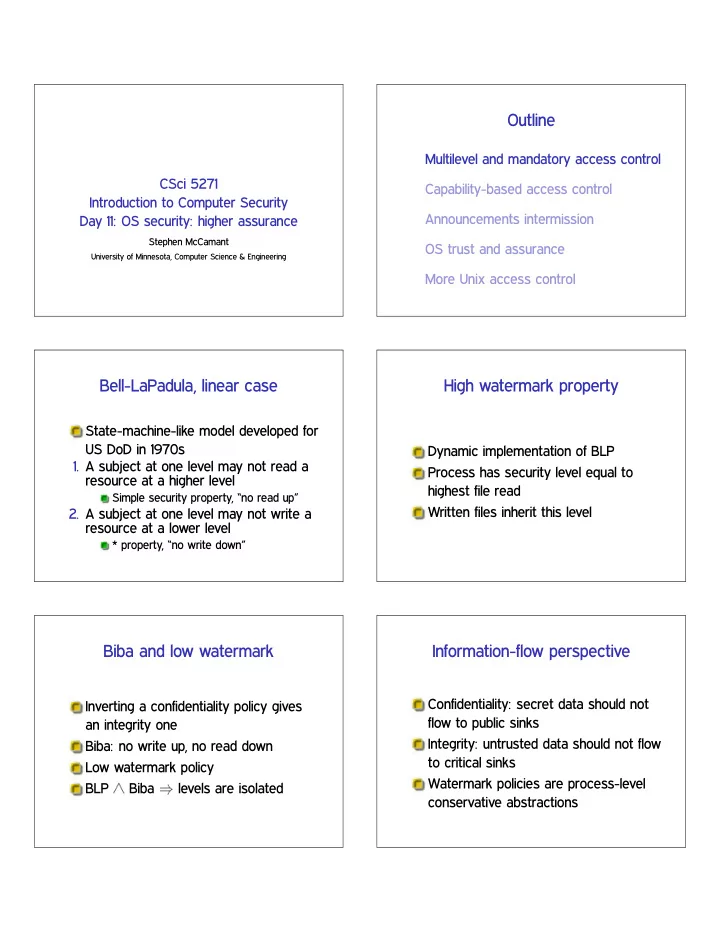
SLIDE 1 CSci 5271 Introduction to Computer Security Day 11: OS security: higher assurance
Stephen McCamant
University of Minnesota, Computer Science & Engineering
Outline
Multilevel and mandatory access control Capability-based access control Announcements intermission OS trust and assurance More Unix access control
Bell-LaPadula, linear case
State-machine-like model developed for US DoD in 1970s
- 1. A subject at one level may not read a
resource at a higher level
Simple security property, “no read up”
- 2. A subject at one level may not write a
resource at a lower level
* property, “no write down”
High watermark property
Dynamic implementation of BLP Process has security level equal to highest file read Written files inherit this level
Biba and low watermark
Inverting a confidentiality policy gives an integrity one Biba: no write up, no read down Low watermark policy BLP ❫ Biba ✮ levels are isolated
Information-flow perspective
Confidentiality: secret data should not flow to public sinks Integrity: untrusted data should not flow to critical sinks Watermark policies are process-level conservative abstractions
SLIDE 2 Covert channels
Problem: conspiring parties can misuse
- ther mechanisms to transmit
information Storage channel: writable shared state
E.g., screen brightness on mobile phone
Timing channel: speed or ordering of events
E.g., deliberately consume CPU time
Multilateral security / compartments
In classification, want finer divisions based on need-to-know Also, selected wider sharing (e.g., with allied nations) Many other applications also have this character
Anderson’s example: medical data
How to adapt BLP-style MAC?
Partial orders and lattices
✔ on integers is a total order
Reflexive, antisymmetric, transitive, ❛ ✔ ❜
Dropping last gives a partial order A lattice is a partial order plus
Least upper bound or join t Greatest lower bound or meet ✉
Example: subsets with ✒, ❬, ❭
Subset lattice example Subset lattice example Lattice model
Generalize MLS levels to elements in a lattice BLP and Biba work analogously with lattice ordering No access to incomparable levels Potential problem: combinatorial explosion of compartments
SLIDE 3 Classification lattice example Lattice BLP example Another notation
Faculty ✦ (Faculty, ❄) Faculty//5271 ✦ (Faculty, ❢✺✷✼✶❣) Faculty//5271//8271 ✦ (Faculty, ❢✺✷✼✶❀ ✽✷✼✶❣)
MLS operating systems
1970s timesharing, including Multics “Trusted” versions of commercial Unix (e.g. Solaris) SELinux (called “type enforcement”) Integrity protections in Windows Vista and later
Multi-VM systems
One (e.g., Windows) VM for each security level More trustworthy OS underneath provides limited interaction E.g., NSA NetTop: VMWare on SELinux Downside: administrative overhead
Air gaps, pumps, and diodes
The lack of a connection between networks of different levels is called an air gap A pump transfers data securely from
A data diode allows information flow in
SLIDE 4 Chelsea Manning cables leak
Manning (n´ ee Bradley) was an intelligence analyst deployed to Iraq PC in a T-SCIF connected to SIPRNet (Secret), air gapped CD-RWs used for backup and software transfer Contrary to policy: taking such a CD-RW home in your pocket
❤tt♣✿✴✴✇✇✇✳❢❛s✳♦r❣✴s❣♣✴❥✉❞✴♠❛♥♥✐♥❣✴✵✷✷✽✶✸✲st❛t❡♠❡♥t✳♣❞❢
Outline
Multilevel and mandatory access control Capability-based access control Announcements intermission OS trust and assurance More Unix access control
ACLs: no fine-grained subjects
Subjects are a list of usernames maintained by a sysadmin Unusual to have a separate subject for an application Cannot easily subset access (sandbox)
ACLs: ambient authority
All authority exists by virtue of identity Kernel automatically applies all available authority Authority applied incorrectly leads to attacks
Confused deputy problem
Compiler writes to billing database Compiler can produce debug output to user-specified file Specify debug output to billing file, disrupt billing
(Object) capabilities
A capability both designates a resource and provides authority to access it Similar to an object reference
Unforgeable, but can copy and distribute
Typically still managed by the kernel
SLIDE 5
Capability slogans (Miller et al.)
No designation without authority Dynamic subject creation Subject-aggregated authority mgmt. No ambient authority Composability of authorities Access-controlled delegation Dynamic resource creation
Partial example: Unix FDs
Authority to access a specific file Managed by kernel on behalf of process Can be passed between processes
Though rare other than parent to child
Unix not designed to use pervasively
Distinguish: password capabilities
Bit pattern itself is the capability
No centralized management
Modern example: authorization using cryptographic certificates
Revocation with capabilities
Use indirection: give real capability via a pair of middlemen ❆ ✦ ❇ via ❆ ✦ ❋ ✦ ❘ ✦ ❇ Retain capability to tell ❘ to drop capability to ❇ Depends on composability
Confinement with capabilities
❆ cannot pass a capability to ❇ if it cannot communicate with ❆ at all Disconnected parts of the capability graph cannot be reconnected Depends on controlled delegation and data/capability distinction
OKL4 and seL4
Commercial and research microkernels Recent versions of OKL4 use capability design from seL4 Used as a hypervisor, e.g. underneath paravirtualized Linux Shipped on over 1 billion cell phones
SLIDE 6
Joe-E and Caja
Dialects of Java and JavaScript (resp.) using capabilities for confined execution E.g., of JavaScript in an advertisement Note reliance on Java and JavaScript type safety
Outline
Multilevel and mandatory access control Capability-based access control Announcements intermission OS trust and assurance More Unix access control
Deadlines reminder
Tonight: Project progress reports Thursday: Ex. 2 Friday: HA1 attack(s) 5 (extra credit) Monday: midterm
Midterm exam Monday
Usual class time and location Covers up through today’s lecture Mix of short-answer and exercise-like questions Open books/notes/printouts, no computers or other electronics Sample exams w/solutions (2013-2015) posted
Outline
Multilevel and mandatory access control Capability-based access control Announcements intermission OS trust and assurance More Unix access control
Trusted and trustworthy
Part of your system is trusted if its failure can break your security Thus, OS is almost always trusted Real question: is it trustworthy? Distinction not universally observed: trusted boot, Trusted Solaris, etc.
SLIDE 7 Trusted (I/O) path
How do you know you’re talking to the right software? And no one is sniffing the data? Example: Trojan login screen
Or worse: unlock screensaver with root password Origin of “Press Ctrl-Alt-Del to log in”
Minimizing trust
Kernel ✦ microkernel ✦ nanokernel Reference monitor concept TCB size: measured relative to a policy goal Reference monitor ✒ TCB
But hard to build monitor for all goals
How to gain assurance
Use for a long time Testing Code / design review Third-party certification Formal methods / proof
Evaluation / certification
Testing and review performed by an independent party Goal: separate incentives, separate accountability Compare with financial auditing Watch out for: form over substance, misplaced incentives
Orange book OS evaluation
Trusted Computer System Evaluation Criteria
- D. Minimal protection
- C. Discretionary protection
C2 adds, e.g., secure audit over C1
B1❁B2❁B3: stricter classic MLS
Common Criteria
International standard and agreement for IT security certification Certification against a protection profile, and evaluation assurance level EAL 1-7 Evaluation performed by non-government labs Up to EAL 4 automatically cross-recognized
SLIDE 8 Common Criteria, Anderson’s view
Many profiles don’t specify the right things OSes evaluated only in unrealistic environments
E.g., unpatched Windows XP with no network attacks
“Corruption, Manipulation, and Inertia”
Pernicious innovation: evaluation paid for by vendor Labs beholden to national security apparatus
Formal methods and proof
Can math come to the rescue? Checking design vs. implementation Automation possible only with other tradeoffs
E.g., bounded size model
Starting to become possible: machine-checked proof
Proof and complexity
Formal proof is only feasible for programs that are small and elegant If you honestly care about assurance, you want your TCB small and elegant anyway Should provability further guide design?
Some hopeful proof results
seL4 microkernel (SOSP’09 and
7.5 kL C, 200 kL proof, 160 bugs fixed, 25 person years
CompCert C-subset compiler (PLDI’06 and ongoing) RockSalt SFI verifier (PLDI’12)
Outline
Multilevel and mandatory access control Capability-based access control Announcements intermission OS trust and assurance More Unix access control
Special case: ✴t♠♣
We’d like to allow anyone to make files in ✴t♠♣ So, everyone should have write permission But don’t want Alice deleting Bob’s files Solution: “sticky bit” 01000
SLIDE 9
Special case: group inheritance
When using group to manage permissions, want a whole tree to have a single group When 02000 bit set, newly created entries with have the parent’s group
(Historic BSD behavior)
Also, directories will themselves inherit 02000
“POSIX” ACLs
Based on a withdrawn standardization More flexible permissions, still fairly Unix-like Multiple user and group entries
Decision still based on one entry
Default ACLs: generalize group inheritance Command line: ❣❡t❢❛❝❧, s❡t❢❛❝❧
ACL legacy interactions
Hard problem: don’t break security of legacy code
Suggests: “fail closed”
Contrary pressure: don’t want to break functionality
Suggests: “fail open”
POSIX ACL design: old group permission bits are a mask on all novel permissions
“POSIX” “capabilities”
Divide root privilege into smaller (✘35) pieces Note: not real capabilities First runtime only, then added to FS similar to setuid Motivating example: ♣✐♥❣ Also allows permanent disabling
Privilege escalation dangers
Many pieces of the root privilege are enough to regain the whole thing
Access to files as UID 0 ❈❆P ❉❆❈ ❖❱❊❘❘■❉❊ ❈❆P ❋❖❲◆❊❘ ❈❆P ❙❨❙ ▼❖❉❯▲❊ ❈❆P ▼❑◆❖❉ ❈❆P P❚❘❆❈❊ ❈❆P ❙❨❙ ❆❉▼■◆ (♠♦✉♥t)
Legacy interaction dangers
Former bug: take away capability to drop privileges Use of temporary files by no-longer setuid programs For more details: “Exploiting capabilities”, Emeric Nasi