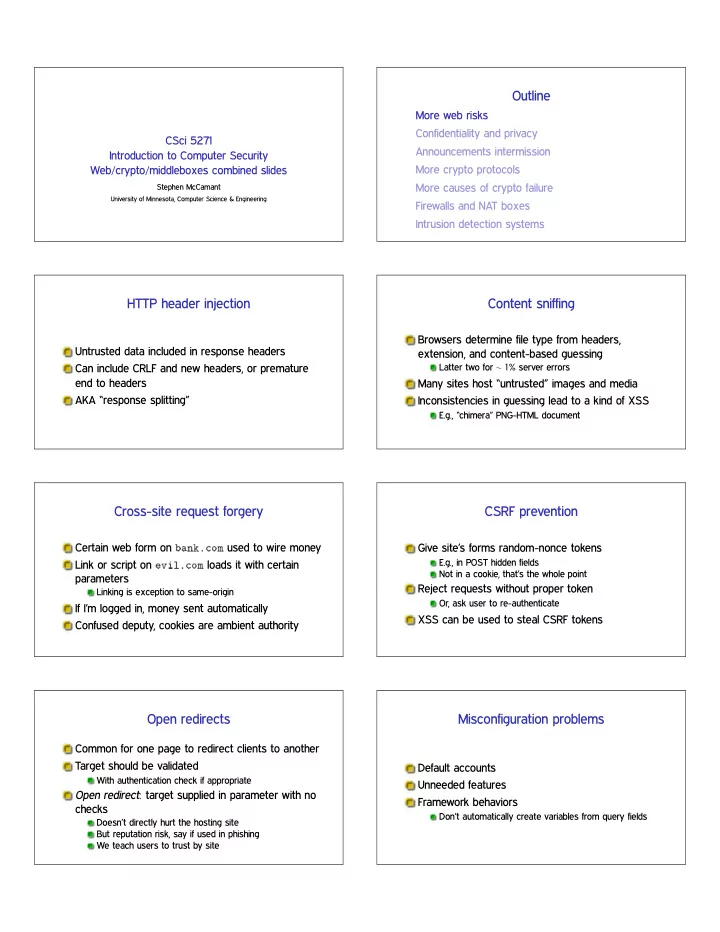
SLIDE 1 CSci 5271 Introduction to Computer Security Web/crypto/middleboxes combined slides
Stephen McCamant
University of Minnesota, Computer Science & Engineering
Outline
More web risks Confidentiality and privacy Announcements intermission More crypto protocols More causes of crypto failure Firewalls and NAT boxes Intrusion detection systems
HTTP header injection
Untrusted data included in response headers Can include CRLF and new headers, or premature end to headers AKA “response splitting”
Content sniffing
Browsers determine file type from headers, extension, and content-based guessing
Latter two for ✘ ✶% server errors
Many sites host “untrusted” images and media Inconsistencies in guessing lead to a kind of XSS
E.g., “chimera” PNG-HTML document
Cross-site request forgery
Certain web form on ❜❛♥❦✳❝♦♠ used to wire money Link or script on ❡✈✐❧✳❝♦♠ loads it with certain parameters
Linking is exception to same-origin
If I’m logged in, money sent automatically Confused deputy, cookies are ambient authority
CSRF prevention
Give site’s forms random-nonce tokens
E.g., in POST hidden fields Not in a cookie, that’s the whole point
Reject requests without proper token
Or, ask user to re-authenticate
XSS can be used to steal CSRF tokens
Open redirects
Common for one page to redirect clients to another Target should be validated
With authentication check if appropriate
Open redirect: target supplied in parameter with no checks
Doesn’t directly hurt the hosting site But reputation risk, say if used in phishing We teach users to trust by site
Misconfiguration problems
Default accounts Unneeded features Framework behaviors
Don’t automatically create variables from query fields
SLIDE 2
Openness tradeoffs
Error reporting
Few benign users want to see a stack backtrace
Directory listings
Hallmark of the old days
Readable source code of scripts
Doesn’t have your DB password in it, does it?
Using vulnerable components
Large web apps can use a lot of third-party code Convenient for attackers too
OWASP: two popular vulnerable components downloaded 22m times
Hiding doesn’t work if it’s popular Stay up to date on security announcements
Clickjacking
Fool users about what they’re clicking on
Circumvent security confirmations Fabricate ad interest
Example techniques:
Frame embedding Transparency Spoof cursor Temporal “bait and switch”
Crawling and scraping
A lot of web content is free-of-charge, but proprietary
Yours in a certain context, if you view ads, etc.
Sites don’t want it downloaded automatically (web crawling) Or parsed and user for another purpose (screen scraping) High-rate or honest access detectable
Outline
More web risks Confidentiality and privacy Announcements intermission More crypto protocols More causes of crypto failure Firewalls and NAT boxes Intrusion detection systems
Site perspective
Protect confidentiality of authenticators
Passwords, session cookies, CSRF tokens
Duty to protect some customer info
Personally identifying info (“identity theft”) Credit-card info (Payment Card Industry Data Security Standards) Health care (HIPAA), education (FERPA) Whatever customers reasonably expect
You need to use SSL
Finally coming around to view that more sites need to support HTTPS
Special thanks to WiFi, NSA
If you take credit cards (of course) If you ask users to log in
Must be protecting something, right? Also important for users of Tor et al.
Server-side encryption
Also consider encrypting data “at rest” (Or, avoid storing it at all) Provides defense in depth
Reduce damage after another attack
May be hard to truly separate keys
OWASP example: public key for website ✦ backend credit card info
SLIDE 3
Adjusting client behavior
HTTPS and ♣❛ss✇♦r❞ fields are basic hints Consider disabling autocomplete
Usability tradeoff, save users from themselves Finally standardized in HTML5
Consider disabling caching
Performance tradeoff Better not to have this on user’s disk Or proxy? You need SSL
User vs. site perspective
User privacy goals can be opposed to site goals Such as in tracking for advertisements Browser makers can find themselves in the middle
Of course, differ in institutional pressures
Third party content / web bugs
Much tracking involves sites other than the one in the URL bar
For fun, check where your cookies are coming from
Various levels of cooperation Web bugs are typically 1x1 images used only for tracking
Cookies arms race
Privacy-sensitive users like to block and/or delete cookies Sites have various reasons to retain identification Various workarounds:
Similar features in Flash and HTML5 Various channels related to the cache Evercookie: store in ♥ places, regenerate if subset are deleted
Browser fingerprinting
Combine various server or JS-visible attributes passively
User agent string (10 bits) Window/screen size (4.83 bits) Available fonts (13.9 bits) Plugin verions (15.4 bits) (Data from ♣❛♥♦♣t✐❝❧✐❝❦✳❡❢❢✳♦r❣, far from exhaustive)
History stealing
History of what sites you’ve visited is not supposed to be JS-visible But, many side-channel attacks have been possible
Query link color CSS style with external image for visited links Slow-rendering timing channel Harvesting bitmaps User perception (e.g. fake CAPTCHA)
Browser and extension choices
More aggressive privacy behavior lives in extensions
Disabling most JavaScript (NoScript) HTTPS Everywhere (whitelist) Tor Browser Bundle
Default behavior is much more controversial
Concern not to kill advertising support as an economic model
Outline
More web risks Confidentiality and privacy Announcements intermission More crypto protocols More causes of crypto failure Firewalls and NAT boxes Intrusion detection systems
SLIDE 4
Upcoming events
Inidividual progress reports due tonight Exercise set 4 out, due next Wednesday Project meetings next week HA2 due a week from Friday
Outline
More web risks Confidentiality and privacy Announcements intermission More crypto protocols More causes of crypto failure Firewalls and NAT boxes Intrusion detection systems
Abstract protocols
Outline of what information is communicated in messages
Omit most details of encoding, naming, sizes, choice of ciphers, etc.
Describes honest operation
But must be secure against adversarial participants
Seemingly simple, but many subtle problems
Protocol notation
❆ ✦ ❇ ✿ ◆❇❀ ❢❚✵❀ ❇❀ ◆❇❣❑❇ ❆ ✦ ❇: message sent from Alice intended for Bob ❇ (after :): Bob’s name ❢✁ ✁ ✁❣❑: encryption with key ❑
Needham-Schroeder
Mutual authentication via nonce exchange, assuming public keys (core): ❆ ✦ ❇ ✿ ❢◆❆❀ ❆❣❊❇ ❇ ✦ ❆ ✿ ❢◆❆❀ ◆❇❣❊❆ ❆ ✦ ❇ ✿ ❢◆❇❣❊❇
Needham-Schroeder MITM
❆ ✦ ❈ ✿ ❢◆❆❀ ❆❣❊❈ ❈ ✦ ❇ ✿ ❢◆❆❀ ❆❣❊❇ ❇ ✦ ❈ ✿ ❢◆❆❀ ◆❇❣❊❆ ❈ ✦ ❆ ✿ ❢◆❆❀ ◆❇❣❊❆ ❆ ✦ ❈ ✿ ❢◆❇❣❊❈ ❈ ✦ ❇ ✿ ❢◆❇❣❊❇
Certificates, Denning-Sacco
A certificate signed by a trusted third-party ❙ binds an identity to a public key
❈❆ ❂ Sign❙✭❆❀ ❑❆✮
Suppose we want to use S in establishing a session key ❑❆❇: ❆ ✦ ❙ ✿ ❆❀ ❇ ❙ ✦ ❆ ✿ ❈❆❀ ❈❇ ❆ ✦ ❇ ✿ ❈❆❀ ❈❇❀ ❢Sign❆✭❑❆❇✮❣❑❇
Attack against Denning-Sacco
❆ ✦ ❙ ✿ ❆❀ ❇ ❙ ✦ ❆ ✿ ❈❆❀ ❈❇ ❆ ✦ ❇ ✿ ❈❆❀ ❈❇❀ ❢Sign❆✭❑❆❇✮❣❑❇ ❇ ✦ ❙ ✿ ❇❀ ❈ ❙ ✦ ❇ ✿ ❈❇❀ ❈❈ ❇ ✦ ❈ ✿ ❈❆❀ ❈❈❀ ❢Sign❆✭❑❆❇✮❣❑❈ By re-encrypting the signed key, Bob can pretend to be Alice to Charlie
SLIDE 5 Envelopes analogy
Encrypt then sign, or vice-versa? On paper, we usually sign inside an envelope, not
Attacker gets letter, puts in his own envelope (c.f. attack against X.509) Signer claims “didn’t know what was in the envelope” (failure of non-repudiation)
Design robustness principles
Use timestamps or nonces for freshness Be explicit about the context Don’t trust the secrecy of others’ secrets Whenever you sign or decrypt, beware of being an
Distinguish runs of a protocol
Implementation principles
Ensure unique message types and parsing Design for ciphers and key sizes to change Limit information in outbound error messages Be careful with out-of-order messages
Outline
More web risks Confidentiality and privacy Announcements intermission More crypto protocols More causes of crypto failure Firewalls and NAT boxes Intrusion detection systems
Random numbers and entropy
Cryptographic RNGs use cipher-like techniques to provide indistinguishability But rely on truly random seeding to stop brute force
Extreme case: no entropy ✦ always same “randomness”
Modern best practice: seed pool with 256 bits of entropy
Suitable for security levels up to ✷✷✺✻
Netscape RNG failure
Early versions of Netscape SSL (1994-1995) seeded with:
Time of day Process ID Parent process ID
Best case entropy only 64 bits
(Not out of step with using 40-bit encryption)
But worse because many bits guessable
Debian/OpenSSL RNG failure (1)
OpenSSL has pretty good scheme using ✴❞❡✈✴✉r❛♥❞♦♠ Also mixed in some uninitialized variable values
“Extra variation can’t hurt”
From modern perspective, this was the original sin
Remember undefined behavior discussion?
But had no immediate ill effects
Debian/OpenSSL RNG failure (2)
Debian maintainer commented out some lines to fix a Valgrind warning
“Potential use of uninitialized value”
Accidentally disabled most entropy (all but 16 bits) Brief mailing list discussion didn’t lead to understanding Broken library used for ✘2 years before discovery
SLIDE 6
Detected RSA/DSA collisions
2012: around 1% of the SSL keys on the public net are breakable
Some sites share complete keypairs RSA keys with one prime in common (detected by large-scale GCD)
One likely culprit: insufficient entropy in key generation
Embedded devices, Linux ✴❞❡✈✴✉r❛♥❞♦♠ vs. ✴❞❡✈✴r❛♥❞♦♠
DSA signature algorithm also very vulnerable
Side-channel attacks
Timing analysis:
Number of 1 bits in modular exponentiation Unpadding, MAC checking, error handling Probe cache state of AES table entries
Power analysis
Especially useful against smartcards
Fault injection Data non-erasure
Hard disks, “cold boot” on RAM
WEP “privacy”
First WiFi encryption standard: Wired Equivalent Privacy (WEP) F&S: designed by a committee that contained no cryptographers Problem 1: note “privacy”: what about integrity?
Nope: stream cipher + CRC = easy bit flipping
WEP shared key
Single key known by all parties on network Easy to compromise Hard to change Also often disabled by default Example: a previous employer
WEP key size and IV size
Original sizes: 40-bit shared key (export restrictions) plus 24-bit IV = 64-bit RC4 key
Both too small
128-bit upgrade kept 24-bit IV
Vague about how to choose IVs Least bad: sequential, collision takes hours Worse: random or everyone starts at zero
WEP RC4 related key attacks
Only true crypto weakness RC4 “key schedule” vulnerable when:
RC4 keys very similar (e.g., same key, similar IV) First stream bytes used
Not a practical problem for other RC4 users like SSL
Key from a hash, skip first output bytes
New problem with WPA (CCS’17)
Session key set up in a 4-message handshake Key reinstallation attack: replay #3
Causes most implementations to reset nonce and replay counter In turn allowing many other attacks One especially bad case: reset key to 0
Protocol state machine behavior poorly described in spec
Outside the scope of previous security proofs
Trustworthiness of primitives
Classic worry: DES S-boxes Obviously in trouble if cipher chosen by your adversary In a public spec, most worrying are unexplained elements Best practice: choose constants from well-known math, like digits of ✙
SLIDE 7 Dual EC DRBG (1)
Pseudorandom generator in NIST standard, based on elliptic curve Looks like provable (slow enough!) but strangely no proof Specification includes long unexplained constants Academic researchers find:
Some EC parts look good But outputs are statistically distinguishable
Dual EC DRBG (2)
Found 2007: special choice of constants allows prediction attacks
Big red flag for paranoid academics
Significant adoption in products sold to US govt. FIPS-140 standards
Semi-plausible rationale from RSA (EMC)
NSA scenario basically confirmed by Snowden leaks
NIST and RSA immediately recommend withdrawal
Outline
More web risks Confidentiality and privacy Announcements intermission More crypto protocols More causes of crypto failure Firewalls and NAT boxes Intrusion detection systems
Internet addition: middleboxes
Original design: middle of net is only routers
End-to-end principle
Modern reality: more functionality in the network Security is one major driver
Security/connectivity tradeoff
A lot of security risk comes from a network connection
Attacker could be anywhere in the world
Reducing connectivity makes security easier Connectivity demand comes from end users
What a firewall is
Basically, a router that chooses not to forward some traffic
Based on an a-priori policy
More complex architectures have multiple layers
DMZ: area between outer and inner layers, for
Inbound and outbound control
Most obvious firewall use: prevent attacks from the
Often also some control of insiders
Block malware-infected hosts Employees wasting time on Facebook Selling sensitive info to competitors Nation-state Internet management
May want to log or rate-limit, not block
Default: deny
Usual whitelist approach: first, block everything Then allow certain traffic Basic: filter packets based on headers More sophisticated: proxy traffic at a higher level
SLIDE 8
IPv4 address scarcity
Design limit of ✷✸✷ hosts
Actually less for many reasons
Addresses becoming gradually more scarce over a many-year scale Some high-profile exhaustions in 2011 IPv6 adoption still quite low, occasional signs of progress
Network address translation (NAT)
Middlebox that rewrites addresses in packets Main use: allow inside network to use non-unique IP addresses
RFC 1918: 10.*, 192.168.*, etc. While sharing one outside IP address
Inside hosts not addressable from outside
De-facto firewall
Packet filtering rules
Match based on:
Source IP address Source port Destination IP address Destination port Packet flags: TCP vs. UDP , TCP ACK, etc.
Action, e.g. allow or block Obviously limited in specificity
Client and server ports
TCP servers listen on well-known port numbers
Often ❁ 1024, e.g. 22 for SSH or 80 for HTTP
Clients use a kernel-assigned random high port Plain packet filter would need to allow all high-port incoming traffic
Stateful filtering
In general: firewall rules depend on previously-seen traffic Key instance: allow replies to an outbound connection See: port 23746 to port 80 Allow incoming port 23746
To same inside host
Needed to make a NAT practical
Circuit-level proxying
Firewall forwards TCP connections for inside client Standard protocol: SOCKS
Supported by most web browsers Wrapper approaches for non-aware apps
Not much more powerful than packet-level filtering
Application-level proxying
Knows about higher-level semantics Long history for, e.g., email, now HTTP most important More knowledge allows better filtering decisions
But, more effort to set up
Newer: “transparent proxy”
Pretty much a man-in-the-middle
Tunneling
Any data can be transmitted on any channel, if both sides agree E.g., encapsulate IP packets over SSH connection
Compare covert channels, steganography
Powerful way to subvert firewall
Some legitimate uses
SLIDE 9
Tunneling example: HA2 Outline
More web risks Confidentiality and privacy Announcements intermission More crypto protocols More causes of crypto failure Firewalls and NAT boxes Intrusion detection systems
Basic idea: detect attacks
The worst attacks are the ones you don’t even know about Best case: stop before damage occurs
Marketed as “prevention”
Still good: prompt response Challenge: what is an attack?
Network and host-based IDSes
Network IDS: watch packets similar to firewall
But don’t know what’s bad until you see it More often implemented offline
Host-based IDS: look for compromised process or user from within machine
Signature matching
Signature is a pattern that matches known bad behavior Typically human-curated to ensure specificity See also: anti-virus scanners
Anomaly detection
Learn pattern of normal behavior “Not normal” is a sign of a potential attack Has possibility of finding novel attacks Performance depends on normal behavior too
Recall: FPs and FNs
False positive: detector goes off without real attack False negative: attack happens without detection Any detector design is a tradeoff between these (ROC curve)
Signature and anomaly weaknesses
Signatures
Won’t exist for novel attacks Often easy to attack around
Anomaly detection
Hard to avoid false positives Adversary can train over time
SLIDE 10
Base rate problems
If the true incidence is small (low base rate), most positives will be false
Example: screening test for rare disease
Easy for false positives to overwhelm admins E.g., 100 attacks out of 10 million packets, 0.01% FP rate
How many false alarms?
Adversarial challenges
FP/FN statistics based on a fixed set of attacks But attackers won’t keep using techniques that are detected Instead, will look for:
Existing attacks that are not detected Minimal changes to attacks Truly novel attacks
Wagner and Soto mimicry attack
Host-based IDS based on sequence of syscalls Compute ❆ ❭ ▼, where:
❆ models allowed sequences ▼ models sequences achieving attacker’s goals
Further techniques required:
Many syscalls made into NOPs Replacement subsequences with similar effect
Next time
Malware and network denial of service