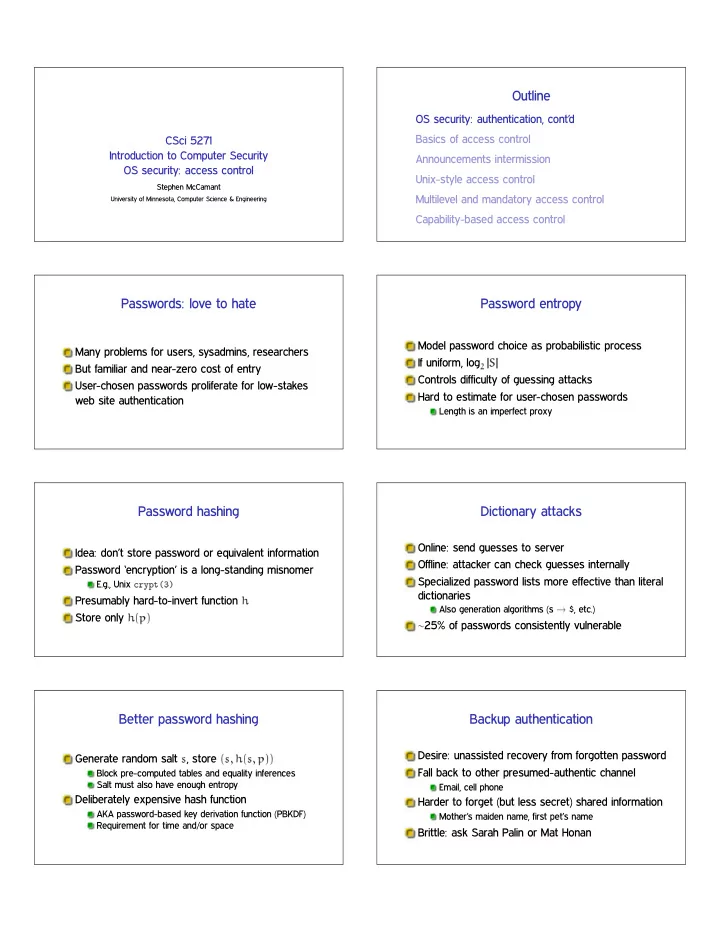
SLIDE 1 CSci 5271 Introduction to Computer Security OS security: access control
Stephen McCamant
University of Minnesota, Computer Science & Engineering
Outline
OS security: authentication, cont’d Basics of access control Announcements intermission Unix-style access control Multilevel and mandatory access control Capability-based access control
Passwords: love to hate
Many problems for users, sysadmins, researchers But familiar and near-zero cost of entry User-chosen passwords proliferate for low-stakes web site authentication
Password entropy
Model password choice as probabilistic process If uniform, log✷ ❥❙❥ Controls difficulty of guessing attacks Hard to estimate for user-chosen passwords
Length is an imperfect proxy
Password hashing
Idea: don’t store password or equivalent information Password ‘encryption’ is a long-standing misnomer
E.g., Unix ❝r②♣t✭✸✮
Presumably hard-to-invert function ❤ Store only ❤✭♣✮
Dictionary attacks
Online: send guesses to server Offline: attacker can check guesses internally Specialized password lists more effective than literal dictionaries
Also generation algorithms (s ✦ $, etc.)
✘25% of passwords consistently vulnerable
Better password hashing
Generate random salt s, store ✭s❀ ❤✭s❀ ♣✮✮
Block pre-computed tables and equality inferences Salt must also have enough entropy
Deliberately expensive hash function
AKA password-based key derivation function (PBKDF) Requirement for time and/or space
Backup authentication
Desire: unassisted recovery from forgotten password Fall back to other presumed-authentic channel
Email, cell phone
Harder to forget (but less secret) shared information
Mother’s maiden name, first pet’s name
Brittle: ask Sarah Palin or Mat Honan
SLIDE 2 Centralized authentication
Enterprise-wide (e.g., UMN ID) Anderson: Microsoft Passport Today: Facebook Connect, Google ID May or may not be single-sign-on (SSO)
Biometric authentication
Authenticate by a physical body attribute ✰ Hard to lose ✲ Hard to reset ✲ Inherently statistical ✲ Variation among people
Example biometrics
(Handwritten) signatures Fingerprints, hand geometry Face and voice recognition Iris codes
Error rates: ROC curve Outline
OS security: authentication, cont’d Basics of access control Announcements intermission Unix-style access control Multilevel and mandatory access control Capability-based access control
Mechanism and policy
Decision-making aspect of OS Should subject ❙ (user or process) be allowed to access object (e.g., file) ❖? Complex, since admin must specify what should happen
Access control matrix
grades.txt /dev/hda /usr/bin/bcvi Alice r rw rx Bob rw
Carol r
Slicing the matrix
❖✭♥♠✮ matrix impractical to store, much less administer Columns: access control list (ACL)
Convenient to store with object E.g., Unix file permissions
Rows: capabilities
Convenient to store by subject E.g., Unix file descriptors
SLIDE 3
Groups/roles
Simplify by factoring out commonality Before: users have permissions After: users have roles, roles have permissions Simple example: Unix groups Complex versions called role-based access control (RBAC)
Outline
OS security: authentication, cont’d Basics of access control Announcements intermission Unix-style access control Multilevel and mandatory access control Capability-based access control
Multiple BCMTA vulnerabilities found!
Buffer overrun in t❡r♠ ❝♦♣② Buffer overrun in constructing the ✳❢♦r✇❛r❞ file location Writing message to file allowed write to system file ❛❝❝❡❧❡r❛t❡❞ str❝♣② was less secure
Changes coming in BCMTA 2.3
Avoid unneeded buffer in t❡r♠ ❝♦♣② Use str❧❝♣② when constructing ✳❢♦r✇❛r❞ file location Check ownership of delivery file Remove optimizations One more delivery feature Release planned for this evening
Outline
OS security: authentication, cont’d Basics of access control Announcements intermission Unix-style access control Multilevel and mandatory access control Capability-based access control
UIDs and GIDs
To kernel, users and groups are just numeric identifiers Names are a user-space nicety
E.g., ✴❡t❝✴♣❛ss✇❞ mapping
Historically 16-bit, now 32 User 0 is the special superuser r♦♦t
Exempt from all access control checks
File mode bits
Core permissions are 9 bits, three groups of three Read, write, execute for user, group, other ❧s format: r✇① r✲① r✲✲ Octal format: 0754
Interpretation of mode bits
File also has one user and group ID Choose one set of bits
If users match, use user bits If subject is in the group, use group bits Otherwise, use other bits
Note no fallback, so can stop yourself or have negative groups
But usually, ❖ ✒ ● ✒ ❯
SLIDE 4
Directory mode bits
Same bits, slightly different interpretation Read: list contents (e.g., ❧s) Write: add or delete files Execute: traverse X but not R means: have to know the names
Process UIDs and s❡t✉✐❞✭✷✮
UID is inherited by child processes, and an unprivileged process can’t change it But there are syscalls root can use to change the UID, starting with s❡t✉✐❞ E.g., login program, SSH server
Setuid programs, different UIDs
If 04000 “setuid” bit set, newly exec’d process will take UID of its file owner
Other side conditions, like process not traced
Specifically the effective UID is changed, while the real UID is unchanged
Shows who called you, allows switching back
More different UIDs
Two mechanisms for temporary switching:
Swap real UID and effective UID (BSD) Remember saved UID, allow switching to it (System V)
Modern systems support both mechanisms at the same time Linux only: file-system UID
Once used for NFS servers, now mostly obsolete
Setgid, games
Setgid bit 02000 mostly analogous to setuid But note no supergroup, so UID 0 is still special Classic application: setgid ❣❛♠❡s for managing high-score files
Special case: ✴t♠♣
We’d like to allow anyone to make files in ✴t♠♣ So, everyone should have write permission But don’t want Alice deleting Bob’s files Solution: “sticky bit” 01000
Special case: group inheritance
When using group to manage permissions, want a whole tree to have a single group When 02000 bit set, newly created entries with have the parent’s group
(Historic BSD behavior)
Also, directories will themselves inherit 02000
Other permission rules
Only file owner or root can change permissions Only root can change file owner
Former System V behavior: “give away ❝❤♦✇♥”
Setuid/gid bits cleared on ❝❤♦✇♥
Set owner first, then enable setuid
SLIDE 5
Non-checks
File permissions on st❛t File permissions on link, unlink, rename File permissions on read, write Parent directory permissions generally
Except traversal I.e., permissions not automatically recursive
“POSIX” ACLs
Based on a withdrawn standardization More flexible permissions, still fairly Unix-like Multiple user and group entries
Decision still based on one entry
Default ACLs: generalize group inheritance Command line: ❣❡t❢❛❝❧, s❡t❢❛❝❧
ACL legacy interactions
Hard problem: don’t break security of legacy code
Suggests: “fail closed”
Contrary pressure: don’t want to break functionality
Suggests: “fail open”
POSIX ACL design: old group permission bits are a mask on all novel permissions
“POSIX” “capabilities”
Divide root privilege into smaller (✘35) pieces Note: not real capabilities First runtime only, then added to FS similar to setuid Motivating example: ♣✐♥❣ Also allows permanent disabling
Privilege escalation dangers
Many pieces of the root privilege are enough to regain the whole thing
Access to files as UID 0 ❈❆P ❉❆❈ ❖❱❊❘❘■❉❊ ❈❆P ❋❖❲◆❊❘ ❈❆P ❙❨❙ ▼❖❉❯▲❊ ❈❆P ▼❑◆❖❉ ❈❆P P❚❘❆❈❊ ❈❆P ❙❨❙ ❆❉▼■◆ (♠♦✉♥t)
Legacy interaction dangers
Former bug: take away capability to drop privileges Use of temporary files by no-longer setuid programs For more details: “Exploiting capabilities”, Emeric Nasi
Outline
OS security: authentication, cont’d Basics of access control Announcements intermission Unix-style access control Multilevel and mandatory access control Capability-based access control
MAC vs. DAC
Discretionary access control (DAC)
Users mostly decide permissions on their own files If you have information, you can pass it on to anyone E.g., traditional Unix file permissions
Mandatory access control (MAC)
Restrictions enforced regardless of subject choices Typically specified by an administrator
SLIDE 6 Motivation: it’s classified
Government defense and intelligence agencies use classification to restrict access to information E.g.: Unclassified, Confidential, Secret, Top Secret Multilevel Secure (MLS) systems first developed to support mixing classification levels under timesharing
Motivation: system integrity
Limit damage if a network server application is compromised
Unix DAC is no help if server is root
Limit damage from browser-downloaded malware
Windows DAC is no help if browser is “administrator” user
Bell-LaPadula, linear case
State-machine-like model developed for US DoD in 1970s
- 1. A subject at one level may not read a resource at a
higher level
Simple security property, “no read up”
- 2. A subject at one level may not write a resource at a
lower level
* property, “no write down”
High watermark property
Dynamic implementation of BLP Process has security level equal to highest file read Written files inherit this level
Biba and low watermark
Inverting a confidentiality policy gives an integrity
Biba: no write up, no read down Low watermark policy BLP ❫ Biba ✮ levels are isolated
Information-flow perspective
Confidentiality: secret data should not flow to public sinks Integrity: untrusted data should not flow to critical sinks Watermark policies are process-level conservative abstractions
Covert channels
Problem: conspiring parties can misuse other mechanisms to transmit information Storage channel: writable shared state
E.g., screen brightness on mobile phone
Timing channel: speed or ordering of events
E.g., deliberately consume CPU time
Multilateral security / compartments
In classification, want finer divisions based on need-to-know Also, selected wider sharing (e.g., with allied nations) Many other applications also have this character
Anderson’s example: medical data
How to adapt BLP-style MAC?
SLIDE 7
Partial orders and lattices
✔ on integers is a total order
Reflexive, antisymmetric, transitive, ❛ ✔ ❜ or ❜ ✔ ❛
Dropping last gives a partial order A lattice is a partial order plus operators for:
Least upper bound or join t Greatest lower bound or meet ✉
Example: subsets with ✒, ❬, ❭
Subset lattice example Subset lattice example Lattice model
Generalize MLS levels to elements in a lattice BLP and Biba work analogously with lattice ordering No access to incomparable levels Potential problem: combinatorial explosion of compartments
Classification lattice example Lattice BLP example Another notation
Faculty ✦ (Faculty, ❄) Faculty//5271 ✦ (Faculty, ❢✺✷✼✶❣) Faculty//5271//8271 ✦ (Faculty, ❢✺✷✼✶❀ ✽✷✼✶❣)
MLS operating systems
1970s timesharing, including Multics “Trusted” versions of commercial Unix (e.g. Solaris) SELinux (called “type enforcement”) Integrity protections in Windows Vista and later
SLIDE 8
Multi-VM systems
One (e.g., Windows) VM for each security level More trustworthy OS underneath provides limited interaction E.g., NSA NetTop: VMWare on SELinux Downside: administrative overhead
Air gaps, pumps, and diodes
The lack of a connection between networks of different levels is called an air gap A pump transfers data securely from one network to another A data diode allows information flow in only one direction
Chelsea Manning cables leak
Manning (n´ ee Bradley) was an intelligence analyst deployed to Iraq PC in a T-SCIF connected to SIPRNet (Secret), air gapped CD-RWs used for backup and software transfer Contrary to policy: taking such a CD-RW home in your pocket ❤tt♣✿✴✴✇✇✇✳❢❛s✳♦r❣✴s❣♣✴❥✉❞✴♠❛♥♥✐♥❣✴✵✷✷✽✶✸✲st❛t❡♠❡♥t✳♣❞❢
Outline
OS security: authentication, cont’d Basics of access control Announcements intermission Unix-style access control Multilevel and mandatory access control Capability-based access control
ACLs: no fine-grained subjects
Subjects are a list of usernames maintained by a sysadmin Unusual to have a separate subject for an application Cannot easily subset access (sandbox)
ACLs: ambient authority
All authority exists by virtue of identity Kernel automatically applies all available authority Authority applied incorrectly leads to attacks
Confused deputy problem
Compiler writes to billing database Compiler can produce debug output to user-specified file Specify debug output to billing file, disrupt billing
(Object) capabilities
A capability both designates a resource and provides authority to access it Similar to an object reference
Unforgeable, but can copy and distribute
Typically still managed by the kernel
SLIDE 9
Capability slogans (Miller et al.)
No designation without authority Dynamic subject creation Subject-aggregated authority mgmt. No ambient authority Composability of authorities Access-controlled delegation Dynamic resource creation
Partial example: Unix FDs
Authority to access a specific file Managed by kernel on behalf of process Can be passed between processes
Though rare other than parent to child
Unix not designed to use pervasively
Distinguish: password capabilities
Bit pattern itself is the capability
No centralized management
Modern example: authorization using cryptographic certificates
Revocation with capabilities
Use indirection: give real capability via a pair of middlemen ❆ ✦ ❇ via ❆ ✦ ❋ ✦ ❘ ✦ ❇ Retain capability to tell ❘ to drop capability to ❇ Depends on composability
Confinement with capabilities
❆ cannot pass a capability to ❇ if it cannot communicate with ❆ at all Disconnected parts of the capability graph cannot be reconnected Depends on controlled delegation and data/capability distinction
OKL4 and seL4
Commercial and research microkernels Recent versions of OKL4 use capability design from seL4 Used as a hypervisor, e.g. underneath paravirtualized Linux Shipped on over 1 billion cell phones
Joe-E and Caja
Dialects of Java and JavaScript (resp.) using capabilities for confined execution E.g., of JavaScript in an advertisement Note reliance on Java and JavaScript type safety
Next time
Techniques for higher assurance