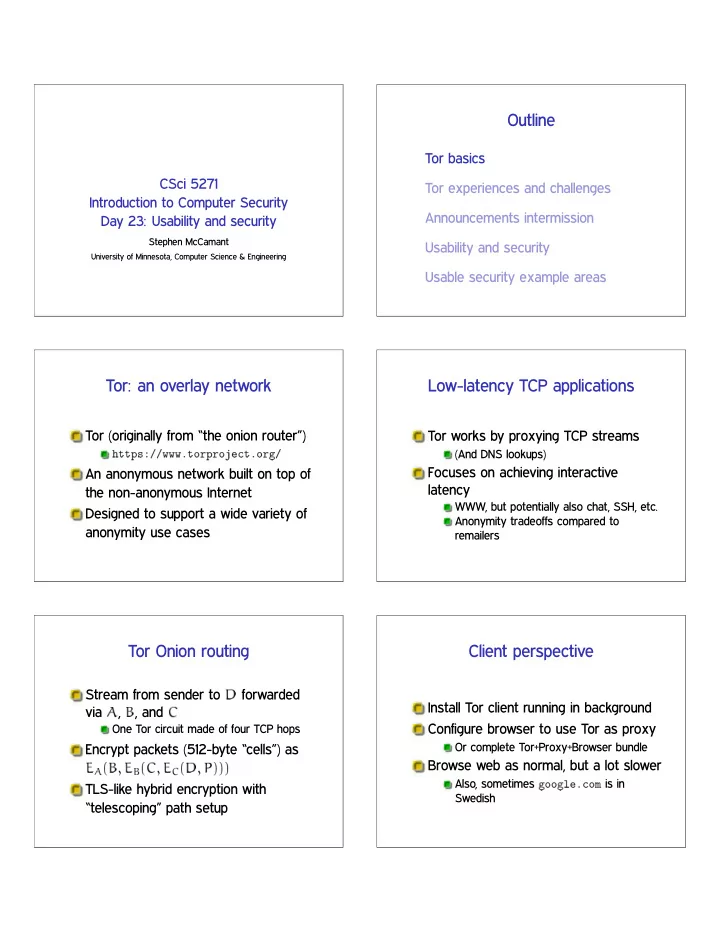
SLIDE 1 CSci 5271 Introduction to Computer Security Day 23: Usability and security
Stephen McCamant
University of Minnesota, Computer Science & Engineering
Outline
Tor basics Tor experiences and challenges Announcements intermission Usability and security Usable security example areas
Tor: an overlay network
Tor (originally from “the onion router”)
❤tt♣s✿✴✴✇✇✇✳t♦r♣r♦❥❡❝t✳♦r❣✴
An anonymous network built on top of the non-anonymous Internet Designed to support a wide variety of anonymity use cases
Low-latency TCP applications
Tor works by proxying TCP streams
(And DNS lookups)
Focuses on achieving interactive latency
WWW, but potentially also chat, SSH, etc. Anonymity tradeoffs compared to remailers
Tor Onion routing
Stream from sender to ❉ forwarded via ❆, ❇, and ❈
One Tor circuit made of four TCP hops
Encrypt packets (512-byte “cells”) as ❊❆✭❇❀ ❊❇✭❈❀ ❊❈✭❉❀ P✮✮✮ TLS-like hybrid encryption with “telescoping” path setup
Client perspective
Install Tor client running in background Configure browser to use Tor as proxy
Or complete Tor+Proxy+Browser bundle
Browse web as normal, but a lot slower
Also, sometimes ❣♦♦❣❧❡✳❝♦♠ is in Swedish
SLIDE 2 Entry/guard relays
“Entry node”: first relay on path Entry knows the client’s identity, so particularly sensitive
Many attacks possible if one adversary controls entry and exit
Choose a small random set of “guards” as only entries to use
Rotate slowly or if necessary
For repeat users, better than random each time
Exit relays
Forwards traffic to/from non-Tor destination Focal point for anti-abuse policies
E.g., no exits will forward for port 25 (email sending)
Can see plaintext traffic, so danger of sniffing, MITM, etc.
Centralized directory
How to find relays in the first place? Straightforward current approach: central directory servers Relay information includes bandwidth, exit polices, public keys, etc. Replicated, but potential bottleneck for scalability and blocking
Outline
Tor basics Tor experiences and challenges Announcements intermission Usability and security Usable security example areas
Anonymity loves company
Diverse user pool needed for anonymity to be meaningful
Hypothetical Department of Defense Anonymity Network
Tor aims to be helpful to a broad range
- f (sympathetic sounding) potential
users
Who (arguably) needs Tor?
Consumers concerned about web tracking Businesses doing research on the competition Citizens of countries with Internet censorship Reporters protecting their sources Law enforcement investigating targets
SLIDE 3 Tor and the US government
Onion routing research started with the US Navy Academic research still supported by NSF Anti-censorship work supported by the State Deptartment
Same branch as Voice of America
But also targeted by the NSA
Per Snowden, so far only limited success
Volunteer relays
Tor relays are run basically by volunteers
Most are idealistic A few have been less-ethical researchers,
Never enough, or enough bandwidth P2P-style mandatory participation?
Unworkable/undesirable
Various other kinds of incentives explored
Performance
Increased latency from long paths Bandwidth limited by relays Currently 1-2 sec for 50KB, 5-10 sec for 1MB Historically worse for many periods
Flooding (guessed botnet) earlier this fall
Anti-censorship
As a web proxy, Tor is useful for getting around blocking Unless Tor itself is blocked, as it often is Bridges are special less-public entry points Also, protocol obfuscation arms race (currently behind)
Hidden services
Tor can be used by servers as well as clients Identified by cryptographic key, use special rendezvous protocol Servers often present easier attack surface
Undesirable users
P2P filesharing
Discouraged by Tor developers, to little effect
Terrorists
At least the NSA thinks so
Illicit e-commerce
“Silk Road” in the news recently
SLIDE 4
Intersection attacks
Suppose you use Tor to update a pseudonymous blog, reveal you live in Minneapolis Comcast can tell who in the city was sending to Tor at the moment you post an entry
Anonymity set of 1000 ✦ reasonable protection
But if you keep posting, adversary can keep narrowing down the set
Exit sniffing
Easy mistake to make: log in to an HTTP web site over Tor A malicious exit node could now steal your password Another reason to always use HTTPS for logins
Browser bundle JS attack
Tor’s Browser Bundle disables many features try to stop tracking But, JavaScript defaults to on
Usability for non-expert users Fingerprinting via NoScript settings
Was incompatible with Firefox auto-updating Many Tor users de-anonymized in August by JS vulnerability patched in June
Outline
Tor basics Tor experiences and challenges Announcements intermission Usability and security Usable security example areas
Exercises
Exercise set 2 was not actually finished Monday, but it is now Leftover papers will be in my office Exercise set 4 due Thursday night
HW2 trailing slash mistake
First versions of the HW2 instructions gave the poke command like ❝✉r❧ ❤tt♣✿✴✴❈▲■❊◆❚✴✶✴
Doesn’t work, gives 404 error
Should be: ❝✉r❧ ❤tt♣✿✴✴❈▲■❊◆❚✴✶
Note no trailing slash
SLIDE 5
Outline
Tor basics Tor experiences and challenges Announcements intermission Usability and security Usable security example areas
Users are not ‘ideal components’
Frustrates engineers: cannot give users instructions like a computer
Closest approximation: military
Unrealistic expectations are bad for security
Most users are benign and sensible
On the other hand, you can’t just treat users as adversaries
Some level of trust is inevitable Your institution is not a prison
Also need to take advantage of user common sense and expertise
A resource you can’t afford to pass up
Don’t blame users
“User error” can be the end of a discussion This is a poor excuse Almost any “user error” could be avoidable with better systems and procedures
Users as rational
Economic perspective: users have goals and pursue them
They’re just not necessarily aligned with security
Ignoring a security practice can be rational if the rewards is greater than the risk
Perspectives from psychology
Users become habituated to experiences and processes
Learn “skill” of clicking OK in dialog boxes
Heuristic factors affect perception of risk
Level of control, salience of examples
Social pressures can override security rules
“Social engineering” attacks
SLIDE 6
User attention is a resource
Users have limited attention to devote to security
Exaggeration: treat as fixed
If you waste attention on unimportant things, it won’t be available when you need it Fable of the boy who cried wolf
Research: ecological validity
User behavior with respect to security is hard to study Experimental settings are not like real situations Subjects often:
Have little really at stake Expect experimenters will protect them Do what seems socially acceptable Do what they think the experimenters want
Research: deception and ethics
Have to be very careful about ethics of experiments with human subjects
Including because of institutional review systems
When is it acceptable to deceive subjects?
Many security problems naturally include deception
Outline
Tor basics Tor experiences and challenges Announcements intermission Usability and security Usable security example areas
Phishing
Attacker sends email appearing to come from an institution you trust Links to web site where you type your password, etc. Spear phishing: individually targeted, can be much more effective
Phishing defenses
Educate users to pay attention to ❳:
Spelling ✦ copy from real emails URL ✦ homograph attacks SSL “lock” icon ✦ fake lock icon, or SSL-hosted attack
Extended validation (green bar) certificates Phishing URL blacklists
SLIDE 7
SSL warnings: prevalence
Browsers will warn on SSL certificate problems In the wild, most are false positives
❢♦♦✳❝♦♠ vs. ✇✇✇✳❢♦♦✳❝♦♠ Recently expired Technical problems with validation Self-signed certificates (HW2)
Classic warning-fatigue danger
SSL warnings: effectiveness
Early warnings fared very poorly in lab settings Recent browsers have a new generation of designs:
Harder to click through mindlessly Persistent storage of exceptions
Recent telemetry study: they work pretty well
Spam-advertised purchases
“Replica” Rolex watches, herbal ❱✦❅❣r❅, etc. This business is clearly unscrupulous; if I pay, will I get anything at all? Empirical answer: yes, almost always
Not a scam, a black market Importance of credit-card bank relationships
Advance fee fraud
“Why do Nigerian Scammers say they are from Nigeria?” (Herley, WEIS 2012) Short answer: false positives
Sending spam is cheap But, luring victims is expensive Scammer wants to minimize victims who respond but ultimately don’t pay
Trusted UI
Tricky to ask users to make trust decisions based on UI appearance
Lock icon in browser, etc.
Attacking code can draw lookalike indicators
Lock favicon Picture-in-picture attack
Smartphone app permissions
Smartphone OSes have more fine-grained per-application permissions
Access to GPS, microphone Access to address book Make calls
Phone also has more tempting targets Users install more apps from small providers
SLIDE 8
Permissions manifest
Android approach: present listed of requested permissions at install time Can be hard question to answer hypothetically
Users may have hard time understanding implications
User choices seem to put low value on privacy
Time-of-use checks
iOS approach: for narrower set of permissions, ask on each use Proper context makes decisions clearer But, have to avoid asking about common things iOS app store is also more closely curated
Trusted UI for privileged actions
Trusted UI works better when asking permission (e.g., Oakland’12) Say, “take picture” button in phone app
Requested by app Drawn and interpreted by OS OS well positioned to be sure click is real
Little value to attacker in drawing fake button
Next time
Electronic voting: dangers and potential fixes