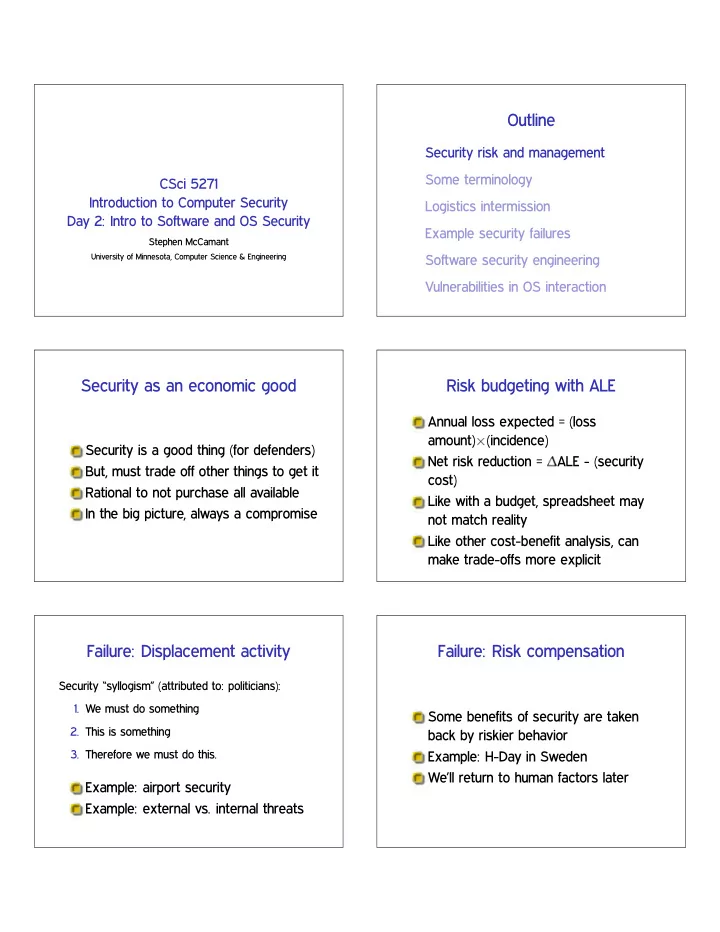
SLIDE 1 CSci 5271 Introduction to Computer Security Day 2: Intro to Software and OS Security
Stephen McCamant
University of Minnesota, Computer Science & Engineering
Outline
Security risk and management Some terminology Logistics intermission Example security failures Software security engineering Vulnerabilities in OS interaction
Security as an economic good
Security is a good thing (for defenders) But, must trade off other things to get it Rational to not purchase all available In the big picture, always a compromise
Risk budgeting with ALE
Annual loss expected = (loss amount)✂(incidence) Net risk reduction = ✁ALE - (security cost) Like with a budget, spreadsheet may not match reality Like other cost-benefit analysis, can make trade-offs more explicit
Failure: Displacement activity
Security “syllogism” (attributed to: politicians):
- 1. We must do something
- 2. This is something
- 3. Therefore we must do this.
Example: airport security Example: external vs. internal threats
Failure: Risk compensation
Some benefits of security are taken back by riskier behavior Example: H-Day in Sweden We’ll return to human factors later
SLIDE 2 This class’s perspective
We’ll mostly ignore management issues For this class, maximize security at all costs
Outline
Security risk and management Some terminology Logistics intermission Example security failures Software security engineering Vulnerabilities in OS interaction
“Trusted”
In security, “trusted” is a bad word ❳ is trusted: ❳ can break your security “Untrusted” = okay if it’s evil Trusted Computing Base (TCB): minimize
“Trusted” vs. “trustworthy”
Something you actually should trust is “trustworthy” Concise definition of security failure: something trusted is not trustworthy
“Privilege”
Privilege is the power to take security-relevant actions Concise definition of security failure: the adversary gets privilege they shouldn’t
3 common privilege levels
- 1. Administrator/root/OS kernel
- 2. Regular user of system
- 3. Evil people on the Internet
SLIDE 3 3 common privilege levels
- 1. Administrator/root/OS kernel
✯ Local exploit
- 2. Regular user of system
✯ Remote exploit
- 3. Evil people on the Internet
Outline
Security risk and management Some terminology Logistics intermission Example security failures Software security engineering Vulnerabilities in OS interaction
Posting slides before lecture
I’ll try for 11:59pm on the night before, not guaranteed Announcements are most likely to change, recheck after
Exercise set 1
Available on website Due Wednesday, September 25th, on Canvas Groups of 1-3, turn in one copy
Outline
Security risk and management Some terminology Logistics intermission Example security failures Software security engineering Vulnerabilities in OS interaction
Classic buffer overflow
❝❤❛r ❜✉❢❬✷✵❪❀ ❣❡ts✭❜✉❢✮❀ Vulnerability in ❢✐♥❣❡r daemon Morris worm brought down 1988 Internet (4.3BSD VAXes)
SLIDE 4 Buffer overflow classification
Bug: stack buffer overflow Attack: return address overwrite Consequence: (binary) code injection
Read It Twice (WOOT’12)
Smart TV (running Linux) only accepts signed apps on USB sticks
- 1. Check signature on file
- 2. Install file
Malicious USB device replaces app between steps TV “rooted”/“jailbroken”
Confused deputy compiler
Compiler writes to billing database Compiler can produce debug output to user-specified file Specify debug output to billing file, disrupt billing How to write policy preventing this?
Leaky intelligence analysts
1000s of analysts need to view 1000s
- f classified documents to do their job
Can we prevent it if one wants to send them to the Washington Post? More than regular access control (Reality: many non-technical problems)
Outline
Security risk and management Some terminology Logistics intermission Example security failures Software security engineering Vulnerabilities in OS interaction
Vulnerabilities are bugs
Security bugs “just a special case” of bugs Like regular bugs, only obscure ones make it through testing Key difference:
Rare regular bug has limited impact Attackers seek out vulnerability circumstances
SLIDE 5
Security and quality
Security correlated with other software quality:
Developers understand code well Interactions between modules controlled Well tested
Security and other features
Security would be much easier if systems were less complex But, very few users want that trade-off Risk compensation with improvements to development process
Contracts and checks
Requirement: check ❳ before doing ❨ What function’s responsibility is the check? Answer embodied in contracts, aka specifications, preconditions and postconditions
Defensive programming
Analogy: defensive driving Don’t assume things are right, check Inbound: preconditions on arguments Outbound: error conditions Within reason: some things can’t be checked at some places
Outline
Security risk and management Some terminology Logistics intermission Example security failures Software security engineering Vulnerabilities in OS interaction
Shell code injection
Don’t pass untrusted strings to a command shell In C: s②st❡♠, ♣♦♣❡♥ s②st❡♠✭✧❝♠❞ ✩❛r❣✶ ✩❛r❣✷✧✮ Fix 1: avoid shell Fix 2: sanitize data (preferably whitelist)
SLIDE 6 Shell code injection example
Benign: s②st❡♠✭✧❝♣ ✩❛r❣✶ ✩❛r❣✷✧✮, arg1 = ✧❢✐❧❡✶✳t①t✧ Attack: arg1 = ✧❛ ❜❀ ❡❝❤♦ ●♦t❝❤❛✧ Command: ✧❝♣ ❛ ❜❀ ❡❝❤♦ ●♦t❝❤❛ ❢✐❧❡✷✳t①t✧ Not a complete solution: blacklist ‘❀’
Bad/missing error handling
Under what circumstances could each system call fail? Careful about rolling back after an error in the middle of a complex operation Fail to drop privileges ✮ run untrusted code anyway Update file when disk full ✮ truncate
Race conditions
Two actions in parallel; result depends
Usually attacker racing with you
- 1. Write secret data to file
- 2. Restrict read permissions on file
Many other examples
Classic races: files in ✴t♠♣
Temp filenames must already be unique But “unguessable” is a stronger requirement Unsafe design (♠❦t❡♠♣✭✸✮): function to return unused name Must use ❖ ❊❳❈▲ for real atomicity
TOCTTOU gaps
Time-of-check (to) time-of-use races
- 1. Check it’s OK to write to file
- 2. Write to file
Attacker changes the file between steps 1 and 2 Just get lucky, or use tricks to slow you down
TOCTTOU example
✐♥t s❛❢❡❴♦♣❡♥❴❢✐❧❡✭❝❤❛r ✯♣❛t❤✮ ❢ ✐♥t ❢❞ ❂ ✲✶❀ str✉❝t st❛t s❀ st❛t✭♣❛t❤✱ ✫s✮ ✐❢ ✭✦❙ ■❙❘❊●✭s✳st ♠♦❞❡✮✮ ❡rr♦r✭✧♦♥❧② r❡❣✉❧❛r ❢✐❧❡s ❛❧❧♦✇❡❞✧✮❀ ❡❧s❡ ❢❞ ❂ ♦♣❡♥✭♣❛t❤✱ ❖ ❘❉❖◆▲❨✮❀ r❡t✉r♥ ❢❞❀ ❣
SLIDE 7
TOCTTOU example
✐♥t s❛❢❡❴♦♣❡♥❴❢✐❧❡✭❝❤❛r ✯♣❛t❤✮ ❢ ✐♥t ❢❞ ❂ ✲✶✱ r❡s❀ str✉❝t st❛t s❀ r❡s ❂ st❛t✭♣❛t❤✱ ✫s✮ ✐❢ ✭r❡s ⑤⑤ ✦❙ ■❙❘❊●✭s✳st ♠♦❞❡✮✮ ❡rr♦r✭✧♦♥❧② r❡❣✉❧❛r ❢✐❧❡s ❛❧❧♦✇❡❞✧✮❀ ❡❧s❡ ❢❞ ❂ ♦♣❡♥✭♣❛t❤✱ ❖ ❘❉❖◆▲❨✮❀ r❡t✉r♥ ❢❞❀ ❣
TOCTTOU example
✐♥t s❛❢❡❴♦♣❡♥❴❢✐❧❡✭❝❤❛r ✯♣❛t❤✮ ❢ ✐♥t ❢❞ ❂ ✲✶✱ r❡s❀ str✉❝t st❛t s❀ r❡s ❂ st❛t✭♣❛t❤✱ ✫s✮ ✐❢ ✭r❡s ⑤⑤ ✦❙ ■❙❘❊●✭s✳st ♠♦❞❡✮✮ ❡rr♦r✭✧♦♥❧② r❡❣✉❧❛r ❢✐❧❡s ❛❧❧♦✇❡❞✧✮❀ ❡❧s❡ ❢❞ ❂ ♦♣❡♥✭♣❛t❤✱ ❖ ❘❉❖◆▲❨✮❀ r❡t✉r♥ ❢❞❀ ❣
Changing file references
With symbolic links With hard links With changing parent directories
Directory traversal with ✳✳
Program argument specifies file, found in directory ❢✐❧❡s What about ❢✐❧❡s✴✳✳✴✳✳✴✳✳✴✳✳✴❡t❝✴♣❛ss✇❞?
Environment variables
Can influence behavior in unexpected ways
P❆❚❍ ▲❉ ▲■❇❘❆❘❨ P❆❚❍ ■❋❙ . . .
Also umask, resource limits, current directory
IFS and why it’s a problem
In Unix, splitting a command line into words is the shell’s job
String ✦ argv array ❣r❡♣ ❛ ❜ ❝ vs. ❣r❡♣ ✬❛ ❜✬ ❝
Choice of separator characters (default space, tab, newline) is configurable Exploit s②st❡♠✭✧✴❜✐♥✴✉♥❛♠❡✧✮
SLIDE 8
Next time
Bugs particular to low-level (e.g., C) programs