OUTLINE ZYXWVUTSRQPONMLKJIHGFEDCBA Introduction - - PDF document

outline zyxwvutsrqponmlkjihgfedcba
SMART_READER_LITE
LIVE PREVIEW

OUTLINE ZYXWVUTSRQPONMLKJIHGFEDCBA Introduction - - PDF document

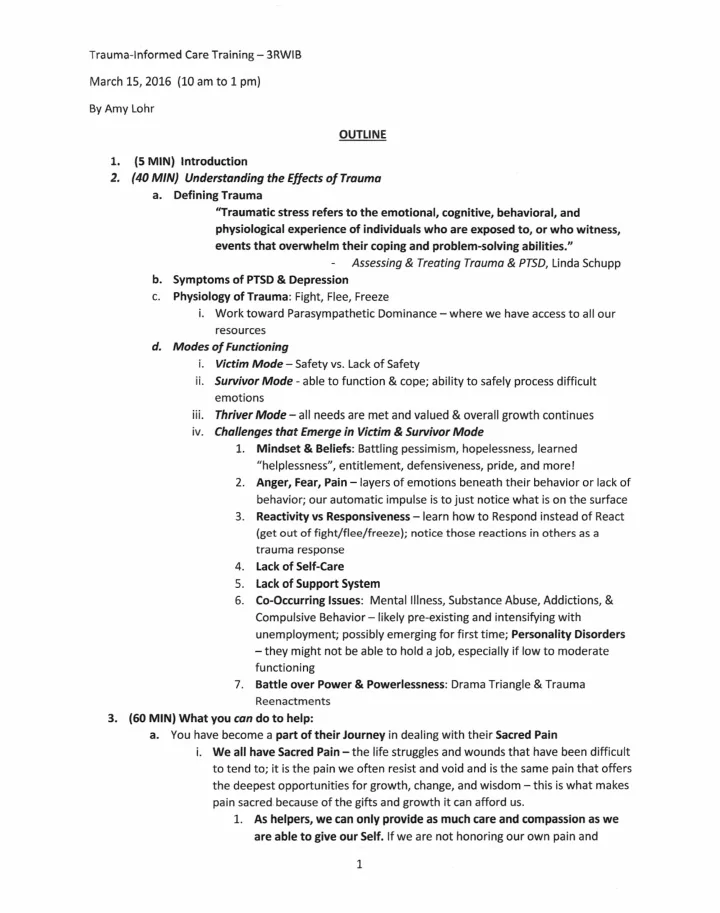
Trauma-Informed Care Training - 3RWIB March 15,2016 (10 am to 1 pm) By Amy Lohr OUTLINE ZYXWVUTSRQPONMLKJIHGFEDCBA Introduction WVUTSRQPONMLKJIHGFEDCBA 1 . (S MIN) 2 . (4 0 M IN ) U n d e rs ta n d in g th e E ffe c ts o f T ra u m a


slide-1
SLIDE 1

Trauma-Informed Care Training - 3RWIB March 15,2016 (10 am to 1 pm) By Amy Lohr OUTLINEZYXWVUTSRQPONMLKJIHGFEDCBA

1 . (S MIN)

IntroductionWVUTSRQPONMLKJIHGFEDCBA

2 . (4 0 M IN ) U n d e rs ta n d in g th e E ffe c ts

  • f

T ra u m a

a. Defining Trauma "Traumatic stress refers to the emotional, cognitive, behavioral, and physiological experience

  • f individuals

who are exposed to, or who witness, events that overwhelm their coping and problem-solving abilities."

A s s e s s in g & T re a tin g T ra u m a

& P T S D , Linda Schupp b. Symptoms

  • f PTSD & Depression

c. Physiology

  • f Trauma:

Fight, Flee, Freeze i. Work toward Parasympathetic Dominance - where we have access to all our resources

d . M o d e s

  • f

F u n c tio n in g

i.

V ic tim M o d e

  • Safety vs. Lack of Safety

ii.

S u rv iv o r M o d e

  • able to function

& cope; ability to safely process difficult emotions iii.

T h riv e r M o d e

  • all needs are met and valued & overall growth

continues iv.

C h a lle n g e s th a t E m e rg e in V ic tim

& S u rv iv o r

M o d e

1. Mindset

& Beliefs: Battling

pessimism, hopelessness, learned "helplessness", entitlement, defensiveness, pride, and more! 2. Anger, Fear, Pain - layers of emotions beneath their behavior

  • r lack of

behavior;

  • ur automatic

impulse is to just notice what is on the surface 3. Reactivity vs Responsiveness

  • learn

how to Respond instead of React (get out of fight/flee/freeze); notice those reactions in others as a trauma response 4. Lack of Self-Care 5. Lack of Support System 6. Co-Occurring Issues: Mental Illness, Substance Abuse, Addictions,

&

Compulsive Behavior -likely pre-existing and intensifying with unemployment; possibly emerging for first time; Personality Disorders

  • they might not be able to hold a job, especially if low to moderate

functioning 7. Battle over Power & Powerlessness: Drama Triangle & Trauma Reenactments 3. (60 MIN) What you

c a n do to help:

a. You have become a part of their Journey in dealing with their Sacred Pain i. We all have Sacred Pain - the life struggles and wounds that have been difficult to tend to; it is the pain we often resist and void and is the same pain that offers the deepest opportunities for growth, change, and wisdom

  • this is what makes

pain sacred. because ofthe gifts and growth it can afford us. 1. As helpers, we can only provide as much care and compassion as we are able to give our Self. If we are not honoring

  • ur own pain and

1

slide-2
SLIDE 2

Trauma-Informed Care Training - 3RWIB

March 15, 2016 (10 am to 1 pm) By Amy Lohr "tender" emotions and experiences, it will be difficult for us to feel a positive regard for other's and their struggles. It is common to experience compassion fatigue in the helping profession

  • so it is

essential you find ways to stay grounded in the passion and meaning that lead you into this field in the first place. One way to re-connect with your passion and feel inspiration is to hear other's stories of pain, survival, and passion for change. Today, Amy will share her inspirational recovery story and demonstrate honoring her sacred pain, as well as identifying the "gifts"

  • f embracing

her sacred pain. Hearing Amy's story and how Amy weave's this in to the experiences with your clients, will help you re-acquaint with the greatest gift we can offer any client- compassion. ii.ZYXWVUTSRQPONMLKJIHGFEDCBA

A s h e lp e rs o n c lie n t's S a c re d J o u rn e y , w e a re ta s k e d w ith :UTSRQPONMLKJIHGFEDCBA 1 .LKJIHGFEDCBA R esp ectin g th eir jo u rn ey u p u n til th is p o in t-

we all have creative strategies to avoid pain in our lives and to survive; those strategies create a foundation

  • f resillence.

When we ask people to dig up their "foundation", so we can help them pour in new, constructive strategies, this is still extremely scary! We are all used to doing what we know and what we are comfortable with - it feels very threatening to ask us to change (....activating Flight/Flee/Freeze).WVUTSRQPONMLKJIHGFEDCBA

2 .

"C reate a V essel fo r S acred P ain " 3 . H elp th em id en tify an d fo ster R eso u rces (In tern alLKJIHGFEDCBA & E xtern al)- Bridge

Exercise; Assess lack of resources; Review Resource ListZYXWVUTSRQPONMLKJIHGFEDCBA

4 . S e e k in g S a fe ty

5.

H e lp th e m id e n tify b a s ic s e lf-c a re : we need to address needs at the

bottom before we can work our way up; focus on basics 6.

E v e ry o n e : Breathe, Relax, & Stop Tensing!

7 . In still H o p e - they struggle to believe in themselves,

so it can go a long way to have others believe in them; ensure you are establishing Hope and Belief in the Person n o tth e situation

  • r outcomes

(employment). "I believe in and have hope in You. You are going to be ok." Sometimes I also say, "I believe in you and your abilities 100%, and I will continue to believe in you until you are able to believe in yourself." DO NOT INSTILL FALSEHOPE OR MAKE PROMISES FOR EMPLOYMENT OR OTHER OUTCOMES- YOU DO NOT HAVE POWER OVER THAT.

8 . In sp iratio n

  • Help them find things (anything)

that provides Inspiration ( a quote, mantra, image, podcasts, books, picture of loved one, objects, etc). Offer a small stone, bead, or object to represent the internal resource they need to overcome unemployment.

9 . M ean in g (S p irit): When we are able to find meaning through

hardship that is beyond "fixing" and "making things better", we feel more grounded, empowered, and trust that "everything will be ok", 2

slide-3
SLIDE 3

Trauma-Informed Care Training - 3RWIB March 15, 2016 (10 am to 1 pm) By Amy Lohr regardless of what happens. This all helps to keep us out of Fight/Flee/Freeze. We need to find something that keeps us grounded. Reality is that the most feared consequences are not that bad - but the way we react to resist the things we are scared of is actually what does cause suffering in our life. (Examples: Victor Frankl; Family & children who were homeless - hope, resilience, & gratitude in all circumstances).UTSRQPONMLKJIHGFEDCBA

1 0 .MLKJIHGFEDCBA A c c e p tin g P o w e rle ssn e ss: W e o n ly h a v e c o n tro l

  • v e r

th e c a reLKJIHGFEDCBA

&

a tte n tio nZYXWVUTSRQPONMLKJIHGFEDCBA w e p ro v id e to o u r S e lf o r th e situ a tio n .

We do not have control

  • ver outcomes;

we can either regard the care and attention we need or disregard it ...we have no control beyond our response.

1 1 . N o rm a lize

pain and struggles

1 2 . F o c u s o n S tre n g th s:

this will help you see hidden resources (internalZYXWVUTSRQPONMLKJIHGFEDCBA

&

external); it will also empower them by seeing their resiliency.

  • 13. Motivational

Interviewing: assess readiness for change; if they aren't ready, your efforts are futile

1 4 . D e -e sc a la tin g C lie n tsLKJIHGFEDCBA & M a n a g in g y o u r o w n re a c tiv ity (th e se g o h a n d

& h a n d ): the more you are tense, reactive, and stressed, the more they

will mirror the same behavior - model relaxation and your own self-care (something as simple as offering water to someone could be huge). Ensure you are not in the Drama Triangle - Rescuing counters empowerment.

1 5 . B o u n d a rie s

  • what are your roles/responsibilities?

Limitations? Don't take client's behaviors personally - its not about you (rarely are other's behaviors ever about us).

1 6 . E m p o w e r-

we are empowered when we have choices, so there are truly few circumstances in life where we are totally powerless. We can empower

  • thers by highlighting

the choices they have (mentally, emotionally, physically, spiritually, and situationally) and providing encouragement and responsibility

in their decision-making

  • r lack

thereof. "I have choices. My choices are . I choose to _

D o n o t te ll th e p e rso n w h a t th e y n e e d to , sh o u ld ,

  • r h a v e

to d o - th is is d ise m p o w e rin g . Y o u c a n h ig h lig h t c h o ic e s , c o n s e q u e n c e s , & a c c o u n ta b ility to w h a t th e y s ta te d th e y w a n t/n e e d .

Judgment does not need to be involvement in the decision-making: they can just own the choices they make. When someone tries to take away our choice, we will want to "fight" for power - Fight mode.

1 7 . S e e th e p e rso n b e y o n d th e ir b e h a v io rs & re sista n c e .

Let them know you see and hear them. Usually negative behaviors are used to "get

  • ther's

attention" for how they are feeling because they are incapable

  • r unwilling

to see their own feelings or take responsibility for them. validrtions:WVUTSRQPONMLKJIHGFEDCBA

t I I know you are hurting"

(when someone is presenting with· nger) or "You have experienced a lot of pain in your life"

3

slide-4
SLIDE 4

Trauma-Informed Care Training - 3RWIB MarchZYXWVUTSRQPONMLKJIHGFEDCBA

1 5 , 2 0 1 6 (1 0 am to 1 pm)

By Amy Lohr 4. (10 MIN) What youUTSRQPONMLKJIHGFEDCBA

C a n 't do & When to refer:WVUTSRQPONMLKJIHGFEDCBA

a .

You can't assess for trauma & mental illness yourself; you can't help them work through the feelings they have to the trauma and loss in their life - refer them to counseling (stay within your realm of expertise).

Y o u c a n v a lid a te w h a t y o u s e e a n d h e a r th e m s a y in g ; y o u c a n n o r m a liz e th a t u n e m p lo y m e n t is a tr a u m a a n d p r o v id e th e m w ith h a n d o u ts fo r th e ir e d u c a tio n ; y o u c a n e x p r e s s c o n c e r n a n d in fo r m th e m th a t th e r e is h e lp fo r th e m w h e n & if th e y a r e in te r e s te d in g e ttin g m o r e s u p p o r t

b. Know when you need to refer and to whom: have a list of resources (including the one I am offering) that are holistic and attend to all aspects of the individual (mental, emotional, physical, social, financial, spiritual, etc) c. Some individual's will not leave Victim Mode in their lifetime d. You can't change someone's personality & sometimes they are in a situation

  • f

unemployment due to personality disorders

  • r traits that are self-sabotaging

e. If the person is still stuck and not moving forward, resistant, etc - they may need the emotional support and process of therapy (inquire if they are open to this) f. Relinquish the statements: "I need to make them __ " Or "I need to get them to __ ", You cannot

m a k e or g e t someone to do anything

  • nor is this your

responsibility

  • r within

your power to do so. When someone tries to m a k e or g e t us to do something, we react negatively. Notice when you are thinking this way or your behavior with a client is motivated by those thoughts

  • manage your own thinking,

accept your powerlessness, and ground yourself back in empowering the client to see his/her choices & responses. g. If you notice the symptoms

  • f depression,

there could be a lot more underlying this (including suicidal thoughts)

  • provide

immediate referrals for a mental health assessment, you don't know how unsafe they may be and unemployment is a significant risk factor for suicide. If you need immediate assistance, contact the Resolve Crisis Network

  • 1 -8 8 8 -7 9 6 -8 2 2 6 ,

where a counselor can assist you if someone is making statements

  • f self-harm

and they can also talk to that individual. 5. (30 MIN) Review of Questions

& Case Examples

*Grab Lunch* 6. (30 MIN) Experiential Learning: Guided Meditation; Practicing Mindfulness

7 . (5 M IN ) C o n c lu s io n .

Hope, Respect, & Compassion are ultimately what goes a long way! Use the information from today to normalize their experiences, instill hope, and offer resources when

  • necessary. You will likely be the only person who will validate

that unemployment is a trauma - which can affect them in ways beyond just changing their circumstances financially

  • r with employment.

The trauma

  • f unemployment

has the potential to cause wounds emotionally, spiritually, physically, mentally, socially. Hearing this can provide relief and hope as they can then start to see the right resources to heal from the trauma beyond just applying for a job. It can continue to remain hopeless to just address the employment side, without addressing the emotions lingering from the trauma - ultimately the fight/flee/freeze can and will sabotage it all.

4

slide-5
SLIDE 5

* U n e m p lo y m e n t is o fte n e x p e rie n c e d a s a tro u m a tic e x p e rie n c e

  • th is is a n o rm a l

re a c tio n ,UTSRQPONMLKJIHGFEDCBA w h ic h w a r r a n ts a tte n tio n a n d m a y n e e d th e a d d itio n a l s u p p o r t

  • f c o u n s e lin g

to w o r k th r o u g h th e e m o tio n a l, m e n ta l, a n d b e h a v io r a l im p a c t

  • f u n e m p lo y m e n t

a s a tr a u m a . " T ra u m a tic stre ss re fe rsLKJIHGFEDCBA

to th e e m o tio n a l, c o g n itiv e , b e h a v io ra l, a n d p h y sio lo g ic a l e x p e rie n c e

  • f in d iv id u a ls

w h o a re e x p o se d

to , o r w h o

w itn e ss, e v e n ts th a t

  • v e rw h e lm

th e ir c o p in g a n d p ro b le m -so lv in g a b ilitie s. " - L in d a S c h u p p * P le a se n o te , th is list is a sse m b le d

to p re se n t

a n e x a m p le

  • f sy m p to m s
  • f D e p re ssio nZYXWVUTSRQPONMLKJIHGFEDCBA

& P T S D , th is is n o t in te n d e d to b e u se d a s a n a sse ssm e n t to o l & d o e s n o t in a n y w a y re p la c e th e n e e d fo r a n a sse ssm e n t fro m a tra in e d m e n ta l h e a lth p ro fe ssio n a l.

P o s ttra u m a tic S tre s s D is o rd e r S y m p to m s :rqponmlkjihgfedcbaZYXWVUTSRQPONMLKJIHGFEDCBA

  • Intrusive

thoughts, feelings, sensations,

  • r images of trauma
  • Distressing dreams
  • Dissociative

reactions - occur on a continuum in re-experiencing emotions, sensations or images

  • f trauma

(could emerge as flashbacks; not feeling present/connected; experiencing self or

  • thers as unreal/distorted)
  • Emotional

distress/reaction (anxiety, anger, sadness) at exposure to triggers to trauma (internal

  • r external

cues that symbolize

  • r resemble an aspect of the trauma)
  • Physical distress/reaction

at exposure to triggers to trauma (could emerge as panic attack)

  • Avoiding

internal reminders

  • f the trauma

(memories, thoughts, feelings) and avoiding external reminders

  • f the trauma

(people, places, things)

  • Difficulty

remembering aspects of the trauma

  • Persistent

and exaggerated negative beliefs or expectations about oneself, others, or the world (e.g., "I am bad," "No one can be trusted," "The world is completely dangerous",

  • r "My whole

nervous system is permanently ruined")

  • Distorted

thoughts about facts of trauma(i.e. blaming self or others)

  • Persistent

negative emotions (anger, blame, shame, guilt, fear, helplessness, etc)

  • Decreased interest

in activities that are normally pleasurable

  • Difficulty

in experiencing positive emotions (happiness, love, compassion, empathy, joy, etc)

  • Increased irritability,

anger or aggression (physical, verbal, or towards property)

  • Poor concentration/focus
  • Reckless or self-destructive

behavior

  • Hypervigilance
  • Exaggerated startle

response

  • Sleep disturbance

(trouble falling or staying asleep; waking; excessive sleeping)

S y m p to m s

  • f D e p re s s io n :
  • Depressed mood most of the day, nearly every day
  • decreased interest
  • r pleasure in all, or almost all, activities

most of the day

  • Significant

weight loss when not dieting or weight gain, or decrease/increase in appetite.

  • Sleep disturbance
  • feelings of restlessness or being slowed down
  • Fatigue or loss of energy
  • Feelings of worthlessness
  • r excessive or inappropriate

guilt

  • Poor concentration,

indecisiveness

  • Recurrent

thoughts

  • f death (not just fear of dying), recurrent

suicidal ideation without a specific plan, or a suicide attempt

  • r a specific plan for committing
  • suicide. P L E A S EN O T E : IfWVUTSRQPONMLKJIHGFEDCBA

y o u

a re c u rre n tly e x p e rie n c in g su ic id a l id e a tio n , p le a se

c a llZYXWVUTSRQPONMLKJIHGFEDCBA

9 1 1 im m e d ia te ly to b e a sse sse d a t y o u r lo c a l h o sp ita l.

Amy Lohr, LCSW lohrcounseling@gmail.com Trauma-Informed Care

3/15/16