SLIDE 1 Health and Safety Executive
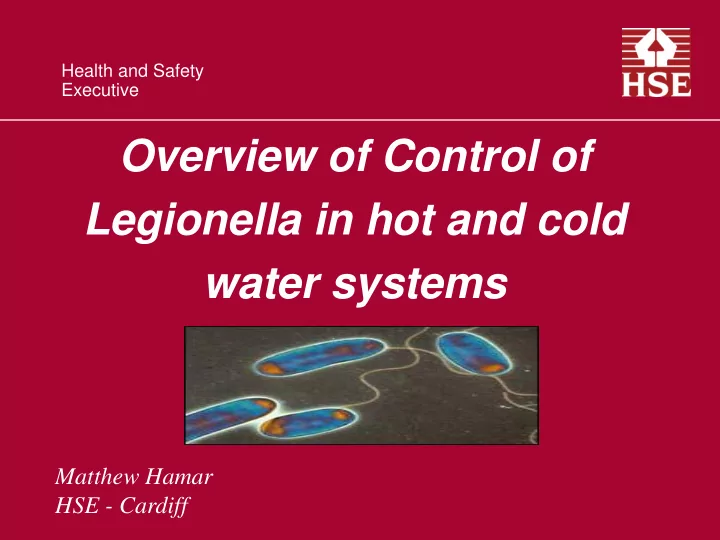
Overview of Control of Legionella in hot and cold water systems
Matthew Hamar HSE - Cardiff
SLIDE 2 What is Legionellosis?
- Collective name for diseases caused by
bacteria legionella.
non-pneumonia varieties.
- The species Legionella pneumophila
presents the most serious hazard.
- Non pneumonia diseases include pontiac
fever-high strike rate with a legionella
SLIDE 3 Legionella pneumophila
- This pneumonia is fatal in 10-12% of cases.
- Incubation period 2-10 days (usually 3-6)
- Symptoms include high fever, general malaise,
muscle and joint pains, headache, dry unproductive cough, chest pains and respiratory distress
- Not everyone exposed will develop symptoms
- Some people will not develop the full blown
disease and may experience a mild flu like infection
- Can be treated effectively using antibiotics
SLIDE 4
Number of cases of Legionellosis by year of onset of symptoms 2005 to 2014 (E&W)
SLIDE 5
Number of confirmed cases of Legionnaires' disease by month and year of onset, 2013–2015 (E&W)
SLIDE 6 People at greatest risk
- Old and infirm
- Men more susceptible than women
- Over 45 years of age
- Smokers
- Alcoholics
- Diabetics
- Existing respiratory problems
- Immuno-suppressed people
SLIDE 7 Infection route
- Inhalation of contaminated water
droplets containing the viable bacteria
- Water droplets less than 5 microns
- No person to person transmission
- Not contracted by drinking
contaminated water
SLIDE 8 Where is legionella found?
- Legionella is widespread in both natural water
sources and artificial water systems.
- It multiplies:
- where temperatures are between 20-450C;
- where nutrients are available; and
- where water is stagnant or re-circulates.
- Infection can then occur by the inhalation of
aerosols or particles generated from the source.
SLIDE 9 Barrow-in-Furness outbreak
- 2500 people affected
- 494 clinically diagnosed
cases
SLIDE 10
Legionnaires at Care Home
SLIDE 11
L8- Legionnaires` disease
Foreseeable and Preventable
SLIDE 12 L8 ACOP describes the responsibilities
- f employers
- Identify and assess risks of legionellosis;
- avoid the use of systems that give rise to a
foreseeable risk of legionellosis or, where this is not reasonably practicable, prepare a written scheme for minimising the risk from exposure;
- implement and manage the scheme of
precautions including the appointment of a person, or persons, to take managerial responsibility and to provide supervision; and
- keep appropriate records.
SLIDE 13 Risk Assessment should include:
- the management responsibilities and name of
the responsible person;
- an assessment & comprehensive schematic
(where complex) of the system;
- details of precautions taken including:
- the control method/s – inspection / monitoring
and maintenance programme (eg checking the system is kept clean;
- records of operation, monitoring and remedial
work;
- population exposed and risk
SLIDE 14
Example of a good schematic
SLIDE 15 Methods of control of legionella in hot and cold water systems
- temperature regime;
- biocide treatments;
- ionisation treatment;
- ozone; and
- UV treatments
SLIDE 16
Temperature parameters
20 0C bacteria remains dormant but viable Bacteria 45 0 C 50 0 C -90% killed in 2 hours 600C -90% killed in 2 minutes 700C- rapid kill to 100% Avoid temperatures in range 20-50 degrees Celsius
SLIDE 17 Overview
controls
Store cold water at <200C Distribute cold water at <200C Store hot water >=600C distribute hot water at >=500C Return water >=500C Note – Hot water should achieve 500C within 1 minute & cold should achieve less than 200C within 2 minutes at sentinel outlets
SLIDE 18
Sentinel Outlets
the nearest and furthest/last outlets from hot and cold water cylinders and tanks.
SLIDE 19 Dead end and dead legs need to be removed
- A dead end- a redundant length of pipe, closed at one end,
through which no water is flowing
- A dead leg - is a pipe leading to an outlet which water flows
but the outlet is un-used or infrequently used. All need to be removed by cutting them back to the main pipe run
SLIDE 20 Thermostat mixing valves
these blend hot and cold water to reduce the temperature where a scald risk is present
SLIDE 21 Expansion vessels in hot or cold water systems (not central heating)
- Preferably be flow through
design
– flush through and purge to drain (HSG274 Pt2 Table 2.1)
- Minimise volume stored
- Should be sited
– in cool areas – vertically on pipework not horizontally
SLIDE 22 Specialised Assisted Baths
shower head system
function
- Flexible hoses
- Expansion vessels
- Filters
SLIDE 23 Other issues to address:
- TMVs should be fitted as close as possible to the point of
use (typically one per outlet);
- Infrequently used outlets should be flushed weekly (includes
short usage and no hot water flowing);
- Shower heads and hoses should be dismantled, cleaned and
descaled or replaced at least quarterly.
- Redundant supply pipework should be cut back as far as
possible to a common supply;
- Replace EPDM (ethylene propylene diene monomer). rubber
hoses with eg. PE (polyethylene), PEX (cross-linked polyethylene
SLIDE 24
Monitoring water temperatures for legionella control
SLIDE 25 Measure the temperature at the hot water tanks monthly
- hold the surface probe against the pipe
work at the hot water tank outlet
- check the temperature tallies with any
fixed thermometer, if installed.
SLIDE 26 Measure the temperatures at the sentinel cold water and hot water outlets monthly
Use the immersion probe to measure the temperature of the water flowing from the outlet (NB – on hot outlet where TMV is fitted, this needs to be done on TMV inlet pipe)
- Hot water should measure at least
500C within 1 minute of running water
- Cold water should measure
less than 200C within 2 minutes
SLIDE 27
Measure sentinel hot water temperature at inlet to TMV monthly
Measure at least 500C within 1 minute of running water
SLIDE 28
Measure the temperatures at the cold water tanks 6 monthly
Incoming water Water in tank Measure less than 200C
SLIDE 29 Common failings 1
- No Legionella risk assessment and occupiers are ignorant
- f the control and monitoring requirements (lack of
competence)
- Assessment findings not being implemented
- No schematics or not comprehensive
- Sentinel outlets not identified
- Not measuring hot water temperatures at inlet to TMVs
where fitted
- Homes only measure and record hot water temps after
tmv’s for scald risk
- Tmv’s fitted too far from outlet
- Not measuring hot water storage temperatures
- Hot water storage thermostats set below 50 degrees C
SLIDE 30 Common failings 2
- No temperature gauges fitted to hot water outlets and
returns (and no one measuring with surface probe)
- Hot water vent pipe overflowing to cold water tank
- Cold water stored above 200C (eg un-insulated cold water
tanks located on roofs)
- Cold water tank lids not tight fitting or broken
- Insects screens not fitted to cold water over flows and
vents
- Dead legs / ends present
- Infrequently used outlets not flushed weekly
- No cleaning of shower heads
- Evidence that some Water treatment company reports do
not reflect the inadequate management, treatment and control of legionella at the homes
SLIDE 31 When is legionella sampling required?
- Where storage and distribution
temperatures are reduced from those required
- Where an outbreak is suspected or
identified
- Where assessment identifies it is
necessary to help monitor effectiveness of controls
SLIDE 32 When is disinfection needed?
- If required temperatures not being
achieved
- System has been substantially altered; or
- During or following an outbreak
SLIDE 33
Other issues to consider
What is an infrequently used outlet? What is the impact of green technologies or energy conservation on Legionella control? How many people are contracting Legionnaires disease from care homes? RIDDOR does not require non-worker reports of disease to HSE – but requirement to report to HPA
SLIDE 34 Frequency of Monitoring Temperatures
Monthly
Measure the temperature at the hot and cold water sentinel outlets and the hot water tank Six monthly Check the temperature at the cold water storage tank/s (at least once in winter and once in summer during a hot period); Annually Check a representative number of cold water outlets on a rotational basis
Frequency of water temperature checks
SLIDE 35 The Frequency of Other Checks
At least weekly Flush infrequently used hot and cold water outlets At least 3 monthly Clean and de-scale or replace shower heads and hoses At least annually Visually inspect the cold water storage tank/s and clean and disinfect as required Check the schematic diagram/s of the H &CW system to ensure they are correct and up to date (eg addition or removal of water tanks and outlets)
Note: All checks should be carried out using safe systems and some checks or corrective actions may need to be done by an external competent person
Frequency of other checks
SLIDE 36 Further information
HSE H&SC Legionella webpage: http://www.hse.gov.uk/healthservices/legionella.htm HSE Legionella H&CWS webpage: http://www.hse.gov.uk/legionnaires/hot-and-cold.htm HSE SIM – Control of Legionella in H&CWS http://www.hse.gov.uk/foi/internalops/sims/pub_serv/07-12-07/index.htm HSE ACOP L8: http://books.hse.gov.uk/hse/public/saleproduct.jsf?catalogueCode=9780 717617722 HSE ACOP HSG274 Part 2 http://www.hse.gov.uk/pubns/priced/hsg274part2.pdf HSE Safety Notice: http://www.hse.gov.uk/safetybulletins/legionella2.htm
SLIDE 37
Schematics
SLIDE 38
SLIDE 39