Overview of Project SCC-1 Software Engineering CSE435 Michigan - - PowerPoint PPT Presentation

overview of project scc 1
SMART_READER_LITE
LIVE PREVIEW

Overview of Project SCC-1 Software Engineering CSE435 Michigan - - PowerPoint PPT Presentation

Overview of Project SCC-1 Software Engineering CSE435 Michigan State University Fall 2018 Team members: Customer: Mr. Eric Winder Project Manager: Yash Patel Instructor: Dr. James Daly Facilitator: Andy Ashton *Please direct all inquiries to


slide-1
SLIDE 1

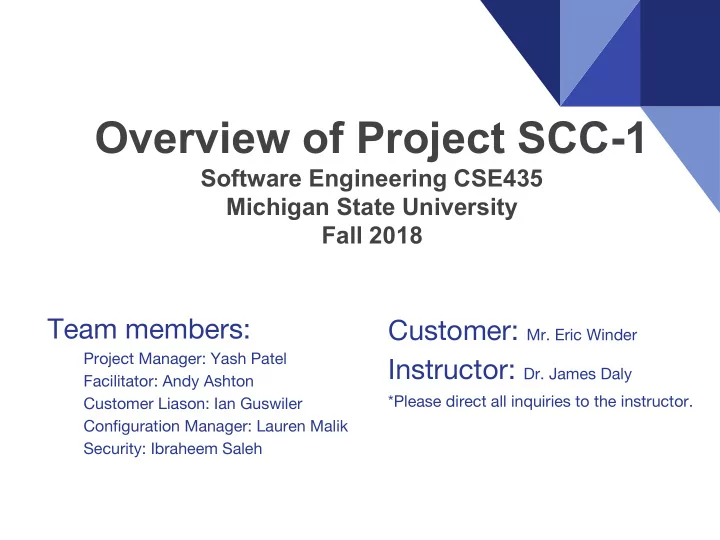
Overview of Project SCC-1

Software Engineering CSE435 Michigan State University Fall 2018

Team members:

Project Manager: Yash Patel Facilitator: Andy Ashton Customer Liason: Ian Guswiler Configuration Manager: Lauren Malik Security: Ibraheem Saleh

Customer: Mr. Eric Winder Instructor: Dr. James Daly

*Please direct all inquiries to the instructor.

slide-2
SLIDE 2

Project SCC-1 Overview

  • System provides functionality of

accident prevention through a cruise control that scales with the speed and distance of a leading vehicle.

  • Motivation for project

– Safer cruise control system, preventing crashes. – User following dist and speed control, activating emergency stop.

slide-3
SLIDE 3

Technical Definitions

  • SCC - Scalable Cruise Control
  • FDM - Following Distance Management
  • AEB - Automatic Emergency Brakes
  • SC - Simple Cruise
slide-4
SLIDE 4

Overview of Features I

  • Simple Cruise

– Sets a speed to be maintained. greater than 25 mph. – Driver may exceed the set speed through direct throttle inputs. – Driver may suspend the feature through a button press or by depressing the brake pedal. – Driver may increase/ decrease the set speed with button presses.

slide-5
SLIDE 5

Overview of Features II

  • Following Distance Management (FDM)

– Set a following distance from a leading vehicle. – Vehicle maintains maximum possible safe speed through throttle and brake control and tracking lead vehicle speed and distance. – Alerts the driver in case of emergency.

slide-6
SLIDE 6

Overview of Features III

  • Automatic Emergency Brake (AEB)

– Inputs come from vehicle speed, and camera /radar object tracking. – Applies maximum braking pressure to minimize stopping distance. – Functions regardless if SC is enabled.

slide-7
SLIDE 7

Domain Research

  • Investigated vehicle braking and

acceleration

  • Needed to apply domain knowledge on

intercept distance.

  • Project Constraints

– AEB braking distance – FDM time to intercept – Prototype model behavior

slide-8
SLIDE 8

Case Diagram

Figure 1: Case Diagram

slide-9
SLIDE 9

Scenario 1: Setting Speed

  • User sets vehicle’s cruise control speed

to 26 mph.

  • User attempts to decrease cruise

control speed through button press.

  • Cruise control remains at a set speed of

26 mph.

slide-10
SLIDE 10

Scenario 2: AEB Engaged

  • Using SCC a vehicle’s cruise speed is

set to 40mph

  • The vehicle suddenly encounters a

stopped vehicle in the same lane

  • The driver doesn’t have time to react
  • The system engages AEB to stop the

car

slide-11
SLIDE 11

Scenario 3: FDM Activated

  • Using SCC a vehicle’s cruise speed is

set to 30mph

  • Using FDM a following distance of

increment 2 is set

  • The vehicle encounter another one in

the same lane which is moving 25mph

  • FDM slows down the original vehicle to

maintain the following distance

slide-12
SLIDE 12

Acknowledgements

  • We gratefully acknowledge and

appreciate the participation of our customer, Mr. Eric Winder from Ford Motor Company