Overview of U.S. agrifood supply chains ECONOMIC CHARACTERISTICS - - PowerPoint PPT Presentation

overview of u s agrifood supply chains
SMART_READER_LITE
LIVE PREVIEW

Overview of U.S. agrifood supply chains ECONOMIC CHARACTERISTICS - - PowerPoint PPT Presentation

OBJECTIVE Overview of U.S. agrifood supply chains ECONOMIC CHARACTERISTICS OF THE AGRIFOOD SUPPLY CHAIN Describe seven specific Michael Boland, Ph.D. Director of University of Minnesota characteristics that are different from Food


slide-1
SLIDE 1

24 October 2012

ECONOMIC CHARACTERISTICS OF THE AGRIFOOD SUPPLY CHAIN

Michael Boland, Ph.D. Director of University of Minnesota Food Industry Center Koller Endowed Professor in Agribusiness Management and Information Technology

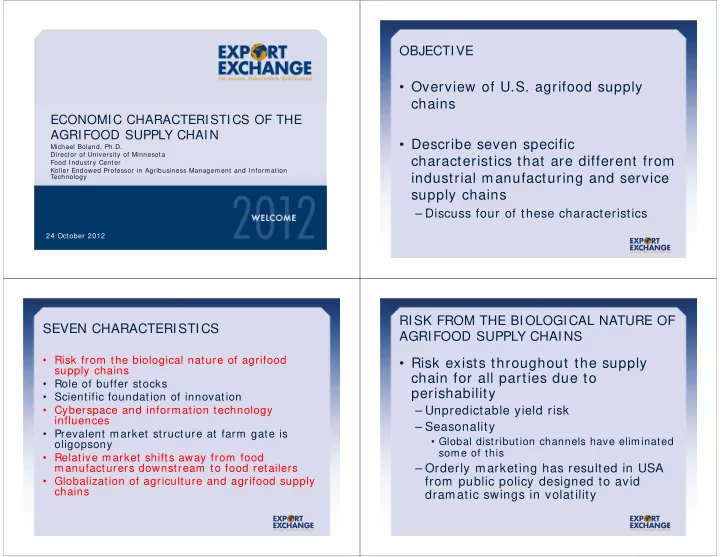
OBJECTIVE

  • Overview of U.S. agrifood supply

chains

  • Describe seven specific

characteristics that are different from industrial manufacturing and service supply chains

– Discuss four of these characteristics

SEVEN CHARACTERISTICS

  • Risk from the biological nature of agrifood

supply chains

  • Role of buffer stocks
  • Scientific foundation of innovation
  • Cyberspace and information technology

influences

  • Prevalent market structure at farm gate is
  • ligopsony
  • Relative market shifts away from food

manufacturers downstream to food retailers

  • Globalization of agriculture and agrifood supply

chains

RISK FROM THE BIOLOGICAL NATURE OF AGRIFOOD SUPPLY CHAINS

  • Risk exists throughout the supply

chain for all parties due to perishability

– Unpredictable yield risk – Seasonality

  • Global distribution channels have eliminated

some of this

– Orderly marketing has resulted in USA from public policy designed to avid dramatic swings in volatility

slide-2
SLIDE 2

RISK FROM THE BIOLOGICAL NATURE OF AGRIFOOD SUPPLY CHAINS

  • Quantity risk is short-term shortfall in

supply

– “We will always plant another crop” – Yield volatility is greatest in maize relative to soybean, wheat, and rice

  • Price risk occurs from changes in

supply and demand

– Ways to hedge this in futures markets or fixed price contracts of a short duration with specific delivery and quality attributes

REAL AGRICULTURAL COMMODITY PRICES ARE FALLING OVER TIME

http://www.instepp.umn.edu/documents/SP‐IP‐09‐01.pdf

YIELD INCREASES ARE VARIABLE

http://www.instepp.umn.edu/documents/SP‐IP‐09‐01.pdf

CYBERSPACE AND INFORMATION TECHNOLOGY INFLUENCES

  • Transportation gains and

communication technology have reduced real freight costs

  • Widening of Panama Canal and

expansion of US rail system will change US system

– Projects in Brazil and southeast Asia (rail, deeper ports, etc.) will further reduce costs.

slide-3
SLIDE 3

INFORMATION TECHNOLOGY IMPACTS

  • Processors can use contracts to obtain

certain plant varieties or animal breed

  • Utilize research to change transfat

profile in oilseeds or intramuscular fat in animals

  • Whole grains, sodium, and calories are

becoming critical issues.

  • Traceability has become more common

which requires trust. INFORMATION TECHNOLOGY IMPACTS

  • Harmonization of information used in

business

– Trade agreements and similar treaties have helped standardize how business is done and data reporting

  • Veterinary and scientific protocols

– Exception: GMO tolerance differences still exist

  • International accounting standards
  • Value and volumes of export and import

data

RELATIVE MARKET SHIFTS AWAY FROM FOOD MANUFACTURERS DOWNSTREAM TO FOOD RETAILERS

  • Market power is shifting away from

food processors to retail supermarkets and restaurants

– Concept of “Chain Captains” in retail supermarkets who decide what is needed in supply chain and influence participants in the chain SUPERMARKETS AND RESTAURANTS HAVE NOT ENGAGED IN EXTENSIVE VERTICAL INTEGRATION STRATEGIES

  • Market power exists due to global

market share and number of retail locations

  • Volume and access to consumer

demands leads to increased leverage

  • Development of global brands
  • Development of ‘sustainable’ practices

– Size of space for layer chickens – Growth hormones in beef – Proposition 37 in California on food labeling

slide-4
SLIDE 4

GLOBAL TOP 100 BRANDS WITH A FOOD FOCUS

Restaurants Beverages Alcohol Consumer Foods

GLOBALIZATION OF AGRICULTURE AND AGRIFOOD SUPPLY CHAINS

  • Information technology provides
  • pportunities for globalization which

leads to

– Increases in market size – Returns to scale – Competition – Capital flows – Multilateral trade agreements

GLOBALIZATION OF AGRICULTURE AND AGRIFOOD SUPPLY CHAINS

  • Use of World Trade Organization to

settle disputes among countries

  • Resource adjustment in agriculture

us slower than in many other industries

– Employment, food security, immigration,

  • etc. issues

MANAGERIAL IMPLICATIONS

  • Ability to process and understand

change

– Greater difficulty in raising prices even if your costs increase

  • Number of products offered,

geographic scope of firms, and source and sustainability of competitive advantage are important

slide-5
SLIDE 5

MANAGERIAL IMPLICATIONS

  • Foreign Direct Investment is more

rapid when there are opportunities

– Requires assessment of risk and reward

  • Transportation investments are going

to offer many opportunities but the timing of these investments is critical

– Geo-politics may delay some investments

MANAGERIAL IMPLICATIONS

  • Role of trade associations in codifying

self-regulation will be more important.

– Food labeling, certification, and similar issues – Helping define sustainability issues

  • Entire supply chains may compete

against each other as opposed to individual firms.

– Much different than what we have seen in past

FOR MORE INFORMATION

  • I can be contacted at + 1.612.625.3013
  • r boland@umn.edu
  • Full description can be found in a

publication by Tom Sporleder (retired) and myself entitled

– Exclusivity of Agrifood Supply Chains: Seven Fundamental Economic Characteristics International Food and Agribusiness Management Review Volume 14, Issue 5, 2011. Available online – http: / / ageconsearch.umn.edu/ bitstream/ 11 9969/ 2/ 20110087_Formatted.pdf