Overview Simple camera is limiting and it is necessary to model a - PDF document
General Camera Overview Simple camera is limiting and it is necessary to model a camera that can be moved We will define parameters for a camera in terms of where it is, the direction it points and the direction it considers to
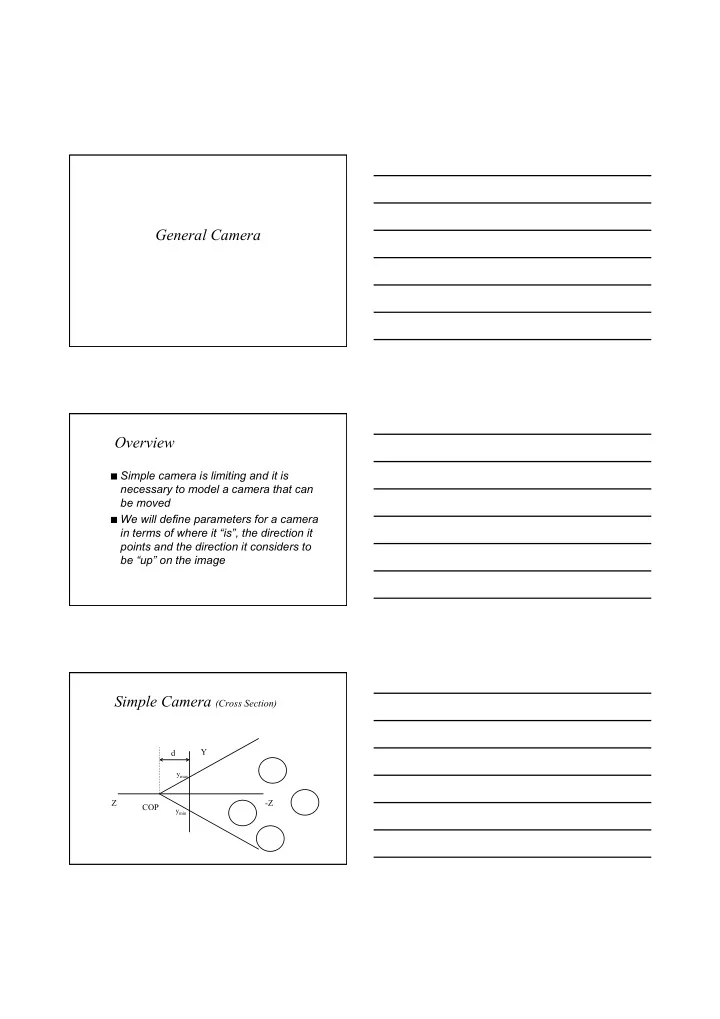
General Camera Overview Simple camera is limiting and it is necessary to model a camera that can be moved We will define parameters for a camera in terms of where it “is”, the direction it points and the direction it considers to be “up” on the image Simple Camera (Cross Section) Y d y max Z -Z COP y min
General Camera View Reference Point (VRP) • where the camera is View Plane Normal (VPN) • where the camera points View Up Vector (VUV) • which way is up to the camera X (or U-axis) forms LH system UVN Coordinates View Reference Point (VRP) • origin of VC system (VC=View Coordinates) View Plane Normal (VPN) • Z (or N-axis) of VC system View Up Vector (VUV) • determines Y (or V-axis) of VCS X (or U-axis) forms Left Hand system World Coords and Viewing Coords Y V U V U V V R P N X (EQ1) We want to find a general transform of Z the above form (EQ1) that will map WC to VC
View from the Camera N and VPN into the page V xmax, ymax VUV Z Y X U xmin, ymin Finding the basis vectors Step 1 - find n Step 2 - find u Step 3 - find v Finding the Mapping (1) u,v,n must rotate under R to i,j,k of viewing space Both basis are normalised so this is a pure rotation matrix • recall in this case R T = R -1
Finding the Mapping (2) In uvn system VRP (q) is (0 0 0 1) And we know from EQ1 so Complete Mapping Complete matrix For you to check If Then
Using this for Ray-Casting Use a similar camera configuration (COP is usually, but not always on -n) To trace object must either • transform spheres into VC • transform rays into WC Ray-casting Transforming rays into WC • Transform end-point once • Find direction vectors through COP as before • Transform vector by • Intersect spheres in WC Ray-casting Transforming spheres into VC • Centre of sphere is a point so can be transformed as usual (WC to VC) • Radius of sphere is unchanged by rotation and translation (and spheres are spheroids if there is a non-symmetric scale)
Tradeoff If more rays than spheres do the former • transform spheres into VC For more complex scenes e.g. with polygons • transform rays into WC Alternative Forms of the Camera Simple “Look At” • Give a VRP and a target (TP) • VPN = TP-VRP • VUV = (0 1 0) (i.e. “up” in WC) Field of View • Give horizontal and vertical FOV or one or the other and an aspect ratio • Calculate viewport and proceed as before Animated Cameras Animate VRP (observer-cam) Animate VPN (look around) Animate TP (track-cam) Animate COP • along VPN - zoom • orthogonal to VPN - distort
Recap We created a more general camera which we can use to create views of our scenes from arbitrary positions Formulation of mapping from WC to VC (and back)
Recommend
More recommend
Explore More Topics
Stay informed with curated content and fresh updates.