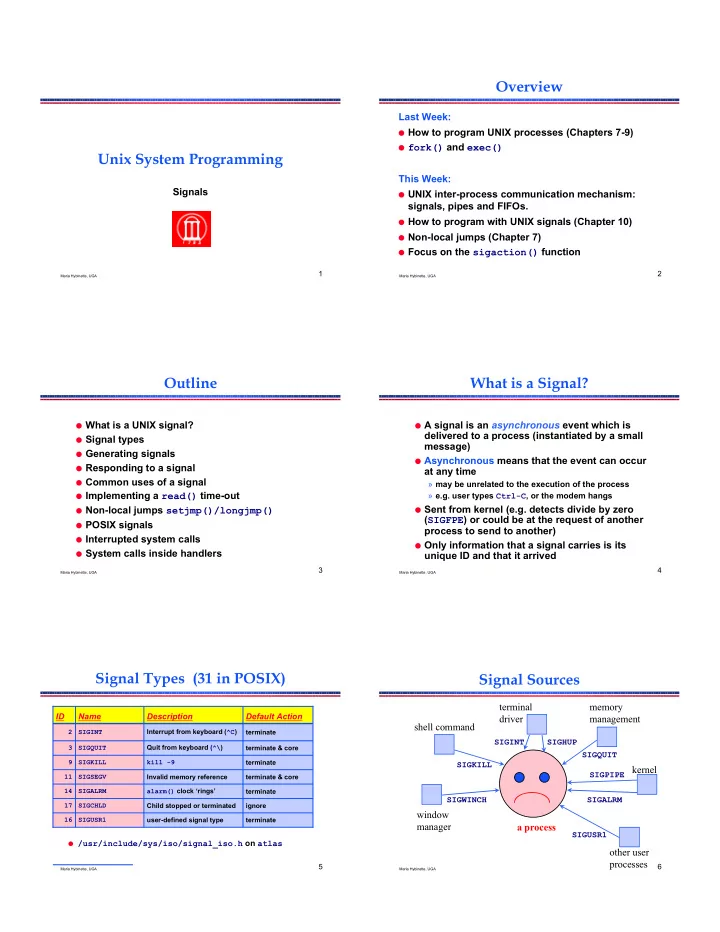

SLIDE 1
Maria Hybinette, UGA
1
Unix System Programming
Signals
Maria Hybinette, UGA
2
Overview
Last Week:
How to program UNIX processes (Chapters 7-9) fork() and exec()
This Week:
UNIX inter-process communication mechanism:
signals, pipes and FIFOs.
How to program with UNIX signals (Chapter 10) Non-local jumps (Chapter 7) Focus on the sigaction() function
Maria Hybinette, UGA
3
Outline
What is a UNIX signal? Signal types Generating signals Responding to a signal Common uses of a signal Implementing a read() time-out Non-local jumps setjmp()/longjmp() POSIX signals Interrupted system calls System calls inside handlers
Maria Hybinette, UGA
4
What is a Signal?
A signal is an asynchronous event which is
delivered to a process (instantiated by a small message)
Asynchronous means that the event can occur
at any time
» may be unrelated to the execution of the process » e.g. user types Ctrl-C, or the modem hangs
Sent from kernel (e.g. detects divide by zero
(SIGFPE) or could be at the request of another process to send to another)
Only information that a signal carries is its
unique ID and that it arrived
Maria Hybinette, UGA
5
Signal Types (31 in POSIX)
ignore Child stopped or terminated SIGCHLD 17 16 14 11 9 3 2
ID Default Action Description Name
terminate user-defined signal type SIGUSR1 terminate alarm() clock ‘rings’ SIGALRM terminate & core Invalid memory reference SIGSEGV terminate kill -9 SIGKILL terminate & core Quit from keyboard (^\) SIGQUIT terminate Interrupt from keyboard (^C) SIGINT /usr/include/sys/iso/signal_iso.h on atlas
Maria Hybinette, UGA
6
Signal Sources
a process window manager shell command terminal driver memory management kernel
- ther user